Now posts ↓

Showing posts with label media. Show all posts

Wednesday, 24 February 2016

Moldova: A mouse, roaring a truth

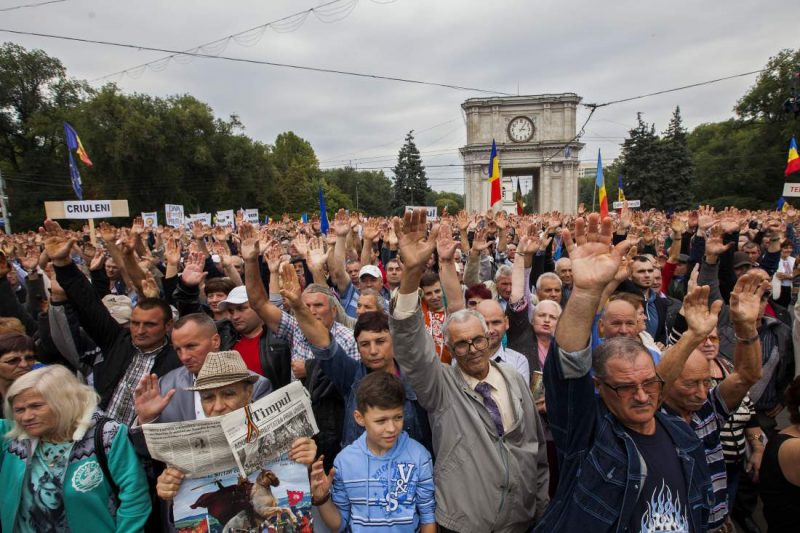
Pic of recent massive demonstration outside Moldovan Parliament.

This story might appear obscure but it reflects a bigger issue - about how Russian revanchism is reported back through democratic Europe's free media.  The issues it describes have also often been the story in Ukraine. How solid, liberal ideas like 'balance' and reporting 'both sides' can become a failure to tell the truth. How inserted reporters don't pay attention to the locals. How the messy 'European ideal' needs much closer reporting if we're to truly live up to any democratic ideal.

In the 1959 British comedy The Mouse That Roared a tiny, obscure European country ends up through comedic slight-of-hand being feted by both sides in the Cold War. In comedy, it showed how much of Europe is to the British 'Ruritania', an inexplicable country whose peoples and cultures all mess into one. As the article explains this approach lives on with today's lens of geo-politics and ideas of 'colour revolution' (via Russian infowar) muddying the coverage yet more.

Reblogged with permission from Open Democracy Russia.

====

By Mihai Popșoi  
 
There’s more to Moldova's protests than “pro-European” versus “pro-Russian”.

Moldova’s image as the poorest country in Europe is rivaled only by its obscurity. In rare outbursts of international media coverage — often related to human trafficking, arms smuggling or mass protests — Moldova is depicted as a pawn on the regional chessboard, caught in a tug of war between Russia and the west. There is no denying that, in a world of realpolitik, Moldova is indeed a playground.

Yet there is more to this intellectual inertia than meets the eye. The sheer lack of nuance and insight displayed by the international media with regards to the latest developments in Moldova is as disappointing as it is predictable. 
Much in the way of confirmation bias is at work here — the tendency to search for or interpret information in a way that confirms one's preconceptions. People are usually unwilling and, at times, admittedly unable to comprehend complex phenomena, especially when simple mental shortcuts are readily available.

Professional journalists and political analysts pride themselves on preventing or minimising the influence of such biases on their work. This is easier said than done, particularly in today’s world of ubiquitous geopolitical expediency. Moldova is a case in point.

Perils of European integration


Since the so-called ‘Twitter Revolution’ of 2009, Moldova has embarked on a path of economic transformation and political democratisation — or so everyone thought. The post-revolutionary government took on a rather inspirational name, the Alliance for European Integration, which proved to be both a blessing and a curse.

Generous western financial assistance and political support locked the United States and European Union into the costly self-fulfilling prophecy of a ‘success story’. But the success failed to materialise, despite promising beginnings. Five pro-European governments succeeded each other faster than the public could keep up with, and they spared no effort in building an elaborate discourse of European integration both at home and abroad. One could not help but be mesmerised by the audacity of Moldova’s leadership that promised to bring the country into the EU by 2020.


Over 100,000 protesters took to the streets of Moldova's capital in September 2015 to protest the ‘stolen billion’. Photo courtesy of Maria Levcenco.

Naturally, high hopes developed among more gullible Moldovans and international development partners alike. But the signs of trouble appeared early on.

As early as 2011, there have been hostile takeovers of privately held shares in several leading banks, known as the raider attacks. Then came the infamous ‘Huntigate’ scandal of 2013 — a cover-up of a fatal accident during a lavish hunting spree attended by the top brass of the country’s judiciary, including the Prosecutor General. Finally, ‘the billion dollar bank heist’ left the country perplexed as to how one could steal the equivalent of 15 percent of GDP from three banks with impunity.

Once a poster child of Moldova’s European Integration, Vlad Filat, former prime minister and Leader of the Liberal Democratic Party, ended up a scapegoat for the missing billion. Meanwhile, Filat’s archenemy the oligarch and senior vice president of the Democratic Party, Vlad Plahotniuc, became the sole decision maker in the country.

By hook or by crook, Plahotniuc was able to create a majority coalition (which oddly bears no name). It was rushed to a vote in parliament as protesters gathered outside and soon started demanding early elections. This clearly begs the question: how can international media refer to the current reincarnation of previous governments as pro-European?

Monstrous coalition


Reports from Euronews, BBC, New York Times as well as Russia Today all described the new government as ‘pro-European’ — much to the bewilderment of Moldovan civil society. In a very heartfelt piece on his personal page, Dumitru Alaiba, a former economic and financial advisor to two prime ministers, urged international media and western politicians: “Do what you must, just don’t call this government ‘pro-European’. It is not Europe that they represent. And don’t call us, the people, pro-Russian either.”

Well-respected media institutions used a default template for covering Moldova, relying mainly on the fact that the new government presented itself as pro-European. A more astute analysis would indicate that the new government is ‘pro-European’ in name only.

After numerous Moldovan activists wrote public letters calling upon western media to take a more mindful view of the ongoing protests, a change of tone occurred. There is now a broad acknowledgement that protesters were, and are, a distinctly heterogeneous group.

Admittedly, many of them are pro-Russian, yet a lot are as pro-European as they come. What unites them all is a genuine frustration with an ad-hoc “monstrous coalition” government and a desire for a more democratic and prosperous future.

This is largely missing from the international media discourse, caught in the cross fire between Russia and the west. Russia has capitalised on the growing anti-European sentiment in Moldova, and by supporting these ruling elites, western media and western politicians have only vindicated Kremlin’s propaganda.

Another piece of the puzzle


Russia’s postimperial syndrome is built on the belief that the west is containing its resurgence by creating a belt of instability in south-east Europe — a mantra that rarely departs from Russian TV screens. Moldova is seen as just another piece of the puzzle.

Moscow has a clear agenda of trying to bring Moldova back into its orbit and does not shy away from making its intentions known either.

For instance, in the aftermath of the 2010 parliamentary elections, Sergei Naryshkin, head of the Russian presidential administration, attempted to broker a coalition deal between the Communists and the Democrats. In the 2014 campaign, Russia openly supported the Socialist Party.

Russian media, which still holds a lot of sway over Moldovan public opinion, has been an indispensable tool in this process. Interestingly though, the rebroadcasting rights in Moldova for the most popular Russian federal TV channels are owned by so called ‘pro-European’ politicians, primarily Vlad Plahotniuc. He owns, among a few others, the Moldovan license for Russia’s flagship Channel One. Russian media coverage of protests in Moldova paints the EU in a negative tone, while reinforcing the message of Eurasian Economic Union as a better alternative. The aim of these reports may be as much to appeal Russia's domestic audience as it is to influence public perceptions in Moldova.
This sort of nuance is helpful in understanding the complexity of the Moldovan political landscape, which cannot be reduced to a mere east-west dichotomy.

The same is true for the protest movement. Many things that politicians had kept to themselves, such as allegations of blackmail and corruption, came to light only after mass protests erupted. However, for a long time, protesters could not set their differences aside in order to pursue a common goal: early elections.

Even when they finally did, the much heralded unity of protesters across ethnic, linguistic, ideological and party lines proved too good to be true. The nascent movement is constantly being undermined by infighting.

Besides, there have always been doubts about the independence of such political players as the socialist leader Igor Dodon, Our Party head Renato Usatii, and front man of the civic platform turned political party, Andrei Năstase. Hence, the real tragedy is that genuine popular protests are led by less than candid individuals.

Bridging the divide


Instead of helping to bridge this divide, both media and politicians have contributed to the increased polarisation of public opinion by presenting just one side of the debate, reinforcing the ever-present confirmation bias.

This development is particularly visible when it comes to Romanian or Russian news reports, as well as political commentary on developments in Moldova. Self-proclaimed leader of the Moldovan diaspora in Russia, Aleksandr Kalinin, posted a Facebook video calling upon Vladimir Putin to come and rescue the Moldovans from what he saw as an imminent takeover by Romanian and Ukrainian special forces.
The response came in a leading Romanian newspaper from none other than a prominent Romanian analyst and former adviser to Romanian president Traian Băsescu, Iulian Chifu, who called the video an “official request” to Putin. To his credit, Chifu went on to debunk Kalinin’s bogus allegations, but the latter was afforded much more attention than he deserved even in the aftermath of Crimea and Donbas.

The EU's former enlargement commissioner Štefan Füle is perfectly right when he says that: “We should be more active in addressing [pro-Russian] propaganda about what the Eurasian Economic Union offers versus what the EU offers a country like Moldova.”

Undeniably, Russian media will continue to produce characteristically biased reports about Moldova, but if western media want to have any claim to a higher moral ground they have to give up using simple shortcuts and produce accurate accounts no matter how tedious or inconvenient that may be.

Max Seddon’s recent article in the Financial Times, for example, does just that. He reports that “In private, some European diplomats say they would welcome a pro-Russian government — if only so that the current coalition cannot further tarnish the EU. Says one: ‘Asking them to do reforms is like asking turkeys to prepare Christmas dinner.’” 


Who are the pro-Europeans now?


No matter how ironic it may sound, a pro-Russian government is likely to be the only thing that can rehabilitate the European Union’s image in Moldova. The risks of a new government changing Moldova’s foreign policy course are minimal: it would be economically irrational and politically suicidal, since most of the burden of adjusting to the new EU-Moldova Association Agreement has been incurred, while the benefits are only kicking in. 


The new government cannot be called pro-European and, to its credit, it does not use the term. The coalition that Plahotniuc has put together literally has no name nor a coalition agreement. It relies on the program of the previous government despite being a “coalition of the willing”. Namely, the will of the 57 lawmakers being to preclude early elections and stay in power for another three years despite the sheer collapse of public trust after the infamous bank heist and the utter refusal to accept any blame either by the government or the parliament.

Moldova is a case study for state capture, though perhaps had Moldova been an EU candidate country, things would have been different via conditionality. The West has sacrificed democracy for geopolitical interests, which is usually a recipe for disaster down the road.

The sole threat of an imminent pro-Russian government is likely to galvanise and reboot the political system, albeit incrementally, with a new breed of upstanding young professionals exiting their comfort zones and entering the public domain to the benefit of their communities and their country — the alternative being a drift away from the values of democracy and the rule of law, all under the watchful eye of the international media.


See also:

Wednesday, 26 August 2015

There is no "civil war" in Ukraine

A Russian war propaganda organ trumpeting the BBC's reaffirmation on terminology
Pump 'Ukraine + "civil war"' into Google and click the 'News' tab and you get dozens of results. Deutsche Welle, Newsweek, CNBC, Huffington Post, The Independent, The Nation, Washington Post, and The Daily Telegraph have all used that phrase to describe what is going on.

As does the BBC, although Euan McDonald, a Kyiv Post Editor, says that's because the BBC "has to use certain terminology to continue to have access to separatist areas." Its own reporters covered the initial takeover of government buildings in the Donbas and said that Russian Special Forces appeared to be involved and they have someone like Mark Urban, the Diplomatic and defence editor of the BBC's lead news show Newsnight, covering in March the presence of Russian troops.

Here Cambridge University's Dr Rory Finnin (Department of Slavonic Studies) and Dr Thomas D Grant (Faculty of Law) argue that what terms are used by someone as trusted as the BBC is not a minor issue and we should all stop employing euphemisms. Reblogged with permission.

====

The war in Ukraine, we are often told, is a “civil war” involving “rebels” fighting the central government in Kiev. Such restrictive, inaccurate terms greatly misrepresent the conflict, which has already killed over 6,500 and displaced at least 1.4m Ukrainians. Too often, the crisis is talked about as if it’s entirely internal to Ukraine, a domestic affair presumably brought on by language politics, identity clashes and historical grievances. Best, therefore, to leave it alone.

Wrong. Ukraine is waging a war of self-defence against an international aggressor – the Russian Federation – whose conduct threatens our collective security. This war is now 18 months old, and we should know better by now.

Face facts

It’s not as if the signs aren’t clear. Recent weeks have seen another intense spike in fighting in eastern Ukraine. Given all the prior sabre-rattling, nuclear threats and general rhetorical brinksmanship, it takes little imagination to see the conflict expanding beyond Ukraine’s borders into EU member states.

Labelling such a crisis a “civil war” serves no purpose of diplomacy or journalistic balance. It is a failure to serve the public interest. The war needs to be described as it really is.

Fundamentally, this conflict was started and is sustained by Russia’s armed intervention, not a Ukrainian civic collapse. In nearly a quarter century of independence, the Ukrainian public’s support for national unity has been stronger than in many long-established states, among them Spain, Belgium and Canada. As Vladimir Putin has since proudly admitted, it was Russian troops in the spring of 2014 who seized Ukraine’s Autonomous Republic of Crimea.

The Russian military presence has not gone away. In August 2015, Organization for Security and Cooperation in Europe (OSCE) monitors again encountered personnel in eastern Ukraine openly identifying as Russian regular military. These forces continue to lead, train, equip and fight alongside militants advancing Russian neo-imperial and ultra-nationalist ideologies against a government in Kiev espousing respect for democracy, transparency and the rule of law.

To tiptoe around the Kremlin’s armed intervention in Ukraine falls short of the basic standards of war reportage. And it’s absurd to call the Donetsk and Luhansk authorities “rebel” administrations when they would not have come into being and would not continue to function without Russian backing.

We do not talk about a Manchukuo “rebel” administration in 1930s China without mentioning that Japan had invaded it; scarcely anybody pays lip service to the myth of an organic, independent separatist movement in 1930s Manchuria. Nobody should credit Russia’s fiction about “rebel” administrations in today’s Ukraine.


Lest we forget, the purported “rebels” in eastern Ukraine agree. Here is Igor Girkin-Strelkov, a Russian national associated with Russian military intelligence who helped lead the “rebel” movement in eastern Ukraine, speaking only weeks ago: “You are making an idiot or fool of yourself if you think that [the Donetsk and Luhansk Peoples’ Republics] were formed by themselves.”

An important conclusion follows from these facts: the Russian Federation is an aggressor and should be characterised as such whenever we talk about areas of Ukraine that have fallen under the Kremlin’s effective military and political control.

There is no need to report aggression in inverted commas. Since early 2014, the Russian Federation has carried out a host of acts of aggression against Ukraine as defined in Article 3 of the UN General Assembly’s definition of aggression. Russia has invaded Ukrainian territory – Crimea, Donetsk and Luhansk so far – and attacked Ukrainian forces without a shred of plausible legal justification; bombarded Ukrainian territory and killed Ukrainian citizens; and seized territory that belongs within the internationally recognised borders of Ukraine, declaring it part of Russia. These are nothing less than acts of aggression under international law.

Nor do the sham referenda in Crimea in March 2014 or in Donetsk and Luhansk in May 2014 offer any legal wiggle room, since these “Potemkin plebiscites” resulted directly from an invasion of Ukraine by the Russian Federation.

As far as the referendums go, the UN General Assembly, the Parliamentary Assembly of the Council of Europe and the President of the OSCE Parliamentary Assembly all agree they were unlawful and illegitimate. To argue or imply that there has been an act of “self-determination” in any part of Ukraine that calls into question Ukraine’s sovereignty over its recognised territory contradicts the highest available organised expressions of international law.

If editors and journalists are substituting their own judgement of the situation, then they must explain why.

A spade’s a spade

Then there’s the matter of Ukraine’s right to self-defence, which of course is a right of all states. Russia’s aggression against Ukraine is just about the only case where a UN member state has seized and in effect sliced off whole regions of another UN member state.

In its official statements the Kremlin goes further still, repeatedly calling into question the right of Ukraine to continue in its current form, invoking a so-called “New Russia” across vast, strategic tracts of the country, and even threatening nuclear action in the wider context of the conflict.

This is not garden-variety geopolitical grandstanding. When Iraq attacked Kuwait in 1990, it was universally condemned, and Kuwait’s right of self-defence was affirmed. There is no principled reason for responding to Russia’s aggression in eastern Ukraine with different rhetoric or a different description.

It’s time to face reality. The continued escalation of the war in Ukraine poses a serious challenge to international public order. Journalists have risked everything to report events from this war, and we need to stop watering down their reports with euphemism and understatement. We need to call this what it is: a war of self-defence against an international aggressor.

The Conversation

Monday, 20 July 2015

The Kremlin's maltreated soldiers


The maltreatment of conscripts in Russia's still largely conscript army has been an open secret for years. In the days when Russia's media was allowed to report on Russia's problems a newspaper like Pravda could report that:
According to the UN International Panel for Struggle against Sexual Exploitation, the Russian army is plagued with male prostitution. A small amount of money is enough to find a Russian soldier-prostitute in the center of Moscow.

Servicemen may become male prostitutes in the Russian army for various reasons. There are young men who voluntarily offer sexual favors to their homosexual clients; others are forced into prostitution against their own will. Newcomers, especially those who finished higher schools before joining the army, suffer from sexual harassment more often than others. Brave soldiers try to protect their honor and rights, although there is no one to help them: commanders and military officials may often be involved in the sex business too.
But that was 2007 and nowadays the deaths of, potentially, thousands in the state secret that is the war in Ukraine must be hidden. The civil society groups set up to deal with the mistreatment of conscript soldiers, like the Committee of Soldiers' Mothers quoted in this 2011 Russia Today article, are now being silenced as they dare to ask questions about the soldier's deaths 'on holiday' or 'on maneuvers'.

If that was not bad enough even when there is an accident the deaths of soldiers are being ignored. Last week a barracks collapsed in Omsk killing 23 young men. State TV barely mentioned it.

This so outraged RFE/RL’s Elena Rykovtseva that she wrote an open letter to those TV network's and her fellow Russian journalists. It has gone viral and has been translated by Kevin Rothrock for Global Voices.

THEIR NAMES HAVEN’T BEEN MENTIONED ONCE ON ANY OF THE NATIONAL TV NETWORKS

    R.Shaihulin, October 5, 1994
    B.Sudnikovich, January 4, 1995
    A.Polegenko, January 17, 1997
    R.Yumagulov, March 29, 1991
    M.Ignatenko, January 20, 1996
    R.Filyanin, July 24, 1996
    M.Ivanov, October 22, 1996
    V.Chemezov, October 19, 1996
    S.Vahrushev
    Filatov, August 18, 1996
    R.Altynbaev, June 14, 1994
    D.Kenih, November 16, 1996
    A.Gritskov, January 30, 1996
    E.Belov, December 3, 1995
    B.Nafikov, 21.09.1996
    O.Kortusov, March 16, 1996
    A.Shokaev, November 5, 1994
    E.Herman, July 30, 1995
    F.Mamliev, September 2, 1996
    E.Reshetnikov, September 30, 1996
    AM.Igoshev, April 6, 1996
    A.Shingareev, April 24, 1997
    V.Lomaev, January 29, 1997

Five of them were buried today in Omsk. Another two went into the ground in Novosibirsk. They’ve declared a day of mourning in Orenburg, too. The dead are also arriving in Irkutsk, Bashkiria, and St. Petersburg. People are crying across the whole country, but it’s no longer an issue for the national TV networks. “[Ukrainian nationalist group] Pravyi Sektor is marching on Europe. The Ukrainian authorities can’t manage the radicals.” This is how their goddamn news broadcasts begin. And there’s not a word about our dead boys.

At this moment, there are funerals happening in Omsk—already for the second day in a row. But there’s no news coming out of there. Not a single live broadcast. And I remember well how Rossiya-24 aired around-the-clock coverage of Lugansk separatist [Alexey] Mozgovoi’s funeral. I remember how it went on endlessly, as the mic was handed off to family, then friends, and then locals, and how everyone cried in their speeches about what a great and wonderful patron and protector he was. When it comes to our own boys in the Russian army, who incidentally wanted fanatically to serve as paratroopers, there’s not a thing on television. Nobody broadcasts the reactions, or the condolences of a single living mourner—apart from Putin’s sympathy, as retold by [his press secretary Dmitry] Peskov. And this was only on the first day.

Yesterday, on the second day, now speaking before a group of students in Klyazma, [Putin] no longer remembered these other young men. He smiled and he beamed and he congratulated the crowd on the day’s fine weather. It was as if the Omsk barracks never happened. The victims’ names were never read on a single national TV network. The men are nameless—all 23 of them.

It’s nothing personal, guys.

But each of these boys has his own social media page, and there are photographs. And it would have been possible at least to say something—anything—about these men, and about their families. Something about Oleg Kortusov, for instance, who was a promising fighter and whose fiancée is expecting a child. Or something about Egor German, another local from Omsk, who leaves behind a baby born less than a year ago.

And this is to say nothing about helping the victims’ loved ones—those close to the men who died and who survived. They transferred another Omsk soldier, Volodya Petrov, to Moscow, and the Defense Ministry is paying for his treatment, but they didn’t allocate any money to his family for their train transportation or accommodations in the city. And his mother has nothing. That’s why the city of Omsk banded together and raised money to help her.

For some reason, they don’t want to talk about this on their national TV networks, with their audience of millions. For some reason, they don’t want to say even one human thing about these guys, or ask the country if maybe it, too, would like to offer some help, in addition to the one-time assistance their families received from the state (which they don’t get right away, incidentally)?

But I don’t want to talk about these people and their TV stations anymore. Let them live with their shame. I just want to tell those boys goodbye. And also in their memory, I want to publish this photograph [see above], which I found on the social media page of one of them, Sergei Filatov. He’s the one second in from the right in the last row in the back. In the front is Valery Lomaev from St. Petersburg. He died, too. The photo is from July 12, a few hours before the tragedy, inside the very same barracks.

Monday, 22 April 2013

Breaking: 'Asylum seekers not immigrants' says no one

English: Jewish refugees from Czechoslovakia b...
Jewish refugees from Czechoslovakia being marched away by British police at Croydon airport in March 1939 (Photo credit: Wikipedia)

Seeking asylum from repression, war and horror is a basic human right which almost every country is signed up to. This right was created in the shadow of World War Two and the then recent shameful memory of the treatment of Jewish refugees before that war.

Asylum seekers are not the same group as 'immigrants'. Neither are they the same group as 'refugees'. People apply to a country to allow them to become immigrants. People are given refugee status in one country, usually next to the country they fled from, and some other countries then select them, usually many years later, to come to them.

Anyone can apply for asylum in another country once they're there, whether by plane or by boat or walking over the border, and they do for all sorts of reasons. People apply because they're being persecuted on account of their ethnicity -- like Chechens. Or their sexuality, or, in one American case, because they cannot home school their children in Germany. Americans have applied for asylum in Canada and, famously, many got it in Scandinavia during the Vietnam War.

There are some basic rules, international law, on asylum seekers but different countries regard them in different ways. In Russia they get sent to a camp in Siberia and in Australia they're all automatically detained. Also in Australia asylum applicants get security checked if they're fleeing, for example, Sri Lanka.

In the United States they get security checked too if they're from certain places. One of those places is the Caucuses -- Chechnya, Dagestan. The Boston bombers were the children of parents originally from Chechnya who were accepted as asylum seekers. They claimed asylum after arriving on tourist visas.

So Senator Rand Paul is either ignorant in calling today for something which is already happening -- security checks -- or willfully stirring slash hot button pressing.

There's more of this and they'll be more to come, from all sides.

Media #fail on asylum seekers ≠ immigration

In the Daily Beast a former Bush official bangs on, like Paul, about double checking 'immigrants' and like this doesn't already happen and, sigh, like this would have made any difference when the bombers were teens when they came to America. In the Boston Herald there's the impolitic version, this full-on anti-immigrant/refugee/whatever rant by Howie Carr.

On Twitter I exchanged with an immigrant advocate, Matthew Kolken, who is countering this nativist ranting by pointing out that one of the guys who helped save the life of the guy who identified the bombers is an immigrant (pictured right, with the big hat).

But if America is now going to have a debate on immigration reform informed by the Boston bombings then it ain't going to be very informed if the media track record thus far keeps up. Because I have now seen a series of stories in major media outlets, including ones making the liberal case, which are confusing asylum and immigration and which contain startling inaccuracies. Startling? Yes, because two seconds thought would have spotted the logical flaws.

Like in this CNN story, or this USA Today one which thinks US cities look at asylum applications, or Weigel at Slate who thinks the US accepts Chechen refugees from Kazakhstan (as does Jason Dzubow, who should know better) which short research disproves or the New York Times which repeats that the family "emigrated to the United States from Kyrgyzstan" ...

Here's The Atlantic getting it right and explaining the bombing suspects status via talking to an expert.

America is not going to un-sign the Refugee Convention, not even the looniest are suggesting that, so will continue to accept asylum applications. Thus, the status of the Boston bombers has sod all to do with immigration reform because asylum seekers ≠ immigration.

Kolken tells me this (ignorance) is normal from journalists, but as with the detailed and extensive criticism over other flaws in the media's coverage of Boston ignorance is no excuse. Basic research, heck, bothering to think it through, would produce better coverage on asylum vs immigration than I am seeing.

One other note. Advocates of immigration reform are blasting -- see this ILW.com editorial 'Terrorist Enablers On The Right' -- those using the bombing and how they are using it. Why don't they point out the complete difference between asylum and immigration?!
Enhanced by Zemanta

Friday, 12 April 2013

Postscript 2: You could make it up

↑ This didn't happen

A last return to the subject of Stafford Hospital and not the statistics, this time, but the human face.

Steve Walker, whose coverage I have been covering, has secured a heart-rending interview with some of the nurses. The people made out in the same media who have played loose with numbers to be witches and evil. The people banned from speaking.

They explain how the level of care was tied to the removal of resources, not human behaviour, their behaviour. The vicious media campaign has devastated them:
Several of the nurses told me of their frustration at the media’s acceptance of the claims by campaign group Cure the NHS (‘Cure’) that nobody from the hospital had apologised to them for the poor care they felt their relatives had received. Two nurses told me that they had apologised in person to Cure leaders – even though they were apologising for something beyond their ability to prevent – and had been thanked for doing so.
One nurse told me of a day that she had worked an extra 12-hour shift at the hospital because there was no one else available to provide cover. As she left the ward, exhausted, at the end of a shift she wasn’t obliged to do, she saw that someone had scrawled on the notice board,
ALL A&E NURSES ARE BITCHES!
There was a sense of helplessness to put forward a counter-view, as all staff had been banned by the new chief executive from making any positive statements or responses on the grounds that it would be ‘insensitive to the families’. Yet when staff appealed to him to stop people from coming into the Accident and Emergency unit and abusing staff, he told them,
I can’t do that.
Staff are still banned from speaking out, especially to the press. But there was no such restraint in the opposite direction. One nurse was spat upon in the street several times, while others were called murderers as they walked with their young children. As I heard these stories, the outrage I felt was barely mirrored in the faces of those telling them. Instead there were red eyes, and tears – a sense of hurt and grief more than resentment.
These were not hard-hearted harpies, but kindly, capable women treated like monsters for circumstances outside their control. One told me:
They said everyone was responsible – but it wasn’t true. There was a lack of resources, a lack of numbers, a lack of even the right forms – how can we be responsible for that?
They did complain, and report, and use procedure, but this is a typical experience:
I blew the whistle about something. The next thing, I was ‘named and shamed’ in a staff meeting, with minutes and everything. I rang the NMC (Nursing and Midwifery Council) and the RCN in flood of tears and was told:

“You can fight it – but it’s Stafford. You won’t get anywhere.”
They feel betrayed. Says Walker:
The public’s anger has been directed at the wrong people – and we shouldn’t forgive the misdirection either.

Thursday, 4 April 2013

Postscript: You could make it up


Somewhat of a validation for my post on how media reports about '1200 deaths' at Stafford Hospital was pulled out of someone's ass thin air. It's Paul Taylor in the august London Review of Books on 'Rigging the Death Rate'.

Taylor, a reader in health informatics at University College London, in a lengthy piece, pretty much demolishes the basis for those media reports and their source, one Professor Jarman. In fact, in an extremely detailed exposition on measuring stuff in health care, he comes back to the points raised by Steve Walker, the blogger on which my post was based and who has been battling away, somewhat on his lonesome, against the use of Jarman's mishandled (to be generous) data by those who wish the NHS ill.

On the controversial source of info in the NHS which we're talking about, here's something I did not know:
The coding, however, is notoriously prone to error (last year’s HES [Health Survey For England] summary statistics record, for instance, that of the 785,263 in-patient episodes coded under Obstetrics, 16,992 were recorded for male patients) and the system wasn’t designed to measure the quality of care, only the quantity.
The basis of Jarman's business (DFI) is something called the 'Good Hospital Guide', which is entirely based on ...
League tables – applied to surgeons, hospitals or schools – do not give the person reading them any sense of how much variation would be expected for a given sample size and instead impose a rank that the data may not support. There were good reasons for a hospital to regard a poor placing in DFI’s tables as merely an irritating bit of bad publicity.
As Walker and some others have noted, the recording of data isn't the problem, it's how it gets used:
Governments and regulators tend to make drastic interventions with the worst-performing institutions in mind, but the more effective strategy is probably to aim at improving average hospitals, since the ideas developed along the way will work almost anywhere. Lilford and Mohammed [Birmingham University critics of DFI] so criticised the use of the HSMR [Hospital Standardised Mortality Ratio] to measure quality of care. The HSMR shares the weaknesses of the HES data on which it based, but Lilford and Mohammed had a more fundamental criticism: mortality is unlikely to be a good measure of how good care is in a hospital. Typically, 98 per cent of in-patients survive their visit, so nearly all the data about what happens in a given hospital are ignored if we concentrate on mortality rates. Not only that, but of the 2 per cent who don’t survive, only a few will have died an ‘avoidable’ death, and it is only those deaths that can be used to measure the quality of care.
Was Stafford 'broken' because of useless nurses, as you may have heard in the MailExpressTelegraphSun, or ...
The chart above shows the distribution of waiting times in A&E in Stafford Hospital. There is an extraordinary peak at 3 hours 50 minutes: patients were being admitted in a hurry to avoid breaking government targets for a maximum of four-hour waits in A&E. That the system encouraged such sleight of hand is unsurprising – the data from many other hospitals would show a similar peak – but the problem at Stafford was that the care in A&E was poor. It was chronically understaffed, initial assessments were carried out by receptionists with no medical training, and essential equipment – cardiac monitors, for example – were missing or broken. Many patients admitted just before the deadline were sent to units where the care was even worse, some of them to an unstaffed ‘clinical decisions unit’, others to the so-called emergency assessment unit (EAU), a large ward described by the Healthcare Commission as poorly designed, busy, noisy, ‘chaotic’. Nurses in the EAU were inadequately trained and it was common for a patient’s condition to deteriorate unnoticed or for necessary medication not to be provided.

After running through the similarities uncovered in a report on a past case of poor care at another hospital with the Mid Staffs report (staff/patient ratios, inadequacy of systems for reporting incidents, whistleblower victimisation, disinterested senior management in which consultants weren't involved), Taylor turns to the latest idea from the No. 10 brains trust, the ‘friends and family’ test:
Given what we’ve learned about how managers respond to targets, it would be surprising if trusts weren’t already looking for wards or services which, given some extra attention, might yield more than their fair share of grateful respondents. If the test worked, it might help identify hospitals where nursing is poor, but it will be of less help in cases where patients are treated with a combination of kindness and technical incompetence – as at Bristol – or, as with Harold Shipman’s patients, ostensible kindness but actual malice. Just as important, most NHS scandals have affected patients who aren’t likely to voice their complaints, aren’t in a position to make choices and who often don’t have friends or family to speak up for them.
Here's Taylor's concluding point, a sad but true one given the investment much of the media and a certain political party have made in misusing data:
A different approach is used in Australia. Queensland Health was the subject of two public inquiries in 2005 over its employment of a surgeon who became known to journalists as Dr Death. In response, it has adopted an approach which bears some similarities to the work of DFI: data are obtained from hospitals across the state and actual outcomes compared with expected outcomes in order to generate alerts. The focus is on performance over time rather than on a single number and, more important, the data are used differently. A broader range of outcomes is considered, not just mortality, and because it was argued that the threshold should be set very low, many hospitals are flagged so that investigations become a normal part of an institution’s commitment to safety. So long as NHS trusts that have a high HSMR continue to be named in the papers and the statistical concept of ‘avoidable death’ is interpreted as providing grounds for criminal prosecution, the argument for a similar system won’t be made here, let alone won, any time soon.
Walker has just reported on how Mid-Staffs is demonstrably improving, yet is being threatened with closure -- for blatantly political reasons. The proposal is to give £30m to a nearby hospital, and close Stafford. As opposed to:
Save £53m over 5 years in order to keep a hospital that serves around 300,000 people and which has been adjudged by the Care Quality Commission (CQC) as ‘meeting all the essential standards of quality and safety‘.

Sunday, 24 March 2013

Follow up: The Lucy Meadows bandwagon


Some comment and interaction about my post deserves follow-up.

I tweeted at two SumOfUs.org advisory board members: Paul Hilder (Oxfam), and; John Wood (TUC). No response yet, if it comes I will add it here.
Update: Kaytee Riek, Campaign Manager, at the SumOfUs New York office emailed me, referred to my tweet to the Board members and said that she'd "be happy to talk with you about your concerns". I reminded Riek of my point on consultation and that some trans people were suggesting caution. I asked again why their petition was launched in competition with an existing petition and why the initial PR was so bad.

I haven't heard back from her but following today's (Wednesday's) delivery of 200,000 signatures new PR from them reflects a change in no longer directly blaming Littlejohn for the suicide, instead it talks of his "connection to the tragic death of transgender schoolteacher Lucy Meadows". It also says that he and the Daily Mail have "become focal points of outrage over an abusive press."

I didn't sign the petition so haven't seen this but there are claims of fundraising emails to signatories.

The change.org petitioner has also been in touch - you can read his comments at the pinknews.co.uk re-post of my post. If he responds to my email I will post anything relevant.
Meadows' MP, Graham Jones, in a long interaction with me, pointed out that:
The Leveson debate was too often glowing about the innocence of local newspapers.
Jones suffered his own 'reputational damage' through local media last year when he was falsely accused of intimidating voters.

Liz Gerard on her blog gives an example of how local media can, and maybe should, cover the same sort of situation to the Lucy Meadows' one, this time in Chelmsford. She generally praises the consideration but not the front page headlining (pictured).

Then Essex Chronicle Editor Alan Geere wrote about how he wrestled over the story in a blog post.

A Google search on the Accrington Observer has their last 'gay' article at more than five years old. Reader Norena Shopland wrote to say:
Last year I put together the first history of LGBT in Wales and during my research I did a survey on the number of 'local' titles owned by groups such as Tindle, Trinity, etc. Most have a search engine from 2000 onwards and my survey consisted of standard keywords but the results were almost non-existent - they rarely if ever published any LGBT news. Even when laws were changed! There was only the occasional article which, like this one, was negative.
At least one person will not be buying the Accrington Observer or the Lancashire Telegraph again after reading my post.

In another bit of local input, Julie Carpenter writes:
I agree that not enough emphasis has been made on the local and other press behaviour over this, and I tried with my little twitter account to raise that yesterday. I even posted on the Accrington Observer's comments, but oddly there was a cull of any posts that criticised their involvement and it (and other) posts doing the same disappeared after a few hours.

There is a huge 'anti-DM' movement and it's a shame they have pinned themselves to the coat tails of this. I guess Littlejohn makes a good pantomime villain and it has raised awareness, but there is a risk that the core point about the on-the-ground behaviour of the press is getting lost in the calls for his sacking.
Former "news agency hack" Dan Waddell has contacted both the Accrington Observer journalist Stuart Pike and the quoted aggrieved parent and had no response. He suggests from experience that Pike spun the original 'non'-story. But this wasn't enough for the Daily Mail so a local news agency added more spin. Waddell goes into great detail about the history of this story, with follow up here.

"The story of Lucy Meadows death is a tragedy. The story of how her story was reported in the newspapers is very revealing about how the press operates," Waddell writes.

In a echo of the Mail's removal of Littlejohn's bile:
The Accrington Observer's Twitter feed usually promotes their front page and other stories each week. In the week of the Lucy Meadows story nothing at all was tweeted. Looking through the timeline, I can't find another week where that's the case. Anyone would think there was a story in their newspaper they might be ashamed of.
Waddell also notes that:
Stuart Pike tweeted about Lucy's death. There was no acknowledgement of his involvement, the previous story he wrote, or any remorse. Just a matter of fact link to the news story in the paper.
David Allen Green, whose tweets have driven much of the traffic to my post, described it as "balanced and measured" and resummarised it as follows:
You think the Lucy Meadows case is just about bashing Littllejohn?
He noted that journalist Amanda Kendal has argued that:
.. however much Littlejohn himself was bang out of order, he is far from unique and he is not ‘The Problem’. Were Littlejohn to disappear off the face of the Earth tomorrow, transphobia would not be consigned to history with him.

We need a cultural change in attitudes toward trans people – indeed, toward both sex and sexuality as a whole.
Indeed. Worth noting that journalist David Banks tweeted earlier a link to the Samaritans media guidelines which, amongst other things, notes:
Avoid simplistic explanations for suicide

Although a catalyst may appear to be obvious, suicide is never the result of a single factor or event and is likely to have several inter-related causes. Accounts which try to explain a suicide on the basis of a single incident, for example unrequited romantic feelings, should be challenged. Where relevant, news features could be used to provide more detailed analysis of the reasons behind the rise in suicides.
Martin Robbins in the New Statesman has linked to my post and followed some of my points. He also got this quote from Trans Media Watch:
We understand the anger behind calls for Richard Littlejohn to be sacked. He has persistently belittled trans people in his columns, but we feel that the real problem is bigger than one man and we don't want to see him become a scapegoat, allowing others to avoid responsibility.
David Allen Green has compiled 'What we know and what we don’t know about the death of Lucy Meadows'.

Wednesday, 20 March 2013

Emily Bell: Meet the ancient Interwebs

Emily Bell, the esteemed former leader of Guardian Online, attacks the proposed new press regulator:
This is all about restraining a notion of the press and journalists as some kind of easily identified pack which feeds into a neatly industrialised process, when in fact the forces are moving in the opposite direction: anyone can be a journalist, yet the institutional support for journalism has seldom been economically weaker.
She points out that what becomes 'news' can start from, and here is one example of hers, a tweet about a raid that turns out to be Osama Bin Laden's house:
The impact a story has now is as much dependent on the network it travels through as on the news brand that presents it.
Bell's point seems to be that the 'times they are a-changin'. But they're not really.

Of course I can blog here and you can tweet there. People have been stapling together pieces of paper and distributing them since whenever. You didn't then need Bell's "industrial publishing complex behind you," as Lord McAlpine - cited often in this context (Leveson and the oldies failure to understand t'internet) numerous times over Twitter - could tell you.

The trashing of McAlpine started in Scallywag in the early nineties (Google if you must, I'm not linking). More people can read it now but it still got wide enough circulation then for McAlpine to get that scandal sheet shut down.

Go further back and people would be distributing 'news' via things called 'leaflets'. I believe some of these may have been involved in starting revolutions? Much like the new fangled interwebs was tied to that 'Arab Spring'?

I distinctly recall something called a Roneo (illustrated above), which was an extremely messy but cheap printing method employed by activists and campaigners and cranks to 'get the word out'. Every so often something which had been ronoed would make it into the Daily Mail -- 'look what the loony left are saying now' kind-of thing -- much like the Mail cherry-picking the interwebs today.

The idea that because we now have new methods of distribution that we don't still have centres of power alongside them and won't have them in the shiny future is wrong. The people always need to have some way to control the powerful, which is what setting up independent regulation of the press is all about.

Self-regulation doesn't work (that big inquiry just proved that), government regulation is not desirable, so that leaves ...

Once the independent regulator is set up it can evolve and tweek and whatever else might need to done. The point is to win it first, which is why the press barons are going apeshit and throwing their toys out the pram.

Hislop

One note on the beloved Ian Hislop, Editor, Private Eye.

His big point seems to be that you just need Lily Law because all the bad stuff which led to Leveson was illegal anyway and the law just needed applying. So why was there a press code? That wasn't law it was just the industry defining how it should practice. Leveson showed not just law breaches like hacking but constant code breaches, contempt for code, but alongside absence of remedy for the powerless.

Monday, 18 March 2013

You could make it up


In today's collective strop by the newspapers about regulation there's one theme, a supposed threat to investigative reporting. One story being pointed at as potentially being threatened by 'government control of the press' is the 'scandal' of hundreds of 'avoidable deaths' at Stafford hospital.

What's funny about the press using this example to make their argument is that their Stafford reporting has, universally, from the BBC all the way to the Daily Star, been terrible, shockingly terrible.

The number of 'avoidable deaths' - the figure commonly reported is 1200 - is completely made-up. Any reporter doing their, you know, job could figure it out.

Blogger Steve Walker explains at length how '1200 deaths' was pulled out of someone's ass thin air and how its basis is undermined by just a cursory understanding of statistics. Here's a key passage:
As I explained in my post on the real story of Mid Staffs, Prof Jarman’s HSMR (hospital standardised mortality ratio) system rates English hospitals according to where they sit according to the average death rate for the nation. A hospital hitting exactly the average rate would receive a ‘score’ of 100. A hospital doing better than average would have an HSMR below 100, and one doing worse would be over 100.

So far, so clear – I hope. But here’s the key fact: every year, the system is ‘rebased‘ – the averages are re-measured and ’100′ is re-calibrated to the new average.

This leads to 3 key problems:
  1. Because of how averages work, unless by some miracle every single hospital in the country got exactly the same score, you will always have some hospitals above 100 and some below. This does not mean the ‘extra’ deaths in those hospitals were avoidable – it just means that somebody has to be above the line because it’s an average.
  2. Because the ’100-line’ moves every year, a hospital can maintain exactly the same standard in one year as it achieved in the previous year – and yet can score below 100 one year and above 100 the next. The performance of the hospital did not get worse. The line just moved. It’s not only wrong but ridiculous to extrapolate ‘extra’ or ‘avoidable’ deaths from a position above or below a line that moves every year.
  3. Leading on from number 2 – and it’s impossible to overstate this – there is no ‘standard’ rate of deaths from a particular illness. No expert clinicians are sitting down together and saying ‘Yes, we agree that out of every 100 patients with an intracranial bleed, this many are going to die’. No. All that happens is that the average for the previous year becomes the re-calibrated ‘expected death’ figure for the following year. This means that HSMRs are measuring the success/failure in achieving/beating/failing to bear a target that moves every year – and has no basis in clinical expertise. It’s just a number.
In his testimony to the Francis inquiry, Prof Jarman claimed that he had to present the figures this way because the English are ‘simple-minded‘ – but in doing so he has committed a fundamental error of logic worthy of a simpleton.

These fundamental logical errors mean that even if everything else was perfect, HSMR scores over 100 cannot be used to calculate avoidable deaths.
Walker explains how behind the media's scary headlines lies 'rubbish in, rubbish out'. The data wasn't being properly recorded at the hospital and the woman brought in to fix that, who he has met, wasn't allowed to give evidence or speak to the media.

That women's work on correcting the errors produced the exact opposite outcome to the screaming headlines:
When Ms Kirkbright arrived at Mid Staffs, she carried out a re-coding exercise on past deaths. This re-coding corrected the absent Z51.5 code and used the case notes to add in the co-morbidities (what is known in the jargon as ‘depth of coding’) that was missing. This brought down Mid Staffs’ HSMR to 88 – well below the national average death rate.
Further:
HSMRs are a statistical device. If you want to be sure whether deaths were avoidable or not, you need to look in detail at the case notes for each patient. The doctor in charge of the Independent Case Note Review (INCR) was asked by the inquiry how many ‘excess’ deaths he had discovered among all of the cases for which families asked for a review. His answer was telling – but has been almost completely ignored:

    Perhaps one such death.
And further, Walker reports evidence that hospitals are gaming this bonkers system because of funding pressures - to increase their incomes.

Plus Walker gives examples of how reporting on supposed bad treatment of patients at the hospital could simply not be true.

The man behind the headlines, Professor Sir Brian Jarman, has a clear conflict of interest. He is financed by a company which sells services that allow NHS Trusts to use and monitor HSMRs. That has not been reported.

What is also not being reported is that the entire system is based on the most ridiculous way of recording and therefore supposedly monitoring morbidity rates.

HSMRs are based on ‘first diagnosis’.
If a patient arrives unconscious and the ambulance driver reports ‘He fainted’, fainting would be the first diagnosis. If that patient is then discovered to have had a serious stroke and dies, that death will be recorded against ‘fainting’ – a condition with a very low death-rate – resulting in an inflated HSMR.
There is no recording of post mortum results. The system is utterly broken. You couldn't make it up!

It's plain once you read Walker, or the handful of other bloggers, or this lonesome letter to The Guardian, or Computer Weekly, all similarly demolishing the media's reporting, that the headlines about '1200 avoidable deaths' aren't wrong because the media are all idiots, they are the result of an agenda. A stealth-privatisation, anti-National Health Service agenda.

Says Walker:
The threat is serious, because a lot of people will believe what’s being said and written just because it’s in the media and has apparent statistical/scientific support. Very few will look beyond the soundbites to see whether they stand up to scrutiny.

So please, if you’ve read this article and agree with its premise, spread the word. We need good information out there to counteract the absolute tripe that’s being force-fed to the British public.
Happy to oblige

Friday, 8 March 2013

Here's a website which deserves more attention


A few days ago I read a fascinating report by the Caribbean gay activist Maurice Tomlinson. It explained how, slowly but surely, LGBT rights were improving on the island nation of Barbados.

This sort of story tends to not get widely read. And that's because it doesn't tend to get reported in mainstream media, nor even in gay media. For one thing it is too nuanced, you have to explain stuff at length, and it doesn't really 'hang' on one event.

Other topics do have outlets which do this sort of knowledgeable, backgrounded and internationalist reporting: Foreign Policy Magazine or The Economist immediately spring to mind. But LGBT stories? Not so much.

So I was pleased to discover that Tomlinson's report wasn't just circulating on activist lists and amongst the NGOs, it was published on a website I'd never heard of which has stacks of similar reports.

76 Crimes is named for the countries around the world which criminalise homosexuality. Current stories include one by a Ugandan updating on the situation with the 'Kill the Gays' bill, how activists in Cameroon are teaching health workers about gender identity and sexual orientation and another report on similar work in Singapore.

The website is the work of American journalist Colin Stewart but much of its contributions come from writers from all around the world. Stewart has pulled together some of those contributions for the book, 'From Wrongs to Gay Rights', money from which funds the St. Paul’s Foundation for International Reconciliation, which supports activists in many of those 76 countries.

Friday, 16 October 2009

Jan Moir is a heterosexist

Now anyone whose reads me knows I like video .. So watch this ...


N'kay. All done?

Jan Moir is a Daily Mail columnist whose printed words have today caused her to reach for her boss' PR agency (because of an Internet revolt that Twitter was at the heart of that blew up the Press Complaints Commission's website) in order to say she's not what you think she is.

That is significant. Today was significant. Social media made this happen - apparently the Mail doesn't usually respond within hours to outrage at its contents.

But listen to what Richard Yates, from black experience, is telling you - focus on what they said, not who you think they are.

And this is very relevant to this situation. The Mail, and others, publish Moir's sort of rant all the time. In the official 'process' it will be judged on what she said, not who she is accused of being.

If what we want is what she (and others) write banished from the mainstream, not to silence but to place them firmly on the fringes, then how is that achieved?

How do we define her words? I ask, is what she wrote heterosexist or is it homophobic?

Cue Wikipedia:
Heterosexism is a term that applies to negative attitudes, bias, and discrimination in favor of opposite-sex sexuality and relationships. It can include the presumption that everyone is heterosexual or that opposite-sex attractions and relationships are the norm and therefore superior.
Homophobia (from Greek homós: one and the same; phóbos: fear, phobia) is defined as an "irrational fear of, aversion to, or discrimination against homosexuality or homosexuals", or individuals perceived to be homosexual; it is also defined as "unreasoning fear of or antipathy toward homosexuals and homosexuality", "fear of or contempt for lesbians and gay men", as well as "behavior based on such a feeling".
I don't think Jan Moir is about fear, she's about superiority. I think this because that's what she wrote.

Yates is laying out for us how, exactly, we undermine the sort of power which a Moir (there's a type) wields, especially including their power in claims of 'victim' or 'silencing'. Here's a template, from other minorities, which should be grasped in order to define her as 'fringe', 'extreme', someone who says she's superior.

Drop 'Moir is homophobic' for 'Moir is heterosexist'.

That's my contribution to the aftermath of today: Learn from others and be precise in attacking power.

Make them go look 'heterosexist' up and in the process completely change the coming debate over 'silencing free speech', the 'power of the mob' and the ubiquitous raising of that cop-out phrase 'PC'.

Thanks to Jamie Potter for inspiration.

Tuesday, 13 October 2009

Mugging the rich bastard lawyers

If the famous media gaggers, the libel law firm Carter-Ruck, scourge of Private Eye, thought they'd scored another famous victory (these guys are big on bragging) suppressing news they hadn't reckoned with social media.

#trafigura is as I type the #1 trending topic on Twitter (that's in the whole world). The Spectator has already broken the wall between what the blogs will say and what the print media thinks it can get away with ... and many, many more people are now aware of the very story a very rich set of bastards running a polluting company is paying them - presumably - many millions to kill.

In a few hours American bloggers will start picking up on the story enmasse. What's Carter-Ruck going to do then? As @ElrikMerlin just pointed out to me 'this is Streisand Effect in action' - something which I have blogged about before.

When Uzbek billionaire Alisher Usmanov tried the same trick, and created the same effect, it generated this quote from Boris Johnson (one of those inadvertently whacked by Usmanov's 'take-down' action):
We live in a world where internet communication is increasingly vital, and this is a serious erosion of free speech.
This is what Carter-Ruck did:
The Guardian has been prevented from reporting parliamentary proceedings on legal grounds which appear to call into question privileges guaranteeing free speech established under the 1688 Bill of Rights.
Today's published Commons order papers contain a question to be answered by a minister later this week. The Guardian is prevented from identifying the MP who has asked the question, what the question is, which minister might answer it, or where the question is to be found.
The Guardian is also forbidden from telling its readers why the paper is prevented – for the first time in memory – from reporting parliament. Legal obstacles, which cannot be identified, involve proceedings, which cannot be mentioned, on behalf of a client who must remain secret.
The only fact the Guardian can report is that the case involves the London solicitors Carter-Ruck, who specialise in suing the media for clients, who include individuals or global corporations.
This feels like another significant turning point for social media.

My updates throughout today

Nick Clegg has tweeted 'Very interested concerned about this #trafigura / Guardian story the @LibDems are planning to take action on this'

Carter-Ruck to be Flash Mobbed.

Twitter panics over Trafigura:
Trafigura was deleted from trending topics, despite the fact it was obviously the top-trending topic. One minute it was top, the next it had vanished. Twitter’s trend explanations were also absent from any topics relating to Trafigura.

I don’t blame them, British libel laws are notorious for being swingeing, and Carter-Ruck’s efficacy in the area is well-know.
[#trafigua has now come back up trending topics]

@arusbridger #Guardian editor tweets: hoping to get into court today to challenge ban by #carterruck on reporting parliament. Watch this space

Wikileaks has updated on the report lying behind the attempted Guardian gag.

BBC finally reporting #guardiangag , fourteen hours after Guardian published.

Telegraph peeks out, surveys on #trafigura

Carter-Ruck are on Twitter (nb: could possibly be imposter). The tweets are unreal:
@carterruck is looking for a new slogan. "Defending the indefensible" #carterruckslogan
LibDems have tabled an urgent question.

The huge US liberal website Daily Kos is now onto #trafigura.
We want to put the Streisand Effect to work, and make hashtags #carterruck and especially #trafigura the top trending topics on Twitter. Please include these hashtags in your tweets of the next 24 hours.
First satirical take: Carter-Ruck successfully preserves Trafigura’s online reputation:
“We at Carter-Ruck are proud to be so effective in protecting such deserving clients, and look forward to working just as effectively for the reputations of similarly environmentally well-behaved companies around the globe,” said Carter-Ruck’s new directors of marketing George Monbiot and Julian Assange.
Guardian reports today's legal action by them.
MP, who Guardian is currently prohibited from identifying, said he would ask the Speaker to consider taking action against Carter-Ruck for contempt of parliament.

The media lawyer Geoffrey Robertson QC said Lord Denning ruled in the 1970s that "whatever comments are made in parliament" can be reported in newspapers without fear of contempt.

He said: "Four rebel MPs asked questions giving the identity of 'Colonel B', granted anonymity by a judge on grounds of 'national security'. The DPP threatened the press might be prosecuted for contempt, but most published."

The right to report parliament was the subject of many struggles in the 18th century, with the MP and journalist John Wilkes fighting every authority – up to the king – over the right to keep the public informed. After Wilkes's battle, wrote the historian Robert Hargreaves, "it gradually became accepted that the public had a constitutional right to know what their elected representatives were up to".
Ungag the Guardian twibbon campaign.

Sky News Niall Paterson blogs:
Should there be any restrictions placed on the reporting and analysis of what is said (and written) in the Palace of Westminster? I'd argue not, save perhaps for those rare occasions when national security is truly at risk.

Yet this "sensitive" question appears on the Order Paper and the answer will appear in Hansard.

Gagged? This journalist is gagging at the court's decision.
@arusbridger Guardian Editor tweets: Victory! #CarterRuck caves-in. More soon on Guardian. No #Guardian court hearing. Media can now report Paul Farrelly's PQ re #Trafigura
Carter-Ruck now under attack on Google Maps
Guardian report on lifting of gag.

journalism.co.uk commentary and background on past Carter-Ruck gagging attempts.

Number Ten petition to the Prime Minister:
We the undersigned petition the Prime Minister to enshrine in law the absolute right of the media to report the proceedings of The House in full at all times.
Plus campaign website on same set up:
Tell your MP to stand up for the media’s right to report on politicians in Westminster: e-mail them in two minutes, now.
BBC: Guardian claims victory on 'gag' :
Newsnight will report on this case and the prevalence of media laws being used by large companies to restrict information on Tuesday 13 October 2009 at 10.30pm on BBC Two.
BBC media correspondent Nick Higham for BBC website, When is a secret not a secret?:
In the anarchic, anything-goes world of the internet, where freedom of speech is a frequently heard rallying cry, injunctions banning publication of anything are unpopular. This one seems to have acted like a red rag to a bull.
Rupert Goodwins for ZDNet UK:
There is no doubt that the events of the past day have been profoundly democratic, entirely in keeping with the Bill of Rights' sweeping away of kingly powers and its assertion of the primacy of openness among the governors of the people. In a parallel universe, attempts to muzzle parliament might be seen as treasonable - but while we'll never have libel lawyers hearing the axe being sharpened in the Tower, the end result - a chilling effect on the silencers - is just as welcome, and welcomingly just.
Tweet from @wikileaks : Remember the UK press is STILL GAGGED from saying the toxic dumping report is on WikiLeaks HERE: http://bit.ly/v5rDJ

James Mackintosh for Financial Times, People power 1, Carter-Ruck and Trafigura 0:
Let’s hope Jack Straw, secretary of state for justice, listens: the trend towards ever-wider gagging orders gives big companies and the rich and powerful yet another way to strangle investigative journalism - as if the overly-restrictive libel and confidentiality laws were not bad enough.
Greenpeace blog on Trafigura:
Oil-trading company Trafigura knew that waste dumped in Ivory Coast in 2006 was hazardous.

Trafigura had persistently denied that the waste was harmful but internal e-mails show staff knew it was hazardous.
...
The chemical waste came from a ship called Probo Koala and in August 2006 truckload after truckload of it was illegally fly-tipped at 15 locations around Abidjan, the biggest city in Ivory Coast.

In the weeks that followed the dumping, tens of thousands of people reported a range of similar symptoms, including breathing problems, sickness and diarrhoea.
More Greenpeace background.
Mark Pack spots an unfortunate quote being served up on the Carter-Ruck homepage and says I think Carter-Ruck might be changing this quote, don’t you?.
NBC News' @AnnCurry tweets:
Victims of alledged toxic waste dumping by Trafigura Co. Its legal firm CarterRuck tried to stop this story: http://bit.ly/3jU0vD
Ian Douglas for the Telegraph, Context overcomes the law for Trafigura and the Guardian:
A search in Google News for Trafigura yielded the Guardian’s piece reporting the order, despite the word never being mentioned. So many people had linked to it using the name of the company that there was no need for the Guardian to break the order themselves, as the search engines determine the subject of a page by analysing those that link to it as much as the page itself.
Tweet from @BristleKRS:
Today's twictionary words: 1: to #CarterRuck up; vb tr, to fail in exponential relationship to invoiced fee
Tory Politico is reporting that The Independent has removed a story, published on September 17, relating to Trafigura’s dumping of toxic waste in the Ivory Coast. The story is still available through the google cache of the page.

Techpresident, The Internet as Toxic Avenger: Trafigura and the Ungagging of the Guardian:
Here you can see how the gagging of the Guardian was rapidly overwhelmed by mentions of Trafigura on Twitter, via Trendistic.


BBC Newsnight [Video], Dirty tricks and toxic waste in Ivory Coast.

Philippe Naughton for the Times, Twitter-power wins gagging victory over Carter-Ruck and Trafigura:

"Wow," said one Twitterer among the deluge of comments. "Never heard of Trafigura before today."

Tweet from Guardian Editor @arusbridger : Now support #Newsnight which is being sued by #Trafigura and #carterRuck over toxic waste expose http://tinyurl.com/pqf4dt

[Via PoliticsHome]: In the Commons this afternoon, Speaker John Bercow was urged to block future legal attempts to prevent the reporting of parliament, or to curtail MPs parliamentary privilege to speak freely.

Labour MP Paul Farrelly, whose question regarding Trafigura was the subject of the gag, asked Mr Bercow to investigate whether the Trafigura's reprentatives, Carter Ruck, had acted in contempt of parliament.

Other members, including Lib Dem frontbencher David Heath and former shadow home secretary David Davis, also raised concerns.

Mr Bercow told MPs he would reflect on the matter, but insisted that the moves to gag The Guardian, which were dropped this afternoon, "in no way inhibited" parliamentary procedure.

"There is no queston of our own proceedure being in anyway inhibited. If the honorable member wants to pursue this as a matter of principle there is of couse, as he will doubtless know, an established procedure of raising it with me in writing," he said.

#trafigura has now dropped off the top ten Twitter trending topics.

twittertrends

Marc Ambinder for The Atlantic Online, The Guardian Gets To Speak, But Britain Deserves A Free Press:

In practice, when compared to, well, almost every other country in the history of the world, Britain's press has flourished. But it has done so without the type of prior right that gives the press in the U.S. its moral force. While the press cannot print anything it wants in either the U.S. or Britain, it is much easier in Britain for an entity to obtain a pre-publication injunction, or for some to win a libel lawsuit, or for parliament to bottle up debate, or for government to prevent journalists from publishing secrets. It is much harder to obtain information from the government. Still, it should be remarked that, believe or not, the Supreme Court of the United States did not formally agree that the government could not prevent the press from revealing "scandalous and defamatory" matter until 1933, in Near v. Minnesota.

It's not so much that an expressed free press right would have resolved this dispute the right way.We're still debating the limits of the bill of rights in this country. And in the U.K., the right to report on what someone says in parliament -- or on the questions submitted to be answered by a minister of government -- is already established in statute. But the existence of a constitutional right would shift the burden away from the interests with relatively less power than the state, the lawyers and the company.

Ian Reeves for Centre for Journalism, The injunction that failed, thanks to Twitter:

The digital revolution is about to lead to a legal one.

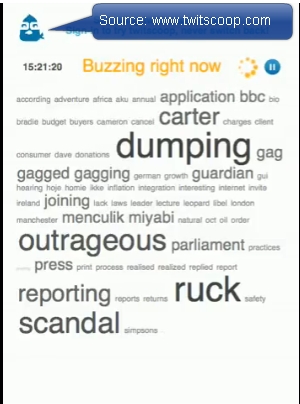
Tweet from @DistantHopes : Holy crap. Unless I miss my guess, check out how the disgraced #Trafigura literally had its name wiped from Twitscoop. [YouTube] #Trafigura on twitscoop.com

Associated Press, The truth is already out there: Twitter users thwart oil company's attempt to gag media.

LONDON (AP) — Bloggers and Twitter users thwarted a legal attempt Tuesday to stop Britain's media from reporting the questions posed by a lawmaker in a parliamentary debate, spotlighting the power of new media to influence public policy.

Alan Brookland, My advice to Trafigura – just wait it out:

Before everyone gets too self-congratulatory, does any of this brief flirtation with online interest ever actually change anything? True, right now, lots of people who had probably never even heard of Trifigura will now be reading up on the dumping story, but, come tomorrow or next week, how many will still remember much about it? The bloggers will chalk up a victory and in this case the gagging order was actually lifted, but this is still an on-going case and nothing will have actually changed.

Sites like Twitter are excellent for catching a wave and occasionally rallying a large number of people behind a cause, but it’s yet to become the force for social change that it’s being made out to be. Real issues sadly aren’t resolved in an afternoon and a normally more complicated than 140 characters. If social media is really going to make the impact that it could, then we all need to keep an eye on the issues which we find important and persue them, not just jump on while it’s in the news and let it quietly die. Nag your MP, pester the mainstream media and ask the annoying questions, not just when the issue is in the news, but repeatedly. It’s only by proving that we can stay interested in an issue that change happens, otherwise people will just wait till the dust settles and everything will stay the same.

[PDF] The letter Index on Censorship sent to the courts in support of the Guardian.

[PDF] Carter-Ruck statement on behalf of Trafigura.

Tweet from @pauloCanning : BBC #Radio4 news *finally (and briefly) reporting #gagcarterruck Fry gets quoted

Mike Butcher for Techcrunch, There’s nowhere to hide if your name trends on Twitter. Is there, Trafigura?

With the traditional media gagged, the new media had kicked in. That created a story which plenty of trad media outlets and blogs outside the UK could not ignore and started reporting on.

In other words, this kind of censorship is over. And I hope that British Libel law will change as a result. It must now move into the 21st Century and reflect new technology. After all, there is now a new defence. Feel libelled? You can defend your case just as much as the other guy online. Except of course if you are dumb enough not to register @carterruck, for instance.

Today's UK Parliamentary questions over #trafigura gag order [YouTube] http://www.youtube.com/watch?v=H_J4ypytxaE

Point of order on the injunction of the Guardian preventing it from printing a parliamentary question

Guardian, Trafigura gag attempt unites house in protest:

Labour MP Paul Farrelly told the speaker, John Bercow, attempts by lawyers Carter-Ruck to gag the media could be a "potential contempt of parliament".

The Liberal Democrat MP Evan Harris said there was a need to "control the habit of law firms" of obtaining secrecy injunctions, and his colleague David Heath told the Commons a "fundamental principle" was being threatened: that MPs should be able to speak freely and have their words reported freely.

On the Conservative side, David Davies criticised the rising use of "super-injunctions", in which the fact of the injunction is itself kept secret. He said courts should not be allowed to grant injunctions forbidding the reporting of parliament.

CharonQC, Lawcast 155: The Guardian Gag affair with Carl Gardner.

Catherine Mayer for Time: Twitter Triumphant: Attempts to Gag Newspaper Are Thwarted By Tweets:

Twitterers across the world colored their avatars green to show support for the protestors who took to Iran's streets after the country's disputed elections earlier this year. Users of the micro-blogging site might now consider overlaying their avatars with a film of sludge brown as a mark of their spontaneous, collective action to help undermine an attempt by the international oil traders Trafigura to gag a British newspaper reporting on a toxic dumping case.

Daily Mail, Law firm's 'Kafkaesque' bid to block reporting of Parliamentary question is defeated - makes no mention of either Trafigura or Twitter!

Professional journal The Chemical Engineer has also been served with an injunction by Carter-Ruck for Trafigura.

Channel Four News report, Parliamentary question ban lifted.

channel four news report

Jon Snow talked to Guardian editor Alan Rusbridger and asked him what had happened after the publication of this morning's paper.

He told Channel 4 News: "The blogosphere went berserk about a story that we published on our front page this morning, in which we said we can’t report a story for reasons we can’t tell you.

"After which there was about 16 hours of mayhem out there in the Twitter-sphere; and about an hour before we were due in court we received a letter from the lawyers saying 'we give in'.

"What has changed was that for the past six weeks we have been faced with an injunction – a so-called super injunction – which not only meant not only could we not tell anyone we had been injuncted, but that we could not mention the company involved either – I think this is a very dangerous phase in English law."

Tweet from @friendsofdarwin No mention of #trafigura or #carterruck on BBC 10 o'clock News. 5 minutes about racehorse's retirement. #bbcfail

Gillian Shaw on canada.com, Twitter backs Guardian newspaper in fight for free speech: A win for all:

Today marked a watershed moment in which social media stepped in to quash an attempt to gag a newspaper.

Guardian, How super-injunctions are used to gag investigative reporting:

Libel lawyers Carter-Ruck and Schillings have proved adept at persuading judges that injunctions should now be granted on privacy grounds. Some tabloid newspapers are being served with "a handful" of such orders each week, according to media lawyers. The Guardian has been served with at least 12 notices of injunctions that could not be reported so far this year, compared with six in the whole of 2006 and five the year before.

The motivation is straightforward, according to Mark Stephens, a partner at law firm Finer Stephens Innocent. "As the libel and privacy capital of the world, people are coming here [to London] to bully the media and NGOs into not reporting on their nefarious activities," he said.

Financial Times, Web’s effect on media law put to test:

Media lawyers, however, focused on the fact that the rulings of UK courts were not enforceable in the US.

Many of the servers hosting websites such as Facebook and Twitter are based in the US, meaning information cannot be suppressed.

Keith Ashby, head of litigation at Sheridans, said: “The difficulty is that injunctions cannot readily be obtained in the English courts against overseas internet service providers which would prevent them making the information available.”

Mr Ashby added: “If people get a whiff that publication of information has been injuncted in the print media, they are getting more canny about how to find the information on the internet.”

Michael Smyth, head of public policy at Clifford Chance, said: “We should not be surprised that the law finds it difficult to keep pace with technological advance and it is no answer in an era when judges are required to act proportionately to make a blanket order directed at the whole world.

“It is common practice for an injunction obtained against one newspaper to be copied to the whole of Fleet Street so that the market is aware of its terms and also bound by it. That’s the easy bit. What, however, of electronic publishers offshore about whom one knows next to nothing?” he added.

Mark Stephens of Finers Stephens Innocent agreed: “The issue with Twitter and SMS [text messaging] is that injunctions are not enforceable as you can’t stop people talking and in any case the servers which host these websites are in the US and outside the jurisdiction of the English courts.”

He pointed out that the order covering The Guardian was enforceable in England and Wales only, meaning that the Scottish and Irish media could report the parliamentary question.

Sunder Katwala on Liberal Conspiracy, Carter-Ruck:0 Guardian: 1… but what next?:

More broadly, wouldn’t it be a good idea to use this enjoyable moment of consciousness-raising to think about how we might sustain our attention and sort out a few deeper issues out too. Others may have a range of ideas. Here are three modest proposals of my own.

Mark Pack discovers that Trafigura have pretty dreadful website which says "This website and its contents are not directed at the general public.".

Tweets from @Danoosha Never seen a thin libel lawyer #newsnight #carterruck #trafigura #fb - @nuxnix BBCNewsnight #trafigura Slightly disappointing report I think this is the day where news media becomes less relevant to the real-time media

~~~~~

On the Wednesday Tory Politico reported Carter-Ruck/Guardian injunction revealed?

The bellow document is believed to be the secret injunction that would have prevented the Guardian reporting parliamentary proceedings yesterday.

Reblog this post [with Zemanta]