Now posts ↓

Showing posts with label UK politics. Show all posts

Saturday, 4 May 2013

Music · James Brown · Talking Loud and Saying Nothing


On the occasion of the UK Independence Party (UKIP)'s saturation media moment this funky moment seems apt. For the party of 'make up populist policy'.
Like a dull knife just ain't cuttin'
We're just talkin' a lot and sayin' nothing
Just sayin' nothing, just sayin' nothing
According to Brown, 'Talkin' Loud and Sayin' Nothing' was "aimed at the politicians who were running their mouths but had no knowledge of what life was like for a lot of people in [the United States]" as well as "some of the cats on their soapboxes... who were telling the people one thing while manipulating their emotions for personal gain."

A mate was panicking about them to which I responded that Brits have been here before. Troglodytes have had their moments before. The BNP has MEPs but now no councillors. Before that we had the National Front (who?) and before that Britain a/ laughed at the 1930s answer to UKIP leader Nigel Farage, Oswald Mosely, and b/ beat back the blackshirts at Cable Street.
Wait a minute, stop fellas, cool.
For a stream of laughs at Farage's expense I recommend this Twitter feed.

Shake your money maker after the jump:

Wednesday, 17 April 2013

When government stops outsourcing: Celebrate gov.uk's design win


There have been some predictable reactions to gov.uk winning a top design award, beating, amongst others, that sublime Olympic cauldron. The Daily Mail's story (pictured) is distilled essence of ignorance and stupidity: 'but it looks boring'!

Here's wired.com on why it won:
Yes, it looks more like an expired domain page than an integrated central location for government services. (We’re not the only ones to notice.) Then again, it’s a little like the DMV: you’re not going to spend any more time there than you have to. Wham, bam, thank you for registering your vehicle with us, ma’am.
Ir won because it achieved the aim of 'simpler, clearer, faster', which is not easy. The content, what it actually says and how it is tailored to the medium (which is now centrally directed and rules driven), is not mentioned by Wired, but is what struck me because 'simple' text is very hard to pull off. Wallpaper's report does notice that:
The website adheres to a strict style guide. Visitors will no longer be baffled by words such as ‘tackling’ (unless the context is about rugby), ‘deliver’ (unless it’s about pizza or post, not policies), and ‘disincentivise’.
Interestingly I have yet to see a real whinge about the win, just other versions of 'boring' or cloaked bitchiness, nothing from anyone of substance, with skin in the game, say, from a webbie, designey, background having a serious go at the site and the award committee. It will be there because this website is the product of civil servants not bleeding edge, Silicon Hub/Fen/Roundabout private enterprise. There will be teeth knashing going on privately.

This award is a slap in the face to those wanting government 'drowned in a bathtub', who see all public servants as losers, if not inherently corrupt. The sort of people who write for the Daily Mail, come to think of it.

For years government has been told that they are naturally incompetent and must outsource work like web design. It has been seen as bleeding obvious that a project such as centralising all government in one place online can only be done by a 'efficient' big company.

Big companies had proved adapt, using fair means and foul, for years and years, at seducing the actual decision makers and getting such contracts. But they failed. The websites may not have looked "boring" but they were crap and I documented some of this history on this very blog.
Here's three posts of mine on the 'Great 2009 Birmingham City Council website disaster', a product of the world's biggest outsourcing contractor Capita, or as it was dubbed 'Crapita':
Lessons from the great 2009 Birmingham City Council website disaster
Postscript -- Postscript two

Public service beats outsourcing: Hurrah!

What is so spectacular and the untold story behind this award is that the Crapitas of this world didn't, for once, fail upwards ... that some key people in government were prepared to battle them, to actually end the chicken and egg, revolving door of yet more failing contractors. To bring it back into government, to trust government, and that this evolving process wasn't cut off by Conservatives when they took over!

The winning GOV.UK design team
What this award is built from is not just the appearance of Martha Lane Fox, great though she is, but an ethos built up over many years in many parts of government of service and a user/citizen focus. Folks I've known as well as marginal idiots like me banging on about it. Lots of connections to others, like those who have built the BBC's world leading web presence on the back of that same service ethos.

Private companies have a harder time doing 'service and a user/citizen focus' precisely because of the profit motive. Their operations are bent by what will make the most money for them, and this includes what they offer government and that, yes, includes design. It is near impossible to imagine any of them creating this award winning design. When I revived this blog the first thing I wrote/ranted about was the massive bloat happening in current web design and how this was due to website needs increasingly impinging on customer needs -- the opposite of what something like gov.uk has to do.

What has changed with government websites, the bit which deserves celebrating, is that the outsourcing enablers, those whose egos the companies can tweak or flirt with, who business knew how to make look hip and not "boring", are gone. For once the good guys won.

Enhanced by Zemanta

Saturday, 13 April 2013

Does Labour want these disabled people jailed?


Ok. First up, I am NOT researching this to death. So you can forget that: FU. I am not descending rabbit-holes and reading endless PDFs about who knows what. But what I do know is that Labour people are suggesting that the people talked about in a Guardian blog post be jailed.

I am not researching to death because I am applying common sense. I don't need to read a lot of academic literature discussing a subject in the abstract. The ideology is in those PDFs and the result is the result -- jail.

The Guardian post is by Tuppy Owens, the legendary campaigner on sexual politics, and it is about disabled people paying for sex. Which is stuff that happens.

There are people in the UK Labour Party who want these people to go to jail. All clients of prostitutes must be punished for their own good and society's betterment, they and their ideology say. They literally claim that these disabled people are committing violence against women. They aren't campaigning for disabled people to be imprisoned but that's precisely where their ideology ends up at.

Those opposing what Owens is describing, the reality she is describing, can talk themselves into a hole, a rabbit hole. The end result, the reality which they have already enacted in much of Scandinavia, which they want in the whole of Europe, would put these disabled people in prison.

They may claim they don't want jail, they just want to 'name and shame'. But what if they aren't ashamed but defiant? They refuse to pay fines?

Oh, and it is people. Owens describes men but disabled women pay for sex too.

This is the reality of the so-called campaign to end prostitution. These Labour people, who think 'Miracle X' policy will 'end this scourge', would put disabled man X (oh, it will likely be a man) in prison.

Is the Labour Party in favour of imprisoning these disabled people?

Dissemble.

Of course I have a further point. This is an extrapolation on something which has annoyed me for a long while.

These feminist arguments on prostitution always ignore male prostitution. If they bother, they try to shovel it into the worst aspects of the female sex trade -- just like Dworkin abysmally did with gay porn -- but it always ends up in the same place that the shoveling of much of the female sex work choice into 'forced trade' has. See the Guardian expose on how independent women choosing sex work all become 'sex slaves' in NGOs eyes.

Let me be blunt. Feminists arguing against sex work don't give a f*** about male sex workers*. I am a gay man and I have seen this again and again -- gay sex workers are collateral damage, if they're considered at all. The laws that result, and impact them, they, feminists, could care less about. Because they impact men. Gay or not, they're still men.

I'm wrong? Show me how I'm wrong. I wish I could think otherwise, 'friend of da gayze' Mary Honeyball MEP. Yes, you. You do give a f***? Where? How? Vera Baird, Harriet Harman, Gavin Shuker -- You too. And don't invent some 'international gay sex slave' racket when what we really mean is some Brazilian guy trying for a better life (and doing it) in London or Berlin.

No one is claiming that it is all 'Belle De Jour' for anyone, including gay prostitutes. But it ain't all sex slavery either and there are plenty of workers yelling at you otherwise. Gay ones you rarely hear from because the nice gays fit to drink tea in the parlor don't tend to stick up for them.

So, will you jail the disabled?

You invent ideological laws to meld society? How f****ing far are you prepared to go?

The very idea of jailing the disabled strikes at the ideology behind the 'Nordic model' laws proposed by Labour MPs, and which mostly male MPs might be too shit scared of ideological error to do anything but go along with. That's why I'm asking the question. This isn't rhetorical, because it may well happen. It nearly happened before in the UK and it's being pushed in Scotland and Wales.

There are very likely some LibDems, Greens, Nationalists and Tories who would go along with it too, but I'm talking about those Labour people who are driven to make this nightmare come true.

We have clear examples of real world decriminalisation of prostitution that works petty well. Much as we have of examples of decriminalisation of 'soft' drugs. Yet -- zoinks -- we, Labour, can't do that because, either, ideology is telling us not to or -- zoinks -- politics (DMail fear etc) is screaming no. So we end up on the verge of jailing the disabled.

Q: How about 'harm reduction'? Something which has a very long and established pedigree?

A: Can't have that, we read this PDF and spoke to some Swedes and our advanced Europa learning tells us otherwise.

Q: Sending disabled people who use sex workers to jail isn't really 'harm reduction', is it?

A: How dare you suggest we are proposing that and would you please shut up with your promotion of male violence. Are you a misogynist? I think we need a new hate speech law ...

Social democracy has a choice here and, in Europe at least, I can guess where we're going ... Europarliament debates on necessary jail disability modifications anyone? ...Who is telling the likes of Mary Honeyball where to get off? Who would dare?

* This is a rant. I do actually know that some feminists acknowledge male sex work.
Enhanced by Zemanta

Friday, 12 April 2013

Postscript 2: You could make it up

↑ This didn't happen

A last return to the subject of Stafford Hospital and not the statistics, this time, but the human face.

Steve Walker, whose coverage I have been covering, has secured a heart-rending interview with some of the nurses. The people made out in the same media who have played loose with numbers to be witches and evil. The people banned from speaking.

They explain how the level of care was tied to the removal of resources, not human behaviour, their behaviour. The vicious media campaign has devastated them:
Several of the nurses told me of their frustration at the media’s acceptance of the claims by campaign group Cure the NHS (‘Cure’) that nobody from the hospital had apologised to them for the poor care they felt their relatives had received. Two nurses told me that they had apologised in person to Cure leaders – even though they were apologising for something beyond their ability to prevent – and had been thanked for doing so.
One nurse told me of a day that she had worked an extra 12-hour shift at the hospital because there was no one else available to provide cover. As she left the ward, exhausted, at the end of a shift she wasn’t obliged to do, she saw that someone had scrawled on the notice board,
ALL A&E NURSES ARE BITCHES!
There was a sense of helplessness to put forward a counter-view, as all staff had been banned by the new chief executive from making any positive statements or responses on the grounds that it would be ‘insensitive to the families’. Yet when staff appealed to him to stop people from coming into the Accident and Emergency unit and abusing staff, he told them,
I can’t do that.
Staff are still banned from speaking out, especially to the press. But there was no such restraint in the opposite direction. One nurse was spat upon in the street several times, while others were called murderers as they walked with their young children. As I heard these stories, the outrage I felt was barely mirrored in the faces of those telling them. Instead there were red eyes, and tears – a sense of hurt and grief more than resentment.
These were not hard-hearted harpies, but kindly, capable women treated like monsters for circumstances outside their control. One told me:
They said everyone was responsible – but it wasn’t true. There was a lack of resources, a lack of numbers, a lack of even the right forms – how can we be responsible for that?
They did complain, and report, and use procedure, but this is a typical experience:
I blew the whistle about something. The next thing, I was ‘named and shamed’ in a staff meeting, with minutes and everything. I rang the NMC (Nursing and Midwifery Council) and the RCN in flood of tears and was told:

“You can fight it – but it’s Stafford. You won’t get anywhere.”
They feel betrayed. Says Walker:
The public’s anger has been directed at the wrong people – and we shouldn’t forgive the misdirection either.

My mum on M. Thatcher


I hadn't thought of much to add to the slew of M. Thatcher pieces until this morning, when a tweet caught my eye.

It was comments from Daily Mail Online:

Via

This is the Mail, that astonishing number of green up arrows tempered slightly by being the online version but still. 'Sacrilegious' comments on her memory in that bastion of the Middle England that Londonist opinion would assume universally loved Maggie.

This break with assumed reality reminded me of one of the oddest bits of memory I have from the eighties. MT survived the Brighton bombing by dint of having completed her ablutions and exited her bathroom, which was wrecked, a short while before the bomb brought the ceiling down.

My mum was and is the very definition of Middle England. Aspiring working class, Daily Mail reader (if unavailable then the Express) and probable, though I never asked, Tory voter. When this happened she expressed annoyance that the IRA missed her.

I'm not remembering that wrong. That's why it sticks out.

The disconnect

The Tories this week have refused any right to speech on why MT was hated across so much of the UK and abroad. I look at onepolitics for UK politics blog headlines and there was one moment when every single Telegraph blogger was fulminating against Thatcher critics.

Now this has developed to the ultimate ironic point that they want a capitalist campaign of record buying -- 'Ding Dong! The Witch Is Dead' -- unmentioned on the BBC. Of course they're not just denying core beliefs (free speech, free enterprise) but being hypocrites. Look what was written when Thatcher contemporary the Labour leader Michael Foot died.

When the Miners' Strike was happening I was in a gay and lesbian support group and we worked solely with one village in South Wales. We travelled there a couple of times. The poverty was tremendous. It was only through the efforts of people like us that people there had food.

Of course the memories there would have been not just of the strikes the previous decade, which brought down the previous Tory government and which Thatcher was avenging, but of how Churchill had sent the troops to put down a miners' strike 70 odd years before. Two years ago locals complained when it was proposed to name a military base after Churchill in Glamorgan.

Those people, the Miners and their families, repaid that support in spades, by the way. The next year they travelled to the London Pride march with their banners and kids in strollers. And it was the Miners who led the union vote to push the first gay rights resolution through the Labour Party conference the next year, against Neil Kinnock's wishes, I might add.

Those mining villages, like so much of Britain, were decimated by the intentional destruction of British industry through her ideological insistence on monetarism, much like how communist ideology would upheave whole peoples in slavery to another blind ideological belief.

Mark Steel writes about what this meant for one Northamptonshire town built around a steel works:
The effect on Corby was like someone taking control of the Lake District and concreting in the lakes.

I was there to record a radio show about the town, and met Don and Irene, both in their seventies, at the Grampian Club. Don’s father had walked to Corby from Larkhall, near Glasgow, in 1932. I mentioned the steel strike and plant closure to Don, but he gestured as if it had somehow passed him by. It would have to be mentioned in the show, so I tried to find someone in the town with a story, an anecdote, something. But no one wanted to say a thing about it. During the recording, I asked if anyone had a story to tell from those days, but no one did, until it felt as if the whole audience collectively passed a motion that went: “I think you’d best move on to another subject, Mark.”

Afterwards in the bar, Irene told me: “We weren’t being rude, love, when we didn’t have a lot to say about the closure. But it wasn’t an easy time. Don marched from Corby to London with a banner. It made him angry about everything, we split up for a year because it was too much to live with. But we were lucky, two of our closest friends committed suicide in the months after the closure. So people would rather forget about those times really. But apart from that we really enjoyed the show.”
Perhaps the right's disconnect on negative talk of Thatcher is simply because they have no connection to these people? Either that or they patronisingly think 'those people don't know what's good for them'?

Why would people be celebrating her death in Brixton? Perhaps because they remember what the police were like in her day. I remember as I was there when people rioted. They used to strip search black men in the street.

Neil Harding has the best, I think, round up of twenty reasons why people might hate MT. It includes some counter-historical on the Falklands I'd forgotten about (because it's so totally whitewashed out):
The Falklands! In a gross piece of incompetence (or was it deliberate?) fails to avert the Falklands crisis by ignoring intelligence on the Argentine preparation for invasion in early 1982. Indeed she seems to positively encourage it by proposing scrapping the only warship we have there and having her defence secretary Nicholas Ridley openly say we didn't want the Falklands, thereby giving the impression we are not bothered about the islands! In 1978 when faced with the same intelligence, the Labour government quietly averts a war through diplomatic channels by threatening to send a taskforce. It's the classic tale, to divert attention from disastrous economic policies at home a crooked leader engages in a foreign war (except I'm not talking about Galtieri!). Perhaps Thatcher was getting advise from some of the brutal dictatorships she helped prop up in South America, "Would you like some more tea Mr Pinochet?". Number of British soldiers killed, 278, Argentines, 3000+. Blood on her hands anyone?
The one gay positive

Reading the gay conservative Andrew Sullivan, who I usually like, represented this disconnect particularly well (and he was very and literally disconnected, mostly, by 4,000 miles). I won't link to his spiel but after, bizarrely, arguing that the end of the mining industry was a good thing because it meant the end of 'black lung', he then credits her 'liberation of the market' with, I think, our progress towards ... gay marriage?

Richard Smith chronicled some of the weird gay reaction, including one description of MT as a 'gay icon' (dear g*d). And he did find this, which I recirculated on Twitter, lest we forget (and much as my memory of my mum's comment stuck with me their memory of this 1987 election poster has been erased):


The nasty Section 28 ("pretend family relationships" verboten in schools) has been mentioned in obituaries but not this homophobic electioneering. On the plus side they've noted her 1960s vote to decriminalise homosexuality but, less widely, Sullivan of all people forgets it, a positive linked, I think, to her scientific background, which has been recalled on climate change and the ozone layer. MT did allow her Heath Minister, Norman Fowler, to do the right thing on HIV/AIDS despite, allegedly and anecdotally, her being repelled by safe sex literature aimed at gay men.

Don’t Hate, Donate

Another thing cozy middle-class people like me learned during the Miners Strike from those subjected to it was the lengths MT would go to break the strike, echoing Churchill again. Illegal lengths. Violent lengths. This culminated in the infamous 'Battle of Orgreave' in South Yorkshire where, in scenes reminiscent of a 19th Century war, waves of police on horses descended on picketing miners. (I saw this elsewhere. On an anti-apartheid rally in Trafalgar square police formed into squares, just as infantry would have done at Waterloo).

Police had to pay out hundreds of thousands in compensation but, spurred on by the two-decade long campaign to get the truth about what happened at the Hillborough disaster, there is also a campaign to get the truth about what really happened at Orgreave.

And MT's death has led to this pitch to give to charities (donthatedonate.com now offline), including Orgreave:
Margaret Thatcher has died. We want to take the moment when our country is remembering her legacy, to remember the people her government hurt - people who don’t get pull-out supplements in national newspapers. People who don’t get ceremonial funerals in St Paul's Cathedral. The people her apologists forget, or want to forget.

Margaret Thatcher's last years were spent coping with dementia, a terrible illness. If, like us, you were disgusted by how she treated the least well off in Britain and around the world, the old line about not wishing something on your worst enemies still applies. We can’t help but think it’s pretty lousy to celebrate or gloat over anyone’s suffering and death and we don’t want anyone else to do it either.

We just want to place front and centre people who had no place in the Thatcherite worldview. And we want to do that in a way that can actually do some good. You can help us by donating to the excellent charities we have chosen to represent a fraction of them – the homeless, miners’ families, gay teenagers, Hillsborough survivors and South African victims of the Apartheid regime.

Nothing is stopping you doing more or taking the spirit of the Don’t Hate, Donate campaign in your own direction. Thank you so much for your support!
Much better than sending 79p to Sony for a Judy Garland song methinks?
Enhanced by Zemanta

Sunday, 7 April 2013

Postscript: *Northern Ireland only: Why is the BBC ghettoising the Troubles?

BBC iPlayer as displayed by the Nintendo Wii

Over at Slugger O'Toole, Mick Fealty promoted my post asking whether the BBC was ghettoising films about the Troubles by only showing them in Northern Ireland.

*Link to Mick's post with warning that Google is saying 'site compromised' of Slugger as of writing.

This attracted some interesting comments, as you'd expect from the leading website devoted to Northern Irish politics and life.

One piece of interesting pushback came from Brian Walker, a former BBC journalist, Political Editor and manager in Belfast.

Walker said that BBC Northern Ireland (NI) are not to blame.
The national networks are commissioned by a team under their own controllers. I’m sure the local BBC do their best to get network showcases. For one thing it spreads the costs. I wouldn’t rule out versioning and airing on BBC4.
Possibly, though my survey could only turn up one example of that transfer to British BBC TV.

Another commentator, Nevin, added this nugget of evidence:
Not just NI, it seems:
Q673 Baroness Bonham-Carter of Yarnbury: You have mentioned Scotland and Wales. In England you hardly get a Scottish story. On Newsnight you have the opt out and there is a real sense that with devolution bits of the country have been cut off from each other. 2005 source [pdf file]
This is a news related comment but it has wider relevance. One of those giving evidence was Pat Loughrey, the then BBC Director of Nations and Regions and former BBC NI Controller.
I haven't watched much Scottish or Welsh regional output because, frankly, it hasn't appealed. But this complaint sounds like one to do with the BBC's structure being 'ghettoised'.

Walker also commented on one show I pointed at as, I thought, suitable for such a transfer, the history of Ulster Presbyterians, 'An Independent People':
This was an ambitious series but in concept definitely NI/Irish, I’d say, and well worth doing in those terms. It could be probably aired in its present form in Scotland without much of a remake but I think it would need subtantially reversioning for the networks.

This is not a criticism by any means. NI’s audience is distinct and not all ambitous programme ideas should be made on the condition that they are only worth funding if they get network airings.
I'm not so sure about that on revisioning. For one thing, BBC4 has vast amounts of time to fill, which it generally does with repeats (not that there's necessarily anything wrong with that), so why not repeat that show there. For another, check the schedule, there are some remarkably esoteric shows on. Plus that show had a fascinating middle episode on the role of Ulster Presbyterians in the American revolution.
I take the unfashionable view that the NI audience needs its owns share of high quality expensive programming. And not all of it should be made for networks in mind. Great if you can co-commission or export some of it but not always essential and not always appropriate.
No, but that wasn't my point. Film and television is replete with examples of shows which were made for very specific audiences yet found much wider appeal. I don't think this is 'either/or'. What seems to be happening -- one region's shows being blocked out, perhaps because of the way the BBC is structured --  is a deprivation for the British audience if we rarely if ever get the chance to see something from that perspective, something not made with 'us' in mind. Or put it this way, we still watch American shows which have no consideration, are not revised, for 'us' -- or Danish ones for that matter.

Australia is fortunate in having what I think is a unique in the world TV channel, the Special Broadcasting Service (SBS), which was set up by a Liberal (conservative) government in the 1970s to cater for an increasingly multicultural Australia. That channel shows TV and films from literally all around the world and is full of gems which audiences for whom the programming wasn't done (i.e not the minority from the relevant country of origin) are grateful to get an opportunity to see.

Walker does point out that the TV landscape is rapidly changing, shown by the fact that I am able to watch '*Northern Ireland only' shows at all on iPlayer. However, again, I beg to disagree as, from my web experience for one, the looming era of thousands if not millions of 'channels' does not really mean that the masses will find something. We will probably always have someone, whether a public or a private corporation, to whom we hand over the remote control and say 'I've had a hard day at work, here, you curate for me'. Most people, after all, only regularly visit, what is it, seven web sites? What shows, after all, does iPlayer, more specifically the Editors there, promote? Not BBC NI ones, or other regional output, as far as I can see, ever.

Enhanced by Zemanta

Thursday, 4 April 2013

Postscript: You could make it up


Somewhat of a validation for my post on how media reports about '1200 deaths' at Stafford Hospital was pulled out of someone's ass thin air. It's Paul Taylor in the august London Review of Books on 'Rigging the Death Rate'.

Taylor, a reader in health informatics at University College London, in a lengthy piece, pretty much demolishes the basis for those media reports and their source, one Professor Jarman. In fact, in an extremely detailed exposition on measuring stuff in health care, he comes back to the points raised by Steve Walker, the blogger on which my post was based and who has been battling away, somewhat on his lonesome, against the use of Jarman's mishandled (to be generous) data by those who wish the NHS ill.

On the controversial source of info in the NHS which we're talking about, here's something I did not know:
The coding, however, is notoriously prone to error (last year’s HES [Health Survey For England] summary statistics record, for instance, that of the 785,263 in-patient episodes coded under Obstetrics, 16,992 were recorded for male patients) and the system wasn’t designed to measure the quality of care, only the quantity.
The basis of Jarman's business (DFI) is something called the 'Good Hospital Guide', which is entirely based on ...
League tables – applied to surgeons, hospitals or schools – do not give the person reading them any sense of how much variation would be expected for a given sample size and instead impose a rank that the data may not support. There were good reasons for a hospital to regard a poor placing in DFI’s tables as merely an irritating bit of bad publicity.
As Walker and some others have noted, the recording of data isn't the problem, it's how it gets used:
Governments and regulators tend to make drastic interventions with the worst-performing institutions in mind, but the more effective strategy is probably to aim at improving average hospitals, since the ideas developed along the way will work almost anywhere. Lilford and Mohammed [Birmingham University critics of DFI] so criticised the use of the HSMR [Hospital Standardised Mortality Ratio] to measure quality of care. The HSMR shares the weaknesses of the HES data on which it based, but Lilford and Mohammed had a more fundamental criticism: mortality is unlikely to be a good measure of how good care is in a hospital. Typically, 98 per cent of in-patients survive their visit, so nearly all the data about what happens in a given hospital are ignored if we concentrate on mortality rates. Not only that, but of the 2 per cent who don’t survive, only a few will have died an ‘avoidable’ death, and it is only those deaths that can be used to measure the quality of care.
Was Stafford 'broken' because of useless nurses, as you may have heard in the MailExpressTelegraphSun, or ...
The chart above shows the distribution of waiting times in A&E in Stafford Hospital. There is an extraordinary peak at 3 hours 50 minutes: patients were being admitted in a hurry to avoid breaking government targets for a maximum of four-hour waits in A&E. That the system encouraged such sleight of hand is unsurprising – the data from many other hospitals would show a similar peak – but the problem at Stafford was that the care in A&E was poor. It was chronically understaffed, initial assessments were carried out by receptionists with no medical training, and essential equipment – cardiac monitors, for example – were missing or broken. Many patients admitted just before the deadline were sent to units where the care was even worse, some of them to an unstaffed ‘clinical decisions unit’, others to the so-called emergency assessment unit (EAU), a large ward described by the Healthcare Commission as poorly designed, busy, noisy, ‘chaotic’. Nurses in the EAU were inadequately trained and it was common for a patient’s condition to deteriorate unnoticed or for necessary medication not to be provided.

After running through the similarities uncovered in a report on a past case of poor care at another hospital with the Mid Staffs report (staff/patient ratios, inadequacy of systems for reporting incidents, whistleblower victimisation, disinterested senior management in which consultants weren't involved), Taylor turns to the latest idea from the No. 10 brains trust, the ‘friends and family’ test:
Given what we’ve learned about how managers respond to targets, it would be surprising if trusts weren’t already looking for wards or services which, given some extra attention, might yield more than their fair share of grateful respondents. If the test worked, it might help identify hospitals where nursing is poor, but it will be of less help in cases where patients are treated with a combination of kindness and technical incompetence – as at Bristol – or, as with Harold Shipman’s patients, ostensible kindness but actual malice. Just as important, most NHS scandals have affected patients who aren’t likely to voice their complaints, aren’t in a position to make choices and who often don’t have friends or family to speak up for them.
Here's Taylor's concluding point, a sad but true one given the investment much of the media and a certain political party have made in misusing data:
A different approach is used in Australia. Queensland Health was the subject of two public inquiries in 2005 over its employment of a surgeon who became known to journalists as Dr Death. In response, it has adopted an approach which bears some similarities to the work of DFI: data are obtained from hospitals across the state and actual outcomes compared with expected outcomes in order to generate alerts. The focus is on performance over time rather than on a single number and, more important, the data are used differently. A broader range of outcomes is considered, not just mortality, and because it was argued that the threshold should be set very low, many hospitals are flagged so that investigations become a normal part of an institution’s commitment to safety. So long as NHS trusts that have a high HSMR continue to be named in the papers and the statistical concept of ‘avoidable death’ is interpreted as providing grounds for criminal prosecution, the argument for a similar system won’t be made here, let alone won, any time soon.
Walker has just reported on how Mid-Staffs is demonstrably improving, yet is being threatened with closure -- for blatantly political reasons. The proposal is to give £30m to a nearby hospital, and close Stafford. As opposed to:
Save £53m over 5 years in order to keep a hospital that serves around 300,000 people and which has been adjudged by the Care Quality Commission (CQC) as ‘meeting all the essential standards of quality and safety‘.

Wednesday, 27 March 2013

*Northern Ireland only: Why is the BBC ghettoising the Troubles?


Why is excellent TV about the Troubles, the war in Northern Ireland and Britain, only shown in Northern Ireland?

This month the BBC broadcast a fascinating and moving documentary, from which the above image comes. It is one of the most famous photographs of the whole war. It shows the priest Fr Alec Reid administering the last rites to a dying soldier, who had strayed into the wrong place and been beaten to death and shot by the IRA.

The documentary was '14 Days' and covers a fortnight during which the British state shot three IRA members in cold blood in Gibraltar, then their funeral was attacked by a Loyalist gunman and then two soldiers were killed. When he was administering to the soldier Fr Reid had in his pocket a letter which he was carrying in his capacity as a go between. Reid was one of the earliest actors to attempt to bring together key parties to try to get a ceasefire, that letter was from Sinn Fein leader Gerry Adams to the leader of the 'moderate Catholic' SDLP, John Hume.

The film uses the device of those two weeks and the focus on one man to try to tell a bigger story of how individuals can have great impacts during momentous times, times when all hope appears lost. It's cinematic and has many powerful images like the one above, the capturing of which itself forms part of the narrative.

'14 Days' is not without its problems.

Professor John D Brewer writes that Reid's pain as he relives this time is seen in his face but it isn't properly explained in the film:
I am certain that what peaceful future Northern Ireland has is down in no small measure to the courageous individuals like Father Reid in the churches who brought paramilitaries, politicians, civil society and others together in sacred spaces.They were not all Catholic clerics. Many were Protestants. We glimpsed in 14 Days the equally seismic role of clergy like Harold Good, Ken Newell and others, working alongside or in parallel to Father Reid.

But there was one thing we didn’t get from this otherwise excellent programme. The Catholic and Protestant clergy more or less acted on their own authority, outside the conservative, cautious institutional church. They were mavericks, independents, easily left out on a limb when the secret back-channel dialogue they were facilitating became public and the institutional church disowned them.

Father Reid was pilloried by the Catholic Church – as was Ken Newell by some of his fellow Presbyterians. Only the Methodist Church gave its peacemakers something approaching official backing. And that is why Father Reid paid such an emotional price for his compassionate commitment to peacemaking.

....

The institutional churches did not perform with honour in trying to establish peace and relegated themselves to burying the dead and comforting the widows. The job of getting their hands dirty was left to a select brave few and it is appropriate to echo that never before was so much owed by so many to so few.
Mick Fealty, aka the blogger Slugger O'Toole, spoke with me about the film and echoed Brewer's criticism. Fealty said that a "more penetrating documentary would have looked in more depth at the context and the deaths of the three on Gibraltar to see where the political story was."

In that famous photo, Reid was carrying, says Brewer, "the first draft of the eventual blueprint that evolved later into the Downing Street Declaration and thence the Belfast Agreement." The 1998 Belfast Agreement, also known as the Good Friday Agreement, reestablished devolved government on the basis of power sharing.

But this version of history leads on to another problem, says Fealty, and one which comes back to the problem of British TV viewers not hearing about Northern Ireland. "I think it ['14 Days'] suffers from 'Peace Processism'", says Fealty. "This place is in a sustained state of cold war."

Brits don't want to know

Wednesday, 20 March 2013

Emily Bell: Meet the ancient Interwebs

Emily Bell, the esteemed former leader of Guardian Online, attacks the proposed new press regulator:
This is all about restraining a notion of the press and journalists as some kind of easily identified pack which feeds into a neatly industrialised process, when in fact the forces are moving in the opposite direction: anyone can be a journalist, yet the institutional support for journalism has seldom been economically weaker.
She points out that what becomes 'news' can start from, and here is one example of hers, a tweet about a raid that turns out to be Osama Bin Laden's house:
The impact a story has now is as much dependent on the network it travels through as on the news brand that presents it.
Bell's point seems to be that the 'times they are a-changin'. But they're not really.

Of course I can blog here and you can tweet there. People have been stapling together pieces of paper and distributing them since whenever. You didn't then need Bell's "industrial publishing complex behind you," as Lord McAlpine - cited often in this context (Leveson and the oldies failure to understand t'internet) numerous times over Twitter - could tell you.

The trashing of McAlpine started in Scallywag in the early nineties (Google if you must, I'm not linking). More people can read it now but it still got wide enough circulation then for McAlpine to get that scandal sheet shut down.

Go further back and people would be distributing 'news' via things called 'leaflets'. I believe some of these may have been involved in starting revolutions? Much like the new fangled interwebs was tied to that 'Arab Spring'?

I distinctly recall something called a Roneo (illustrated above), which was an extremely messy but cheap printing method employed by activists and campaigners and cranks to 'get the word out'. Every so often something which had been ronoed would make it into the Daily Mail -- 'look what the loony left are saying now' kind-of thing -- much like the Mail cherry-picking the interwebs today.

The idea that because we now have new methods of distribution that we don't still have centres of power alongside them and won't have them in the shiny future is wrong. The people always need to have some way to control the powerful, which is what setting up independent regulation of the press is all about.

Self-regulation doesn't work (that big inquiry just proved that), government regulation is not desirable, so that leaves ...

Once the independent regulator is set up it can evolve and tweek and whatever else might need to done. The point is to win it first, which is why the press barons are going apeshit and throwing their toys out the pram.

Hislop

One note on the beloved Ian Hislop, Editor, Private Eye.

His big point seems to be that you just need Lily Law because all the bad stuff which led to Leveson was illegal anyway and the law just needed applying. So why was there a press code? That wasn't law it was just the industry defining how it should practice. Leveson showed not just law breaches like hacking but constant code breaches, contempt for code, but alongside absence of remedy for the powerless.

Monday, 18 March 2013

You could make it up


In today's collective strop by the newspapers about regulation there's one theme, a supposed threat to investigative reporting. One story being pointed at as potentially being threatened by 'government control of the press' is the 'scandal' of hundreds of 'avoidable deaths' at Stafford hospital.

What's funny about the press using this example to make their argument is that their Stafford reporting has, universally, from the BBC all the way to the Daily Star, been terrible, shockingly terrible.

The number of 'avoidable deaths' - the figure commonly reported is 1200 - is completely made-up. Any reporter doing their, you know, job could figure it out.

Blogger Steve Walker explains at length how '1200 deaths' was pulled out of someone's ass thin air and how its basis is undermined by just a cursory understanding of statistics. Here's a key passage:
As I explained in my post on the real story of Mid Staffs, Prof Jarman’s HSMR (hospital standardised mortality ratio) system rates English hospitals according to where they sit according to the average death rate for the nation. A hospital hitting exactly the average rate would receive a ‘score’ of 100. A hospital doing better than average would have an HSMR below 100, and one doing worse would be over 100.

So far, so clear – I hope. But here’s the key fact: every year, the system is ‘rebased‘ – the averages are re-measured and ’100′ is re-calibrated to the new average.

This leads to 3 key problems:
  1. Because of how averages work, unless by some miracle every single hospital in the country got exactly the same score, you will always have some hospitals above 100 and some below. This does not mean the ‘extra’ deaths in those hospitals were avoidable – it just means that somebody has to be above the line because it’s an average.
  2. Because the ’100-line’ moves every year, a hospital can maintain exactly the same standard in one year as it achieved in the previous year – and yet can score below 100 one year and above 100 the next. The performance of the hospital did not get worse. The line just moved. It’s not only wrong but ridiculous to extrapolate ‘extra’ or ‘avoidable’ deaths from a position above or below a line that moves every year.
  3. Leading on from number 2 – and it’s impossible to overstate this – there is no ‘standard’ rate of deaths from a particular illness. No expert clinicians are sitting down together and saying ‘Yes, we agree that out of every 100 patients with an intracranial bleed, this many are going to die’. No. All that happens is that the average for the previous year becomes the re-calibrated ‘expected death’ figure for the following year. This means that HSMRs are measuring the success/failure in achieving/beating/failing to bear a target that moves every year – and has no basis in clinical expertise. It’s just a number.
In his testimony to the Francis inquiry, Prof Jarman claimed that he had to present the figures this way because the English are ‘simple-minded‘ – but in doing so he has committed a fundamental error of logic worthy of a simpleton.

These fundamental logical errors mean that even if everything else was perfect, HSMR scores over 100 cannot be used to calculate avoidable deaths.
Walker explains how behind the media's scary headlines lies 'rubbish in, rubbish out'. The data wasn't being properly recorded at the hospital and the woman brought in to fix that, who he has met, wasn't allowed to give evidence or speak to the media.

That women's work on correcting the errors produced the exact opposite outcome to the screaming headlines:
When Ms Kirkbright arrived at Mid Staffs, she carried out a re-coding exercise on past deaths. This re-coding corrected the absent Z51.5 code and used the case notes to add in the co-morbidities (what is known in the jargon as ‘depth of coding’) that was missing. This brought down Mid Staffs’ HSMR to 88 – well below the national average death rate.
Further:
HSMRs are a statistical device. If you want to be sure whether deaths were avoidable or not, you need to look in detail at the case notes for each patient. The doctor in charge of the Independent Case Note Review (INCR) was asked by the inquiry how many ‘excess’ deaths he had discovered among all of the cases for which families asked for a review. His answer was telling – but has been almost completely ignored:

    Perhaps one such death.
And further, Walker reports evidence that hospitals are gaming this bonkers system because of funding pressures - to increase their incomes.

Plus Walker gives examples of how reporting on supposed bad treatment of patients at the hospital could simply not be true.

The man behind the headlines, Professor Sir Brian Jarman, has a clear conflict of interest. He is financed by a company which sells services that allow NHS Trusts to use and monitor HSMRs. That has not been reported.

What is also not being reported is that the entire system is based on the most ridiculous way of recording and therefore supposedly monitoring morbidity rates.

HSMRs are based on ‘first diagnosis’.
If a patient arrives unconscious and the ambulance driver reports ‘He fainted’, fainting would be the first diagnosis. If that patient is then discovered to have had a serious stroke and dies, that death will be recorded against ‘fainting’ – a condition with a very low death-rate – resulting in an inflated HSMR.
There is no recording of post mortum results. The system is utterly broken. You couldn't make it up!

It's plain once you read Walker, or the handful of other bloggers, or this lonesome letter to The Guardian, or Computer Weekly, all similarly demolishing the media's reporting, that the headlines about '1200 avoidable deaths' aren't wrong because the media are all idiots, they are the result of an agenda. A stealth-privatisation, anti-National Health Service agenda.

Says Walker:
The threat is serious, because a lot of people will believe what’s being said and written just because it’s in the media and has apparent statistical/scientific support. Very few will look beyond the soundbites to see whether they stand up to scrutiny.

So please, if you’ve read this article and agree with its premise, spread the word. We need good information out there to counteract the absolute tripe that’s being force-fed to the British public.
Happy to oblige

Monday, 11 March 2013

It's like Iraq all over again


Remember when the news media failed to investigate the reasons given for going to war in Iraq? That waste of blood and treasure which started ten years ago this week?

LibDem activist Stephen Tall has a post up on Liberal Democrat Voice which tells me that nothing has been learned by the news media. That instead of doing their job and investigating Very Important issues they're fixated instead on the Tweedledum and Tweedledee, Humpty Dumpty politics of Westminster.

Tall writes that:
I had an odd experience on Friday. I was doing a round of media interviews – 3 for TV, 3 for radio – previewing the Lib Dem conference. I’d been called by researchers in advance to ‘get my take’ on the key issues. Each time, I said there was a big issue on which the party leadership could expect to be defeated and which would see activists from across the broad spectrum of the Lib Dems united: opposition to secret courts. This received an “Uh-hum” response which I took for baffled boredom. And as expected, each interview in turn dwelt instead on Vicky Pryce and Chris Huhne and the allegations against Lord Rennard.
Which is even worse because Tall also writes that they missed out on the sort of argument they appear to thrive on:
If they’d asked me about secret courts, however, I’d have had no hesitation in letting the party leadership have it with both barrels.
The LibDem leadership is backing the government's bill and saying FU both to party policy and the very basis of classic liberalism. Last week only seven of their MPs 'rebelled'.

Unfortunately Tall then descends onto a 'woe is us' plea for the meeja to not be so focused on LibDem travails, assuming that the problem is a recent one.

Well no, this sort of attitude to political reporting is not recent, and it is not just exclusive to Westminster. It got us into a disastrous war, remember?

Saturday, 19 September 2009

Introducing 'lifestream': UK MP's website breaks new ground


LibDem MP Lynne Featherstone is the party's lead on web stuff and so she should be - she's had a blog since 2003 and has fed it practically everyday since. Lynne even credits her election victory to her strong online presence and use of it as an organising tool.

When she came to updating her website she chose Simon Dickson of Puffbox, the man responsible for many website transformations including Number Ten's.

For her site Dickson has done something entirely new and - I think - brilliant. Called a 'lifestream' it brings together all the flotsum and jetsum of Lynne's online life in one place - her site.

Says Dickson:
So the grand concept of the site is the use of a tabbed 'lifestream' as the homepage. The initial view lists her last 10 actions, no matter where they happened - including Early Day Motion signatures, which required me to write my own scraper. Then, if you want to see her activity on one of those specific areas, you just click the appropriate tab. It's all driven by RSS; the tabs are powered by ajax; the lists are generated by a cron for obvious reasons.

It includes content from:
  • Her blog
  • Hornsey & Wood Green LibDem press releases
  • Her tweets
  • Her pictures on Flickr
  • Her in Hansard
  • Early Day Motion signatures
  • Her videos on YouTube
  • Media cuttings about her
So rather than a whole lot of icons you click through to find content this brings it all together. As I said, brilliant. And just maybe a first?

(Just not sure about the name 'lifestream', only I can't think of anything better).

Friday, 4 September 2009

First use of Twitter to prevent a deportation

Anselme Noumbiwa

This is Anselme Noumbiwa. He's a Cameroonian who fled his country for the UK in 2006 because on the death of his father, the village Chief, he was expected to 'marry' his father's wives.

When he would not adhere to tribal traditions the village elders tortured him. Although the Home Office believed him they did not accept the report of the Medical Foundation for the Care of Victims of Torture arguing on a technicality (as is often the case) that the doctor who wrote it didn’t “work” for the Foundation.

The Home Office also said he could relocate within Cameroon and would be safe. But the influence of powerful members of his tribe reaches beyond the area where he lived. If he is sent back he would be in mortal danger.

So last week he was detained.

And last week he became the first known person to tweet from immigration detention in the UK.

He was detained despite another appointment, in October, with Medical Foundation for the Care of Victims of Torture. This time with a doctor who “worked” – even in the twisted definition of the Home Office – for them. The doctor needed another meeting to conclude his report. So why on earth did they detain Anselme before this appointment? Because that's what they do.

He got out of detention only because people campaigned on his behalf, bombarding the Home Office with e-mails on the Friday just before the long bank holiday weekend.

I have seen this time and time again - they skirt around rules and procedures to deport someone, supporters rally and very often the deportation is stopped. So then they move to try and make it even easier to deport, even harder to apply rules, and law. A cat-and-mouse game which gives the lie to any claims of 'fairness'.

It's happening against a background of relentless media scare stories such as the one this week in the Daily Mail which was headlined One out of every five killers is an immigrant (no, foreign-born person does not equal 'immigrant' and they counted both 'unknown' and Irish people as 'foreign') and a foreground of weak Labour politicians who have forgotten what their party is supposed to stand for.

Cameroonian asylum seekers are being rounded up across the UK and put on “ethnic charter flights”. Today there is a demo organised by British-Africans against them outside the UK Border Agency Enforcement Unit at Salford Quays in Manchester.

Last quarter only 6,045 people applied for asylum in the UK. There are 42 million uprooted people in the world. On Wednesday the EU called for member countries to accept more refugees seeking resettlement.

Anselme's supporters made this film about his story.


HT: NCADC
Reblog this post [with Zemanta]

Thursday, 13 August 2009

Marriage equality: Australia stumbles out of the Jurassic

Marriage equality has become a major issue in Australia. As it should.

Despite the Sydney Mardi Gras and all that legally Australia has until, er, now been in the Jurassic era vs LGBT equality.

Prior to the annual conference of the governing Australian Labor Party (ALP) rallies and protests were held and they produced the most odd compromise of"removing the explicit definition of marriage being between a man and a woman from its national platform" but still remaining opposed to marriage equality and promising national civil partnerships.

The antagonistic attitude of religious PM Kevin Rudd to marriage equality reminds one of the attitude of religious PM Tony Blair: 'separate but equal = good enough'.

Advocates of marriage equality produced some of the best adverts for it (in a great Aussie stylee) which I think I've ever seen. Take a look (and learn, Californians):


Wednesday, 12 August 2009

Gordon Brown: Wiring a web for global good

There's been some follow-up from Rafael Behr's piece in the Observer saying 'The Tories think the internet favours them. They're wrong' which repeats the meme that Gordon Brown is a web luddite whilst 'webcameron' gets it.

This is just wrong and the following talk by Brown at TedGlobal last month shows why.

Yes, Labour has a crap web operation. Yes, Gordon should stop jigging around in Downing Street videos.

But this presentation off the Westminster bubble circuit is seemingly effortless and masterful and demonstrates that he 'gets it' web-wise.

Friday, 24 July 2009

Embedding recommended for Parliament video

The British Houses of Parliament, LondonImage via Wikipedia

The House of Lords shows itself - again - to be the most thoughtful and progressive chamber in a new report 'Are the Lords listening? Creating connections between people and Parliament' from its Information Committee.

Parliament has some really daft rules against use of video of proceedings, which it has been extremely slow in changing. Leading the charge against this has been LibDem MP Jo Swinson.

The Lords new report backs Swinson's campaign to free up reuse of video and - hurrah! - backs embedding and republication.

42. 'Embedding' is the process whereby a document or file of one type is inserted into a document or file of another type on the internet. Embedding is central to much use of multimedia in web pages, which tend to embed video, animation, and audio files. In our Annual Report 2007-08,[11] we reported the growing number of people asking to embed parliamentary material (such as video footage of proceedings) into their own web sites. Such embedding would, for instance, allow other web sites to include windows within their web pages so that clips of parliamentary proceedings could play within their own pages instead of having to open a separate window and application to view the clips. Under the terms of the current licences, the Parliamentary Broadcasting Unit Limited (PARBUL) cannot allow any of its licensees to offer embedding. Peter Lowe of Sky News found it "extraordinary" that Parliament did not allow embedding (Q 311).

43. The BBC asked Parliament to change this policy so that it could include footage from Westminster in its 'Democracy Live' website, which would also include footage from the Scottish Parliament, the Welsh Assembly, the Northern Ireland Assembly and the European Parliament (QQ 308-09, 314; p84). Last year, we called for further research to be carried out on allowing embedding of footage of parliamentary proceedings. During our inquiry, it was made clear to us that embedding would allow wider access to parliamentary proceedings through websites and other channels (pp 16, 143). Peter Riddell, Political Commentator and Assistant Editor of The Times, said that it would be "a tremendous help" to journalists preparing articles online (Q 191). Channel 4 said that enabling users "to embed clips on their own sites, and then use social bookmarking tools to promote these clips to others, is an effective and low-cost way of expanding the reach of Parliament—as the easier it is to spread information the more people will see it" (p 104). Jo Swinson MP told the Committee: "we need to wake up and get into the twenty-first century on this. If we can actually get clips of Parliament out there, particularly in two or three-minute pieces which are easy to watch, easy to forward to friends, that is a much better way and a much easier way for people to understand what is going on in Parliament than having to watch the BBC Parliament channel for hours on end until something they might be interested in comes up."

44. People should be allowed to embed the House's proceedings on their websites, so that our proceedings can have as wide a distribution as possible on the internet. We recommend that a trial start as soon as possible. We have invited the BBC and the House of Lords administration to bring forward proposals for how the House can maximise potential synergies with the BBC's forthcoming 'Democracy Live' website.

Yay! The irony here though is how slow the BBC has been with the option to embed on its video. There does seem to be a lot of internal resistance and only some news video is embeddable. What's bizarre is that you can find loads of BBC news video on YouTube, which they don't police.

As well, people are getting iplayer content and reusing it, here's how to get the iplayer embed code. That's not being policed either.

Here's what the Lords says about Parliament and YouTube

38. In May 2008 Parliament launched a YouTube channel, which it uses primarily to show short films promoting and explaining the work of Parliament. The Hansard Society praised the videos about the work of the House of Lords (p 13). We used YouTube throughout our inquiry, to update people outside Westminster on what had happened during our meetings and to provide an insight into the views of witnesses and members of the Committee. In June 2009, the House of Lords Economic Affairs Committee and the European Union Committee released videos on YouTube to mark the publication of their reports.

39. We also used Parliament's YouTube channel in our inquiry to allow people to contribute by submitting their views on video. Dr Jackson said that this development was "very exciting": the fact that members of the public can upload videos gives the channel the potential to be "a powerful interactive instrument" (p 139). Parliament would benefit from the interactive nature of such websites, by treating them not simply as publishers and distributors but as places where user-generated content can be created and displayed.

40. Members of either House are allowed to post footage featuring the member on the member's own website. However, at present, the two Houses do not allow parliamentary proceedings to be posted on YouTube or any other third-party hosting website. This ban has attracted negative publicity; and Parliament has been criticised for not embracing new technology. Last November, we agreed that Lords be allowed to place on YouTube (and similar searchable video hosting websites) clips of their contributions to the House's proceedings. The final administrative and legal steps around copyright are being taken, and the Committee will inform members when they can start to upload their contributions to YouTube. Technical training will be provided for members who wish to take advantage of this new possibility.

HT: Emma

Reblog this post [with Zemanta]

Tuesday, 7 July 2009

'I'm tempted to extend the metaphor'

Oh, go-on ...


"Every Prime Minister needs a Willie" - of course the famously naive Margaret Thatcher had no concept of a double entendre. Out (but not out) Mandy however ...

Monday, 6 July 2009

How very dare he! Woolas claims UK fair on LGBT asylum

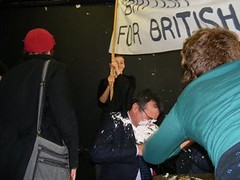
Minister gets cake in his faceImage by solomonsmfield via Flickr

In a shameless piece of bandwagon climbing, Immigration Minister Phil Woolas has published a piece on LabourList claiming that his department is fair on LGBT asylum. He says he is "proud" that people were at Saturday's London Pride march who have won asylum.

Practically nothing written in the article matches the actual experience of LGBT asylum seekers at the hands of the Home Office and the UK Border Agency (UKBA).

He claims that his department does not tell people to 'be discrete' and send them home - that's the Court of Appeal.
From time to time we are accused of expecting gay men and lesbians to be discreet, effectively to suppress their sexuality in order to avoid persecution. This is not an accurate representation. The Court of Appeal has found, in line with our policy that whether a gay claimant can reasonably be expected to tolerate behaving discreetly is something that must be considered on the individual merits of the case.
This is so barefaced as to take my breath away. Who writes the rules, the courts or the government?
Following an eight year ordeal the Ugandan gay asylum seeker John 'Bosco' Nyombi has finally won asylum in the UK.

Despite a well-documented media and government anti-gay campaign in Uganda, which has included articles and photos of Bosco, he was deported in September last year. The UK Border Agency making it usual claim that LGBT can be safe in such countries if only they are 'discreet'. However the method of his deportation, which involved deception, violence and rule breaking, led to a historic decision by a British court following which the Home Office was forced to return him to the UK in March, where he was immediately put into a detention centre due to an 'error'.
John finally got leave to remain a few weeks ago.

It took a major international campaign to secure leave (which was exceptional and outside the department's strictures) for Mehdi Kazemi, the 19 year old Iranian whose boyfriend had been executed.

A spokesperson for the Iraqi LGBT group told me that Home Office evidence submitted in all cases of Iraqis in the UK says they can return and 'be discrete'. This in a country where death squads are actively seeking out and torturing and executing gays in large numbers.

The UK Lesbian and Gay Immigration Group (UKLGIG) writes in a letter responding to his article:
The UKBA (and judiciary) often argue something along the lines of “if you kept quiet about it before, you can go back and do so again”. Such argumentation does not acknowledge that fears for repercussions along with internalised homophobia and shame usually are the - very damaging - reasons for such ‘keeping quiet’ or ‘staying in the closet’.

Also worrying is the consideration given to the ‘social norms and religious beliefs of their country of origin’ as a factor in assessing whether an LGBT person could be required to be (more) discreet. Even the Indian Delhi High Court recently stated that arguments of cultural relativism - or indeed the views of a majority of the population - can not 'hold captive' principles of equality and non-discrimination!

Phil Woolas claims that “a degree of discretion can be required in all sexual relationships, heterosexual as well as homosexual”, which implies that the measure of discretion required would be applied equally. This is clearly not the case and in practice LGBT persons would be forced to have to live a lie.

Moreover, this reference to discretion does not reflect the realities of most LGBT asylum claims: applicants simply want a life in which they can be who they are and/or have a relationship with their partner, without fearing death, violence, rape, prosecution, forced marriage or losing their livelihood or homes. Their claims are not about seeking the right to commit ‘public indecencies’. However, within the legal, social, cultural or religious framework in many of their home countries, an (open or secret) LGBT identity or same sex relationship is often, in and of itself, considered ‘indecent’.

Their claims are not about wanting some sort of freedom to ‘public indecency’. However, within the legal, social, cultural or religious framework in many of their home countries, an (open or secret) LGBT identity or same sex relationship is often in and of itself considered ‘indecent’.
These are policy decisions - not court ones - and nothing to do with the 'merits of the case', unless Woolas seriously believes Iraqi gays should just 'be discrete' and hence avoid having their anuses glued or Bosco could survive in Kampala despite a rampant Ugandan media after his blood (he actually went into hiding) or Kazemi could safely be returned into the arms of the Basiji.

Woolas claims that there are "clear instructions" to caseworkers that homophobic and transphobic persecution are legitimate grounds for granting asylum. But the UKLGIG reports that:
Currently there is no Asylum Policy Instruction (API) on LGBT issues. UKLGIG have been requesting such an instruction from the UKBA to guide their staff for a long time.
Woolas says country information used to make decisions in accurate and up to date. Well in the case of Iraq the UNHCR "advises favourable consideration" for persecuted the LGBT minority two months ago. Human Rights Watch and others have been reporting the pogrom of Iraqi gays for several years. Woolas claims country information comes from such sources and "does not contain any Home Office policy or opinion". If that was the case why are his lawyers opinions saying gays can be safely sent back to Iraq?

Here's why, the independent governmental Advisory Panel on Country Information recently (October 2008) published a very critical review of the quality and quantity of information on LGBT issues within the country of origin information (COI). UKLGIG say they are hopeful that new COI reports "will show a significant improvement".

LGBT asylum seekers are not safe in the care of Woolas' department, in accommodation provided for them or in detention centers as a recently published groundbreaking report found out. They suffer high levels of homelessness, discrimination and exploitation. Cases of rape are described in the report.

Asylum staff and adjudicators receive race and gender awareness training but, again contrary to Woolas' claims, have only just started extremely limited training for a few caseworkers on sexual orientation issues. Lack of training results in them often making stereotyped assumptions: that a feminine woman can’t be a lesbian or that a masculine man cannot be gay. They sometimes rule that someone who has been married must be faking their homosexuality.

Cuts in the funding of legal aid for asylum claims means that most asylum applicants - gay and straight – are unable to prepare an adequate submission at their asylum hearing. Most solicitors don’t get paid enough to procure the necessary witness statements, medical reports and other vital corroborative evidence.

It is left to groups such as UK Lesbian and Gay Immigration Group and campaigners and hard-working solicitors. They are the people responsible for those asylum seekers on the Pride march- not Woolas.

For him to claim otherwise is nothing short of outrageous and not to be believed, and isn't by many, including many members of his own party.

Labour LGBT passed a motion at its recent AGM which said that "the experience of LGBT people in the system does not often match the up to the high standards of treatment we would expect from the UK" and that "the UK Government should not return people on the pretext that they will have to 'hide' their sexuality on return to their home country." It mandated its executive to question the Home Office.

And amongst those who signed a petition on this issue to Gordon Brown were Labour MEPs Eluned Morgan, Claude Moraes and Glenys Kinnock, Mick Houghton, Secretary Greater London Association of Trade Union Councils, Labour MP Celia Barlow and former Minister Stephen Twigg.

It is great that Labour members are finally waking up to this issue. Perhaps Woolas' brazenness will finally provide the push for the changes in LGBT asylum which are so desperately needed for those that I know most right-thinking people believe deserve our protection.


Reblog this post [with Zemanta]