Now posts ↓

Showing posts with label economics. Show all posts

Wednesday, 24 February 2016

Moldova: A mouse, roaring a truth

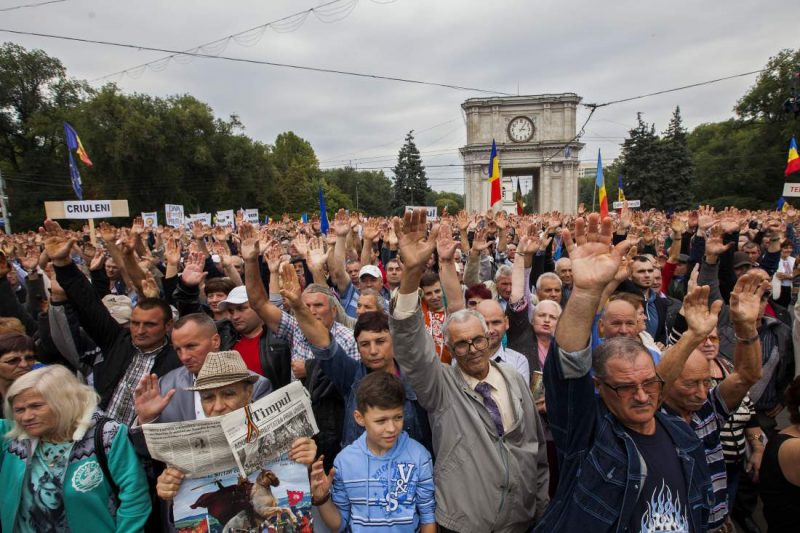
Pic of recent massive demonstration outside Moldovan Parliament.

This story might appear obscure but it reflects a bigger issue - about how Russian revanchism is reported back through democratic Europe's free media.  The issues it describes have also often been the story in Ukraine. How solid, liberal ideas like 'balance' and reporting 'both sides' can become a failure to tell the truth. How inserted reporters don't pay attention to the locals. How the messy 'European ideal' needs much closer reporting if we're to truly live up to any democratic ideal.

In the 1959 British comedy The Mouse That Roared a tiny, obscure European country ends up through comedic slight-of-hand being feted by both sides in the Cold War. In comedy, it showed how much of Europe is to the British 'Ruritania', an inexplicable country whose peoples and cultures all mess into one. As the article explains this approach lives on with today's lens of geo-politics and ideas of 'colour revolution' (via Russian infowar) muddying the coverage yet more.

Reblogged with permission from Open Democracy Russia.

====

By Mihai Popșoi  
 
There’s more to Moldova's protests than “pro-European” versus “pro-Russian”.

Moldova’s image as the poorest country in Europe is rivaled only by its obscurity. In rare outbursts of international media coverage — often related to human trafficking, arms smuggling or mass protests — Moldova is depicted as a pawn on the regional chessboard, caught in a tug of war between Russia and the west. There is no denying that, in a world of realpolitik, Moldova is indeed a playground.

Yet there is more to this intellectual inertia than meets the eye. The sheer lack of nuance and insight displayed by the international media with regards to the latest developments in Moldova is as disappointing as it is predictable. 
Much in the way of confirmation bias is at work here — the tendency to search for or interpret information in a way that confirms one's preconceptions. People are usually unwilling and, at times, admittedly unable to comprehend complex phenomena, especially when simple mental shortcuts are readily available.

Professional journalists and political analysts pride themselves on preventing or minimising the influence of such biases on their work. This is easier said than done, particularly in today’s world of ubiquitous geopolitical expediency. Moldova is a case in point.

Perils of European integration


Since the so-called ‘Twitter Revolution’ of 2009, Moldova has embarked on a path of economic transformation and political democratisation — or so everyone thought. The post-revolutionary government took on a rather inspirational name, the Alliance for European Integration, which proved to be both a blessing and a curse.

Generous western financial assistance and political support locked the United States and European Union into the costly self-fulfilling prophecy of a ‘success story’. But the success failed to materialise, despite promising beginnings. Five pro-European governments succeeded each other faster than the public could keep up with, and they spared no effort in building an elaborate discourse of European integration both at home and abroad. One could not help but be mesmerised by the audacity of Moldova’s leadership that promised to bring the country into the EU by 2020.


Over 100,000 protesters took to the streets of Moldova's capital in September 2015 to protest the ‘stolen billion’. Photo courtesy of Maria Levcenco.

Naturally, high hopes developed among more gullible Moldovans and international development partners alike. But the signs of trouble appeared early on.

As early as 2011, there have been hostile takeovers of privately held shares in several leading banks, known as the raider attacks. Then came the infamous ‘Huntigate’ scandal of 2013 — a cover-up of a fatal accident during a lavish hunting spree attended by the top brass of the country’s judiciary, including the Prosecutor General. Finally, ‘the billion dollar bank heist’ left the country perplexed as to how one could steal the equivalent of 15 percent of GDP from three banks with impunity.

Once a poster child of Moldova’s European Integration, Vlad Filat, former prime minister and Leader of the Liberal Democratic Party, ended up a scapegoat for the missing billion. Meanwhile, Filat’s archenemy the oligarch and senior vice president of the Democratic Party, Vlad Plahotniuc, became the sole decision maker in the country.

By hook or by crook, Plahotniuc was able to create a majority coalition (which oddly bears no name). It was rushed to a vote in parliament as protesters gathered outside and soon started demanding early elections. This clearly begs the question: how can international media refer to the current reincarnation of previous governments as pro-European?

Monstrous coalition


Reports from Euronews, BBC, New York Times as well as Russia Today all described the new government as ‘pro-European’ — much to the bewilderment of Moldovan civil society. In a very heartfelt piece on his personal page, Dumitru Alaiba, a former economic and financial advisor to two prime ministers, urged international media and western politicians: “Do what you must, just don’t call this government ‘pro-European’. It is not Europe that they represent. And don’t call us, the people, pro-Russian either.”

Well-respected media institutions used a default template for covering Moldova, relying mainly on the fact that the new government presented itself as pro-European. A more astute analysis would indicate that the new government is ‘pro-European’ in name only.

After numerous Moldovan activists wrote public letters calling upon western media to take a more mindful view of the ongoing protests, a change of tone occurred. There is now a broad acknowledgement that protesters were, and are, a distinctly heterogeneous group.

Admittedly, many of them are pro-Russian, yet a lot are as pro-European as they come. What unites them all is a genuine frustration with an ad-hoc “monstrous coalition” government and a desire for a more democratic and prosperous future.

This is largely missing from the international media discourse, caught in the cross fire between Russia and the west. Russia has capitalised on the growing anti-European sentiment in Moldova, and by supporting these ruling elites, western media and western politicians have only vindicated Kremlin’s propaganda.

Another piece of the puzzle


Russia’s postimperial syndrome is built on the belief that the west is containing its resurgence by creating a belt of instability in south-east Europe — a mantra that rarely departs from Russian TV screens. Moldova is seen as just another piece of the puzzle.

Moscow has a clear agenda of trying to bring Moldova back into its orbit and does not shy away from making its intentions known either.

For instance, in the aftermath of the 2010 parliamentary elections, Sergei Naryshkin, head of the Russian presidential administration, attempted to broker a coalition deal between the Communists and the Democrats. In the 2014 campaign, Russia openly supported the Socialist Party.

Russian media, which still holds a lot of sway over Moldovan public opinion, has been an indispensable tool in this process. Interestingly though, the rebroadcasting rights in Moldova for the most popular Russian federal TV channels are owned by so called ‘pro-European’ politicians, primarily Vlad Plahotniuc. He owns, among a few others, the Moldovan license for Russia’s flagship Channel One. Russian media coverage of protests in Moldova paints the EU in a negative tone, while reinforcing the message of Eurasian Economic Union as a better alternative. The aim of these reports may be as much to appeal Russia's domestic audience as it is to influence public perceptions in Moldova.
This sort of nuance is helpful in understanding the complexity of the Moldovan political landscape, which cannot be reduced to a mere east-west dichotomy.

The same is true for the protest movement. Many things that politicians had kept to themselves, such as allegations of blackmail and corruption, came to light only after mass protests erupted. However, for a long time, protesters could not set their differences aside in order to pursue a common goal: early elections.

Even when they finally did, the much heralded unity of protesters across ethnic, linguistic, ideological and party lines proved too good to be true. The nascent movement is constantly being undermined by infighting.

Besides, there have always been doubts about the independence of such political players as the socialist leader Igor Dodon, Our Party head Renato Usatii, and front man of the civic platform turned political party, Andrei Năstase. Hence, the real tragedy is that genuine popular protests are led by less than candid individuals.

Bridging the divide


Instead of helping to bridge this divide, both media and politicians have contributed to the increased polarisation of public opinion by presenting just one side of the debate, reinforcing the ever-present confirmation bias.

This development is particularly visible when it comes to Romanian or Russian news reports, as well as political commentary on developments in Moldova. Self-proclaimed leader of the Moldovan diaspora in Russia, Aleksandr Kalinin, posted a Facebook video calling upon Vladimir Putin to come and rescue the Moldovans from what he saw as an imminent takeover by Romanian and Ukrainian special forces.
The response came in a leading Romanian newspaper from none other than a prominent Romanian analyst and former adviser to Romanian president Traian Băsescu, Iulian Chifu, who called the video an “official request” to Putin. To his credit, Chifu went on to debunk Kalinin’s bogus allegations, but the latter was afforded much more attention than he deserved even in the aftermath of Crimea and Donbas.

The EU's former enlargement commissioner Štefan Füle is perfectly right when he says that: “We should be more active in addressing [pro-Russian] propaganda about what the Eurasian Economic Union offers versus what the EU offers a country like Moldova.”

Undeniably, Russian media will continue to produce characteristically biased reports about Moldova, but if western media want to have any claim to a higher moral ground they have to give up using simple shortcuts and produce accurate accounts no matter how tedious or inconvenient that may be.

Max Seddon’s recent article in the Financial Times, for example, does just that. He reports that “In private, some European diplomats say they would welcome a pro-Russian government — if only so that the current coalition cannot further tarnish the EU. Says one: ‘Asking them to do reforms is like asking turkeys to prepare Christmas dinner.’” 


Who are the pro-Europeans now?


No matter how ironic it may sound, a pro-Russian government is likely to be the only thing that can rehabilitate the European Union’s image in Moldova. The risks of a new government changing Moldova’s foreign policy course are minimal: it would be economically irrational and politically suicidal, since most of the burden of adjusting to the new EU-Moldova Association Agreement has been incurred, while the benefits are only kicking in. 


The new government cannot be called pro-European and, to its credit, it does not use the term. The coalition that Plahotniuc has put together literally has no name nor a coalition agreement. It relies on the program of the previous government despite being a “coalition of the willing”. Namely, the will of the 57 lawmakers being to preclude early elections and stay in power for another three years despite the sheer collapse of public trust after the infamous bank heist and the utter refusal to accept any blame either by the government or the parliament.

Moldova is a case study for state capture, though perhaps had Moldova been an EU candidate country, things would have been different via conditionality. The West has sacrificed democracy for geopolitical interests, which is usually a recipe for disaster down the road.

The sole threat of an imminent pro-Russian government is likely to galvanise and reboot the political system, albeit incrementally, with a new breed of upstanding young professionals exiting their comfort zones and entering the public domain to the benefit of their communities and their country — the alternative being a drift away from the values of democracy and the rule of law, all under the watchful eye of the international media.


See also:

Friday, 12 February 2016

Russia in Crisis: the Agonies of the Oil Empire

Small business desperate to stop its demolition by Moscow City government display a Putin portrait


Reblogged with permission from LeftEast. Translated from the Russian by Emma Clair Foley.

Author Ilya Budraitskis is a historian, cultural and political activist. Since 2009 he is Ph.D. student at the Institute for World History, Russian Academy of Science, Moscow. In 2001-2004 he organized Russian activists in mobilizations against the G8, in European and World Social Forums. Since 2011 he has been an activist and spokesperson for Russian Socialist Movement. Member of Editorial board of “Moscow Art Magazine”. Regular contributor to the number of political and cultural websites.

=====

Everyone understands that the coming year will see Russia immersed in an economic crisis, one which will almost inevitably entail a social and political crisis. It was already over a year ago that Vladimir Putin, while taking part in his favorite genre of television, “direct association with the people,” assured viewers that the crisis was a matter of temporary difficulties which would be successfully overcome within a year or two. These assertions are not simply a propagandist’s device, but a reflection of deeply-rooted elements of the consciousness of Russia’s ruling elite, accustomed as they are to switching out strategy for tactics and reacting to challenges as they arise. This consciousness is the result of an unbroken decade of increase in oil prices during which the entire domestic economy was tightly bound to the export of natural resources.

The windfall from oil sales both created the sense that Russia’s foreign policy muscle was strengthening and guaranteed a constant rise in state spending. The army, the bureaucratic apparatus and the murky system of government procurements received the bulk of this beneficence. Nevertheless, the growth in spending in the social sphere was seen as more of a residual effect, and education and medicine have always been regarded as the first things to sacrifice when money is short.

The years of oil prosperity fostered the growth of an ugly social model in which the inflation of energy resource prices on speculation compensated for the decline of production, a phenomenal level of social inequality, corruption, and increasingly systemic authoritarian political power protecting the interests of the elite. Vladimir Putin’s popularity rested (and, for now, still rests) on this uncertain foundation. Key to this popularity was the widespread notion that because of his ruthlessness, Putin is the one person who is capable of guaranteeing “stability,” an enduring trajectory of national growth protected from any risk of shake-ups.

Protesting lorry drivers hope for some words from the Tsar
The most valuable insight here for the majority of Russia’s residents is that “Putinist stability” is now most definitely a thing of the past, and that the Russian elite has no backup plan for redeeming the situation. By last year it had already become clear that the government’s anti-crisis politics boils down to a local variety of austerity outdoing even the current politics of EU governments in its ruthlessness. It consists of sharply reduced social spending, forced pension reform (a proposed increase in the retirement age to 65), the refusal on principle to index salaries to the rate of inflation (12.9% last year) and more taxes and fees collected from the population. The weakening of the ruble, restrained with the help of currency reserves introduced onto the market and increased interests rates at the Central Bank, made loans inaccessible to small- and medium-sized business and contributed further to the economy’s collapse.

The state budget for 2016, in accordance with this crisis, is based on calculation that set the median price of oil at $50 a barrel, but it has already fallen below $30. Although the government has not yet publicly considered revising it, the Minister of Finance has already recommended that all other departments reduce spending by 10%.

The situation is exacerbated by the current system of revenue distribution between Moscow and the regions, in which all revenue becomes part of the federal budget, only then to be recounted into local budgets. The result is a growing tension between the government and regional authorities, who must bear responsibility for these “austerity measures” before the people. At the same time, in an effort to maintain his popularity, the president publicly demands from them demonstrations of “social commitment,” putting them in an impossible situation.

The sharp decline in government revenues exposes the vulnerability of Putin’s “power verticals,” that is, the complete political dependence of local powers on the center combined with their economic “autonomy” (that is, responsibility for fulfilling budget responsibilities). The political losses incurred from austerity must be shouldered by the federal government headed by Dmitri Medvedev or local governors—anyone but the president, whose popularity should not under any circumstance suffer as a result of a reduction in the quality of life of the people who support him.

The figure of Putin as a “national leader” is the main basis of legitimacy for those in power in the eyes of the majority. The irony of the situation lies in the fact that people trust their president, but they don’t trust the state he represents. In these catastrophic conditions the Putin political machine is preparing for parliamentary elections, which are set to take place in September 2016. Like all previous elections, they will have to conform to the script written by the Kremlin. It currently appears to name “United Russia” as the majority in Parliament, while casting Medvedev as the victim of growing passive dissatisfaction. The “independent” candidates, as well as the kept opposition (including the communists and Zhirinovsky’s party) will attack the government for its antisocial austerity measures, but the president will remain beyond the reach of critics.

This guiding script may get out of control and provoke a wave of public disturbances (as happened in December 2011, after the previous parliamentary elections). The principal difference today may turn out to be the combination of political protests against an antidemocratic system and social protests against poverty and the government’s neoliberal policies. 2015 saw a serious uptick in local protests in connection with delays in the disbursement of salaries, job cuts and unnecessary new taxes. In December demonstrations by truck drivers indignant at new, extremely high road tolls took place in nearly half of all regions of the country. In some cities, there were protest actions against harsh limitations placed on state medical coverage. On the whole, experts estimate that there have been 409 protests in the past year linked to the violation of workers’ rights (168 of which took the form of work stoppages). That’s 76% more than the average for the period 2008-2013.

The economic crisis along with the regular political cycle (parliamentary elections in 2016 and presidential elections in 2018), will unavoidably provoke and strengthen divisions within the elite. The possible battle lines can already be faintly seen: between Moscow and regional powers; between government finance experts and army lobbyists, who will insist on an increase in the defense budget in the face of “external threat,” and among state corporations, demanding all new subsidies from the state budget to finance their huge debts.

In the attempt to maintain the existing balance of forces, the regime must revisit their foreign policy of the past two years, including the war that is still dragging on in Ukraine, conflict with the west and the developing military engagement in Syria. Moscow is already taking active steps toward the removal of US and EU sanctions. For the first time since the moment that Russia annexed Crimea, direct negotiations over the fate of Donbas began in Kiev in between Ukrainian president Poroshenko and Russian representative Boris Gryzlov (a member of Putin’s inner circle of “friends”). This meeting was followed by an hours-long consultation between the Kremlin’s main “facilitator” of Ukrainian affairs and Assistant US Secretary of State Victoria Nuland. The repeal of the sanctions is necessary for the Russian government, among other reasons to enable large-scale foreign loans to augment depleted national financial resources. Dependence on oil prices could soon be completely replaced by another dependency—this time on international creditors.

All of this means that Russia is on the threshold of serious changes, which in the short term indicate an end to “Putinism” as a system—at least as we have known it during these “fat” years.

See also:


Sunday, 6 September 2015

Putin fans in love with a myth


Crosspost from Little Green Footballs:
Just as Western communists used to espouse not the real situation in the USSR but the myth of the USSR in the past, there also exists a myth about Putin. Unlike fairly solid communist mythology, this myth is eclectic: strength; efficiency; economic success; the fight against evil - from terrorism to ‘oligarchy’. And mutually exclusive arguments circulate depending on the sector of agitation.

Let us take a walk through this mythology: ‘from right to left’. Thus, according to the ‘right-wing myth’ about Putin (the myth favored by those who think more about economics and those, first and foremost, in favor of ‘traditional values’ and who are anti-migration) which is quite well represented in the famous manifesto of terrorist Anders Breivik or the statements of Ron Paul, or the former US Republican, TV presenter and now outcast Patrick Buchanan who considers Putin to be ‘one of us’, Putin appears to be a classic conservative who introduced low taxes in Russia, a supporter of family values and an opponent of the migration of alien culture. In fact, if we look at the classic research: Paying taxes (see page 155 and below), we can see that tax rates in the RF are higher than the global average and are even higher than in the USA and many European countries (48,1% compared to a mean of 40% globally; to compare: 44% in the USA, 21% in Canada, 34% in the UK, 29% in Switzerland, 48% in Germany, too, and even ‘socialist Sweden’ has a rate which is only 0.5% higher - 49,4%).

Labor costs are very high in Russia - in fact, apart from the income tax of 13% one should also include welfare contributions of 30% (some enjoy allowances on welfare contributions and that is why the total labor tax rate is estimated at the level of 36% and not 43%). That being said, in contrast to developed countries, there are almost no tax deductibles in the RF and it is not a family but rather a natural person of legal age which is a taxable entity. As a result, the effective tax rate is several times higher when compared to let’s say the USA or UK. The RF is the only one of the emerging economies to have a visa-free regime with underdeveloped Muslim countries of Central Asia. That is why in the RF approximately 9-10 million migrants are only ‘legally present’: about 10 % of Russia’s adult population and an even higher proportion of the able-bodied population. Due to the visa-free regime, a huge number of migrants can enter the territory and reside there illegally. One of the closest associates of Putin’s, Ramzan Kadyrov, organized a mass rally in support of the Islamic terrorists who killed journalists in France while Foreign Minister Lavrov participated in a mourning procession in their memory. As for the number of abortions, twice as many are carried out in the RF as in the USA, one-and-a-half times more than the most disadvantaged countries in Europe and over three-times more than in the prosperous ones. The homicide rate in the RF amounts to approximately 10 per 100 thousand citizens, which is twice as high as in the USA and eight-ten times higher than in the European countries.
More (including the myths lefties buy into): Putintern: A View From Russia

Tuesday, 23 April 2013

World Bank examining LGBT poverty globally


LGBT people in the West have an image of being a comparatively well-off group. Since the early 1990s, LGBT media and marketeers have promoted dubiously sourced statistics on supposed average earnings and created the idea of the 'Pink Pound/Dollar'.

Here's a recent corporate example promoted unquestioningly by Queerty: ' SURVEY: The Gays Earn More Money, Have Less Debt Than Average Americans.'

This idea has then been used by the opponents of LGBT rights, including in court cases, to portray LGBT people as a privileged and powerful group. It has "great long term costs", wrote the great Australian activist Rodney Croome back in 1996:
One cost is the way the anti-gay movement uses our claim to consumer power to portray us as greedy whingers. The hate rhetoric, designed so well to tap into lower middle class and blue collar economic insecurity, goes something like "they've got the jobs, they own the businessess, they've got all the money and they still want more". Another cost is when funding bodies use our supposed disposables as an excuse to leave us out in the cold. One of the chief reasons given by Tasmanian Legal Aid for refusing to help fund our current High Court appeal was that the gay and lesbian community is rich enough to pay for its own litigation. But worse of all, is the way the pink dollar has obscured lesbian and gay poverty leaving economically disadvantaged gays and lesbians a hidden and voiceless minority.
Actual studies of economic well-being for LGBT people are rare. It is hard to study a group of people whose boundaries are fuzzy and where many of its members are pretty invisible and practically no one has even tried.

Croome quotes an Irish study from 1995 which found poverty rates double that of the general population. It's not hard to imagine why this might be. Studies of homeless youth in the US has found very high numbers are LGBT. 320,000 to 400,000 is a conservative estimate of the number of American gay and transgender youth facing homelessness each year. Discrimination, job segregation, and subsequent issues like higher rates of drugs and alcohol abuse might have something to do with higher poverty rates. As might other health issues.

"The majority of people with HIV and AIDS in San Francisco are living in extreme poverty," says Brian Bassinger, executive director of the San Francisco AIDS Housing Coalition:
There's this mythology that gay men are wealthy. The reality is that gay men living in poverty are twice the national average. We are poor. And poor people see marriage equality as a middle class and upper class issue.
Bassinger's clients, and those of LGBT homeless charities in cities like New York, are struggling for attention and support.

A 2009 University of California study of same-sex families -- reputedly a first -- found extremely high poverty rates in sub-groups like rural couples and African-American couples. But it also found that white urban gay couples had poverty rates similar to the general population. Perhaps this explains why certain LGBT issues have prominence and financial support and others less so?

Global LGBT poverty

As in Western countries, in the so-called 'Global South' LGBT people also suffer discrimination and marginalisation and hence higher poverty rates.

Albert Ogle reports on a new survey of almost 6,000 men who have sex with men (MSM) from 165 countries by MSM Global Forum.
20% of younger MSM surveyed had no income and 30% had no stable housing, which have both been linked to greater HIV vulnerability and reduced access to HIV services. Compared to older MSM in the 2012 GMHR sample, younger MSM experienced significantly higher levels of homophobia and violence. Among all MSM surveyed, homophobia was significantly associated with reduced access to condoms, lubricants, HIV testing and HIV treatment.

“This data shines light on our collective failure to ensure that YMSM have the resources they need to keep themselves healthy,” said Dr. George Ayala, executive director of MSM Global Forum. “Moreover, it is a powerful reminder that HIV among MSM is an international development issue, inextricably linked with housing, health, education, and security. Donors and policy makers must treat HIV among MSM of all ages with the same level of urgency afforded to other international development priorities, and they must take concrete steps to ensure that the unique needs of YMSM are accounted for.”
Ogle just attended a first, a meeting at the World Bank featuring international gay activists. It included Victor Mukasa, who founded the rights organisation Sexual Minorities Uganda (SMUG) but has been forced to claim asylum in the US. A charity which Ogle in involved with, he writes, supports HIV testing for Ugandan gay men who are simply denied health services elsewhere -- services which are often funded by foreign governments and international bodies.

Meetings such as this one as well as the efforts of bodies such as MSM Global Forum and the pressure of activists on bodies such as USAID are beginning to change the approach of funders on discrimination such as that seen in Uganda. Writes Ogle:
Every institution from the family, the church, the World Bank and governments are failing the LGBT community right now. The presence of this panel was seen as a positive step to begin to address the appalling neglect of this community in heath, education and employment opportunities.
And Ogle reports that the World Bank is funding a ground breaking study on the 'economic impact of homophobia globally', to be published later this year.

The Bank is a controversial partner for any civil rights movement or for those promoting health, given its history. But given the paucity of basic research on LGBT poverty this study has to be welcomed.

Whether such a study can get any resonance in the international LGBT movement or the media is another matter.
Enhanced by Zemanta

Wednesday, 23 September 2009

PayPal still thinks Africa is the 'dark continent'

PayPal Inc.Image via Wikipedia

I just got an email from a friend in Austria. Inspired by a post on LGBT Asylum News he wanted to make a donation to the Sex Workers Outreach Program (SWOP) in Nairobi.
The people there are wonderful, and intelligent, and courageous and open-minded people indeed, and they deserve our help and solidarity. Tears are forming in my eyes when thinking of the women and men with HIV infection and AIDS living in poverty there.


But my friend found out that whilst sending money via PayPal is possible for people in Kenya receiving money is not.

When he contacted PayPal customer services by email they claimed that receiving money is not allowed by the legislation of Kenya. Yet he was able to send the money to Kenya via Western Union — for the transmission of Euro 100 he had to pay a fee of Euro 17,50 which is far higher than PayPal's charges.

Jonathan Gosier, a software developer, writer and social entrepreneur, explains on appafrica how:
PayPal, intentional or not, are sending a very strong message to the rest of the world about Africa.
Prior to moving to Uganda, Gosier had used PayPal for four years and estimates that he's transferred over $100,000 during that time

Bu this counted for nothing once he'd moved to 'the dark continent'.
Apparently PayPal’s way of ‘policing’ their service is to simply flag various IP addresses as being ’suspect’ . hrmm. I have a few Iranian and Indian friends who could tell you a bit about what it’s like to get profiled based on where you appear to be from. (And if they won’t suffice as anecdotal evidence, I’ve got a few million mexican and black american friends who’d double down on the sentiment.)

So Africa remains a high-risk zone as the sheer number of comments like these from paypal users indicates:

I am in the process of trying to sell a laptop. i have posted ads on comtrader and ebay. So far the item has been bought off ebay by a mother who wants its for a present for her daughter in AFRICA. Two people have expressed interest through comtrader, one wishes to buy it for a business associate in AFRICA, and the other wants it for himself, and guess where he lives….. AFRICA. Sorry for all the capitals, but am i missing something here. I’ve replied to the ebay purchaser who is going to pay through Paypal, which i know is covered by ebay so i feel safest. Just wondering if this obsession with me posting it to AFRICA is anything i should be sketchy about.

Or this person’s thoughtful reply:

Anything from africa is a scam so stay well clear. Re-list the item if you have too.

Wow. Anything from Africa is a scam. I better take back this computer I just bought from GAME!

The unintentional effect here is that by blanketing the whole region as suspect, it reduces the number of viable alternatives for legitimate businesses and professionals who want to use services like PayPal for trade. I use PayPal for some of my payroll now (for people who don’t live near me). However, whenever I do, PayPal flags my account and shuts it down temporarily ‘because I accessed it from a suspicious location’. To unlock it I have to call them, from Uganda and do a bunch of other stuff that’s inconvenient. I suppose this is the price of admission for using the service in country it wasn’t intended to be used in. So no complaint here either.

But what it does mean, is that from every angle legitimate African businesses are smacked in the face by measures put in place to police the one’s that are indeed abusing the system. But this affects even expatriates and NGOs that might want to use the service. If it’s accessed from a certain IP there’s a red flag, especially if that IP is not where you registered to use the service.
Once again, the message perpetuated here is to be cautious when dealing with Africans, Africa or anything you suspect of being related to the aformentioned. This is nothing new. Most people here have been dealing with such mentality their whole lives, why would it stop now that the medium has changed? To be fair, there’s truth to this stereotype. There is indeed a huge problem of scams here. There is some truth to most stereotypes, the word itself simply implies that those truths are applied where they don’t necessarily belong.

Unfortunately, there are a lot of people here who are just like consumers everywhere else in the world. They want to buy things, they want the conveniences of online shopping, they want to do business…and they want their neighbors to stop scamming you so they can have those things.
I realize that the problem can’t be solved entirely by Paypal alone but I would appreciate at least an option to flag my account in advance for what might be mistaken for ’suspicious activity’. I’d be happy to leave this to PayPal’s discretion but my problem is they aren’t using any. African transaction? Banned! Banks will allow customers to indicate that they will be abroad for a certain period so that they don’t shutdown accounts by mistake. Why doesn’t PayPal? You’d be surprised at how damaging these blanket policies can be to an organization like mine that simply just wants to pay employees and be paid by clients.

I suppose the complaint is that PayPal doesn’t give me an option to avoid my account getting bricked. It costs me money everytime they do it. they give me no alternative to prevent it from happening and when I talk to them, somehow it’s my fault for existing ‘in that country where The Last King of Scotland took place‘.
My Austrian friend says:
To me this is a kind of discrimination, and neo-colonialism, and racism towards African people, and it reminds me of the inhuman politics of the pharmaceutical industries not to reduce their prices for medicaments for HIV and AIDS in poor countries, but to accept the death of lots of people who could not afford these high prices. If you are living in a rich country of the European Union you survive, if you are a poor woman and a poor man in Africa you die. We must not accept it!
I thought of his experience and Gosier's whilst reading about the coming of broadband to East Africa (which includes Uganda) via the BBC's excellent series of reports.

This did warn of and catalogue the whole raft of other challenges to Africans other than the lack of broadband, which puts its arrival in context, but they missed this one.

Theresa Carpenter Sondjo notes that there are alternatives for African entrepeneurs to PayPal, however they are all more "more expensive and less flexible". That seems to be a running theme for Africa - lots of stuff to build a business is way more expensive, Africans have a stack of hurdles to jump over.

Maybe Oxfam, Mr Bono and Mr Geldof should get onto this one and start shaming PayPal?

Reblog this post [with Zemanta]

Monday, 8 June 2009

Socially responsible outsourcing

15 million Africans ready for work. Got tasks?

I posted recently about mobile developments in Africa and how they are being used in a number of imaginative ways - many of which which we're yet to see in the 'West'!

As well as being used to organise day labour they're also used by people to do small jobs such as translations. In Kenya, with its many languages, this is how help resources for mobile companies' customer services are being built - word-by-word

Nokia being used for translation job

Samasource is a fantastic new San Francisco non-profit that partners with small, talented, tech companies and nonprofit training centers in poor and rural communities (currently Kenya, Cameroon, Uganda, rural India, and Nepal) to find them clients.

It derives its name from the word sama, Sanskrit for “equal”.

Their partners must meet stringent social impact criteria - fewer than 20% of applicant firms are selected - and they specialize in services ranging from data entry to advanced software and website development.

It's about giving work, not aid to people in the world's poorest countries.


Here's a profile of Ann Wangui, a graduate with honors from Nairobi's Methodist University. She is an example of the sort of person who is struggling to find a job in Nairobi despite her qualifications and who Samasource aims to help.


This is certainly a much better approach than the one being adopted by the world's large tech companies. Erik Hersman recently posted Microsoft vs the Open Source Community in Africa.

If Microsoft developer communities do emerge in Africa, Erik writes, even with the massive hurdle of paying for expensive access to developer tools, "we’re still left with what one person wrote: …they will be formed from programmers who are completely dependent on American software for the livelihood: it’s neo-colonialism, pure and simple."
In Africa organizations have a lot of hurdles to overcome, not least of which is the straight cost of doing business. Where it might be simple for some organizations in the US and Europe to wave off a couple thousand dollars worth of licensing fees, the same is not true in Africa. The margins are lower, so every cent counts.

In a region where cost is so important, it’s amazing then that the most lucrative deals go to the Western organizations that have high costs for ownership and maintenance. These outside organizations use backdoor methods to gain contracts where in-country options are available, usually with less expense and with greater local support.
Hersman also reports that Microsoft are trying to muscle in on the African-developed Ushahidi crisis reporting social software with a new product called Vine. He says "if they really are about creating emergency and disaster software for use by normal people, then I would encourage them to not charge for it and to make it as open as possible for others to work with it."

Fat chance, I suspect.

HT: Owen Barder
Reblog this post [with Zemanta]

Friday, 22 May 2009

Today I will be mainly feeling anger


My oldest mate's marketing company has just gone under after eighteen very successful years.

It wasn't killed by the recession, as this report says, or by losing business from playstation, but by the banks.

About six weeks ago, with no warning, their bank cut their overdraft down to 10% of what it was. They couldn't get any credit from anywhere else, not from any other lender and there is nothing either local or national government had set up to help small businesses like theirs.

And they had business. Despite reports of major cuts in marketing budgets they had been gaining clients (it was a youth specialist, one of the first to be set up).

So twenty jobs have gone entirely because of the bank's malfeasance and with no help whatsoever from a government which bails out banks and has yet to prosecute any of the criminals in them but has done nothing for thriving small business hit by a credit crunch their billions is alleged to be helping end.

This makes me extremely angry, especially as he has weathered a series of major hits, including a huge fraud against him, the sorts of ups and downs that end many small businesses, and come out stronger through sheer hard work and bravado. He deserves better.

It really is time a few of those b(w)ankers were strung up as an example to others.

Tuesday, 24 March 2009

Credit crunch as transmissible disease


Rolling Stone has an absolutely brilliant piece on what they call Wall St's 'coup d'etat', which I can't recommend enough as a primer on the credit crunch.

It names the meltdown's 'patient zero' (think 'typhoid Mary') as one Joseph Cassano of AIG. He operated out of - wait for it - London! And was enabled by weak UK/EU regulation.

Seriously, a must read,

Saturday, 14 March 2009

Jon Stewart is god

Paxman? Pweergh ...

Background:
A war between basic cable personalities has broken out between financial channel CNBC's Jim Cramer and Comedy Central's Jon Stewart.

The skirmish started on 4 March when the Daily Show's Jon Stewart rallied against CNBC for its poor advice to viewers. Part of Stewart's segment included a clip of Mad Money host Jim Cramer making a rosy prediction about Bear Stearns just before the investment bank failed.

Cramer complained Stewart's use of the clip was unfair and and taken out of context. Stewart responded by revealing previous footage of Cramer pumping up Bear Stearns.

The next day, Cramer blasted Stewart on NBC's Today Show and scoffed at Stewart saying the comedian hosts "a variety show". Later, Cramer appeared on MSNBC's Morning Joe where host Joe Scarborough called Stewart out for cherry picking clips to amuse the Daily Show's audience at the expense of Cramer and others. Stewart said Scarborough was not quite correct in his assessment of the Daily Show saying he is more in the business of "turd binding".

The next round of the fight continues tonight at 11pm ET when the Mad Money host will appear with Stewart on the Daily Show Will the basic cable hosts play nice or will they lock horns in an epic duel?
Oh, he 'played nice'! This interview is being hailed stateside as worthy of Edward R. Murrow. WhiteHouse press secretary Robert Gibbs even praised it. So it has exposed the US MSM (which, I would add, the BBC relies on as a journalistic source for the US 'news' they bring you license-fee payers) to justified, scaring criticism.


Monday, 12 January 2009

Corporate socialism

Remember that $700 billion corporate bailout? Seems that, A/ no one's accounting for it - no one - and B/ it's being spent to do stuff like boost market position. And the auto industry bailout? The fine print forbids strikes.

This - Bush's legacy - is entirely the source for the global economic crisis and begs a lot of questions about how the UK bailout is being spent.

Rachel Maddow interviewing David Cay Johnston,
"Ninety percent of American's incomes today are smaller than they were in 1973."

"Nothing is being done today, with the initial bailout money, to affect foreclosures. That's what congress said should be done with the money, but that has not been done. The foreclosure crisis is affecting everyone's home value and is at the center of this economic crisis."