I have been following African tech development for years. Many in the West will be unaware that in many areas they are way in advance.
In Nairobi hundreds of buses have Wi-Fi - unlike in New York or London. Africans have been able to use mobile phones to make payments and transfer money for years.
The open source project Ushahidi, which allows users to crowdsource crisis information and began during the disastrous 2007 Kenyan elections, is now used worldwide.
So it does not surprise me that an African has done this:
Kodjo Afate Gnikou has imagination, talent and ambition.
Using rails and belts from old scanners, the case of a discarded desktop computer and even bits of a diskette drive, he has created what is believed to be the first 3D printer made from e-waste.
It has taken him several months to put together his experimental device. Lifting designs off a computer, the 3D printer produces physical objects. He shows us by “printing” a small round container.
And it doesn’t stop there – the 33-year old says he believes this model is only the prototype for something much larger. His aim is to one day transport e-waste to Mars to create homes for mankind.
“My dream is to give young people hope and to show that Africa, too, has its place on the global market when it comes to technology. We are able to create things. Why is Africa always lagging behind when it comes to technology?”, he asks.
Some elements had to be bought new but, in all, his printer cost him 100 US dollars to build.
Gnikou says his printer can also be useful on a daily basis as it can print various utensils needed in any household, that are not always easy to get hold of.
The immensely influential Arianna Huffington has decided to launch her own version of the 12 year old Webbys Awards (which are kindof like the web's answer to the Oscars, complete with star-studded red carpet).
The HuffPost Game Changers awards [are] to honor and celebrate 100 people who are using new media to reshape their fields and change the world.
Note the use of 'world'. Unfortunately and predictably it's extremely likely that, like the Webby awards, they're unlikely to feature many non-Americans in the eventual nominations.
But at least they're free to enter, you just add a comment to her post. So these are the ones which sprung off the top of my head (I know I've forgotten some) and I'd encourage readers to go there, add some more and get some US attention (and possible support) for some amazing non-American 'game-changers'.
The Iranian blog/twit-osphere - it seems a bit churlish to single out one person, although this may make it harder to pick.
MySociety - the UK geeks who, before anyone else in the world (yep!), have been liberating data from government, mashing it up and making it available to the public. Their work has inspired gov geeks around the world, including the US.
Ushahidi - an amazing African work, set up to monitor Kenyan post-election violence and now monitoring elections around the world (more).
Global Voices - an amazing site which brings together bloggers from every corner of the globe.
Committee Addiopizzo - young Sicilians using the web to fight the paying of 'pizzo' (extortion) to the mafia (more)
And some Americans:
Samasource - who team with tekkies in the third world doing socially responsible outsourcing using the rapidly expanding cell phone networks (more on this here)
I posted recently about mobile developments in Africa and how they are being used in a number of imaginative ways - many of which which we're yet to see in the 'West'!
As well as being used to organise day labour they're also used by people to do small jobs such as translations. In Kenya, with its many languages, this is how help resources for mobile companies' customer services are being built - word-by-word
It derives its name from the word sama, Sanskrit for “equal”.
Their partners must meet stringent social impact criteria - fewer than 20% of applicant firms are selected - and they specialize in services ranging from data entry to advanced software and website development.
It's about giving work, not aid to people in the world's poorest countries.
Here's a profile of Ann Wangui, a graduate with honors from Nairobi's Methodist University. She is an example of the sort of person who is struggling to find a job in Nairobi despite her qualifications and who Samasource aims to help.
If Microsoft developer communities do emerge in Africa, Erik writes, even with the massive hurdle of paying for expensive access to developer tools, "we’re still left with what one person wrote: …they will be formed from programmers who are completely dependent on American software for the livelihood: it’s neo-colonialism, pure and simple."
In Africa organizations have a lot of hurdles to overcome, not least of which is the straight cost of doing business. Where it might be simple for some organizations in the US and Europe to wave off a couple thousand dollars worth of licensing fees, the same is not true in Africa. The margins are lower, so every cent counts.
In a region where cost is so important, it’s amazing then that the most lucrative deals go to the Western organizations that have high costs for ownership and maintenance. These outside organizations use backdoor methods to gain contracts where in-country options are available, usually with less expense and with greater local support.
Hersman also reports that Microsoft are trying to muscle in on the African-developed Ushahidi crisis reporting social software with a new product called Vine. He says "if they really are about creating emergency and disaster software for use by normal people, then I would encourage them to not charge for it and to make it as open as possible for others to work with it."
The aim of Ushahidi is to create a platform that any person or organization can use to set up his or her own platform for collecting and visualizing information. They explain that, ‘the core Ushahidi platform allows for a plug-in and extensions that can be customized for different locales and needs. The tool is open source allowing others to download, implement and use the engine so that they can bring awareness to crises in their own region.’
The core engine is built on the premise that gathering crisis information from the general public provides new insights into events happening in ‘near real-time.’
Ushahidi is also being utilised in the Indian election by Vote Report India.
Users contribute direct SMS, email, and web reports on violations of the Indian Election Commission’s Model Code of Conduct (PDF). The platform will then aggregate these direct reports with news reports, blog posts, photos, videos and tweets related to the elections from all relevant sources, in one place, on an interactive map.
Vote Report India aim is to not only increase transparency and accountability in the Indian election process, but also provide the most complete picture of public opinion in India during the elections.
Vote Report India is a non-partisan all-volunteer collaboration between software developers, designers, academics, and other professionals.
Here's Erik Hersman, aka WhiteAfrican, talking to TED about Ushahidi:
Here's a paper on the use of the Ushahidi platform in the Gaza war. Scroll to sec.5 for new media.
Recent research from ResearchICTAfrica reveals that Kenyans are spending incredible amounts on mobile communication as a proportion of income.
Here’s how it breaks down. The average Kenyan spends over 50% of their disposable income on mobile communication. For the bottom 75% of the population, that figure goes up to 63.6%. In terms of total individual income, the average Kenyan spends 16.7% of their income on mobile communication. That figure rises to 26.6% when looking at the bottom 75% of the population.
Africans are paying for mobile communication in spite of how expensive it is, not because of how affordable it is and because access to mobile communication is critical for people. Even if you are digging a ditch by the side of the road, day labour is now organised via SMS.
Nathan Eagle of MIT recently gave a talk to eTech where he explained about the mobile scene in Africa.
Entrepreneurs are constantly finding new uses for the technology.
A Kenyan water pump manufacturer combines an mobile-mPesa-enabled, solar-powered metering system with their water pumps. They give water pumps away for free and then make a profit by selling access to water via Safaricom’s mPesa service. Send the pump 20 Kenyan Shillings and it pumps 20 litres of water for you. This has increased the water pump companies business and made water more accessible to those who need it.
When a single mobile operator is a gatekeeper to water supply, something is wrong. For any village in this situation, [Kenya's largest mobile network]Safaricom can charge whatever they like.
If we accept the premise that, in places like Kenya, no one can afford not to have access to a phone, then one cannot help but feel that something needs to be done. A flour milling company in South Africa was recently fined more than 45 million Rand by the Competition Commission for price fixing and collusion. I think it is time to take a serious look at mobile operators.
Imagine an alternate reality where Africans paid less than 5% percent of their income on mobile communications and all phones operated on an IP-based network so that any new African innovation might be unlimited in terms of scope. Then we would see mobile-enabled social and economic innovation taking off in Africa.
As Nathan explains, African colleges and universities are turning out a lot of entrepreneurial tech talent. Unfortunately, much of this then migrates. Things like his work and the establishment of companies like Google Kenya is helping to stem this flow. Barcamp's have been held in Kenya and are coming up in Nigeria.
London is hosting a chance for sponsors and African innovators to meet up this weekend at Africa Gathering.
WhiteAfrican's blog is full of tales of tech innovation in Africa. Here he talks about the problems facing the next generation of techies in Liberia. Here's his list of African tech events.
Here Jonathan Gosier explains about his work in developing a tech hub in Uganda.
The rest of the world has a lot to learn from Africa, most obviously in developments around mobile phones.
First, we’d love to get experts involved to help us with planning and development work.
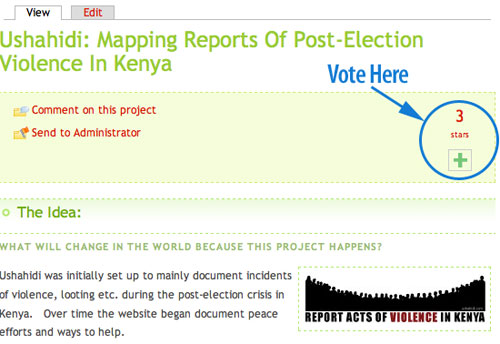
Second, if you go help vote up our application (LINK), we have a stronger chance of being selected. Going and voting for us at this point is the biggest help you can be at this point.
Third, even though the crisis in Kenya appears to be over (thank God), we’re continuing to build out Ushahidi in order for it to be used in future crisis related situations around the world.
Here’s their explanation of the challenge:
This year’s NetSquared Conference will bring together a unique mix of people from the public and private sectors to develop and release Mashups designed to provide deeper insight into the social issues affecting communities around the globe.
Those “people” are you — members of the NetSquared universe working on behalf of communities everywhere and the technical experts who care about these issues.
If we’re successful, we’ll learn something about cross-sector collaboration, meet new and interesting people, and build a unique gallery of Mashups that citizens, schools, and community-based groups everywhere can learn from, replicate, and build upon.
So, there you have it. Head on over to Netsquared, register and vote. I know it’s a hassle to have to register before you vote, but we would greatly appreciate it if you did. Better yet, if you’re interested in helping to extend Ushahidi even further, let us know!
Let’s see if we can make a global product out of an African initiated project…