Now posts ↓

Showing posts with label law. Show all posts

Monday, 26 October 2015

Russia's brave 75yo protester


Reblogged with permission. Russia's 'justice' system is bringing new meaning to the term Kafkaesque in the legal assault on one brave pensioner protester. In the UK for years a similarly aged, anti-war lone protester literally camped opposite the Houses of Parliament. In Russia, one man holding up a sign is a huge threat to the system. Which is odd given the President's huge poll ratings is it not? His treatment also shows the impunity for those seen to be defending the Kremlin's interests, even when thuggishly.

====

By Halya Colynash

The members of two pro-Kremlin organizations [NOD and SERB] who attacked an elderly pensioner holding a single-person picket outside the History Museum in Moscow on Oct 24 threatened to do the same to “all those who insult Putin, insult Russia”.

75-year-old Vladimir Ionov was standing alone with a placard reading “We have Putin, no need for a mind” when he was approached by Igor Beketov [who calls himself Gosha Tarasevich] from SERB who demanded to know why Ionov was insulting people who had voted for Russian President Vladimir Putin. Tarasevich claimed also that the words on the placard fall under Article 319 of the Criminal Code (insulting a representative of the authorities).

Seconds later Ionov was doused first in green paint, then with some kind of chemical cleaning substance which got into and burned his eye. The assailants must have been aware they were attacking somebody old enough to be their grandfather.

All of this was recorded on a video by Alexandra Ageeva. You can see activist Maria Ryabikova leaping in to defend Ionov, and being pushed away. They move away as the banner is grabbed and ripped to pieces, while others take photos with their phones.

No police officers came even close. It is quite likely, however, that they would have been there immediately had any other people tried to defend Ionov, since that would have provided an excuse to accuse Ionov and others of holding an ‘unauthorized gathering’.

Ionov’s trial is currently underway on surreal and disturbing charges. He is the first of four people so far to be tried under a new article of the Criminal Code which envisages up to 5-year sentences if a court has issued three rulings on administrative offences within 180 days. It is quite standard in today’s Russia for police to detain people at entirely peaceful protests, with administrative protocols then drawn up and processed by the courts with no questions asked. Three such unwarranted administrative penalties can now lead to criminal prosecution.

"We'll give up everything we have, but we'll save Assad!"
Ionov is accused of four episodes: a single-person picket on Jan 10 with a placard: “Je suis Charlie” [this was just after the massacre at Charlie Hebdo in Paris]; taking part in gatherings on Jan 15 and on March 21, as well as participation in a picket in support of Nadiya Savchenko on May 11 (the imprisoned Ukrainian MP’s birthday).

On June 28 the authorities blocked Ionov’s pension card citing his non-payment of administrative fines as the reason. He is now, therefore, effectively deprived even of his pension.

At the preliminary hearing back on Sept 17, the judge asked Ionov if he understood what he is accused of. He replied that this was impossible to understand.

"The police state killed our Boris."

Four people are now facing criminal proceedings under Article 212.1 of the Russian Criminal Code: Ionov; Mark Galperin; Ildar Dadin and Irina Kalmykova.

The Memorial HRC stated on Feb 4 that the new legislation destroys freedom of peaceful assembly in Russia (More details here: Russia criminalizes peaceful protest)


After the jump see video of Ionov being attacked. Pictures via Sarah Hurst.

See a surreal transcript from Ionov's trial.


See also:

Wednesday, 26 August 2015

Sanctions response needed to Sentsov, Kolchenko case

Via

Reblogged with permission from Kharkiv Human Rights Protection Group. The author is one of the leading and most respected human rights activists in Ukraine.


===


By Halya Colnash

International outrage over the long sentences passed on Ukrainian film director Oleg Sentsov and civic activist Oleksandr Kolchenko was as foreseeable as the predetermined outcome of Russia’s Crimean show trial. The courage and defiance shown by Sentsov, Kolchenko and Gennady Afanasyev was certainly not what Moscow had planned. It is now for Ukraine and western countries to demonstrate commitment to rule of law by ensuring proper penalties against all those who take part in Russia’s farcical prosecutions and trials of Ukrainian nationals (and thus far one Estonian).

It was clear back at the end of May 2014 that Russia was seeking a Crimean show trial aimed at sending a chilling warning to other opponents of Russia’s annexation to keep their head low. The Stalinist echoes were present from the outset in the emphasis on the demonized Ukrainian far-right nationalist party Right Sector and in the public demonstration of the ‘confession’ of two of the men – Oleksy Chirniy and Gennady Afanasyev. Both Sentsov and Kolchenko insisted throughout on their innocence and Sentsov consistently repeated his account of the torture and threats he had been subjected to.

That was the Kremlin’s first miscalculation, and there have been many since. Moscow has effectively abducted Ukrainian nationals and its attempts to foist Russian citizenship on the men are overtly illegal. The defence could only be forced to remain silent about the file material for so long. Once the indictments were made public, and from the first day of the trial, it was clear for everybody to see that there was no ‘terrorist plot’, and no evidence at all against Sentsov.

As the Memorial Human Rights Centre pointed out in its statement declaring both men political prisoners, the one charge against Kolchenko was in no way ‘terrorism’. Memorial pointed to analogous cases in Russia where the charges had been different and the sentence at least three times smaller.

The prosecutor Igor Tkachenko ignored all of this, as did the three judges: presiding judge Sergei Mikhailyuk, Viacheslav Korsakov and Edward Korobenko.

There was no response from any of them to Afanasyev’s retraction of his testimony and statement in court that he had given it under duress. There was none when the first real lawyer that Afanasyev has had, Alexander Popkov, read out Afanasyev’s account of the torture he had been subjected to and the threats he had received both before and after his courageous act in court.

The prosecutor and judges are demonstrably complicit in the crime committed against Afanasyev, Kolchenko and Sentsov.

It took a long time for countries to agree to sanctions against people implicated in the death in detention of Russian lawyer Sergei Magnitsky. This case, that of Nadiya Savchenko and some other Ukrainians, as well as the trial of Estonian police officer Eston Kohver, are more straightforward. No country should be allowed to abduct foreign nationals and convict them in farcical court trials on fabricated charges.

In the Crimean case there is also compelling evidence of the use of torture, and two of the men are now already serving sentences. Afanasyev in particular is in danger, and measures are needed at international level to safeguard both him and his mother from likely reprisals.

A list is currently being drawn up of all those most implicated. It will almost certainly include four FSB officers identified by the Centre for Journalist Investigations as directly involved in the arrest and torture of, at least, Oleg Sentsov. All four are former officers of the Ukrainian Security Service [SBU] and are, or until recently were, Ukrainian nationals. The four men are Alexander Kulabukhov; Sergei Markov; Dmitry Vasilkov and Alexander Zinchenko. It will also include the investigators, prosecutors, judges and others implicated in the men’s prolonged detention; the refusal to investigate credible allegations of torture; and multiple other violations of the men’s rights.

A similar list is needed for former pilot and Ukrainian MP Nadiya Savchenko, with this certainly including people holding high position in Russia’s Investigative Committee. Ideally such a list could also include those responsible for the ongoing detention without properly legal services of 73-year-old Yury Soloshenko; the detention and torture of Serhiy Litvinov, and at least five other Ukrainians now in Russian detention.

A clear message is needed now. The ‘trial’ of Nadiya Savchenko has not begun, but there are all grounds for expecting a similar travesty. The sentences passed on Sentsov and Kolchenko will certainly be appealed.

The appeal court judges, as well as all those taking part in Savchenko’s trial and other demonstrations by Moscow of legal banditry should know now that their actions will have real consequences for them. Criminal orders to destroy human lives should not be obeyed, and those who arrest, torture, abduct and convict those the Kremlin wants punished should, as a minimum, face automatic bans on entry to EU and other democratic countries, and any other measures already applied to those on the Magnitsky List.

Edited to add: The Ukrainian Foreign Minister has said that he will be pushing for sanctions.

See also:

There is no "civil war" in Ukraine

A Russian war propaganda organ trumpeting the BBC's reaffirmation on terminology
Pump 'Ukraine + "civil war"' into Google and click the 'News' tab and you get dozens of results. Deutsche Welle, Newsweek, CNBC, Huffington Post, The Independent, The Nation, Washington Post, and The Daily Telegraph have all used that phrase to describe what is going on.

As does the BBC, although Euan McDonald, a Kyiv Post Editor, says that's because the BBC "has to use certain terminology to continue to have access to separatist areas." Its own reporters covered the initial takeover of government buildings in the Donbas and said that Russian Special Forces appeared to be involved and they have someone like Mark Urban, the Diplomatic and defence editor of the BBC's lead news show Newsnight, covering in March the presence of Russian troops.

Here Cambridge University's Dr Rory Finnin (Department of Slavonic Studies) and Dr Thomas D Grant (Faculty of Law) argue that what terms are used by someone as trusted as the BBC is not a minor issue and we should all stop employing euphemisms. Reblogged with permission.

====

The war in Ukraine, we are often told, is a “civil war” involving “rebels” fighting the central government in Kiev. Such restrictive, inaccurate terms greatly misrepresent the conflict, which has already killed over 6,500 and displaced at least 1.4m Ukrainians. Too often, the crisis is talked about as if it’s entirely internal to Ukraine, a domestic affair presumably brought on by language politics, identity clashes and historical grievances. Best, therefore, to leave it alone.

Wrong. Ukraine is waging a war of self-defence against an international aggressor – the Russian Federation – whose conduct threatens our collective security. This war is now 18 months old, and we should know better by now.

Face facts

It’s not as if the signs aren’t clear. Recent weeks have seen another intense spike in fighting in eastern Ukraine. Given all the prior sabre-rattling, nuclear threats and general rhetorical brinksmanship, it takes little imagination to see the conflict expanding beyond Ukraine’s borders into EU member states.

Labelling such a crisis a “civil war” serves no purpose of diplomacy or journalistic balance. It is a failure to serve the public interest. The war needs to be described as it really is.

Fundamentally, this conflict was started and is sustained by Russia’s armed intervention, not a Ukrainian civic collapse. In nearly a quarter century of independence, the Ukrainian public’s support for national unity has been stronger than in many long-established states, among them Spain, Belgium and Canada. As Vladimir Putin has since proudly admitted, it was Russian troops in the spring of 2014 who seized Ukraine’s Autonomous Republic of Crimea.

The Russian military presence has not gone away. In August 2015, Organization for Security and Cooperation in Europe (OSCE) monitors again encountered personnel in eastern Ukraine openly identifying as Russian regular military. These forces continue to lead, train, equip and fight alongside militants advancing Russian neo-imperial and ultra-nationalist ideologies against a government in Kiev espousing respect for democracy, transparency and the rule of law.

To tiptoe around the Kremlin’s armed intervention in Ukraine falls short of the basic standards of war reportage. And it’s absurd to call the Donetsk and Luhansk authorities “rebel” administrations when they would not have come into being and would not continue to function without Russian backing.

We do not talk about a Manchukuo “rebel” administration in 1930s China without mentioning that Japan had invaded it; scarcely anybody pays lip service to the myth of an organic, independent separatist movement in 1930s Manchuria. Nobody should credit Russia’s fiction about “rebel” administrations in today’s Ukraine.


Lest we forget, the purported “rebels” in eastern Ukraine agree. Here is Igor Girkin-Strelkov, a Russian national associated with Russian military intelligence who helped lead the “rebel” movement in eastern Ukraine, speaking only weeks ago: “You are making an idiot or fool of yourself if you think that [the Donetsk and Luhansk Peoples’ Republics] were formed by themselves.”

An important conclusion follows from these facts: the Russian Federation is an aggressor and should be characterised as such whenever we talk about areas of Ukraine that have fallen under the Kremlin’s effective military and political control.

There is no need to report aggression in inverted commas. Since early 2014, the Russian Federation has carried out a host of acts of aggression against Ukraine as defined in Article 3 of the UN General Assembly’s definition of aggression. Russia has invaded Ukrainian territory – Crimea, Donetsk and Luhansk so far – and attacked Ukrainian forces without a shred of plausible legal justification; bombarded Ukrainian territory and killed Ukrainian citizens; and seized territory that belongs within the internationally recognised borders of Ukraine, declaring it part of Russia. These are nothing less than acts of aggression under international law.

Nor do the sham referenda in Crimea in March 2014 or in Donetsk and Luhansk in May 2014 offer any legal wiggle room, since these “Potemkin plebiscites” resulted directly from an invasion of Ukraine by the Russian Federation.

As far as the referendums go, the UN General Assembly, the Parliamentary Assembly of the Council of Europe and the President of the OSCE Parliamentary Assembly all agree they were unlawful and illegitimate. To argue or imply that there has been an act of “self-determination” in any part of Ukraine that calls into question Ukraine’s sovereignty over its recognised territory contradicts the highest available organised expressions of international law.

If editors and journalists are substituting their own judgement of the situation, then they must explain why.

A spade’s a spade

Then there’s the matter of Ukraine’s right to self-defence, which of course is a right of all states. Russia’s aggression against Ukraine is just about the only case where a UN member state has seized and in effect sliced off whole regions of another UN member state.

In its official statements the Kremlin goes further still, repeatedly calling into question the right of Ukraine to continue in its current form, invoking a so-called “New Russia” across vast, strategic tracts of the country, and even threatening nuclear action in the wider context of the conflict.

This is not garden-variety geopolitical grandstanding. When Iraq attacked Kuwait in 1990, it was universally condemned, and Kuwait’s right of self-defence was affirmed. There is no principled reason for responding to Russia’s aggression in eastern Ukraine with different rhetoric or a different description.

It’s time to face reality. The continued escalation of the war in Ukraine poses a serious challenge to international public order. Journalists have risked everything to report events from this war, and we need to stop watering down their reports with euphemism and understatement. We need to call this what it is: a war of self-defence against an international aggressor.

The Conversation

Thursday, 9 May 2013

Guess who has gay rights in its constitution?

Map of the Republic of the Congo.
Even if you have gay rights  written into a country's constitution you don't necessarily have protections for gay people.

This truism is well understood in South Africa, where the constitution which came in with the ANC famously has sexual orientation as a protected class. Yet South Africa also has high levels of violence against LGBT and strong societal hostility. You can get gay married but your likelihood of getting gay bashed is higher there than, say, in Mississippi, where unless the Supremes rule otherwise is likely to be the last US State to go for equal marriage (according to Nate Silver).

I just learned something which double underlines this point. Another African country has sexual orientation in its constitution, you'd be shocked to read (I was) that it is -- drumroll: The Republic of The Congo, also known as Congo (Brazzaville). Gasp.

They've had it since 1995, when the constitution was rewritten following the introduction of multi-party democracy.

I learned this from 76 Crimes, a website I've praised before which covers LGBT rights outside the 'West'.

This factoid comes from the US State Department's Human Rights Report which, 76 Crimes notes, shows that life for gay people in Central Africa is that little bit better than elsewhere in Africa.

It is a slight stretch because I've read reports about gay life in other African pockets being slightly better (written one, here's Côte d'Ivoire). Something notable is the connections loosely between CAR, Chad and the Congos being that they're the bits Britain didn't colonise.

The French haven't criminalised homosexuality since the 18th Century, so they didn't impose criminalisation on their colonies, note.

Here's the State Department note, which makes the constitution thing sound even more bizarre in the detail and explains further on how the constitution thing apparently makes b'all difference (and yes I did look to find out how it ended up there in the first place, got nowhere so I can only guess they just copied the then new South African one and no religious nutters noticed what was in it).
Republic of the Congo

The constitution prohibits discrimination based on, sexual orientation. There was a small openly gay or lesbian community due to the social stigma associated with consensual same-sex sexual conduct. A law promulgated during the colonial era and still in force prohibits homosexual conduct and makes it punishable by up to two years’ imprisonment; however, the law was rarely enforced. The most recent arrest under this law was in 1996.

There were no known cases of violence against gays, lesbians, or transgender individuals during the year. Although homosexual activity is generally stigmatized by society, overt intimidation was not believed to be a factor in preventing reports of incidents of abuse.

There was no known advocacy group or organization representing the interests of gays, lesbians, or transgender individuals in the country, and homosexuality remained a private subject.
The full reports on human rights in those countries are available at www.humanrights.gov.

Enhanced by Zemanta

Wednesday, 20 March 2013

Home Office bans access to annoying web forum


A few years ago I was around when Whitehall webbies drew up guidance on social media use.

At the time the guidance was well received by everybody. It was common sensical, it was written in plain English, it fulfilled its brief -- it didn't piss off any interests. Blogging was being developed across government, seen as an existential part of communications.

Here's what that has turned into at the Foreign Office and here's my old mucker Jeremy Gould, one of the men from the Ministry who pushed it all along, covering its early development.

That straightforward guidance has been developed on, applied elsewhere, and here [pdf] is what was drawn up by civil servants at the Ministry of Justice and it covers judges, amongst others.

Now, the Home Office has decided that those judges cannot write anonymous comments, perhaps even read them, on this forum and this forum alone:
The Free Movement forum is a private, progressive space in which immigration lawyers, campaigners, academics, students and select others can help one another and discuss any or all immigration, asylum, nationality and human rights law questions and policy. It is restricted to members only and cannot be viewed by the public. It is not open to those who work for or with the Home Office.
You think this forum's Home Office worker ban might have something to do with it?

One is reminded of the playground. The guy behind the forum correctly labels this action "hysterical overkill":
Singling out particular websites for banning orders probably isn’t the right way forward. It is flattering to think that Free Movement is a special case in some way because of its wide readership amongst immigration lawyers and judges. It is just a blog and forum after all, though, not a cesspit of moral turpitude. Will a blacklist of other banned sites be maintained somewhere? Are immigration judges also to be banned from socialising where only claimant lawyers are present at a gathering? Will they be forbidden from being in the same room as a Home Office Presenting Officer where no one else is present? Will they be banned from professional or other organisations from which Home Office civil servants are excluded? What about judges in other areas of law?
They also block Free Movement forum and blog access for immigration detainees. Can't have the illegals communicating, or reading certain information can we?
The ban seems a shame. Some interesting tidbits are emerging on the forum already ... Immigration judges remain welcome readers of the main blog, at least so long as they aren’t banned from looking at it as well.
I wouldn't put it past them ...

Tuesday, 13 October 2009

Mugging the rich bastard lawyers

If the famous media gaggers, the libel law firm Carter-Ruck, scourge of Private Eye, thought they'd scored another famous victory (these guys are big on bragging) suppressing news they hadn't reckoned with social media.

#trafigura is as I type the #1 trending topic on Twitter (that's in the whole world). The Spectator has already broken the wall between what the blogs will say and what the print media thinks it can get away with ... and many, many more people are now aware of the very story a very rich set of bastards running a polluting company is paying them - presumably - many millions to kill.

In a few hours American bloggers will start picking up on the story enmasse. What's Carter-Ruck going to do then? As @ElrikMerlin just pointed out to me 'this is Streisand Effect in action' - something which I have blogged about before.

When Uzbek billionaire Alisher Usmanov tried the same trick, and created the same effect, it generated this quote from Boris Johnson (one of those inadvertently whacked by Usmanov's 'take-down' action):
We live in a world where internet communication is increasingly vital, and this is a serious erosion of free speech.
This is what Carter-Ruck did:
The Guardian has been prevented from reporting parliamentary proceedings on legal grounds which appear to call into question privileges guaranteeing free speech established under the 1688 Bill of Rights.
Today's published Commons order papers contain a question to be answered by a minister later this week. The Guardian is prevented from identifying the MP who has asked the question, what the question is, which minister might answer it, or where the question is to be found.
The Guardian is also forbidden from telling its readers why the paper is prevented – for the first time in memory – from reporting parliament. Legal obstacles, which cannot be identified, involve proceedings, which cannot be mentioned, on behalf of a client who must remain secret.
The only fact the Guardian can report is that the case involves the London solicitors Carter-Ruck, who specialise in suing the media for clients, who include individuals or global corporations.
This feels like another significant turning point for social media.

My updates throughout today

Nick Clegg has tweeted 'Very interested concerned about this #trafigura / Guardian story the @LibDems are planning to take action on this'

Carter-Ruck to be Flash Mobbed.

Twitter panics over Trafigura:
Trafigura was deleted from trending topics, despite the fact it was obviously the top-trending topic. One minute it was top, the next it had vanished. Twitter’s trend explanations were also absent from any topics relating to Trafigura.

I don’t blame them, British libel laws are notorious for being swingeing, and Carter-Ruck’s efficacy in the area is well-know.
[#trafigua has now come back up trending topics]

@arusbridger #Guardian editor tweets: hoping to get into court today to challenge ban by #carterruck on reporting parliament. Watch this space

Wikileaks has updated on the report lying behind the attempted Guardian gag.

BBC finally reporting #guardiangag , fourteen hours after Guardian published.

Telegraph peeks out, surveys on #trafigura

Carter-Ruck are on Twitter (nb: could possibly be imposter). The tweets are unreal:
@carterruck is looking for a new slogan. "Defending the indefensible" #carterruckslogan
LibDems have tabled an urgent question.

The huge US liberal website Daily Kos is now onto #trafigura.
We want to put the Streisand Effect to work, and make hashtags #carterruck and especially #trafigura the top trending topics on Twitter. Please include these hashtags in your tweets of the next 24 hours.
First satirical take: Carter-Ruck successfully preserves Trafigura’s online reputation:
“We at Carter-Ruck are proud to be so effective in protecting such deserving clients, and look forward to working just as effectively for the reputations of similarly environmentally well-behaved companies around the globe,” said Carter-Ruck’s new directors of marketing George Monbiot and Julian Assange.
Guardian reports today's legal action by them.
MP, who Guardian is currently prohibited from identifying, said he would ask the Speaker to consider taking action against Carter-Ruck for contempt of parliament.

The media lawyer Geoffrey Robertson QC said Lord Denning ruled in the 1970s that "whatever comments are made in parliament" can be reported in newspapers without fear of contempt.

He said: "Four rebel MPs asked questions giving the identity of 'Colonel B', granted anonymity by a judge on grounds of 'national security'. The DPP threatened the press might be prosecuted for contempt, but most published."

The right to report parliament was the subject of many struggles in the 18th century, with the MP and journalist John Wilkes fighting every authority – up to the king – over the right to keep the public informed. After Wilkes's battle, wrote the historian Robert Hargreaves, "it gradually became accepted that the public had a constitutional right to know what their elected representatives were up to".
Ungag the Guardian twibbon campaign.

Sky News Niall Paterson blogs:
Should there be any restrictions placed on the reporting and analysis of what is said (and written) in the Palace of Westminster? I'd argue not, save perhaps for those rare occasions when national security is truly at risk.

Yet this "sensitive" question appears on the Order Paper and the answer will appear in Hansard.

Gagged? This journalist is gagging at the court's decision.
@arusbridger Guardian Editor tweets: Victory! #CarterRuck caves-in. More soon on Guardian. No #Guardian court hearing. Media can now report Paul Farrelly's PQ re #Trafigura
Carter-Ruck now under attack on Google Maps
Guardian report on lifting of gag.

journalism.co.uk commentary and background on past Carter-Ruck gagging attempts.

Number Ten petition to the Prime Minister:
We the undersigned petition the Prime Minister to enshrine in law the absolute right of the media to report the proceedings of The House in full at all times.
Plus campaign website on same set up:
Tell your MP to stand up for the media’s right to report on politicians in Westminster: e-mail them in two minutes, now.
BBC: Guardian claims victory on 'gag' :
Newsnight will report on this case and the prevalence of media laws being used by large companies to restrict information on Tuesday 13 October 2009 at 10.30pm on BBC Two.
BBC media correspondent Nick Higham for BBC website, When is a secret not a secret?:
In the anarchic, anything-goes world of the internet, where freedom of speech is a frequently heard rallying cry, injunctions banning publication of anything are unpopular. This one seems to have acted like a red rag to a bull.
Rupert Goodwins for ZDNet UK:
There is no doubt that the events of the past day have been profoundly democratic, entirely in keeping with the Bill of Rights' sweeping away of kingly powers and its assertion of the primacy of openness among the governors of the people. In a parallel universe, attempts to muzzle parliament might be seen as treasonable - but while we'll never have libel lawyers hearing the axe being sharpened in the Tower, the end result - a chilling effect on the silencers - is just as welcome, and welcomingly just.
Tweet from @wikileaks : Remember the UK press is STILL GAGGED from saying the toxic dumping report is on WikiLeaks HERE: http://bit.ly/v5rDJ

James Mackintosh for Financial Times, People power 1, Carter-Ruck and Trafigura 0:
Let’s hope Jack Straw, secretary of state for justice, listens: the trend towards ever-wider gagging orders gives big companies and the rich and powerful yet another way to strangle investigative journalism - as if the overly-restrictive libel and confidentiality laws were not bad enough.
Greenpeace blog on Trafigura:
Oil-trading company Trafigura knew that waste dumped in Ivory Coast in 2006 was hazardous.

Trafigura had persistently denied that the waste was harmful but internal e-mails show staff knew it was hazardous.
...
The chemical waste came from a ship called Probo Koala and in August 2006 truckload after truckload of it was illegally fly-tipped at 15 locations around Abidjan, the biggest city in Ivory Coast.

In the weeks that followed the dumping, tens of thousands of people reported a range of similar symptoms, including breathing problems, sickness and diarrhoea.
More Greenpeace background.
Mark Pack spots an unfortunate quote being served up on the Carter-Ruck homepage and says I think Carter-Ruck might be changing this quote, don’t you?.
NBC News' @AnnCurry tweets:
Victims of alledged toxic waste dumping by Trafigura Co. Its legal firm CarterRuck tried to stop this story: http://bit.ly/3jU0vD
Ian Douglas for the Telegraph, Context overcomes the law for Trafigura and the Guardian:
A search in Google News for Trafigura yielded the Guardian’s piece reporting the order, despite the word never being mentioned. So many people had linked to it using the name of the company that there was no need for the Guardian to break the order themselves, as the search engines determine the subject of a page by analysing those that link to it as much as the page itself.
Tweet from @BristleKRS:
Today's twictionary words: 1: to #CarterRuck up; vb tr, to fail in exponential relationship to invoiced fee
Tory Politico is reporting that The Independent has removed a story, published on September 17, relating to Trafigura’s dumping of toxic waste in the Ivory Coast. The story is still available through the google cache of the page.

Techpresident, The Internet as Toxic Avenger: Trafigura and the Ungagging of the Guardian:
Here you can see how the gagging of the Guardian was rapidly overwhelmed by mentions of Trafigura on Twitter, via Trendistic.


BBC Newsnight [Video], Dirty tricks and toxic waste in Ivory Coast.

Philippe Naughton for the Times, Twitter-power wins gagging victory over Carter-Ruck and Trafigura:

"Wow," said one Twitterer among the deluge of comments. "Never heard of Trafigura before today."

Tweet from Guardian Editor @arusbridger : Now support #Newsnight which is being sued by #Trafigura and #carterRuck over toxic waste expose http://tinyurl.com/pqf4dt

[Via PoliticsHome]: In the Commons this afternoon, Speaker John Bercow was urged to block future legal attempts to prevent the reporting of parliament, or to curtail MPs parliamentary privilege to speak freely.

Labour MP Paul Farrelly, whose question regarding Trafigura was the subject of the gag, asked Mr Bercow to investigate whether the Trafigura's reprentatives, Carter Ruck, had acted in contempt of parliament.

Other members, including Lib Dem frontbencher David Heath and former shadow home secretary David Davis, also raised concerns.

Mr Bercow told MPs he would reflect on the matter, but insisted that the moves to gag The Guardian, which were dropped this afternoon, "in no way inhibited" parliamentary procedure.

"There is no queston of our own proceedure being in anyway inhibited. If the honorable member wants to pursue this as a matter of principle there is of couse, as he will doubtless know, an established procedure of raising it with me in writing," he said.

#trafigura has now dropped off the top ten Twitter trending topics.

twittertrends

Marc Ambinder for The Atlantic Online, The Guardian Gets To Speak, But Britain Deserves A Free Press:

In practice, when compared to, well, almost every other country in the history of the world, Britain's press has flourished. But it has done so without the type of prior right that gives the press in the U.S. its moral force. While the press cannot print anything it wants in either the U.S. or Britain, it is much easier in Britain for an entity to obtain a pre-publication injunction, or for some to win a libel lawsuit, or for parliament to bottle up debate, or for government to prevent journalists from publishing secrets. It is much harder to obtain information from the government. Still, it should be remarked that, believe or not, the Supreme Court of the United States did not formally agree that the government could not prevent the press from revealing "scandalous and defamatory" matter until 1933, in Near v. Minnesota.

It's not so much that an expressed free press right would have resolved this dispute the right way.We're still debating the limits of the bill of rights in this country. And in the U.K., the right to report on what someone says in parliament -- or on the questions submitted to be answered by a minister of government -- is already established in statute. But the existence of a constitutional right would shift the burden away from the interests with relatively less power than the state, the lawyers and the company.

Ian Reeves for Centre for Journalism, The injunction that failed, thanks to Twitter:

The digital revolution is about to lead to a legal one.

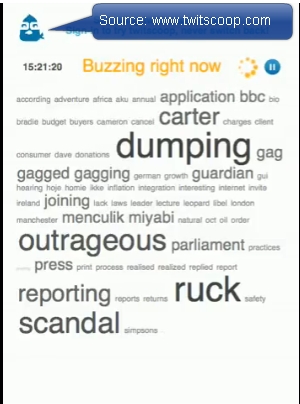
Tweet from @DistantHopes : Holy crap. Unless I miss my guess, check out how the disgraced #Trafigura literally had its name wiped from Twitscoop. [YouTube] #Trafigura on twitscoop.com

Associated Press, The truth is already out there: Twitter users thwart oil company's attempt to gag media.

LONDON (AP) — Bloggers and Twitter users thwarted a legal attempt Tuesday to stop Britain's media from reporting the questions posed by a lawmaker in a parliamentary debate, spotlighting the power of new media to influence public policy.

Alan Brookland, My advice to Trafigura – just wait it out:

Before everyone gets too self-congratulatory, does any of this brief flirtation with online interest ever actually change anything? True, right now, lots of people who had probably never even heard of Trifigura will now be reading up on the dumping story, but, come tomorrow or next week, how many will still remember much about it? The bloggers will chalk up a victory and in this case the gagging order was actually lifted, but this is still an on-going case and nothing will have actually changed.

Sites like Twitter are excellent for catching a wave and occasionally rallying a large number of people behind a cause, but it’s yet to become the force for social change that it’s being made out to be. Real issues sadly aren’t resolved in an afternoon and a normally more complicated than 140 characters. If social media is really going to make the impact that it could, then we all need to keep an eye on the issues which we find important and persue them, not just jump on while it’s in the news and let it quietly die. Nag your MP, pester the mainstream media and ask the annoying questions, not just when the issue is in the news, but repeatedly. It’s only by proving that we can stay interested in an issue that change happens, otherwise people will just wait till the dust settles and everything will stay the same.

[PDF] The letter Index on Censorship sent to the courts in support of the Guardian.

[PDF] Carter-Ruck statement on behalf of Trafigura.

Tweet from @pauloCanning : BBC #Radio4 news *finally (and briefly) reporting #gagcarterruck Fry gets quoted

Mike Butcher for Techcrunch, There’s nowhere to hide if your name trends on Twitter. Is there, Trafigura?

With the traditional media gagged, the new media had kicked in. That created a story which plenty of trad media outlets and blogs outside the UK could not ignore and started reporting on.

In other words, this kind of censorship is over. And I hope that British Libel law will change as a result. It must now move into the 21st Century and reflect new technology. After all, there is now a new defence. Feel libelled? You can defend your case just as much as the other guy online. Except of course if you are dumb enough not to register @carterruck, for instance.

Today's UK Parliamentary questions over #trafigura gag order [YouTube] http://www.youtube.com/watch?v=H_J4ypytxaE

Point of order on the injunction of the Guardian preventing it from printing a parliamentary question

Guardian, Trafigura gag attempt unites house in protest:

Labour MP Paul Farrelly told the speaker, John Bercow, attempts by lawyers Carter-Ruck to gag the media could be a "potential contempt of parliament".

The Liberal Democrat MP Evan Harris said there was a need to "control the habit of law firms" of obtaining secrecy injunctions, and his colleague David Heath told the Commons a "fundamental principle" was being threatened: that MPs should be able to speak freely and have their words reported freely.

On the Conservative side, David Davies criticised the rising use of "super-injunctions", in which the fact of the injunction is itself kept secret. He said courts should not be allowed to grant injunctions forbidding the reporting of parliament.

CharonQC, Lawcast 155: The Guardian Gag affair with Carl Gardner.

Catherine Mayer for Time: Twitter Triumphant: Attempts to Gag Newspaper Are Thwarted By Tweets:

Twitterers across the world colored their avatars green to show support for the protestors who took to Iran's streets after the country's disputed elections earlier this year. Users of the micro-blogging site might now consider overlaying their avatars with a film of sludge brown as a mark of their spontaneous, collective action to help undermine an attempt by the international oil traders Trafigura to gag a British newspaper reporting on a toxic dumping case.

Daily Mail, Law firm's 'Kafkaesque' bid to block reporting of Parliamentary question is defeated - makes no mention of either Trafigura or Twitter!

Professional journal The Chemical Engineer has also been served with an injunction by Carter-Ruck for Trafigura.

Channel Four News report, Parliamentary question ban lifted.

channel four news report

Jon Snow talked to Guardian editor Alan Rusbridger and asked him what had happened after the publication of this morning's paper.

He told Channel 4 News: "The blogosphere went berserk about a story that we published on our front page this morning, in which we said we can’t report a story for reasons we can’t tell you.

"After which there was about 16 hours of mayhem out there in the Twitter-sphere; and about an hour before we were due in court we received a letter from the lawyers saying 'we give in'.

"What has changed was that for the past six weeks we have been faced with an injunction – a so-called super injunction – which not only meant not only could we not tell anyone we had been injuncted, but that we could not mention the company involved either – I think this is a very dangerous phase in English law."

Tweet from @friendsofdarwin No mention of #trafigura or #carterruck on BBC 10 o'clock News. 5 minutes about racehorse's retirement. #bbcfail

Gillian Shaw on canada.com, Twitter backs Guardian newspaper in fight for free speech: A win for all:

Today marked a watershed moment in which social media stepped in to quash an attempt to gag a newspaper.

Guardian, How super-injunctions are used to gag investigative reporting:

Libel lawyers Carter-Ruck and Schillings have proved adept at persuading judges that injunctions should now be granted on privacy grounds. Some tabloid newspapers are being served with "a handful" of such orders each week, according to media lawyers. The Guardian has been served with at least 12 notices of injunctions that could not be reported so far this year, compared with six in the whole of 2006 and five the year before.

The motivation is straightforward, according to Mark Stephens, a partner at law firm Finer Stephens Innocent. "As the libel and privacy capital of the world, people are coming here [to London] to bully the media and NGOs into not reporting on their nefarious activities," he said.

Financial Times, Web’s effect on media law put to test:

Media lawyers, however, focused on the fact that the rulings of UK courts were not enforceable in the US.

Many of the servers hosting websites such as Facebook and Twitter are based in the US, meaning information cannot be suppressed.

Keith Ashby, head of litigation at Sheridans, said: “The difficulty is that injunctions cannot readily be obtained in the English courts against overseas internet service providers which would prevent them making the information available.”

Mr Ashby added: “If people get a whiff that publication of information has been injuncted in the print media, they are getting more canny about how to find the information on the internet.”

Michael Smyth, head of public policy at Clifford Chance, said: “We should not be surprised that the law finds it difficult to keep pace with technological advance and it is no answer in an era when judges are required to act proportionately to make a blanket order directed at the whole world.

“It is common practice for an injunction obtained against one newspaper to be copied to the whole of Fleet Street so that the market is aware of its terms and also bound by it. That’s the easy bit. What, however, of electronic publishers offshore about whom one knows next to nothing?” he added.

Mark Stephens of Finers Stephens Innocent agreed: “The issue with Twitter and SMS [text messaging] is that injunctions are not enforceable as you can’t stop people talking and in any case the servers which host these websites are in the US and outside the jurisdiction of the English courts.”

He pointed out that the order covering The Guardian was enforceable in England and Wales only, meaning that the Scottish and Irish media could report the parliamentary question.

Sunder Katwala on Liberal Conspiracy, Carter-Ruck:0 Guardian: 1… but what next?:

More broadly, wouldn’t it be a good idea to use this enjoyable moment of consciousness-raising to think about how we might sustain our attention and sort out a few deeper issues out too. Others may have a range of ideas. Here are three modest proposals of my own.

Mark Pack discovers that Trafigura have pretty dreadful website which says "This website and its contents are not directed at the general public.".

Tweets from @Danoosha Never seen a thin libel lawyer #newsnight #carterruck #trafigura #fb - @nuxnix BBCNewsnight #trafigura Slightly disappointing report I think this is the day where news media becomes less relevant to the real-time media

~~~~~

On the Wednesday Tory Politico reported Carter-Ruck/Guardian injunction revealed?

The bellow document is believed to be the secret injunction that would have prevented the Guardian reporting parliamentary proceedings yesterday.

Reblog this post [with Zemanta]

Saturday, 22 August 2009

Council blogging policy and self-censorship

chilledImage by zachstern via Flickr

Jack Pickard has a great post about policy on council staff blogging, which is sparked by Cambridgeshire making their Social Network and Blogging Policy (below) publicly available.

He notes that it is mercifully brief and written in plain English but points out that the bit which relates back to the council's general policy on how staff behaviour: it is full of hazy statements about 'bring us into disrepute' and 'being libelous'.

There’s a slight difference in implication here. Some [definitions] seem to suggest that any negative statement may be defamation, but it would only become slander or libel under other circumstances (for example, it not being true). I would assume that the Council would be using the term ‘defamation’ meaning ‘untrue and negative remarks’, but this isn’t entirely clear.

After all, if they were simply using it in the ‘negative’ sense only, this would mean that if I was a resident and an employee of a local authority, then I would have less rights to complain about something the Council was doing badly than some other resident would have. And surely that can’t be right.

I agree, it's not right. Council staff do appear to have less rights to voice their opinion of the council than other residents.

As a former journo I well understand that libel can indeed be read many ways and in practice it is the decisions of courts which set precedents.

There was a famous case in Australia where a fat rugby player successfully sued because being called fat would affect his income. I don't know if this precedent was overturned by another Australian court decision (and Australian law has its basis in English law) but we've all seen the rich use 'libel tourism' in English courts to slap the bothersome down.

I also know from my own experience that the vagueness and lack of clear examples of where exactly the council draws the line has a chilling effect - as libel law can - and in practice can mean that council staff become expected to be a-political in their own time, much like civil servants, despite this not being part of the contract they sign up for.

I first became aware of this problem at my previous council job when a manager spoke negatively about my posting comments on a local bulletin board. I was told this had been ‘noticed’ and I ‘had to be careful’. Then I was referred to the ‘code of conduct’ – after I asked what ‘careful’ meant.

This appeared to relate entirely to whether you could complain about the council in a letter to the local newspaper - like most councils I expect they had a neurotic co-dependent relationship with the local newspaper - and could easily be read as saying you couldn’t complain about the state of the flowerbeds.

This had a chilling effect on me because I could see how a manager could use it to threaten anyone who lived in the town as I did and took an interest in local affairs which they didn’t approve of.

In practice a couple of staff I knew were in fact involved in ‘political’ areas locally where clashes with the council happened and their manager’s were OK with it.

I’m certain - I know - that others weren’t either because the policy was so vague, or because it was assumed they shouldn’t get involved. And as almost any civic activity relates to the council in some way I’m sure it would put people off.

I'm sure staff thought of themselves as being policed and regarded in the same way that civil servants are when in fact that's not what the contract is between a council and its workers. I know I did. I simply stopped posting comments on local issues on the bulletin board.

I did point out the problem with managers, the union and even a councilor but none of them understood it as a problem (It probably didn’t help that most staff didn’t actually live in the city) so as far as I know this vague ‘code of conduct’ still exists.

Council staff can potentially have all sorts of comments they make online used against them due to the vagueness not of blogging policy but the age-old and undoubtedly identical contractual 'conduct' policies which they refer to.

As Jack says, yes, having a blogging policy is a great step forward but unless a lot more work is done most council staff simply won't feel free to express themselves online let alone talk freely about their work lives.

Cambridge Shire County Council social media policy

Postscript: In comments on Jack's post two useful additional points.

Richard Taylor notes that the blogging policy applies to staff and councilors and says "I would be very worried if councils tried to stop elected members from criticising their councils."

Karl Limpert comments on my cross-post (my highlight) to the Wardman Wire that:

Unfortunately for employees, disciplinary procedures are & always will be deliberately vague - it’s absolutely impossible to even imagine some of the incidents that do arise as a disciplinary matter.

The ACAS Code of Practice (employers are expected to take this into account when forming & going through a disciplinary process) makes clear that policies should give an idea of the types of conduct that may be minor, serious, or gross misconduct. The final assessment will always rest with managers, but if the employee could not reasonably recognise that their conduct was inappropriate, a warning & necessary training should follow.

“…unless a lot more work is done most council staff simply won’t feel free to express themselves online let alone talk freely about their work lives.” Unfortunately, this work will be in the form of disciplinary action - the policy will evolve as it is called upon, but until the first few cases arise & set precedent on what the treatment is (employers need to act consistently in these processes) the employees will have to venture into blogging unclear about the rules.

Matt Wardman suggests that the Civil Service Code of Practice, which he has written by Tom Watson but I'd tag Jeremy Gould more as author, be used as a model.

On GovLoop its editor says:
I think it can be scary for many to have employees participate online but there is an even bigger risk of us not being part of the conversation. And as the military analogy goes if they train and trust us with rockets and jets, can't they trust us to blog.
Michael Walsh reckons that:
The key here is that the individual cannot represent the organization or disclose legally protected information.
I agree and added that:
What I perhaps am not making clear here is the policy has a problem with what's written. It veers off into legalese to cover this area. The policy should provide here some encouragement and it should be possible to give some examples which 'set the stage'. One could be 'yes, you can link back to our website' or another 'yes, you can comment about services as a resident but don't discuss your job'.


Reblog this post [with Zemanta]

Thursday, 14 August 2008

Another UK blogger censored


Sensing a theme?

Matt Wardman has alerted me to the story of Phil Groom, who is yet another blogger being censored for free speech in the UK (where's that Bill of Rights?)

Phil used to work for the SPCK chain of Christian bookshops, which is owned by people not some benevolent, holy authority, and they appear to be behaving as many 'owners' do - i.e. like pigs towards the staff.
The Brewers then started screwing people’s contracts around, trying to impose new terms of employment that didn’t comply with UK employment law. They also started to narrow down the range of stock and stopped paying their suppliers.
Phil has been blogging about this and, like with Arsenal's suitor, The Brewers then started throwing the legal letters around.

Always a giveaway when there's something to hide.
Dave Walker and myself had each been independently reporting on the story on our websites and this year I set up a separate, dedicated blog to allow for more focused reporting and discussions. Unfortunately the Brewers didn’t like people talking about the way they were running things etc so they decided to try and nail us down by sending out ‘Cease and Desist’ (C&D) messages threatening legal action if we didn’t take down our websites.
Now there's a very obvious irony in me defending Christian bookshop workers right to whinge but ... what's that Voltaire line again? (Or was it actually Evelyn Beatrice Hall).

Wednesday, 25 June 2008

“I f****** hope he dies"


A few days a go a woman walked free from a Liverpool court after she'd killed her husband.

He hadn't bashed her.

He hadn't abused her.

He'd told her he was gay.

When I first saw this story on the PinkPaper website I started a Google Alert monitor and apart from the initial local BBC story nobody else has covered it.

This is the PinkPaper story (the local BBC story misses a few crucial bits), and the lack of coverage/interest says everything about the actual position of LGBT in the UK today.
Christine McGreavey, who told police: “I fucking hope he dies,” shortly after her arrest, stood trial for the murder of Barry Parkin after the incident in January.

She was also found not guilty of manslaughter at Liverpool Crown Court.

McGreavy, 48, formerly of Manorbier Crescent, Walton, Merseyside, denied the charges.

Prosecutor Richard Pratt QC told the jury Parkin had initially tried to cover for the mother of his daughter, but, as the 48-year-old realised he was dying, admitted to paramedics that McGreavy had “lost it” and stabbed him in the chest.

McGreavy said the incident happened during a row about his sexuality. Police were called to Parkin’s home at 9.20pm on 6 December after he staggered to a neighbour, covered in blood and requesting help.

Allegedly, he came out of the kitchen with a knife pointing towards his chest. She lunged forward and accidentally “bumped” the knife into his torso. The knife pierced his heart which slowly filled with blood. He died five hours later in Fazakerley hospital.

McGreavey later apologised at the police station, telling officers she had acted in self-defence. “I just flipped,” she said. “I just found out today that the father of my child is gay.”
Liverpool Echo has more, more.
Mr Pratt told the jury Mr Parkin initially told officers he had been attacked on Rice Lane. But as he travelled to hospital he asked the paramedic if he was going to die, and said it was his former girlfriend McGreavy who attacked him.
Sure sounds like gay men are fair game for murder to me.

Tuesday, 17 June 2008

Getty and copyright and threats


HT: Dom Latter

Some people on my local list are all of a tizz because they were getting threatening letters with £800 bills attached from Getty Images - Corbis also does this. Dom Latter reminded people that, no, Getty cannot 'name their price' (my precis of his points follows).

Because it's copyright infringement, all they can do is sue (for loss of earnings). To his knowledge - and feel free to correct me - this process has now been going on for many years without anyone actually being taken to court during this period.

As a layman, I don't see how an invoice for an abitrary amount can be made to stick in the absence of a contract; Getty are of course free to claim damages for the infringement of their copyright, but it would appear that they don't,

out-law
makes it clear that they cannot sue for "additional" damages, in the case of *unwitting* infringement.

In addition, Dom provides links to cases of people who "got caught and got out of it".

http://www.sitepoint.com/forums/showthread.php?t=390902
http://www.sitepoint.com/forums/showthread.php?t=445041
http://www.guardian.co.uk/technology/2007/feb/01/copyright.newmedia
http://finance.groups.yahoo.com/group/gettycrackdown/
http://groups.google.com/group/help-for-victims-of-getty-images?hl=en

Monday, 16 June 2008

Associated Press backs down

That was quick.
On Saturday, The A.P. retreated. Jim Kennedy, vice president and strategy director of The A.P., said in an interview that the news organization had decided that its letter to the Drudge Retort was “heavy-handed” and that The A.P. was going to rethink its policies toward bloggers.

The quick about-face came, he said, because a number of well-known bloggers started criticizing its policy, claiming it would undercut the active discussion of the news that rages on sites, big and small, across the Internet.
Apparently they will ...
attempt to define clear standards as to how much of its articles and broadcasts bloggers and Web sites can excerpt without infringing on The A.P.’s copyright.
Must be something to do with blogosphere's reaction. Oh, and this:
Timothy Wu, a professor at the Columbia Law School. Mr. Wu said that the case is not clear-cut, but he believes that The A.P. is likely to lose a court case to assert a claim on that issue.

More: Jeff Jarvis has a couple of good lines in a piece that sounds like a Family Guy script:
The AP is still trying to preserve its way. But, as I often say, protection is no strategy for the future. In the story - which, note, I’m only summarizing here, without the quotes from the AP that might better state its stance (ahem)

.......

Where’s my Reuters T-shirt?

Thursday, 15 May 2008

West Midlands Police finally apologise ...


... but only after being taken to court.

Last year I covered how Channel Four's 'Dispatches' sent undercover reporters into British mosques and filmed preachers saying amongst other things:
“Do you practise homosexuality with men? Take that homosexual man and throw him off the mountain.”

“If I were to call homosexuals perverted, dirty, filthy dogs that should be murdered, that’s my freedom of speech isn’t it? They’ll say: “No”, I’m not tolerant. But they feel that it’s okay to say something about the Prophet.”

"Whoever changes his religion from Al Islam to anything else – kill him"
And how, after a ridiculous 'investigation', West Midlands Police (and the Crown Prosecution Service) instead of prosecuting these people for inciting violence made a complaint to Ofcom about the editing of the programme claiming it was 'stirring up racial hatred'. A complaint which itself was technically odd.

I noted that this was the same police who had a fraught relationship with their local gay and lesbian community.

And how police in general had had to be forced into taking action against murder music, dancehall reggae which is all about how to kill gays and lesbians.

I even found myself on the same side as the Editor of the Daily Telegraph, Charles Moore, who said:

I do not know whether the Dispatches programme is right in every detail. But it clearly raises serious, important questions - about extremists in our midst, about the way apparently moderate organisations give them shelter, about the Saudi Arabian network that supports them.

What security agencies call "thematic analyses" show that, at present, the problems of Islamist extremism are particularly acute, especially in prisons and universities, in the West Midlands area.

Yet the West Midlands police and the Crown Prosecution Service decide that the target of their wrath should be not people who want to undermine this country, but some journalists who want to expose them.

Are they fit to protect us?

Late last year, Ofcom threw the complaint out and Channel Four then decided to launch a court action for defamation.

Andy Duncan, Channel 4 chief executive, said at the time:
West Midlands Police acted in a calculated fashion - they made no attempt to discuss their concerns about the film with us in advance of going public with their complaint to Ofcom knowing that an allegation of 'fakery' would generate significant media interest. Their action gave legitimacy to people preaching a message of hate to British citizens.
After being dragged to court, this apology and £100k payout is the result (half of the payout covers costs, the other goes to the Rory Peck Trust for freelance news gatherers and their families in times of need).
Following an independent investigation by the broadcasting regulator Ofcom, we now accept that we were wrong to make these allegations. We now accept that there was no evidence that the broadcaster or programme makers had misled the audience or that the programme was likely to encourage or incite criminal activity. A review of the evidence (including untransmitted footage and scripts) by Ofcom demonstrated that the programme had accurately represented the material it had gathered and dealt with the subject matter responsibly and in context.

We accept, without reservation, the conclusions of Ofcom and apologise to the programme makers for the damage and distress caused by our original press release.
[CPS apology]

I think they should apologise to the gay and lesbian community - infact the whole community - as well, for 'wasting police time'.

The people who were responsible and should suffer some consequences are:
  • CPS lawyer, Bethan David
  • Assistant Chief Constable of the West Midlands Police, Anil Patani
  • West Midlands Chief Constable, Paul Scott-Lee
Amongst others who weighed in against Channel Four were
  • The secretary general of the Muslim Council of Britain, Muhammad Abdul Bari
  • Press spokesperson of the Muslim Council of Britain, Inayat Bunglawala
I would also be interested to know who, if any, of Birmingham's MPs supported Channel Four.

And whether any prosecutions for 'incitement to violence' against the hate preachers exposed in the documentary will ever follow.