Now posts ↓

Showing posts with label maps. Show all posts

Tuesday, 19 May 2009

Your emissions are killing me


These two maps show, firstly, the world in terms of carbon emissions and, secondly, the world in terms of mortality as a result of climate change.

They come from a study published in the Lancet (pdf / more).

Humbled somewhat?

In an editorial (registration required) the Lancet identifies:
  • an astonishing lack of knowledge about how we should respond to the negative health effects of climate change
  • we have an immense task before us to address the inadequacies of health systems to protect people in countries most at risk
  • technologies have to be developed out of greater research investments into climate change science, better understanding about how to deliver those technologies in the field, and a more complete appreciation of the social and cultural dimensions into which those technologies might be implanted
  • there is a political challenge in creating the conditions for low-carbon living
As a leading foci for discussion on health, the Lancet is calling for nothing more than a bringing together of the disciplines of disease, food, water and sanitation, shelter and settlements, extreme events, and population and migration in this challenge.

And it says:
Too many doctors have been silent for too long about the importance of climate change to the future of health and health services.
HT: Ezra Klein

Tuesday, 27 January 2009

Change you can believe in


Obama promises 'transparency'. Obama delivers 'transparency'.

At least as far as Google Maps is concerned.

Cheney (aka 'Dr Strangelove') has spent the past few years under a blur. His official residence, the Naval Observatory, hidden from close, satellite inspection.

No longer.

Google announced yesterday:
Our most recent update, which went live last week, included updated imagery of the Washington D.C. area from several providers. The imagery of the Naval Observatory comes from Digital Globe.
And they're unblurred.

Remember, this is the guy who - secretively (he thought) - invented his own logo.

Tuesday, 18 November 2008

"I think we should kill Obama"


Not a good sign. The election is bringing out the racists. As black people feared, way back in the primary.

From Mudflats, reporting from a town next to Palin's Wasilla:
The event was supposed to be for all parties, for all people, but it didn't feel like it. I was shocked and offended. The event was supposed to be for supporters of Senators Obama and McCain and no one paid respect to President-elect Obama's historic moment. Finally, another step toward complete equality and it seemed no one cared.

So the next day I borrowed my mother's Obama shirt and walked into school wearing my pride on my chest. Finally the campaign was over and I was actively supporting our new president, even though I knew I would be vastly out numbered at school. I expected complaints and qualms about the new president, but I was not prepared for the flat-out racist remarks said openly in the halls and classrooms. I was appalled. While I sat at my desk trying to do my work I could hear my fellow classmates:

"I think we should kill Obama," one said.

"I hope someone comes up and shoots him in the head," another would say.

"I hate Obama ... he's black."

On went the racist words for the full 80 minutes of that class. Angered, I began to think of the injustice of it all and the ignorance of the students I was surrounded by. I wondered where they learned to be so hateful, and I wondered why the teacher never stepped in - why no adult, no student, including myself, had the guts to cut in and say it was not OK. Because it's never OK for intolerance. It is never OK to cut someone down and dehumanize them because they do not look like you, or think like you, or talk like you, or worship the way you do.
From the Christian Science Monitor:
The election of America's first black president has triggered more than 200 hate-related incidents, according to the Southern Poverty Law Center – a record in modern presidential elections. Moreover, the white nationalist movement, bemoaning an election that confirmed voters' comfort with a multiracial demography, expects Mr. Obama's election to be a potent recruiting tool – one that watchdog groups warn could give new impetus to a mostly defanged fringe element.

Most election-related threats have so far been little more than juvenile pranks. But the political marginalization of certain Southern whites, economic distress in rural areas, and a White House occupant who symbolizes a multiethnic United States could combine to produce a backlash against what some have heralded as the dawn of a postracial America. In some parts of the South, there's even talk of secession.

"Most of this movement is not violent, but there is a substantive underbelly that is violent and does try to make a bridge to people who feel disenfranchised," says Brian Levin of the Center for the Study of Hate and Extremism at California State University, San Bernardino. "The question is: Will this swirl become a tornado or just an ill wind? We're not there yet, but there's dust on the horizon, a swirling of wind, and the atmospherics are getting put together for [conflict]."

At least two white nationalist websites – Stormfront and the Council of Conservative Citizens – report their servers have crashed because of heavy traffic. The League of the South, a secessionist group, says Web hits jumped from 50,000 a month to 300,000 since Nov. 4, and its phones are ringing off the hook.

"The vitriol is flailing out shotgun-style," says Mr. Levin. "They recognize Obama as a tipping point, the perfect storm in the narrative of the hate world – the apocalypse that they've been moaning about has come true."

"We're not looking at a race war or anything close to it, but ... what we are seeing now is undeniably a fairly major backlash by some subset of the white population," says Mark Potok of the Southern Poverty Law Center's Intelligence Report in Montomgery, Ala. "Many whites feel that the country their forefathers built has been ... stolen from them, so there's in some places a real boiling rage, and that can only become worse as more people lose jobs."

In an election in which barely 20 percent of native Southern whites in Deep South states voted for Obama, the newly apparent political clout of "outsiders" and people of color has been unnerving to some.

"In states like Mississippi, Louisiana, and Alabama, there was extraordinary racial polarization in the vote," says Merle Black, a political scientist at Emory University in Atlanta. "Black Americans really do believe that Obama is going to represent their interests and views in ways that they haven't been before, and, in the Deep South, whites feel exactly the opposite."

But for nonviolent secessionist groups like the League of the South, the hope is for a more vigorous debate about the direction of the US and the South's role in it, says Michael Tuggle, a League blogger in North Carolina.

Mr. Tuggle says his group isn't looking for an 1860-style secession but, rather, a model that Spain, for one, is moving toward, in which "there's a great deal of autonomy for constituent regions" – a foil to what is seen as unchecked, dangerous federal power in Washington.

"To a lot of people, the idea of secession doesn't seem so crazy anymore," says Tuggle. "People are talking about how left out they feel, ... and they feel that something strange and radical has taken over our country."
Don't say you weren't warned ...

Monday, 26 May 2008

Web power: Avaaz beats the Burmese colonels


This is a pretty amazing demonstration of how the Web is able to respond and deliver in ways unimaginable a decade ago.
In the days since a catastrophic cyclone struck Burma and killed over 100,000 people, Avaaz members have donated $2 million (almost 1.3 million Euros) to the aid effort. Our community has given more than many governments, and our aid hasn't been stopped at the border like theirs -- we've supported Burmese monks and other aid groups who have worked without their brutal government's permission.
Avaaz.org is an international civic organization that promotes issues such as climate change and human rights. Its stated mission is to "ensure that the views and values of the world's people inform global decision-making." The organization operates in thirteen languages, and claims more than three million members from every country in the world.
It's been a challenge to get such a lot of money in. Most Burmese groups can safely move only a limited amount of money each day through informal networks. So far, we know that $550,000 has arrived in Burma and been spent, and an additional $1,000,000 is en route and may have arrived. We are currently working with the International Burmese Monk Organization and 7 other Burmese organizations, including monk groups, educational groups, and medical clinics, who have asked not to be named for their own security.

The way the money moves is through informal transfers between bank accounts and by hand. Sometimes it is as simple as a deposit in one country that is then withdrawn inside Burma by the account holder and then carried to a monastery or aid group. Because many merchants do this, the Burmese government cannot tell the difference between commercial funds and aid money.

This work carries some dangers; Burmese junta has harassed and, in one case, attacked the groups we are working with. But in the vast majority of cases, soldiers simply arrive, warn our partners that their work must be authorized by the government, and leave. Once they are out of sight, the aid work continues.

It is a challenge in such circumstances to exercise complete oversight over how the money is used -- most of the work is in secret. But we have chosen to work only with the most universally respected institutions, and we have asked them to provide detailed lists of monasteries and groups who receive it. These details allow us to verify receipt of the funds.
And this is where that money's ended up.


View Larger Map

Here's their donation page.

Wednesday, 30 April 2008

Google Reader clips catch up


Not on Reader

Tuesday, 29 April 2008

Eggs, potholes and Robert Mugabe's last days - we hope


The Zimbabwean underground Civil Action Group Sokwanele is proving the best source for online news about what's going on.

They are:
A civic action support group driven towards the use of non-violent actions to bring democracy, justice and freedom to Zimbabweans.
Sokwanele means 'enough is enough' in Ndebele. The non-violence is very important with comments regularly deleted or edited. They are not affiliated with the MDC.

Yesterday they posted a telling story about the Zimbabwean International Trade Fair - yes, such a thing exists and went ahead at the weekend. The sole news about the event was that local hotel managers ended up arrested because inflation is so unbelievable that they had to put up prices, which in the Alice in Wonderland economy is illegal.

Prices of eggs double in one day, from Z$100mil to Z$210mil. For a shop owner, just keeping two out-of-date yogurts on the shelves can drive them out of business. Once ended, businesses are taken over by the state and handed to Zanu-PF's allies.

Roads outside the shiny Bulawayo hotels don't have potholes, around the corner there's potholes and traffic lights which don't work. The potholes themselves are one way for starving Zimbabweans to make some money. Kids fill them in with sand and then clamor for tips when drivers slow down.

Sokwanele's blog was the first to report on the Chinese arms-carrying ship - which they now say is being shadowed by a British nuclear submarine.

And they have also set up - as happened in Kenya - a whole series of online tools.

A Google Map is marking locations of the terror campaign currently going on.


As well as a contacts database for taking action in support - currently aimed at the UN and South Africa. And a terror photo album on Flickr. And a cartoon gallery.

These last three I don't recall seeing in Kenya, although Joseph Karoki was posting lots of photos there.

Monday, 14 April 2008

Gordon B on the bleeding edge


Hat tip to Simon Dickson for what can only be his work/influence in making the PMs current US visit a bleeding edge tech/web event.

Checking out the #10 website and page created for the visit, it's just about the most bleeding edge web coverage by a Great Leader out there in - oh - the world?

It simply uses Flickr, Twitter, RSS and Google Maps. No outsourcing or farming out to IBM or MS or god knows who. It's 'bleeding edge'. And actually simple.

As for the content and the politics ... another story. But the tech. two thumbs up. No wonder the US website following their campaign, TechPresident, keeps raving about this.

Sunday, 13 April 2008

One year on: Ten answers for Minister Watson


I wrote a response to egov Minister Tom Watson's latest speech, dissecting the interim report into The Power of Information report by Tom Steinberg and friends: Leadership in egov: what's missing? And Tom challenged me to, well, put up!
What should we be doing that we're not?
I usually imagine these challenges coming from between gritted teeth and with arms crossed (I am picturing actually seeing this from others), but Tom has already shown himself actually dialoguing with stirrers like moi so here goes.

The timing is neat and slightly spooky - it's one year since I started this blog, something I should have done much earlier. And so I have one year's worth of egov posts to scour for the missing ideas which Tom wants to hear but actually it just pops out because, as my egov friends know, I am the proverbial 'stuck record' on this stuff. This also may explain my occasionally ragged and cynical tone. Please forgive me.

Here's a top ten but #1 just leaps out from my latest post on online suicide prevention.

~~~~~~

Ten things not happening in eGov

1. Findability

Search is the prime route to content and is followed by links from other websites. How government addresses this is through newspaper ads - see DirectGov - or, slowly, very limited textads and rare banner ads. I'm not aware of any strategy which looks at how people find services or information in the real world online. Most pages are not optimised for search, most top results are by fluke rather than design and most links by legacy. All of that is and will continue to end - there is competition online. If they can't find you, what's the point?

2. Disengagement from the wider web and those damned walled gardens

This is part and parcel of the reasons why findability is so bad for services and information - like suicide prevention. Links into government sites aren't there due to any effort, they're there because of luck - we're government so people sometimes refer to us. But as you can see with the growth of health websites, this isn't a given. We tend to still live in the world of 'build it and they will come' or 'look at our sexy website'. Not good enough any more. There seems to be no understanding of how to drive traffic, let alone how to target the audience online. It's offline strategy pasted onto online, largely. This all comes from a disengagement, possibly a mistrust, of the wider web. And it's about way more than just sexy social networks and 'engagement' with them.


3. Engaging the industry

How many government seminars and conferences include people from the wider web industry? If the people aren't there and if webbies in government have no power (Jeremy Gould has a recent rant about this) and if web development in government isn't by webbies and if a self-reinforcing circle exists whereby public servants just talk to public servants, how will #2 ever evolve? In Australia, very early on, they brought the guru of usability, Jacob Nielsen, in to give a speech at the big annual shindig. That one speech reached the key people (Al Gore's strategy on climate change) and set the trend and embedded usability thinking in Aussie egov people. Outside engagement just isn't happening and it should. It's vital.

4. Marketing

Online marketing is increasingly sophisticated but it's also very basic. Asking for links, giving people content - anyone can do this, small websites do it all the time and it gets them traffic which has a reinforcing effect. Banner ads are the norm on the rare occasions when government does it (some rare, clunky, textads), but I would say this is the pick simply because it's comprehensible to Communications. Wider industry has been there and done that and is changing its attitude. Unfortunately, banner ads aren't anywhere near as efficient as other methods, such as search marketing. The failure around marketing is no more clearly shown than in the complete waste of millions than is e-citizen. Again, if they can't find you, what's the point?

5. Widgetising services

This is my particular bugbear because, to me, it's all about going to where people are online rather than forcing them through hoops to you and hence losing them on the way. That's the reason that widgets are all over the web nowadays - they work. The classic idea (well, mine) is to offer a widget which tells you when the bins are emptied - and slips in messages you want, such as recycling tips - to the local newspaper. Or the local social group. Or the specialist website. Or whoever the heck wants it. This still takes people back to you but it's a win-win. Any Google Maps work can be shared as well. Free content for them, traffic for you. Transport Direct already do one (though it's not promoted) but otherwise they're no-existent - we're still stuck in old methods.

6. Engaging the local

The general trend will be for local websites, including hyper-local and localised versions of services like Google Maps, and we already have targeted websites - the proverbial NetMums - but also ones most disabled people would pass through. What engaging means is things like offering free content such as guides - you have links for 'more details' at the end back to your pages, rather than ageneral link so they end up lost in your site. And widgets. You can even offer politician's best wishes to satisfy the enablers. This is another win-win because they'd all like the engagement, you help their users find your stuff, including services, and you both look good and get more traffic.

7. Cheaper usability methods

Usability is still thought of as tied into hiring professionals and mastering very complex ideas - that's rubbish. Cheap methods work in straightforward ways and this has been proved. Yes, professionals are needed and they are worth their weight, but most government websites cannot afford them or can't keep using them. Simple methods should be proselytized through government - like they are through the wider web - but they're not, it's still seen as a 'black art'. And do I have to explain why ensuring usability is absolutely essential?

8. Content

This relates back to other issues which we do do well. I'm particularly thinking of accessibility, which egov is very good at beating itself up about. Yes, there are some issues with disabled people being able to use our sites (though that's as nothing compared to the disaster that is commercial website accessibility) but what's the point of being able to more easily click through to content when that content makes no sense. Much content, both Whitehall and local government remains all about Ministers, Councillors, programs, what we're doing - It doesn't answer the question, the task which the user is there for. Website content isn't 'user-focussed'. It's usually 'rah rah, look at how brilliant we are and, oh, here's some complex routes to some content you might actually want'.

9. Fixations on 'engagement'

This particular 'bleeding edge' is all very well but it has lead to a severe imbalance in both resources and interest. I am actually quite fed up with being seemingly the only government webbie who has a basic grasp of stuff which webbies in the wider world take for granted like search engine optimisation or online marketing or usability methods - or any of the other issues above. Simply put, politicians love this but what good is it for users compared to the preceeding issues? From the outside looking in, do you really think edemocracy or finding out every last detail of the council's budget or whether we're adding comments to social networks is the #1 priority for citizens? This isn't to say it's not important or interesting or shouldn't happen, it's just way, way over prioritised.


10. Utilising reputation

With all of the above the difference with us is - we are government. We are generally trying to help people (no, really) and in many areas - like, for example, suicide prevention - services are pretty much politically neutral. This means we can ask for and get help, very often for free, from a wide range of the rest of the web. We also come with a built in online reputation simply because of who we are which, most clearly in search, is a solid foundation on which to build.

~~~~~~

There could be more but ten is enough. Correct me if I'm wrong, but I don't think The Power of Information covered any of these points, although implementing it would help with some.

Thursday, 10 April 2008

A new view of London


e-society classification

UCL has developed a fantastic new tool, still in Beta, which uses Google Maps and has a pretty good interface.


PTAL - Public Transport Accessibility Level

London Profiler builds up a picture of the geo-demographics of Greater London from data on population attributes such as cultural/ethnicity, deprivation, the extent of e-literacy, level of higher education, and health related problems.


London's Welsh

You can "visualise themes at different scales, search by postcode or zoom at borough level, to change the layer's transparency and to add KML layers". Loads quickly and all it's missing is a 'how to use' link.


Index of multiple deprivation

It's amazing, really, that the BBC covered this solely as about 'Mapping London's immigration', which is actually wrong. I don't see a map showing how the early C20th Jewish emigres landed in the East End then moved to North London ...

Tuesday, 1 April 2008

BBC News redesign: Can someone powerful please yell at them?


The BBC News website is extremely popular, so it's not surprising that yesterday's BBC Internet blog post about it's redesign attracted over 1000 comments - this must be a record?

The News Website Editor, Steve Herrmann, explains the changes in terms of doing some research and asking people what they wanted changing (and heard what it appears they wanted to hear):
But it was also clear from the feedback we got that there were others who thought the site design could do with a bit of a revamp – something we’d been thinking about doing for a while.
The specific changes he focuses on are:
  • the changed width - because 95% of screens are wider
  • more open design - to make it easier to scan
  • new masthead - which is about cross-site branding
  • bigger images - from user feedback and 'the power of pictures in telling stories on the web'
  • space for adverts - for the international audience
  • space for embedded media
  • incorporation of TV and radio current affairs content
Several of these make sense in terms of usability issues which have been known about and well understood for years - such as better use of pictures.

A number of comments from other developers than me point out that the accessibility was obviously not a factor in the redesign, not just in terms of requiring that it meet WC3 but that it appears it wasn't cross-browser tested. A redesign should be improving accessibility.

This is truly unacceptable and I hope the accessibility movement and organisations for disabled people scream their tits off about it. The BBC is in a leadership role with its website and it has huge resources. Someone, somewhere decided to ignore this. Who were they? Was it Herrmann?

I had a quick look at the very prominently featured 'accessibility help' and it's a link to 'my web my way', which is about 'the web', not the BBC News website.

This features a 'change colours and text size' button - absent on the website and a lot of 'rah rah' for the BBC from selected disabled comments. I understand that it is better than other websites and that many disabled users are grateful for some attention, but when most commercial websites pay no attention and - for me - when Council + Whitehall websites (which are the best) get hauled over coals when they're not 100% perfect the BBC can indeed 'do better' (as they would undoubtedly put it).

A number of other comments point to a design-led rather than user-led process, such as the choice of the Verdana font, unfluid design and the wasted top banner space.

I would add a couple of things to what others have already said which add to the design-led feeling.

1. Because of the redesign, the left-side navigation bars are now too close together. Combined with the on-focus colour change this would definitely cause issues for users who have trouble using a mouse - it fails 'the mom test'. I don't know what's gained from keeping the on-focus, either.

2. Removing links from the page is design-centred rather than user-centred. This pushes people towards search, which is an issue for most sites to do well and certainly is not very good on the BBC site. This is why you always need alternative navigation routes, like a site map. I know from doing this process that there is always pressure to remove links but when you test you can easily make both an 'uncluttered' look'n'feel, which is really about removing visual distraction, as well as providing more options both for navigation and content. Look at the Guardian's recent redesign - does that look 'cluttered'? Everything about the redesign process as explained appears to be dominated by this idea.

Overall, I'm disturbed that, from the BBC's presentation of it's News site redesign it's fairly clear that it wasn't led by usability - making the website more useful - but a whole lot of other factors which pushed user-focus aside. Changes aren't explained in terms of testing results and rarely about becoming more useful. I can imagine what actually happened from the mentions in the BBC blog post about some of those other factors, as well as from previous blog posts which mention terrible ideas like coding from photoshop designs - the very essence of being 'design-led'.

In the first response to the blog comments by the head of 'design and user experience', none of the accessibility issues are responded to and the 'technical' issues are referred to the 'technical team'. She also gives the very strong impression of being prepared to change design elements from blog responses and this response in particular really makes me think they're 'design-led':
We added the extra white space because a number of users told us, through surveys, listening labs and usability tests, that the previous design was starting to look "cluttered" and "busy".
This isn't the language of someone responding to test results and producing a user-led redesign - or even, to cut her some slack, of someone communicating process to non-tekkies.

Unfortunately, I am all too familiar with how this happens and how this works having fought too many losing battles - power and who has it is an real issue in defending the bloody user in web design.

That an organisation the size of the BBC is still behaving in web development this way in 2008 requires someone powerful outside the BBC to yell at them to do this stuff properly. Perhaps Cameron could add this to his BBC websites critique? And perhaps someone could do a FOI request for the process documentation so we can see exactly who's responsible rather than make educated guesses?

Dan G has more:
Something very strange is happening in the BBC webdesign department.
~~~~~~

One of his comments takes him to task for his own coding and design - so I expect something similar.

Just to say, I don't care. It's a bit ad hominem ... (although I am interested to know if something plain isn't working, which I understand can be the case with some video servers).

I had one of these to my post 'BBC Blogs: Why bother?', which got hundreds of visits via the BBC Blog post which specifically mentioned it.
Please have a Flash bypass (you do not have it now) as there are many businesses, mine included, that will not allow Flash. Without the bypass we will not be able to see your videos.
Flash tracks, by IP address, every use of it and puts the information together into a report for its subscribers. Please show some respect for the intelligence and privacy of your readers.
I am glad to see you finally got rid of the 3cm wide blank band near the top.
I will investigate this but it's news to me (I don't read all the technical news all the time), so it's not about disrespect. Further, the past design was Blogger off-the-shelf. This one is 'off the shelf' tweaked. Did I ever claim it was perfect? And I'd rather spend time researching posts than - basically - fussing with design or coding in order to impress, who?

I would say that a business blocking Flash is stupid. Video is a business tool and to over-block (to stop YouTube time-wasting) is short-sighted. Sounds like someone was sold a filter package and they didn't tell them what the side-effects would be — all too familiar.

More about that in this post: How to disable web filter software.


Update: The BBC Sports Editor has commented further here.
Our audience research cannot just be confined to this blog. We have been working for months to develop an approach that works for our users and gives them a more dynamic sport website, now and in the future. This was considered research and usability testing - which was used by a team of technical, design and editorial experts to help define this new-look website.
But how was it used? And what happened with accessibility?

And this post is sitting prominently in the 'blog reaction' column next to the reactions post on the BBC Internet Blog, sending me hundreds of hits again. And I'm not getting any furiously disagreeing readers ...

Tuesday, 11 March 2008

Google Reader clips catch up

Monday, 3 March 2008

Ushahidi - Help make a global product out of an African initiated project


From White African:

We’ve entered Ushahidi (background story here) into the $100,000 Netsquared Mashup Challenge for further development. We’re really excited about this opportunity for a number of reasons.
    First, we’d love to get experts involved to help us with planning and development work.

    Second, if you go help vote up our application (LINK), we have a stronger chance of being selected. Going and voting for us at this point is the biggest help you can be at this point.

    Third, even though the crisis in Kenya appears to be over (thank God), we’re continuing to build out Ushahidi in order for it to be used in future crisis related situations around the world.

Here’s their explanation of the challenge:

This year’s NetSquared Conference will bring together a unique mix of people from the public and private sectors to develop and release Mashups designed to provide deeper insight into the social issues affecting communities around the globe.

Those “people” are you — members of the NetSquared universe working on behalf of communities everywhere and the technical experts who care about these issues.

If we’re successful, we’ll learn something about cross-sector collaboration, meet new and interesting people, and build a unique gallery of Mashups that citizens, schools, and community-based groups everywhere can learn from, replicate, and build upon.

So, there you have it. Head on over to Netsquared, register and vote. I know it’s a hassle to have to register before you vote, but we would greatly appreciate it if you did. Better yet, if you’re interested in helping to extend Ushahidi even further, let us know!

Let’s see if we can make a global product out of an African initiated project…
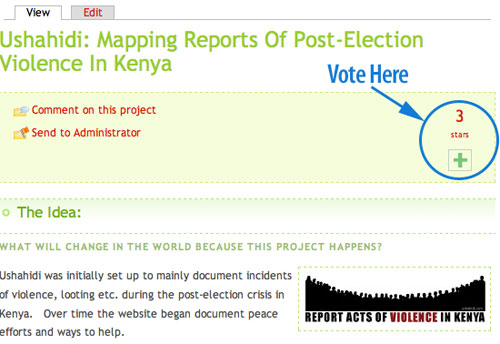

Ushahidi: vote here


Hat-tip: Kenya Pundit

Thursday, 24 January 2008

Blow me away travel maps


Absolutely stunning project from MySociety, a bunch of geniuses, on truly useful travel maps.
This mapping work was very important because it provides a potentially revolutionary new way of working out the best place for people to live and work.
You can see some examples here.

This one shows which areas it makes more sense to get public transport to work in Edinburgh, and which areas it makes more sense to drive.


They compare car vs cycling and one allow users to set both the maximum time they’re willing to commute, and the median house price they’re willing or able to pay.

There are two ways in which you can get a travel map of this sort centred on a location of interest to you.

If you’re a interested user, you can contact your local transport journey planning organisation, for example Transport for London or San Francisco BART, and encourage them to work with us to get a system like this working interactively on their websites.

If you’re a rich user, or company, you can commission us to create bespoke maps – we’re a non-profit after all and all the money will help run our other projects. And if you’re really rich, you can work with us to develop a real-time service of the sort that the transport agencies should be doing. Francis Irving from mySociety has written a technical review on the challenges of developing a real-time map generation system.

If you’re interested in working with us on this, email karl@mysociety.org.

Saturday, 19 January 2008

US States Renamed For Countries With Similar GDPs


The creator of this map has had the interesting idea to break down that gigantic US GDP into the GDPs of individual states, and compare those to other countries’ GDP.

read more | digg story

Friday, 18 January 2008

This is Web power · Kenyans need blogs

Back from a break and some new-ish sites to tell you about, all of which show more new tricks and more great uses for the web (and they're truly inspiring). More to follow, first to Kenya.

NAIROBI — Dipping in and out of the headlines but far from resolved, the Kenyan crisis has shown up many media organisations and quite a few journalists in their ignorance about Kenya. Many have actually openly said that they don't 'get' it.

One good example was China's first statement, issued on Monday (14th). They, rightly, criticised colonialism's legacy, but also said:
"The Western 'democracy' transplanted to Africa is unsuited to local conditions and has sowed the seeds of disaster."
African bloggers have already picked this up and called it 'racist' — western media have so far missed it entirely.

What interested bystanders can now do though is get a wide range of Kenyan opinion and reporting 'on the ground' via blogs. If you really want to get some idea of what's happening and why, blogs are your best source.

There are dozens of Kenyan blogs. Some are by white people but most aren't, many are by expats. Some support President Kibaki, many the opposition but most aren't political. Many are religious or business blogs. Across the range you get endless eye-witness accounts and background, including from members of the Kikuyu, and one incredible photo-journalist's blog.

Saying far more in a few photos than yet another news-free monotone sob story from the BBC's Orla Guerin or ITV's Neil Connery (many Kenyan bloggers have praised Al-Jazeera's coverage), Joseph Karoki's blog has been documenting what's happening since the stolen election.

joseph karoki
Joseph Karoki
Karoki has been sourcing photos from all over - I noticed today that a New York Times photographer is now contributing. And linking to others such as this Flickr collection.

He, along with the other bloggers, have managed to build up a fact-heavy network which is trying to talk peace and preach calm. Anything else, particularly 'tribalism', is being shouted down by other Kenyans in their blogosphere - it's great to watch this network evolving, even if the circumstances are appalling.

Kenyan blog Mentalacrobatics, has another positive angle - which, again, I'm not seeing in the MSM:
I have been expecting many of the younger voters to come and express their anger at me for getting their hopes up that their vote was as powerful as anyone else’s vote. Instead what I have seen is very encouraging; people are engaged in the political process as never before.

For example, earlier on Tuesday a group of youth were busy calculating how many votes you need to be elected Speaker of parliament. At petrol stations you hear debates about whether Nominated MPs are nominated before or after the speaker is elected, people come up to me and ask if there is anything that can prevent Kibaki from stealing all the Nominated MP positions for his own party in defiance of tradition which states the nominated positions are given out in proportion to the number of seats won, and the most requested document request I receive by email these days is for the Constitution.

Tuesday’s parliamentary proceedings were broadcast live on TV and the whole country was watching and taking note. When Marende [opposition candidate] was elected speaker we could hear shouts of celebration from Kibera and Kawangware [Nairobi slums]. This engagement is not exclusive to the middle class. It looks like stealing an election is a fantastic way to get the public engaged in civic education. Now that is a massive silver lining!
The exasperation with leaders is constant, as is the demand for fair elections. One sign of blogging's growing power in Kenyan politics is that they've rapidly developed as an avenue for counter-opposition propoganda.

Another rapidly growing angle is the use of video. This has been circulating news of acts of police violence — The following video may disturb you - which have transferred to MSM.


All of which gives the lie to the opinion expressed not just by the Chinese but by many Westerners - that democracy won't work in Africa. Online you can watch Kenyans trying to build their democracy. I find this inspiring and the cynical, sometimes racist, attitudes to their efforts somewhat depressing and lazy.

Karoki and other bloggers are working with Mama Mikes - the big electronic money transfer business - with an appeal for Kenya. There, you can buy a shopping voucher which will be used by Kenya Red Cross for food, water, blankets, clothes, sanitary products, toys for children etc. (And maybe condoms).

There's also another excellent blogger initiative called Usahidi (Swahili word for 'witness') which is recording all acts of violence (on a Google Map).


As many bloggers have explained, what's happening - especially with the continuing total news media blackout imposed by the government - has shown exactly why the Internet is so important for Africa.


Addendum: Wikipedia is a good source on British colonialism in Kenya (stuff you wouldn't know from school). Did you know we (the British) had over a million Kenyans in concentration camps within living memory - during the 1950s uprising?


Saturday, 15 September 2007

World's Worst Polluted Places 2007


View Larger Map

The Top Ten (in red) of the Dirty Thirty (in purple) as determined by the Blacksmith Institute.

KML KML

NB: This was easily done from new 'Link to this page' Google Maps option, but the worstpolluted.com site didn't suggest it.

Wednesday, 12 September 2007

Google loses it and other musings


I've posted before about removing widgets because the servers serving them were too slow - and holding up other content. Well add to this the widget being reprogrammed with no warning and disappearing.

That's what Google just did with Reader. Changed something so one aspect of the service disappeared, in this case my 'what I'm reading' widget - vanished. Fortunately, I spotted it because someone else did and alerted me, I thought to check whether I could redo it and I could.

Crap customer service from Google - adding to the accumulating bad image they have in that regard - as sending me an email alerting me to it changing is dead, dead simple. Automatable, even.

Because I figure it's a one off (hah!) I did a bit more and withered my feeds and put them through the Reader widget.

Availability is very important! Google Maps is a real alternative to expensive alternatives not just because it's free but also because it's available, it's reliable. MS Live Local isn't, it's slow. Haven't experimented with Yahoo Maps yet but I prefer their interface and they're fast, so there is a Google alternative.

I also removed the Technorati 'tag cloud' widget because it wasn't picking up my tagging — Blogger has 'labels' rather than tags, the cause I believe. You clicked 'environment' and it gave no results. I haven't seen an easy to use 'tag cloud' widget yet (I may now go look, they're the best way to organise content :).

I really dislike how Technorati's changed and I haven't seen much development in areas like widgets with them for a long while (Read/Write Web has more about Technorati's woes).

Blogger does seem some way behind WordPress, which appears to be the cogniscienti choice, having used that elsewhere and seen what else it provides I see why. I just find myself defaulting to Google products because it's easier and quicker and the negatives aren't crucial.