Now posts ↓

Showing posts with label australia. Show all posts

Thursday, 12 September 2013

Refugee Convention assaulted by Australia and Israel

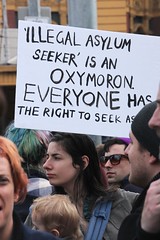
'illegal asylum seeker' is an oxymoron - Refug...
Refugee Action protest 27 July 2013 Melbourne (Photo credit: Takver)

Although the issue of refugees and asylum seekers has been the subject of furious - and often intemperate and ignorant - debate the world over only now is the actual Refugee Convention under serious threat.

In the run up to Australia's election something happened which caused a collective gawp for the sizable Australian minority who haven't lost their minds about refugee boat arrivals.

The then Labor government proposed a new policy of shipping boat arrivals to Papua New Guinea (PNG) and refusing them asylum in Australia, thus abrogating a basic principle of the Refugee Convention, which almost all nations are signed up to, either the 1951 Convention and/or the 1967 Protocol.

Australian policy towards asylum seekers is described by politicians as "harsh". 'Vindictive' and 'cruel' would be more apt. The place in PNG where boat arrivals are being sent (and only them, not those claiming asylum at an airport, logic has nothing to do with this politics) is a dump, on a tropical island, where rape and torture has been uncovered as ocurring - the government tried to cover that up. They are sending children there. The 'PNG option' came from strong arming and aid threats. Locals to the camp, on Manus Island, say they are being shut out of jobs and get no benefit from it. They say they would welcome the asylum seekers living in their community.

This was sold to Australians as "humanitarian" because it would 'stop the boats' coming from Indonesia as some of them sink and over 1000 are thought to have drowned since 2001. But another investigation found more cover up of a failure to stop boats at risk of sinking and aid them - another two-finger salute to international law, in that case the international law of the sea which demands mutual aid on the high seas.
In the dead of night on 17 December 2011, an asylum seeker boat called the Barokah left the coast of Java with around 250 men, women and children on board. One of them was ethnic Hazara man, Esmat Adine. The boat was so crowded, Adine couldn't even find a place to sit. The Barokah was just 40 nautical miles from Indonesia when it fell apart.
'At first I couldn't believe that our boat has sank,' Adine recalls. 'But I saw a toy is coming from the inside of the boat; it is coming by water. When it comes close to me, I realised that no, that was not a toy. That was a kid. That was a kid named Daniel. Daniel was with his mother; they were sitting in front of me, next to me, while we came by bus. When I saw Daniel's body, I realised that our boat has sank, and there is no further hope for us to be alive. '
Eight hours later, at 3 o'clock that afternoon, a passing fishing boat found around a hundred people in high seas, desperately clinging to debris. It was only able to rescue 34 people. Adine shouted to the people in the water, 'Be patient—we will bring you more boats, and they will rescue you.'
In Canberra that evening, Australian agencies became aware the Barokah had sunk. They told Indonesian authorities, because the boat was in their search and rescue zone.
Months later, customs officials would tell a Senate Estimates hearing that Indonesia had initially declined Australia's offer to help with the search and rescue.
But the official incident timeline, which Fairfax obtained under freedom information laws, revealed that BASARNAS, Indonesia's search and rescue agency, had asked AMSA to coordinate the rescue response—AMSA refused.
For two days, while men, women and children struggled to survive in waves up to six metres high, Indonesia and Australia did nothing.
Finally, on December 19, BASARNAS asked again for help. This time, AMSA agreed, and dispatched naval and Customs assets to the scene.
But it was too late. Two hundred and one people were dead.
(I should note there have been similar criticisms of the Italian and Greek's border protection services and the EU.)

Australia actually wanted the Refugee Convention to be changed to suit them. Fortunately they were rebuffed but who knows if either the new Australian government or some other governments peaked by the Australian effort will try again.

The Convention was drawn up in the wake of World War Two, during that period when most of the world worked together to draw up the basic laws which make up a decent, peaceful world. It was a reaction to the shameful way Jews attempting to flee Nazi Germany had been treated in the 1930s, as well as the immediate needs of those fleeing communism.

The latter is why Israel's abrogation of the Convention is causing such consternation as it acts much as Australia is doing. In Israel's case, I kid you not, trading refugees for weapons with Uganda.

Writes Natasha Roth for +972 Magazine:
That this is a war on asylum seekers and human rights is self-evident. But it is also a war on dignity and an assault on human memory and conscience. Whether or not the deal goes through, the fact remains that the Israeli government has seriously considered forcibly dispatching thousands of Africans, to a country not of their choosing, as part of a trade agreement. This brings up a historical recollection of such offensiveness that it is difficult to address it directly. Furthermore, the overlooked “commodity” in this proposed deal is space – for that is what the Israeli government will receive for its part in the potential bargain. This reported agreement is nothing more than a chapter in Israel’s playbook for ‘making room’ and homogenizing; it is persecution as ‘preservation.’ Doubtless one of Netanyahu’s spokespersons will find an appropriate moniker to try and lend some legitimacy to the proceedings (when the Serbs did the same thing in the 1990s, they dubbed it “ethnic cleansing”).
The Israelis characterise the refugees as "infiltrators". The Australians insist they're all "economic migrants".

The ones in Israel are all black, mostly Sudanese and Eritrean. The ones arriving in Australia by boat are mostly Muslim, Afghans, Iranians and Iraqis.

Makarere University Security Studies Professor Paul Omach told allAfrica.com that Israel's actions are 'just another example of a richer nation paying a poorer one to solve its problems'.
Israel looks at these immigrants, mostly Africans really, as unwanted in its country. So if somebody can take it and you can just sign the checks, and you get somebody who is itching for money, that is definitely what they will do.
The co-founder of the International Refugee Rights Initiative in Kampala, Dismas Nkunda, told allAfrica.com that the deal would completely undermine the Refugee Convention:
What happens to them, certainly that is going to be a very big legal problem, because on what basis are they being admitted in Uganda? They have not sought refugee status in Uganda, they have not sought asylum in Uganda. They sought first asylum in the first country they thought of, which was Israel. Actually, you might say that they might end up becoming stateless.
If Australia gets away with it and Israel gets away with it who will be next? If they want to do this just unsign and stop pretending to be 'humanitarian'. Why are there no consequences for those who sign up and then ignore the rules?

As Laissez Passer points out, Kenya's courts are doing a better job of defending international law than Israel's - you could say much the same of Australia's courts. And Kenya hosts hundreds of thousands of refugees. Israel 55000 and Australia far, far less.

Jerome Connolly and Joan Roddy write that:
An unwritten assumption underlying the Convention is that States Parties would not be faced with unmanageable flows of asylum seekers. But experience has belied that assumption on a number of occasions and shown how, in practice, this and other assumptions on which the smooth running of the Convention depends can be invalidated. Asylum determination procedures may be overwhelmed or made irrelevant by mass movements engendered by political violence, especially when conflict spills over frontiers. There may be an associated breakdown of political authority or alternatively borders may be closed as an emergency measure to protect the authority and resources of the host country. This may deny asylum to many refugees or lead to greatly diminished protection for them.
But neither Israel nor Australia are "overwhelmed" except by rhetoric saying they are "overwhelmed". Their actions go far beyond criticism you could make of the treatment of refugees and asylum seekers by Greece or the UK or Turkey, they undercut the basic concepts agreed on for years.

And this is happening when many are worried that growing conflicts and problems like climate change and water shortages will also test the Convention, that protections need strengthening not weakening.
Enhanced by Zemanta

Tuesday, 10 September 2013

Behind the scenes of Assange's WikiLeaks Party disaster

English: Picture of Julian Assange during a ta...
Assange during a talk at 26C3 (Photo credit: Wikipedia)
Assange's Wikileaks Party got less than 1% in Australia's election at the weekend.

This followed damning revelations about party operations and preferences given to the far-right in the Senate. Formerly loyal insider Gary Lord here unloads on Assange and his Australian praetorian guard.
I first met John Shipton [Assange's father] when he was contacting National Council members prior to the formal registration of the WikiLeaks Party. As a long-time vocal supporter of Julian Assange and WikiLeaks, I was honoured to have been invited to join the Council. But given that the party would soon be under huge public scrutiny, there was something I needed to explain: I had gone bankrupt a few years earlier (after the failure of Kevin Rudd's Green Loans scheme, ironically) and I was still not formally discharged, so I was not sure if I was legally allowed to be on the Council.

John made a quick phone call to lawyer Kellie Tranter, later the party's NSW candidate, and then told me I would not be able to join the Council. After years of dedicated support for WikiLeaks, I felt gutted. But I accepted the decision in the best interests of the party.

"Never mind," smiled John with a sly wink, "we all have a few skeletons in our closets, don't we?"

John did not seem too unhappy at all about my situation, and I couldn't help wondering if that had something to do with my friendship with Julian's mum Christine. It was never going to be easy for the two of them to work together. [removed at request of Christine Assange - Gary]. My original understanding was that John would help set up the WikiLeaks Party and then step away from the day to day running of it. It's a pity this did not happen.

Months later, as the divisions within the party became more obvious, I contacted the Australian Electoral Commission myself, and learned that bankruptcy did NOT in fact prohibit me from being on the National Council (it only made me ineligible to run as a Candidate in the election, an option which was also discussed).

In retrospect, sharing my financial situation with John Shipton may have been one of the biggest mistakes of my life. I do not regret it because I did what I thought was right for the party and the values WikiLeaks represents. But given the WikiLeaks Party's own subsequent lack of honesty and transparency, my voluntary personal disclosure seems bitterly ironic.
.....
In New South Wales, the White Nationalists from Australia First and the militant Shooters and Fishers party were preferenced above the Greens. In Western Australia, Julian Assange's staunchest parliamentary supporter, Greens Senator Scott Ludlam, was preferenced below his strongest rival, the National Party. Even in Victoria, the Greens were well down the list behind minor parties. By contrast, the Greens had preferenced the WikiLeaks Party (WLP) extremely highly in every state. 
I had just spent a week on Twitter trying to suppress rumours that the Greens would be preferenced well down the WLP list, and now it turned out the rumours were true. Worse yet, the source of those rumours was a WLP National Council member, Cassie Findlay, who helped submit the NSW preferences. And after helping me and others look like fools, Cassie conveniently disappeared off Twitter and ignored my DMs (thanks for that, Cassie). 
The WikiLeaks Party issued a statement blaming an "admin error" for the preferencing debacle and promising a review AFTER the election. That was never going to be good enough. Social media was going off. The mainstream media was all over it. Our biggest detractors were rubbing our noses in it and there was nothing we could say in reply.  
We clearly needed a proper public response from the party ASAP. But all the WikiLeaks Party insiders were suddenly - and very strangely - silent. This was not OK.  
I spoke with the only National Council members I knew personally, Sam Castro and Kaz Cochrane. They were both in tears on the phone. I urged them to be patient and give things time to work out, but they explained that others were already walking out the door. When Leslie Cannold's resignation prompted a wave of departures the next day, I started publicly demanding answers from @WikiLeaksParty on Twitter.
.....
The WikiLeaks Party had promised a full inquiry AFTER the election. But Julian's August 30th appearance on ABC The Drum suggested that no inquiry would be necessary. Mistakes were made but nobody would be held accountable, the people who resigned over these errors were somehow out of order, even if Julian accepted responsibility, and in any case he agreed pretty much with everything that was done anyway.  
Was her serious? Or just trying to bluff his way through? 
.....
I am deeply concerned that the WikiLeaks Party was unnecessarily politicised, not by Greens supporters, but by people with a hidden right-wing agenda, including John Shipton, Greg Barns (campaign manager, former Liberal Party candidate and advisor to former PM John Howard) and Julian Assange himself.  
Gary joins a long, long line of former supporters burned by arrogant prat Julian Assange.

More >> Jaraparilla: Where's That WikiLeaks Party Inquiry?
Enhanced by Zemanta

Thursday, 29 August 2013

Australian Aboriginal community 'bombed': Australia shrugs


On Tuesday a report flickered across Twitter that an Aboriginal community in Western Australia had been "bombed". Wait, What!? The ABC report was that a bomb had been thrown at a group in the One Mile community outside Broome. Three had been injured, one very seriously.

This, one day after the fiftieth anniversary of the March on Washington. An event whose relationship to this report is not fanciful.

I dug around. There was no further reporting. But others, a very few others, had noticed. Bree Blakeman, a Canberra based anthropologist, was tweeting background. There had been another attack, arson, on emergency housing used by Aboriginal people. Local Aboriginal people did believe that their people had been attacked and were scared, she wrote.

Shift forward one day and the event was still not being widely reported. The local ABC then reported that the local police were calling it not a 'bombing' involving "explosives" anymore but 'pyrotechnics'. A 'firework' had somehow caused spinal injuries, burn or blast injuries which exposed bone and a 43 year-old woman had lost the use of her hands. Among the others injured was a 13 year-old girl. They repeated a comment made the previous night, emphasising that it may all have been a "prank" and played down a possible racial motivation.

This comment from the initial report suggests serious police apathy (my emphasis):
I'm looking forward to catching up with the people responsible for this and bringing it to their attention, and also bringing them before the judicial system.
The local ABC radio ran a call-in asking listeners if there 'should be more measures in place to stop fireworks and crackers coming into WA [Western Australia]?'

The infrastructure of Aboriginal Australia is a legacy of colonialism and dispossession. Communities which are former missions, gulags originally built for Aboriginal people in the 19th and early 20th centuries where they were to be trained as a second-class workforce. Shanty towns on the fringes of rural towns, like Broome, where segregation existed just like in Dixie and led to 'freedom rides' by Aborigines and concerned whites inspired by the American civil rights movement. Continuing this tradition of segregation, in Broome some white locals still want the 'Aboriginal problem' to be 'out of sight'.

One Mile in Broome is a legacy of what came before. It is part of a impoverished local community, where up to a quarter are homeless, in one of the richest parts of the world, and where sub-standard housing is the norm and its development constantly stalled. A community made poorer by sky rocketing rents and living costs.

Western Australia is rich from mining. Broome is no longer just a very isolated tourist and fishing town but a service centre for vast mines, oil and gas.

Blakeman suggests that one place to look for possible suspects could be "rednecks" flown in from the rest of Australia to work in the nearby giant gas works. She notes that swastikas have been daubed at One Mile.

She also points out that Australian police have form on dismissing attacks, even killings, of Aboriginal people as 'non-suspicious'. It is not just police in rural Australia. Police in Melbourne were caught using racist beer holders and their failures around racist attacks on Indian students caused an international incident. In Sydney, police treatment of Aborigines caused riots in 2004 in the inner-city suburb of Redfern, whose impact continues in the claimed persecution of the family of one of the youth whose death caused the rioting.

That the local police would underline that the Broome attack could be a 'prank' sets off warning signs for many as so many other violent, racist attacks in the past have been thus dismissed.

I will note that what exactly happened in Broome, let alone why, is unclear. A local freelance, Chris Campey, has been reporting and has been careful to simply report and not speculate. It may turn out to be a 'fiework' and a 'prank', though one which definitely has caused serious injury.

But physical attacks on Aboriginal communities are not rare. What they never are is 'terrorism'. If a "bomb" had been reported being thrown at parishioners of Sydney's influential Hillsong church, or at people outside Melbourne's Stock Exchange, it would dominate local media, we would know the names of those hurt, and international media would descend.

Those attacked in One Mile are the most marginal people in Australia. These communities are raw with violence, abuse and death. This is often the only view both Australians and the rest of us see of Aboriginal Australia. That can be damaging, dispiriting and inaccurate. I have written about the other side: the magical collaboration with scientists on Australia's unique history; on the great work being done in building Aboriginal enterprise and economic opportunity; on the breakthrough into the media and artistic mainstream.

But that a "bomb" can be reported as going off in Australia and it simply be ignored because of who it targeted speaks volumes about how far Australia has to go to tackle its ingrained racism.

Update, September 10: Police have ruled out racial motive and describe an "ignited object".

As I wrote, this situation may well have not been racially motivated. This does not take away from the initial and total absence of any reaction to the initial reporting, which would have been different if those reports were coming from anywhere but an Aboriginal community.

Enhanced by Zemanta

Tuesday, 27 August 2013

Murdoch punks Australian election


I wrote the other day about how the collapse of Julian Assange's electoral project in Australia seems to have attracted little attention, even among Assange's detractors. Australian stories don't get attention unless they involve crocodiles or missing backpackers. The BBC's former Australian correspondent Nick Bryant has bewailed on that very subject.

Here's another being missed story, the blatant attempt to swing the Australian election by Rupert Murdoch.

According to Neil Chenoweth, a senior writer with The Australian Financial Review, and who is described by the International Consortium of Investigative Journalists as "the world’s most substantive writer on the public and hidden worlds of the Murdoch business empire", Murdoch's campaign against the Australian Labor Party (ALP) is in large part because the ALP dared to try to regulate, or rather reign in the excesses of, Murdoch's Australian newspapers.

Following the revelations in the UK of systematic law-breaking by Murdoch's papers, which culminated in the Leveson Inquiry and the closure of the News of The World, Australia's government grabbed the opportunity and instituted their own inquiry and devised new media laws. They failed (and the proposed laws didn't even tackle media centralisation in Australia, the worst by far in the Western world).

Murdoch then dispatched his most vicious attack dog, Col Allen, and, says Chenoweth, "what politicians in Britain and the US can draw from this is that leaving Rupert Murdoch with a flesh wound is like writing a suicide note. He is taking names. He will come after you."
Under Col Allan, News Corp Australia has unleashed an extraordinary campaign to denigrate the Labor Prime Minister at every opportunity, while endlessly praising [opposition leader] Tony Abbott.
...
In the face of unrelenting negative coverage from the News Ltd papers the Gillard government came to believe News had crossed the line. It sought to pass media reform which would disadvantage News but failed to get it up. The election campaign was always going to be bloody.
Another Murdoch foe, Tom Watson MP, has flown into the election to support the ALP and specifically to highlight Murdoch's relentless campaign. Murdoch's newspapers' response has been to report Watson as "fat" and ignore his actual criticism and reason for being in the country.

Watson's thesis is that the ALP's National Broadband Network (NBN) is a threat to Murdoch's business interests. Murdoch has cable TV interests and the government plan for super fast national Internet is a threat to NewsCorp in a world where Netflix is now reportedly a third of internet traffic in the US.

Watson said he decided to travel after he saw what the BBC has reported (as a one-off), one Murdoch paper's front page rubbishing Prime Minister Kevin Rudd (pictured above, second from top right). Chenoweth points out that this front page is an example of a tactic that Col Allen honed in the bearpit that is politics in the state of New South Wales:
His photographers dogged state and local politicians until they caught them drinking in the wrong place, jaywalking or breaking road rules. As a merry jape he would superimpose politicians’ faces on film characters with outrageous headlines.
Watson's numerous media appearances since he arrived seems to have at least tweaked Murdoch's mates. So there's that.

Watson has pointed out that the Murdoch paper's coverage need only swing a few voters to deliver a right-wing victory in a very tight election. The sustained anti-Labor campaign has been going on since early 2011. Although the ability of Murdoch to swing elections has been questioned many times before, most famously his own newspaper The Sun's claim that they were 'what won it' for the Tories in Britain in 1992, even skeptical media academic Peter Chen points out that media spin/bias does empirically have an effect, though maybe in ways you mightn't think it would and maybe just at the margins.

Chen, like Chenoweth, also sees Murdoch's actions as less, or not just, about NBN and more, or equally, about payback and "the greater ideological alignment between the aging patriarch and Tony Abbott." Murdoch's praise for Abbott on Twitter has been almost cringe-worthy.

Warns Watson:
Politicians should know that they are commodities to Murdoch. He moves them around. They should think again if they think they will enjoy his loyalty forever.
Underlines Chenoweth:
There is a cost to this. First, Murdoch will demand his price . . . every year. It’s what he does.

Second, it looks like Col Allan isn’t going back to New York. He’s hanging around. He has six big papers to play with but only one style of journalism: it’s about brute force. It doesn’t really matter which government is in power. He has no other model. So he’ll be coming for you too.

News Corp Australia, whether overtly or not, will claim that it got Abbott into government. This puts Abbott into an impossible situation.

It undermines the legitimacy of his incoming government. This is not a partisan thing. You may or may not feel Abbott deserves to be PM. But whether you are a Liberal or Labor supporter. it’s absolutely unacceptable for a foreign company to be able to claim that it determined the Australian government.
Or, for that matter, any government.
Enhanced by Zemanta

Thursday, 22 August 2013

Assange getting kicked in the nuts in Australia's election

English: Julian Assange at New Media Days 09 i...
 (Photo credit: Wikipedia)

Since it does not involve crocodiles or stranded backpackers, the news that Julian Assange is set for humiliation in Australia's election is unlikely to get much traction, but it should.

There was never more than a faint chance that he would be elected to Australia's Senate from the state of Victoria in the first place, according to Australia's version of Nate Silver, Anthony Green. It was always smelling of stunt politics because Australia has rules which near certainly bar Senators who cannot actually sit in the Senate, who attempt to do their job from foreign embassies in foreign cities.

But the past few days there's been a trio of hits showing the party for what it always was: an extension of Julian's massive ego.

First came Assange's love fest with Ron and Rand Paul, thanks to a question from an Australian student activist at an election forum about their version of libertarianism. Assange said:
“So non-violence – don’t go and invade a foreign country. Non-violence – don’t force people at the barrel of a gun to serve in the US Army. Non-violence – don’t extort taxes from people to the Federal Government with a policeman. Similarly, there are other aspects of non-violence in relation to abortion that they hold.”
The guns statement hasn't got much traction, even though Australia is famously anti-gun, but the abortion one certainly has (the Paul's are anti-abortion and push for such measures as 'personhood' which would outlaw abortion and some forms of birth control). I guess Assange has to somehow twist to support the Paul's on that murky area of their politics, much as Paul supporters generally do. He avoided commenting on the Paul's racism.

Abortion is an issue in the election because Abbott, the opposition leader and likely next PM, is a Catholic like Mel Gibson is a Catholic. Former PM Julia Gillard made some noise about fears for what Abbott would do on abortion if elected. For women voters this isn't some minor issue.

Some of his other comments would no doubt rankle with most Australians, given that libertarianism holds little sway and Australians not only support free abortion access and gun laws but also their national health service. On taxes, he couldn't be more out of touch with voters concerns in an election being held in an economy going gangbusters where the potential PM's are outbidding each other on what programs voters' taxes should be spent on.

Then we had the Wikileaks Party preferencing the Greens last.

In the Senate you vote above or below the line, meaning that you either tick one box or write numbers in dozens of boxes. Above the line and that vote is allocated according to the party's ticket. This is how minor party candidates and independents get elected to the Senate, based on the preferences of people who voted 1 for someone else.

The Senate elections are actually descending into farce with some metre long ballot papers with candidates' names written in 8pt type and election officials buying up magnifying glasses. The host of minor parties now includes the Coke in the Bubblers’ party. Reforms are needed because these tiny parties actually wield some power when negotiating preference swaps with the big parties. So even though Assange must have known his election was unlikely, just setting up a party has had bought him a measure of influence.

Wikileaks claimed it was all a big typo and Assange put it down to teething pains and 'we're all volunteers'. It means they are preferencing last some of Assange's biggest supporters in Australian politics and putting ahead of the Greens far-right Australian parties including one which is allied to Greece's fascist Golden Dawn.

Now it has come out that the preferencing wasn't a mistake as there's been a spate of resignations, including Assange's #2 on the Victorian Senate ticket, the women who would have actually sat in the Senate if Assange had got up.
In a blistering statement, Ms Cannold said she could not remain as a candidate because to do so would be implicitly making a statement that the WikiLeaks Party was what it claimed to be - "a democratically run party that both believes in transparency and accountability, and operates in this way".
Oh, the humanity.

Anyone who has seen a documentary on Wikileaks or read Guardian journalist James Ball or followed the saga of Julian's flight from Swedish sexual assault charges will know that the organisation is now little more than a front for his ego. How anyone knowing that would think his party could be 'transparent' or 'accountable' must have been asleep the past two years.

Among the flood of resignations, Party National Council member Daniel Matthews said this:
The final straw for me was Julian’s explanation of the fiasco on Triple J [national public service youth radio station] hack on Tuesday night — after a full day of frantic communication within the party, including to his inbox.

He said the following, in flagrant contradiction of everything that had been happening within the party, going to him and his inbox.

“There was a decision that preferences would be done by the states, by the candidates in the states.”

This is wrong. Preferences decisions were made by the National Council and were binding on the party. It was only in Julian’s proposal that candidates were given free rein over preferencing — and that proposal also gave Julian veto power and reduced the National Council to a sham, and was rejected.
I can picture the scene in a cupboard in the Ecuadorian embassy, Assange ranting and raving as he contemplates the utter humiliation due to him in a fortnight's time.

If you'd like to continue having a laff at Assange's expense you can watch him 'dancing' after the jump.

Update: When in a hole ... Assange has now bitchslapped resigned Senate candidate Leslie Cannold and called her second rate.

Wednesday, 21 August 2013

Against Said on 'orientalism'

Margaret Katherine at Gabarnmung

After once more regretting going BTL (below the line) in a comments section of The Guardian I discover a fantastic demolition of Edward Said's 'Orientalism' on Jacobinism.

The lengthy, thorough post had lots which springs out. It quotes Ibn Warraq on practitioners "intellectual terrorism". It describes Said's hugely influential work as "an accusatory and deeply reactionary text" and describes the ill effects it has had, principally in the Arab world. Go read the whole thing.

But what most sprung out to me was this:
And while Said's work was a convenient cudgel with which to bash the West, it was often misleading and tendentious to the point of outright fraudulence. The Orientalists Said attacks in Orientalism were not the Imperialist stooges of his imagination. They were learned classicists and multi-lingual philologists motivated by a desire to know about and to understand cultures, traditions and peoples unlike their own. Their voluminous research and the translations of Arab texts they undertook have proven invaluable, not only to Western scholars but also - in spite of Said's claims to the contrary - to Middle Eastern scholars, who were grateful for the preservation of their own neglected pre-Islamic history.
I immediately thought of the scholars who documented Australian Aboriginal culture in C19th and early C20th. Who did this work at a time when the worst horrors were being inflicted on Aboriginal people.

Their records are now used by Aboriginal communities all over Australia to reconstruct or fill in the blanks about their ancient culture. They have been crucial to native title claims over land.

It also made me think of the four part series just finished on Australian TV, First Footprints, about how Aboriginal people transformed the environment. The series is a collaboration demonstrating this alive and wonderful connection between scientists and Aborigines.

Doug Anderson, the veteran TV critic now writing for Guardian Australia, describes one of the series' highlights, from a site which is at least 15,000 years older than Stonehenge:
The sight of Jawoyn elder, Margaret Katherine, learning factual details at an amazing rock art gallery near Kakadu from anthropologists and archeological experts is profoundly moving. You can feel her joy as she realises the stories she is custodian of not only have authenticity but are verified by tangible evidence thousands of years old. Her gratitude is as palpable as her dignity.
Indeed. Throughout the series we see a real exchange. In one highlight trackers from the central desert explain to scientists what is going on in ancient footprints found at Willandra Lakes. In another at the 'world's largest gallery' in the Kimberley, Western Australian, a scientist gives the date of rock art depicting a human face to an awestruck young Aboriginal local.
  • The whole of First Footprints is on YouTube, part one here. (Timelapse photography short after the jump.)
Another of the things I learned from the series was that there are probably more trees now in Australia than at first contact because Aboriginal people systematically burnt to create grassland and open woodland. This so impressed the first white settlers and it is now thought that the pictures painted of pastoral scenes once thought misleadingly reminiscent of Britain are accurate.

HT: Harry's Place.

Tuesday, 30 April 2013

The Guardian's 'Avatar' view of Aboriginal people


Simplistic and out of touch could be one recent impression of The Guardian's publishing on Aboriginal people.

Take two current examples from the left presenting angry white, male and Western enviromentalist/socialist perspectives.

On the face of it, if you know nothing of the subject matter, Martin Lukacs 'View from the North' on land rights and mining/drilling in Canada is an odd bit of writing.

He describes a meeting with a Master of The Universe (MOTU) on Wall Street, accompanied by (natch) rape apologist Naomi Klein Wolf. The meeting's aim being to push indigenous land rights as having legal force and hence that they should be counted in consideration of a countries credit rating.

The MOTU, shock, agrees. Legally they may be right but "you and whose army" are going to enforce them.

Lukacs' subsequent argument (it's not really reporting) seems to be predicated on the idea that the battle over land rights in Canada will result in the end of mining/drilling. Literally, he seems to be arguing, Canada's First Nations (as they are known) will 'SAVE THE EARTH' from climate change because, y'know, Aboriginal people, like the inhabitants of Pandora, don't want 'land rape' ...

Not all 'Earth Warriors'

The other day I was watching 'Mabo', the ABC drama about the Murray Islander whose long legal battle ended the concept of 'Terra Nullius' -- empty land -- which meant that he had no legal claim to ancestral land.

Eddie Mabo had all sorts of issues to deal with and one of them was his own people. In one of the first scenes in the drama the elders police his behavior on behalf of the white 'protector'. Later fellows drop out of his legal claim and he is left alone.

The Aboriginal experience in Australia is not one experience and is not solely one of oppression by whites, the communities have their own internal problems, often ones experienced by lots of other communities and which come down to being human. Writers like Lukacs ignore all this grey.

Lukacs' hope for humanity's salvation via Aboriginal land rights is predicated on Aboriginal people not wanting any of that nasty mining/drilling. Now I don't follow First Nations' issues closely but a quick Google brings up negotiated settlements between nations and mining companies, here's one signed a few days ago by a community on Vancouver Island:
Elliott called the potential deal "huge" for his people."

"It's going to create jobs," he said.

Details on exactly how revenue would be shared between the company and the First nation have not been worked out yet, Elliot noted.

"I think any percentage is going to be significant," he said.

"We're going to have a big hand in how the whole project works."

Elliott pointed to an agreement his council signed with Fortis B.C. worth $6 million. The First Nation also has stakes in forestry, aquaculture, petroleum and commercial construction.

"This (new) partnership is going to be 10 times, 20 times larger in the sense of creating opportunities for our members," he said.
Now Canada may be having issues with such deals but clearly they exist and they sound, in terms of what Aboriginal leaders say, just like Aboriginal leaders elsewhere, just like those in Australia. They demand to be part of economic development.

Green/left Kryptonite

An Australia elder, Professor Marcia Langton, has caused consternation on the Green Left through her arguing that mining has been a massive economic plus for Aboriginal people:
When W.E.H. Stanner delivered the Boyer Lectures in 1968, After the Dreaming: Black and White Australians - An Anthropologist's View, he gave credence, perhaps inadvertently, to the widely held assumption at that time that Aboriginal life was incompatible with modern economic life. Today, the expectation is quite the reverse.

The policies of federal governments for the past decade have made explicit the expectation that educational achievement and employability will be the key outcomes of spending in indigenous affairs portfolios. This is a view shared by most ordinary Australians.

But on the left, and among those opinion leaders who hang on to the idea of the new ''noble savage'', Aboriginal poverty is invisible, masked by their ''wilderness'' ideology. Their unspoken expectation is that no Aboriginal group should become engaged in any economic development.
In her Boyer lecture Langton goes further, asking whether legendary environmental campaigner Tim Flannery had written something he intended to be "provocative and racist". Langton has caused mass outrage of course as environmentalists and the left struggles to deal with her arguments (or resorts to claims that she must be in the pay of the mining companies). I've embedded Langton speaking at last year's Indigenous Business Enterprise and Corporations Conference after the jump.

It is of a pattern. Another Aboriginal elder, Noel Pearson, has faced similar exasperation from the left as he has worked on alternatives to welfare dependency.

So how does the Guardian, which is trying to expand its reach to Australia, deal with this issue of mining and Aboriginal people? It publishes an 'woe-is-us' essay by John Pilger which is entirely about mining and Aboriginal people and which ignores Langton, even though the area he focuses in on -- the Pilbara in Western Australia -- is her focus too.

Pilger silences the major Aboriginal voice contradicting him and ignores the huge debate in his supposed country that her Aboriginal elder's voice has caused. What would you call that if it was not Pilger, the great white exposer of Australia's historic sins, who was doing it? Dare I say racist?

Writes Russell Skelton in The Age:
The attacks on Langton could be filed away as nothing more than a monumental storm in a tiny teacup. But I believe there is something far more profound going on - given the level of vitriol, she has touched some exposed nerves.

What Langton is saying sits uncomfortably with the way the Aboriginal industry - activists, NGOs, Amnesty and anti-intervention groups - have stereotyped Aboriginal Australians as a powerless, downtrodden, oppressed minority living in a world of disadvantage fuelled by government neglect.

It's a view that has its roots in our shocking colonial history and in the landmark battles fought in the 1970s when Gough Whitlam and Malcolm Fraser led the charge on land rights, native title, equal pay, access to welfare and unemployment benefits against a coalition of belligerent miners, ruthless pastoralists and recalcitrant state and territory governments. An essential part of Langton's thesis is that times have changed, old ways of seeing are no longer useful.
Skelton says something which is like Green Left Kryptonite:
[The mining corporation] Rio Tinto has a far superior track record when it comes to creating skills and jobs than any government or NGO.
Australia 'Closing the Gap'

What Pilger fails to tell the Guardian's left/liberal British audience is that there has been an incredible development in Australia over the past decade. As I reported when comparing it to Australia's sickening treatment of asylum seekers arriving by boat, there is now near universal and definitely bipartisan commitment to both Aboriginal development and facing up to history.

Pilger is flat out wrong when he claims that Australia is still trying to bury the past.

All political parties are committed to changing the constitution. Australian TV, as I have also reported, now features Aboriginal stories written, produced and directed by Aboriginal people in prime time and getting hit ratings and awards.

When Kevin Rudd apologised to the Stolen Generations in 2007 he also launched the bipartisan 'Closing The Gap' strategy of systematically meeting targets in education, housing and health. Five years on and one has been met, by the end of 2013 all Indigenous four-year-olds in remote communities will have access to early childhood education.

Australians are well aware of the problems -- the 'gap' -- which Pilger writes exclusively about. He is not telling any of them, that's any Australians, urban/rural, right or left wing, anything they are not both knowledgeable about or concerned about.

Pilger comes with no solutions, none. That is something Australians are sick of and if The Guardian is going to get any traction in Australia it had better start publishing some thinkers coming with solutions, ideas to end the horrors Pilger describes, and not just old white lefties that Brits still think are relevant whilst Australia has moved on.

Edited to add: Just noticed that for the Guardian's audio edition which features the Pilger article that they've picked a traditional, apparently stock, touristy image (pictured right) to illustrate rather than looked a bit harder for one of your average Aboriginal person.

Edited to add: I missed this excellent video report (not embeddable) via The Age about the Aboriginal run multimillion dollar businesses proving themselves in the Pilbara. It interviews some of the owners and I'm left wondering if a photo of one of them could best illustrate a 'typical Aboriginal person' rather than a stock traditional one, eh Guardian? Also wondering if any of these businesses will make it into Pilger's film, supposedly about their area, for ITV?

Listen to Marcia Langton at the 2012 Indigenous Business Enterprise and Corporations Conference after the jump:

Postscript: America's shame in one photo


After suggesting that the world shun America over guns and their lack of control I see that The Daily Show has a better idea: Mockery.

They sent John Oliver Down Under to investigate Australia's 1990s conservative-led tightening of gun control laws. Americans are even aware of Australia's example probably because former Prime Minister John Howard published a New York Times Op-Ed post-Sandy Hook, titled 'I Went After Guns. Obama Can, Too'.

Oliver speaks with him, drops the "Whoopty-f—ing do" bomb on him even (word is Howard approved), as well as opponents from then who have changed their mind now and an obligatory deranged American. Oh, and there's a man in a kangaroo suit. Oh, and ...
(Song plays throughout: Land Down Under – Men At Work)

JOHN OLIVER: Mr Prime Minister, let's begin in the formal Australian way. G'day.

JOHN HOWARD, FORMER AUSTRALIAN PRIME MINISTER: How do you do?

JOHN OLIVER: Obviously gun control doesn't work, it can't work, it will never work. So how was your scheme a failure?

JOHN HOWARD: Well my scheme was not a failure. We had a massacre at a place called Port Arthur 17 years ago and there have been none since.

JOHN OLIVER (Voiceover): Zero gun massacres? Hold on... did gun control actually work?

PHIILIP VAN CLEAVE, AMERICAN GUN LOBBYIST: It stopped one thing, that could also be a statistical anomaly.

JOHN OLIVER: Yeah. It was just their mass shootings disappeared.

PHIILIP VAN CLEAVE: But there were so few of them. Woopty-doo.

JOHN OLIVER: Woopty-doo?

PHIILIP VAN CLEAVE: Yeah.

JOHN OLIVER: Woopty-doo?

PHIILIP VAN CLEAVE: Yes. Mass shootings were rare anyhow.

JOHN OLIVER (Voiceover): Exactly.

JOHN HOWARD: There were about 13 in the previous 18 years.

JOHN OLIVER (Voiceover): But perhaps there were other non-woopty-doo side effects.

JOHN HOWARD: The homicide rate involving the use of guns has declined significantly by factors of up to 50 and 60 per cent.

JOHN OLIVER: Woopty-f*****g-doo.
Pleased to see Comedy Central has loosened the strings on geoblocks and, even better, Youtube clip uploads so enjoy, in three parts, after the jump:

Thursday, 25 April 2013

Smoking: shunning, banning, fining - what's next?

Remember when Michael Bloomberg tried to ban large cups of soft drinks (a judge blocked it) and it became a thing, a meme? Not just a local ordinance but a symbol of something else? 'Big Brother' vs 'save-the-obsese-children'?

What to say of the new University of California 'educational' ordinance banning smoking everywhere: outside dorms, in the middle of lawns - everywhere, even chewing it is banned. It's unclear but marijuana cookies with a doctor's certificate seem to be OK.

According to student newspaper the Daily Bruin, how they plan to police persistent 'offenders' is opaque:
The policy, which aims to educate people about the effects of tobacco, bans the use of tobacco through the use of pipes, water-based pipes, electronic cigarettes and cigars….
Students who keep using tobacco on campus after repeatedly being told to stop would technically be violating school policy and the student code of conduct, Sarna said. She added that students could receive a warning, which means that the dean will give the student a notice stating the student’s behavior may have violated university policy or regulations. If the behavior is repeated, the student may be subject to further discipline, according to the UCLA student code of conduct.
Faculty and staff could be written up by their superiors for using tobacco on campus.
However, it is unlikely they would be fired for the violations, said Timothy Fong, associate professor of psychiatry and member of the Tobacco-Free Steering Committee.
Sarna said she hopes that group pressure to not use tobacco on campus will help to enforce the policy.
"Group pressure"? That's a bit loaded don't you think?

Shun the unbelievers

If you bought some cigarettes in Australia today you'd be looking at a packet which is one big, graphic health warning. Packaging for brands there is banned, a world first.

Now the actual banning of cigarette sales is being considered, to those born after the year 2000.

The state of Tasmania is first off the blocks. The plan, introduced last year into the state's parliament, would be introduced in 2018. No one now 12 years old or younger would ever be allowed to buy cigarettes. South Australia is considering similar action.

Australia has led world efforts on demonising smoking and now a policy of ending it altogether is the New Normal.

Supporting the Tasmanian proposal, Cameron Nolan wrote for the Sydney Morning Herald that the profits of tobacco companies are "ill-gotten gains" and compares them to the criminal drug gangs. He claims that "most" Australians "demand that our government prohibit the creation of such unscrupulous markets." Writing that Tasmania's plan will protect future generations he says that "it is time for the government to pick up a knife and cut the problem in half."

English: Cartoon showing a mourner in front of...

A conformist, illiberal society

Critics charge that what they call a ""nanny state" would create a 'slippery slope' that could lead to similar action on alcohol and fatty foods. Proposals have been made in Australia to license smokers and to only allow them to purchase so many cigarettes per day. Various places ban welfare recipients from buying cigarettes, including Los Angeles as of last month.

Other critics have called it a return to the prohibition era of bans on alcohol and a reflection of the failed 'War on Drugs'. Writing for the Australian news site Crikey, Martyn Goddard points out that existing Australian policy is working. The numbers of people smoking, especially amongst the young, has plummeted. Goddard points out that cigarettes contain an addictive substance, like currently illegal drugs, and a similar ban on cigarettes would just fuel a criminal industry illicitly supplying 'addicts'.
The patterns of cannabis use show how powerfully attractive a drug --  even a relatively non-addictive one -- can become, particularly to the young, if the allure of mild outlawry is bestowed upon it. Naughty is nice, even when it isn’t really nice at all.

It is a fantasy to say that this ban will result in a smoke-free generation. It won’t. It will lead instead to the criminalization of an entire generation of law-abiding people.
Similar bans to Tasmania's are being considered in Sweden and Singapore. In Scotland the plan is for the country to be 'smoke free' within two decades. Reports of policy under consideration there include a ban on all tobacco commerce, much more tobacco tax and laws against children ever being exposed to the sight of someone smoking.

Writes Simon Clark for politics.co.uk of Scotland's plan:
Things have got out of hand. There is now a degree of bullying involved that is unacceptable in a tolerant society. People are no longer educated to cut down or quit. Instead they are insulted and coerced and made to feel like lepers.

As long as we don't harm other people we should be allowed to take risks. If we try to eliminate every risk through draconian legislation we create a bland, conformist, illiberal society.
Sounds about right.
Enhanced by Zemanta

Sunday, 14 April 2013

'White Australia' lives on

Image via Senthorun Raj
Four hundred years ago boats began arriving in Northern Australia looking for sea cucumber, an animal still prized in Chinese cooking and medicine.

Fishermen from what is now Indonesia would trade with the local Yolngu people. When the British arrived in the area a hundred years later they encouraged the lucrative trade.

Four hundred years on and similar fishing boats coming to Australia's northern shores are being presented in an entirely different light.

Cynical politics has led both major parties to pretend that the country's borders are 'under siege' and 'at risk of invasion'. That is the sort of language deployed against the arrival on those fishing boats of refugees from the world's major trouble spots. Year after year, politicians vie with unworkable plan after unworkable plan to 'stop the boats', the latest being to spend over A$2b on drones to someone find boats in millions of square kilometers of ocean, when it is illegal to 'turn boats back' on the high seas.

The demonisation of desperate and frightened people was already awful -- a grub fight -- but has now reached a new low. The conservative opposition, very likely to be the next government, has taken one case of alleged rape by an asylum seeker in order to propose that all asylum seekers living outside camps (where they all used to be kept until the outcry got too loud over the conditions, particularly the impact on children):
.. are not to be housed near ''vulnerable communities'' - presumably children and, in the context of the alleged assault which sparked the debate, female college students.

They will be subject to ''behaviour protocols'', breach of which will carry ''negative sanction'', which might mean a return to detention, or perhaps criminal charges - it is unclear. The police must be notified and consulted at every instance. And, of course, the neighbourhood must be ''alerted'' to their presence.
Matthew Zagor writes:
Apart from the unavoidable equating of refugees with child sex offenders, there is a clear assumption that they are not to be trusted close to our Australian women, a classic racist trope with its undertones of the sexually threatening foreigner.

There is also a remarkable inversion and appropriation of the rhetoric of vulnerability: it turns out ''we'' are the vulnerable ones, the ones under threat and in need of protection.
Bianca Hall writes in The Age that, asylum seekers on bridging visas, released from detention, are 45 times less likely to be charged with a crime than members of the general public. Almost all these people are genuine refugees, meaning that they will be accepted as asylum seekers, though, as with the UK, there is controversy over increased removals of Tamils.

Since a third wave of 'boat people' began arriving in 1999 Australian politics has been like this, Labour and Liberal alike have played footsie with 'dog whistles' that hark back to Australia's explicitly racist policy history of stoked-up fear of Asians from the North, 'yellow peril', the 'White Australia' immigration policy written into the constitution and finally ditched by Gough Whitlam in the 1970s, with the last racist provision gone in 1978. Bahá'ís and Jews were amongst those also impacted by racist immigration policy.

When the first 'boat people' arrived from South-East Asia in the late seventies the reaction was "symptomatic of an insecure nation threatened by Asian penetration", writes Dr. Rachel Stevens. The numbers then, and in a second wave from the late eighties, were small but they remain small today.

In 2010 134 boats arrived unauthorised in Australia with a total of about 6,879 people on board (including crew). Most asylum seekers arrive by air. There are ten times as many people overstaying their visa, with the largest number of those being British.

Since the first boat with five Vietnamese men arrived in Darwin in 1976 Australia has spent countless billions and huge amounts of political focus on what, to outsiders, certainly to Europeans, is a non-issue. The numbers are tiny. In forty years there's been no 'terrorist threat'. There is no 'solution' to 'secure the border'.

Given how both elements of the media and some politicians have played up and played loose with the issue it's easy to think that Australians are merely reacting, like mushrooms in a cupboard being fed the proverbial. But this forgets the history, what is already out there.

'Atone for the hardness of heart'

It could change. A decade ago Indigenous issues divided the country with many accusing the then Prime Minister, conservative John Howard, of using division on issues like land rights and apologies for past treatment in much the same way that 'boat people' are being used now.

Now? Who said this?
One of the reasons why Aboriginal policy has been so unsuccessful, despite an abundance of official goodwill, is that few policy-makers have ever spent a night in an Aboriginal community or mixed with Aboriginal people except those who have made it into the middle class.
A hippie, liberal big city type? No, that was the extremely conservative likely next Prime Minister, Tony Abbott.

Indigenous issues now unite all the major parties, including the representatives of white and rural Australia, the Nationals. In February:
Prime Minister Julia Gillard and Opposition Leader Tony Abbott put aside politics .. as the lower house passed legislation to create an Act of Recognition of indigenous people.
In a bipartisan process just like that which led up to the 1967 referendum which first recognised Aborigines in the national census the plan is to further recognise the first inhabitants in the constitution. This is difficult as most constitutional change proposed in Australia has failed.
Mr Abbott said he and Ms Gillard were partners on this matter.

He honoured her work and that of other leaders who paved the way over the years.

'Most of all I honour the millions of indigenous people, living and dead, who have loved this country yet maintained their identity, and who now ask only that their existence be recognised and their contributions be acknowledged,' he said.

Australia now had an opportunity to do what should have been done 200 or 100 years ago.

'We need to atone for the omissions and for the hardness of heart of our forebears to enable us all to embrace the future as a united people,' he said.

'We shouldn't feel guilty about our past, but we should be determined to rise above that which now makes us embarrassed,' he said.

Mr Abbott said Australia was a blessed country.

'Except for one thing - we have never fully made peace with the first Australians.'
Maybe, one day, Australia will come together to apply the same logic to their treatment of another marginalised, maligned and dehumanised minority?
Enhanced by Zemanta

Monday, 8 April 2013

Indigenous TV making Aussie strides


And now for some good news ....

Television about, produced by, staring and worked on by Indigenous Australians is making serious headway in Australia. This has been marked by wins at last night's Logies, Australia's serious TV awards, for two productions.

The wonderful actress Deborah Mailman won her third Logie for 'Mabo', the story of Torres Strait Islander Eddie Mabo's long fight for Native Title, which culminated in the landmark 1992 decision of the High Court of Australia which overturned the legal doctrine of terra nullius ("land belonging to nothing, no one"). Mailman played Eddie's wife Bonita, who joined Mailman in a tearful moment on stage as she accepted her award.

Redfern Now, the first ever contemporary drama series written, directed and produced by Aborigines and which Mailman also starred in won two Logies.

One of the producers, Darren Dale, said that the wins highlighted the work of Indigenous people in the television industry. He said:
I'm so happy to stand here on this stage, with great Indigenous writers, actors and blackfellas suddenly on prime time.

That is what makes Redfern such a great show, that finally at 8:30 at night on the public broadcaster on the ABC you see black faces, and I'm so proud of that.
The six-part 'Redfern Now' was set in the inner-Sydney suburb usually associated in the public's mind with deprivation and depression. The individual stories, produced by Indigenous production company Blackfella Films, introduced all Australians to a far more rich, real and nuanced community living in the 21st century metropolis.

Most of the cast, directors and many production staff are Indigenous with many of Australia's most famous Indigenous actors participating, including Mailman and Leah Purcell. Well-known English television writer Jimmy McGovern was story producer.

Said Mailman:
When you have Indigenous writers, directors and actors, it means you can be uncompromising and complex with your stories and characters because you're giving it insight that doesn't often come from outside a community. We hope people will come away from it with much more understanding and insight into who we are and into our stories.
Sally Riley, from the ABC, told The Guardian:
We take the audience to a place they've never been before. People are saying to me they didn't even know this world existed.

It's a landmark because for so long we have had other people telling our stories and the government telling us what we should be doing to help ourselves. This is a chance for us to comment on our own stuff, our own problems, our own issues.
The show was part of an ABC strategy to get more Indigenous storytelling into prime time and drew an average of three quarters of a million viewers. It has been commissioned for a second series.

In 2013 the ABC is planning more prime time Indigenous drama as well as a comedy series set in an Alice Springs radio station and a sketch comedy series.

The show came on the 20th anniversary of a famous speech by then Prime Minister Paul Keating. In it, Keating, for the first time, gave state acknowledgment to the wrongs done to Aboriginal people, famously saying "we poisoned the waterholes ... we took the traditional land … we brought the diseases and murders... we took the children from their mothers … how would I feel if this was done to me?"

That speech is now seen as setting the path towards the 'reconciliation' process which has since been embraced by both sides of Australian politics and most ordinary Australians.

'Reconciliation' is explored in one of the shows. In 'Stand Up' sixteen year old Joel wins an Indigenous scholarship to an elite private school. At his first day's assembly he's not singing the national anthem, breaking the rules.

Joel's dad doesn't want his son to sing, his mum doesn't want him to lose his opportunity. The school's principal is shown as torn between her history of support for 'reconciliation' vs her role as the guardian of school tradition. How the show ends demonstrates how 'reconciliation' works in the real world.

This episode highlights the increase in the number of Indigenous success stories which has come from the efforts of white people in Australian professional bodies and organizations. Other episodes tell the other side of the story, which is shown in persistent poverty amongst Indigenous communities as well as newly recognized problems such as sexual abuse and drugs.

'Redfern Now' shows can be watched in their entirety (at the time of writing) on this YouTube channel.

Watch a preview clip of the "Stand Up" episode and two clips from 'Mabo' after the jump:

Tuesday, 26 March 2013

Canberra memories


The 100th birthday of Australia's capital Canberra has seen a lot of debate about the place. Not least on the BBC, after an article called it "dull and devoid of soul".

It's also seen a lot of history discussed, such as where its pronunciation came from (the Lady who pronounced it Can-berra at the opening ceremony), what the name means (much amusement about alleged 'tits' reference to local aboriginal names for mountains), how it was built for trams but, like most places of the era, got cars instead, how the building of it really only started in the 1960s and Malcolm Farr in Punch, who says it lacks "flesh and blood" because the humanity of those who built it has been deliberately removed:
There is a strange belief elsewhere in Australia that Canberra simply happened, as if it fell from the sky in final form, complete with clipped hedges and pampered inhabitants.

Thousands of people bent their backs to the task of carving Canberra from a group of farms. These people should be recognised because without them there would not be a centenary to celebrate.
Argues Martin McKenzie-Murray in The Age:
What was splendid in the vision was sterile in the living. [Canberra architect Walter Burley] Griffin had designed a city that pre-empted the primacy of the car, which was both prophetic and pathetic. Instead of a tightly knit centre, six (now seven) small districts emerged, separated by vast space and ill-connected by public transport. Between these centres lies mandated green space, which is pretty for tourists but pushes locals apart, limits land availability and drives up property prices.

All of which demonstrates the cruel irony of Griffin's vision of a ''humanised'' city - a vision that demands some of the lowest density living among our capital cities. Griffin applied to his canvas a vision that sought splendour in empty roads and monuments, rather than in the people that would inhabit it.

It's as if Griffin had unwittingly designed Superman's Fortress of Solitude for wonks and staffers.
My memories of Canberra are of a place exactly with humanity removed. There is not only no roadside advertising but shops and petrol stations are behind hedges, like something which needs to disguised. Everything is zoned to within an inch, Sim City on steroids. At that time it was the only place porn could be legally purchased in the country, but you had to go to the industrial zone near the airport, Fyshwick. The train station was nowhere near the city centre.

Getting around by car from my memory was stunningly quick, all the way across town in thirty minutes (though I read locals complaints now of traffic jams) and then there was the utter un-walkability of the central area where all the attractions lie. But also how amazing many of those attractions are, with particularly fond memories of the National Gallery.

The Gallery has Nolan, Streeton, Boyd, Roberts, Drysdale and Pollack, Matisse, Warhol, Rothko. But for my money its most striking work is the first thing you see as you walk in, the Aboriginal Memorial, a beautiful installation of 200 hollow log coffins from Central Arnhem Land. It was installed in the bicentennial year of 1988, a time of great anger and sorrow. 'Reconciliation' wasn't an idea then, Aboriginal art itself had yet to make much of a mark on the art world.

The Memorial was created by an Aboriginal man who was in part inspired by John Pilger's 1985 documentary 'The Secret Country', which covers the wars and massacres which came with the invasion. That history still lies largely buried, both in actuality as well as in the Australian psyche.

Canberra has a huge War Memorial and museum, Australia in general has almost nothing memorialising the tens of thousands who perished as their country was taken over.