Now posts ↓

Showing posts with label bbc. Show all posts

Wednesday, 24 February 2016

Moldova: A mouse, roaring a truth

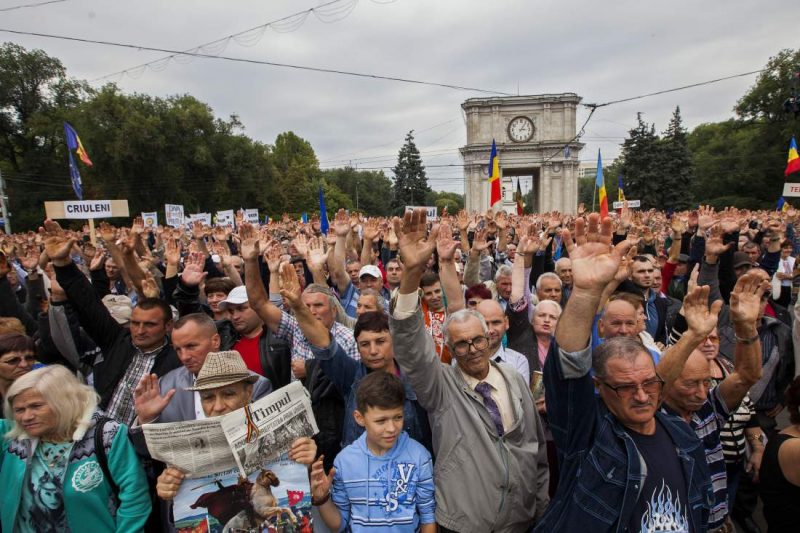
Pic of recent massive demonstration outside Moldovan Parliament.

This story might appear obscure but it reflects a bigger issue - about how Russian revanchism is reported back through democratic Europe's free media.  The issues it describes have also often been the story in Ukraine. How solid, liberal ideas like 'balance' and reporting 'both sides' can become a failure to tell the truth. How inserted reporters don't pay attention to the locals. How the messy 'European ideal' needs much closer reporting if we're to truly live up to any democratic ideal.

In the 1959 British comedy The Mouse That Roared a tiny, obscure European country ends up through comedic slight-of-hand being feted by both sides in the Cold War. In comedy, it showed how much of Europe is to the British 'Ruritania', an inexplicable country whose peoples and cultures all mess into one. As the article explains this approach lives on with today's lens of geo-politics and ideas of 'colour revolution' (via Russian infowar) muddying the coverage yet more.

Reblogged with permission from Open Democracy Russia.

====

By Mihai Popșoi  
 
There’s more to Moldova's protests than “pro-European” versus “pro-Russian”.

Moldova’s image as the poorest country in Europe is rivaled only by its obscurity. In rare outbursts of international media coverage — often related to human trafficking, arms smuggling or mass protests — Moldova is depicted as a pawn on the regional chessboard, caught in a tug of war between Russia and the west. There is no denying that, in a world of realpolitik, Moldova is indeed a playground.

Yet there is more to this intellectual inertia than meets the eye. The sheer lack of nuance and insight displayed by the international media with regards to the latest developments in Moldova is as disappointing as it is predictable. 
Much in the way of confirmation bias is at work here — the tendency to search for or interpret information in a way that confirms one's preconceptions. People are usually unwilling and, at times, admittedly unable to comprehend complex phenomena, especially when simple mental shortcuts are readily available.

Professional journalists and political analysts pride themselves on preventing or minimising the influence of such biases on their work. This is easier said than done, particularly in today’s world of ubiquitous geopolitical expediency. Moldova is a case in point.

Perils of European integration


Since the so-called ‘Twitter Revolution’ of 2009, Moldova has embarked on a path of economic transformation and political democratisation — or so everyone thought. The post-revolutionary government took on a rather inspirational name, the Alliance for European Integration, which proved to be both a blessing and a curse.

Generous western financial assistance and political support locked the United States and European Union into the costly self-fulfilling prophecy of a ‘success story’. But the success failed to materialise, despite promising beginnings. Five pro-European governments succeeded each other faster than the public could keep up with, and they spared no effort in building an elaborate discourse of European integration both at home and abroad. One could not help but be mesmerised by the audacity of Moldova’s leadership that promised to bring the country into the EU by 2020.


Over 100,000 protesters took to the streets of Moldova's capital in September 2015 to protest the ‘stolen billion’. Photo courtesy of Maria Levcenco.

Naturally, high hopes developed among more gullible Moldovans and international development partners alike. But the signs of trouble appeared early on.

As early as 2011, there have been hostile takeovers of privately held shares in several leading banks, known as the raider attacks. Then came the infamous ‘Huntigate’ scandal of 2013 — a cover-up of a fatal accident during a lavish hunting spree attended by the top brass of the country’s judiciary, including the Prosecutor General. Finally, ‘the billion dollar bank heist’ left the country perplexed as to how one could steal the equivalent of 15 percent of GDP from three banks with impunity.

Once a poster child of Moldova’s European Integration, Vlad Filat, former prime minister and Leader of the Liberal Democratic Party, ended up a scapegoat for the missing billion. Meanwhile, Filat’s archenemy the oligarch and senior vice president of the Democratic Party, Vlad Plahotniuc, became the sole decision maker in the country.

By hook or by crook, Plahotniuc was able to create a majority coalition (which oddly bears no name). It was rushed to a vote in parliament as protesters gathered outside and soon started demanding early elections. This clearly begs the question: how can international media refer to the current reincarnation of previous governments as pro-European?

Monstrous coalition


Reports from Euronews, BBC, New York Times as well as Russia Today all described the new government as ‘pro-European’ — much to the bewilderment of Moldovan civil society. In a very heartfelt piece on his personal page, Dumitru Alaiba, a former economic and financial advisor to two prime ministers, urged international media and western politicians: “Do what you must, just don’t call this government ‘pro-European’. It is not Europe that they represent. And don’t call us, the people, pro-Russian either.”

Well-respected media institutions used a default template for covering Moldova, relying mainly on the fact that the new government presented itself as pro-European. A more astute analysis would indicate that the new government is ‘pro-European’ in name only.

After numerous Moldovan activists wrote public letters calling upon western media to take a more mindful view of the ongoing protests, a change of tone occurred. There is now a broad acknowledgement that protesters were, and are, a distinctly heterogeneous group.

Admittedly, many of them are pro-Russian, yet a lot are as pro-European as they come. What unites them all is a genuine frustration with an ad-hoc “monstrous coalition” government and a desire for a more democratic and prosperous future.

This is largely missing from the international media discourse, caught in the cross fire between Russia and the west. Russia has capitalised on the growing anti-European sentiment in Moldova, and by supporting these ruling elites, western media and western politicians have only vindicated Kremlin’s propaganda.

Another piece of the puzzle


Russia’s postimperial syndrome is built on the belief that the west is containing its resurgence by creating a belt of instability in south-east Europe — a mantra that rarely departs from Russian TV screens. Moldova is seen as just another piece of the puzzle.

Moscow has a clear agenda of trying to bring Moldova back into its orbit and does not shy away from making its intentions known either.

For instance, in the aftermath of the 2010 parliamentary elections, Sergei Naryshkin, head of the Russian presidential administration, attempted to broker a coalition deal between the Communists and the Democrats. In the 2014 campaign, Russia openly supported the Socialist Party.

Russian media, which still holds a lot of sway over Moldovan public opinion, has been an indispensable tool in this process. Interestingly though, the rebroadcasting rights in Moldova for the most popular Russian federal TV channels are owned by so called ‘pro-European’ politicians, primarily Vlad Plahotniuc. He owns, among a few others, the Moldovan license for Russia’s flagship Channel One. Russian media coverage of protests in Moldova paints the EU in a negative tone, while reinforcing the message of Eurasian Economic Union as a better alternative. The aim of these reports may be as much to appeal Russia's domestic audience as it is to influence public perceptions in Moldova.
This sort of nuance is helpful in understanding the complexity of the Moldovan political landscape, which cannot be reduced to a mere east-west dichotomy.

The same is true for the protest movement. Many things that politicians had kept to themselves, such as allegations of blackmail and corruption, came to light only after mass protests erupted. However, for a long time, protesters could not set their differences aside in order to pursue a common goal: early elections.

Even when they finally did, the much heralded unity of protesters across ethnic, linguistic, ideological and party lines proved too good to be true. The nascent movement is constantly being undermined by infighting.

Besides, there have always been doubts about the independence of such political players as the socialist leader Igor Dodon, Our Party head Renato Usatii, and front man of the civic platform turned political party, Andrei Năstase. Hence, the real tragedy is that genuine popular protests are led by less than candid individuals.

Bridging the divide


Instead of helping to bridge this divide, both media and politicians have contributed to the increased polarisation of public opinion by presenting just one side of the debate, reinforcing the ever-present confirmation bias.

This development is particularly visible when it comes to Romanian or Russian news reports, as well as political commentary on developments in Moldova. Self-proclaimed leader of the Moldovan diaspora in Russia, Aleksandr Kalinin, posted a Facebook video calling upon Vladimir Putin to come and rescue the Moldovans from what he saw as an imminent takeover by Romanian and Ukrainian special forces.
The response came in a leading Romanian newspaper from none other than a prominent Romanian analyst and former adviser to Romanian president Traian Băsescu, Iulian Chifu, who called the video an “official request” to Putin. To his credit, Chifu went on to debunk Kalinin’s bogus allegations, but the latter was afforded much more attention than he deserved even in the aftermath of Crimea and Donbas.

The EU's former enlargement commissioner Štefan Füle is perfectly right when he says that: “We should be more active in addressing [pro-Russian] propaganda about what the Eurasian Economic Union offers versus what the EU offers a country like Moldova.”

Undeniably, Russian media will continue to produce characteristically biased reports about Moldova, but if western media want to have any claim to a higher moral ground they have to give up using simple shortcuts and produce accurate accounts no matter how tedious or inconvenient that may be.

Max Seddon’s recent article in the Financial Times, for example, does just that. He reports that “In private, some European diplomats say they would welcome a pro-Russian government — if only so that the current coalition cannot further tarnish the EU. Says one: ‘Asking them to do reforms is like asking turkeys to prepare Christmas dinner.’” 


Who are the pro-Europeans now?


No matter how ironic it may sound, a pro-Russian government is likely to be the only thing that can rehabilitate the European Union’s image in Moldova. The risks of a new government changing Moldova’s foreign policy course are minimal: it would be economically irrational and politically suicidal, since most of the burden of adjusting to the new EU-Moldova Association Agreement has been incurred, while the benefits are only kicking in. 


The new government cannot be called pro-European and, to its credit, it does not use the term. The coalition that Plahotniuc has put together literally has no name nor a coalition agreement. It relies on the program of the previous government despite being a “coalition of the willing”. Namely, the will of the 57 lawmakers being to preclude early elections and stay in power for another three years despite the sheer collapse of public trust after the infamous bank heist and the utter refusal to accept any blame either by the government or the parliament.

Moldova is a case study for state capture, though perhaps had Moldova been an EU candidate country, things would have been different via conditionality. The West has sacrificed democracy for geopolitical interests, which is usually a recipe for disaster down the road.

The sole threat of an imminent pro-Russian government is likely to galvanise and reboot the political system, albeit incrementally, with a new breed of upstanding young professionals exiting their comfort zones and entering the public domain to the benefit of their communities and their country — the alternative being a drift away from the values of democracy and the rule of law, all under the watchful eye of the international media.


See also:

Monday, 5 October 2015

BBC's John Simpson incites Brits to break the law over Crimea

A protest in the first month after Russia’s invasion which would now get participants arrested


Reblogged with permission. There has been some speculation that the reason Simpson made the trip and wrote the piece was to secure support for an exclusive interview with Putin. A number of people have made complaints to the BBC.

That such a senior BBC man would go to Crimea and write what he did immediately became a news item on Russian state media war propaganda.

Here is warning about consequences of visiting Crimea.


====

By Halya Coynash

BBC journalist John Simpson has ‘uncovered Crimea’s charms’ and a quite staggering degree of contempt for international law and human rights. In a travel piece for the Telegraph, he encourages people to do as he did: break the law, effectively whitewash Russia’s invasion and forced annexation of Crimea and wax lyrical about the charms of Crimea, while ignoring extremely serious human rights concerns under Russian occupation.

Simpson alleges that “there are moments in international affairs when the clouds part, and the sun illumines an area which has been murky for years. They have recently parted over the magical peninsula of Crimea; and my advice is, take advantage of it.”

Wonderfully lyrical and frighteningly nihilistic. The clouds in this case “did not part” but were wrenched apart, and a cursory glance at the globe would cast a better light on the number of countries and borders which can with equal justification, or none, be dismissed as ‘murky’.

Russian President Vladimir Putin couldn’t have phrased the attempt in the following paragraph to justify Russia’s annexation better, although the two men’s arguments are identical. Crimea was allegedly always “Russian”, and therefore it was “that engaging old crook Nikita Khrushchev” who first did the fiddle. So what then, if Russia “by foul means, grabbed it back”?

Simpson might like to consider that Andrei Zubov, the history professor from Russia’s prestigious MGIMO Institute who was dismissed for criticizing Russia’s land grab, has said that he would have failed any student who argued that Crimea had always been Russian. Should the BBC journalist feel the need to delve into the history of the area. Observance of the law, however, is not optional.

Simpson could argue that he does not incite people to break the law. He simply avoids telling his readers that this is precisely what they will be doing if they take his advice and visit Crimea via Russia.

This is not through lack of knowledge, and the Telegraph even provides a link to the Foreign Office information about Crimea. This states unambiguously that:
“From 4 June 2015, to enter or exit Crimea, foreign nationals will need to provide their passport and a special permit issued by the State Migration Service of Ukraine.”
Simpson was thus in breach of Ukrainian law and is advising Telegraph readers that they should behave similarly.

It is worth noting that a Russian NGO and its head are now facing harassment and threats of criminal prosecution for warning people of the legal implications of visiting Crimea. In June the consumer rights society ‘Public Control’ published information which accurately described Crimea as ‘occupied territory’ and warned of the legal ramifications of any trips undertaken without Ukrainian permission. Within hours, the Russian Prosecutor General’s Office was threatening prosecution and the website had been blocked. A summary in English of this advice can be found here. Unlike the BBC’s foreign correspondent, we would recommend that readers heed it. There is nothing murky about international law and Ukraine has every right to impose restrictions on territory which has been illegally occupied.

Simpson’s account of Crimea’s beauty and his obvious interest in literature might have inclined him to consider some of those who have suffered most profoundly through Russia’s occupation. These include Crimean filmmaker Oleg Sentsov whom a Russian court has sentenced to 20 years imprisonment after a totally ‘Stalinist trial’ of him and another opponent of Russia’s annexation, Oleksandr Kolchenko.

One blogger, Yury Ilchenko is currently in detention over an article criticizing annexation, and a EuroMaidan activist Oleksandr Kostenko has been imprisoned for 4 years on totally surreal charges. All independent Crimean journalists have effectively been driven out of Crimea and virtually all Crimean Tatar and Ukrainian media have been stifled, Just in the last few days the first two Internet publications daring to present alternative points of view and information about human rights abuse have been blocked. The list is certain to be extended.

The Crimean Tatars – the indigenous people of Crimea – are facing constant harassment and persecution, with most leaders in exile and one – Akhtem Chiygoz – imprisoned on legally nonsensical charges.

Simpson has not followed the example presented by other visitors to Crimea, such as from the far-right Bulgarian Ataka Party, who made a point of ‘recognizing’ Crimea as Russian. Members of the far-right Hungarian Jobbik party are also due shortly and can be expected to be just as approving. Russia is currently going all out to convince its own population and the international community that all is well, and Crimea ‘Russian’. A group of Polish students were almost certainly conned into visiting Crimea, rather than St. Petersburg last week precisely in order to provide good camera stunts. It is galling that a BBC correspondent should now be so obligingly helping Russia’s propaganda efforts.


See also:

Wednesday, 26 August 2015

There is no "civil war" in Ukraine

A Russian war propaganda organ trumpeting the BBC's reaffirmation on terminology
Pump 'Ukraine + "civil war"' into Google and click the 'News' tab and you get dozens of results. Deutsche Welle, Newsweek, CNBC, Huffington Post, The Independent, The Nation, Washington Post, and The Daily Telegraph have all used that phrase to describe what is going on.

As does the BBC, although Euan McDonald, a Kyiv Post Editor, says that's because the BBC "has to use certain terminology to continue to have access to separatist areas." Its own reporters covered the initial takeover of government buildings in the Donbas and said that Russian Special Forces appeared to be involved and they have someone like Mark Urban, the Diplomatic and defence editor of the BBC's lead news show Newsnight, covering in March the presence of Russian troops.

Here Cambridge University's Dr Rory Finnin (Department of Slavonic Studies) and Dr Thomas D Grant (Faculty of Law) argue that what terms are used by someone as trusted as the BBC is not a minor issue and we should all stop employing euphemisms. Reblogged with permission.

====

The war in Ukraine, we are often told, is a “civil war” involving “rebels” fighting the central government in Kiev. Such restrictive, inaccurate terms greatly misrepresent the conflict, which has already killed over 6,500 and displaced at least 1.4m Ukrainians. Too often, the crisis is talked about as if it’s entirely internal to Ukraine, a domestic affair presumably brought on by language politics, identity clashes and historical grievances. Best, therefore, to leave it alone.

Wrong. Ukraine is waging a war of self-defence against an international aggressor – the Russian Federation – whose conduct threatens our collective security. This war is now 18 months old, and we should know better by now.

Face facts

It’s not as if the signs aren’t clear. Recent weeks have seen another intense spike in fighting in eastern Ukraine. Given all the prior sabre-rattling, nuclear threats and general rhetorical brinksmanship, it takes little imagination to see the conflict expanding beyond Ukraine’s borders into EU member states.

Labelling such a crisis a “civil war” serves no purpose of diplomacy or journalistic balance. It is a failure to serve the public interest. The war needs to be described as it really is.

Fundamentally, this conflict was started and is sustained by Russia’s armed intervention, not a Ukrainian civic collapse. In nearly a quarter century of independence, the Ukrainian public’s support for national unity has been stronger than in many long-established states, among them Spain, Belgium and Canada. As Vladimir Putin has since proudly admitted, it was Russian troops in the spring of 2014 who seized Ukraine’s Autonomous Republic of Crimea.

The Russian military presence has not gone away. In August 2015, Organization for Security and Cooperation in Europe (OSCE) monitors again encountered personnel in eastern Ukraine openly identifying as Russian regular military. These forces continue to lead, train, equip and fight alongside militants advancing Russian neo-imperial and ultra-nationalist ideologies against a government in Kiev espousing respect for democracy, transparency and the rule of law.

To tiptoe around the Kremlin’s armed intervention in Ukraine falls short of the basic standards of war reportage. And it’s absurd to call the Donetsk and Luhansk authorities “rebel” administrations when they would not have come into being and would not continue to function without Russian backing.

We do not talk about a Manchukuo “rebel” administration in 1930s China without mentioning that Japan had invaded it; scarcely anybody pays lip service to the myth of an organic, independent separatist movement in 1930s Manchuria. Nobody should credit Russia’s fiction about “rebel” administrations in today’s Ukraine.


Lest we forget, the purported “rebels” in eastern Ukraine agree. Here is Igor Girkin-Strelkov, a Russian national associated with Russian military intelligence who helped lead the “rebel” movement in eastern Ukraine, speaking only weeks ago: “You are making an idiot or fool of yourself if you think that [the Donetsk and Luhansk Peoples’ Republics] were formed by themselves.”

An important conclusion follows from these facts: the Russian Federation is an aggressor and should be characterised as such whenever we talk about areas of Ukraine that have fallen under the Kremlin’s effective military and political control.

There is no need to report aggression in inverted commas. Since early 2014, the Russian Federation has carried out a host of acts of aggression against Ukraine as defined in Article 3 of the UN General Assembly’s definition of aggression. Russia has invaded Ukrainian territory – Crimea, Donetsk and Luhansk so far – and attacked Ukrainian forces without a shred of plausible legal justification; bombarded Ukrainian territory and killed Ukrainian citizens; and seized territory that belongs within the internationally recognised borders of Ukraine, declaring it part of Russia. These are nothing less than acts of aggression under international law.

Nor do the sham referenda in Crimea in March 2014 or in Donetsk and Luhansk in May 2014 offer any legal wiggle room, since these “Potemkin plebiscites” resulted directly from an invasion of Ukraine by the Russian Federation.

As far as the referendums go, the UN General Assembly, the Parliamentary Assembly of the Council of Europe and the President of the OSCE Parliamentary Assembly all agree they were unlawful and illegitimate. To argue or imply that there has been an act of “self-determination” in any part of Ukraine that calls into question Ukraine’s sovereignty over its recognised territory contradicts the highest available organised expressions of international law.

If editors and journalists are substituting their own judgement of the situation, then they must explain why.

A spade’s a spade

Then there’s the matter of Ukraine’s right to self-defence, which of course is a right of all states. Russia’s aggression against Ukraine is just about the only case where a UN member state has seized and in effect sliced off whole regions of another UN member state.

In its official statements the Kremlin goes further still, repeatedly calling into question the right of Ukraine to continue in its current form, invoking a so-called “New Russia” across vast, strategic tracts of the country, and even threatening nuclear action in the wider context of the conflict.

This is not garden-variety geopolitical grandstanding. When Iraq attacked Kuwait in 1990, it was universally condemned, and Kuwait’s right of self-defence was affirmed. There is no principled reason for responding to Russia’s aggression in eastern Ukraine with different rhetoric or a different description.

It’s time to face reality. The continued escalation of the war in Ukraine poses a serious challenge to international public order. Journalists have risked everything to report events from this war, and we need to stop watering down their reports with euphemism and understatement. We need to call this what it is: a war of self-defence against an international aggressor.

The Conversation

Thursday, 9 July 2015

Frankie Boyle and the Aborigines


If you enjoy laughing and have ever watched the British (knowing laugh) nihilistic comedian Frankie Boyle I very much doubt that you have never laughed at his jokes.

The joke about the Queen's vagina being haunted? If you heard it I would bet that something akin to laughter ensued.

Yet that and other comedic transgressions has resulted in transgressive Frankie being banished by the evil English establishment.

Except it hasn't.

Oh no. We have the BBC commissioning a show headed by Boyle after the Scottish referendum and then another commission for online after the UK General Election. Some banishment. The Boyle election show was on the BBC iplayer homepage for weeks.

In his election show Boyle had two female comedians to bounce off and a 'Grime' commentator - aka a black British bloke. All of whom polished his mantle.

Now I can think of a number of bitchy conservatives who could have been a perfect foil to Boyle. Were they even considered? It would have made for great TV.

But why I am even asking this? Multi millionaire Boyle needs his 'safe space', bless. He has no history of stepping outside of his comfort zone but let's try. Here we go Frankie. Here's me puncturing your safe space.

The treatment of Australia and Australians by Boyle and his 'Grime' commentator Akala was colonialist and racist.

Boyle cherry picked a brief extract from Australian morning TV to showcase how Australians are all stupid fucking colonials and so so racist. This was as bad as the treatment of the 'colonials' by the Brits going way back has ever been. Barry Humphries, Private Eye and Humphries' Barry McKenzie character were satirising this Brit attitude in the 1970s (the 70s FFS).

We recently had the Gallipoli hundredth anniversary. Gallipoli in the Australian imagination is all about how the Brits have traditionally treated Aussies as subaltern. This stuff has form.

After his cherrypick, Boyle, backed by Akala, then underlined by calling Australia, quote, "the most racist country in the world".

Worse than Mali? Worse than Russia? Worse than India? Worse than Brazil?

Akala cited the utter revelation, to much of the audience I would assume, that Australian Aborigines 'used to be ruled by the Flora and Fauna Act'. This is actually a myth (the Act is) but the bigger point is that nearly fifty years ago Australians voted to end that mythical status, change the  Constitution and grant Aborigines citizenship by 91% in favour. Right now Australians are 85% in favour of proposals to change the Constitution to recognise Aboriginal people.

Why does Akala mention the (non existent) Flora and Fauna Act? To back Boyle's claim that Australia remains "the most racist country in the world".

Boyle's claim, with Akala's backing, does two things: it denies that white Australia has moved one centimeter on from the 1960s; it denies that Aboriginal and progressive activism has had any impact.

Obviously both are wrong. Clearly they are wrong. But both Akala and Boyle have an investment in denying the reality in Australia: their British audience will love to hear Australia called "the most racist country in the world" - and Akala and Boyle know it.

In order to make that claim both have to behave exactly like colonialists. Racist, British colonialists. And they have to fail to listen to Aboriginal people.

I wrote about this a few years back. Listening involves understanding that Aboriginal people have different opinions on how to advance the interests of their communities. (Of course they effing do.) There are some who want sovereignty to be central. (If Akala knew anything he would mention the absence of treaties.) Then there are others working with capitalism to create Aboriginal owned business and create jobs. And then there's the mass in between, trying to get on.

Outside of this we have white people like leftie icon John Pilger and environmentalists like newly minted BBC star Professor Tim Flannery who also have opinions. And don't they ever have opinions - and the whites always know better than the bad blackfellas.

Who is going to get the attention of the likes of Boyle/Akala (and countless other Brits)? Short answer: the white people. They'll know and trust someone like Pilger (Akala's comment is a 'tell' here) and have never heard of the likes of Professor Marcia Langton.

Langton has slammed Flannery and the "racist assumption in the green movement about Aboriginal people being the enemies of the wilderness." She is a leading light in the national debate around Aboriginal advancement and particularly the role of mining and is one of the most well known Aboriginal people in Australia. Yet when Pilger covered the area of Australia she has focused on in a film he flat out ignored her because she was an inconvenient black woman. What would you call that?

It is not going to even vaguely occur to Boyle/Akala what they're doing, namely that Aboriginal people in their world view may as well be regarded as 'flora and fauna' - invisible, lacking any agency. They're just going to be led by presumptions and ignorance and what white leftie icons say, for that is what it is.

Invisible: Two examples

Tuesday, 8 October 2013

Tomorrow's world + the NSA: James Burke reflects


A science broadcasting legend predicts the future, after getting it mostly right 40 years ago, and has some choice words on the NSA 'scandal'.

James Burke is a British broadcasting legend, one who any Brit over 45 years old would recognise as the face of technological progress.

Most familiar as the chief presenter of the long-running BBC science series 'Tomorrow's World', he also anchored the Moon landing coverage and has written many influential books. The Washington Post has called him "one of the most intriguing minds in the Western world."

He may be familiar to Americans for his hit PBS series charting how technological progress happens, 'Connections', and his writing for Scientific American and Time.

Writing in 1973 for BBC magazine Radio Times he predicted life today and marking that 40th anniversary the BBC has looked back to see how his predictions stack up: they mostly do. He predicted the mass take-up of computers, in-vitro fertilisation and cheap air travel.He got right that the British people would resist identity cards. He got wrong that there would be 300,000 computer terminals by 2000 - there were 134 million.

Burke also predicted "metadata banks" of personal information - Facebook, Google - and that "young people" would be completely relaxed about releasing their personal information.

Speaking to the BBC's Eddie Mair (audio after the jump), Burke was asked about this attitude to privacy in the light of the current panic about government and privacy.

Burke says that issues like transparency and accountability are new, they have come forward because of the Internet, the 'information age'. That the general public now has access to more information, and is demanding it - this is "healthy". But matters of privacy are contextual:
When street numbers came out in the Austro-Hungarian empire in the 1820s there were riots, because nobody wanted others to know what your street number was. Times change. When you tick a box when you buy something online that allows them to put you in their big data pile and find out what you'd really like next time.

Walmart does 300 million transactions an hour and they use that information, for example, when there is a big hurricane predicted they'll put torches on the shelves exactly where you want to buy them. And pop-tarts because, believe it or not, that's what people buy when there's going to be a hurricane.

So it's a quid pro quo.
Asked if he's content with this situation (which he had predicted) Burke reflects that when he visited the Soviet Union he was told to be careful of what he said, 'because everyone is listening'. Says Burke:
Of course they're not listening. If they had to listen to everything we said in hotel rooms in the USSR in those days they'd be up all day and night.

So called snooping is them looking for metadata, not what you say. Not what you said to Charlie but the fact you talked to Charlie. If Charlie's unimportant and you're unimportant the thing they're happiest to do is dump it because the pile is unmanageably big now.
So called Big Data, the electronic exhaust we leave behind, is unbelievably large and growing at extrapolated rates. Nobody is going to ask me what I said to somebody on the phone yesterday afternoon, they're not interested. The algorithm will say 'I see he's talking to so-and-so and it's not relevant to us', and that's as far as it will go. There's no other way you can run the system anywhere.
So you're unperturbed by the NSA and the Edward Snowden revelations and all that?
We've been doing that since we left the caves. Anybody who thinks that governments have not been taking what they can about public behaviour, they haven't understood the political process.
Of course everyone does it, of course they've always done it. Seems to me the press has jumped on the idea that people are snooping without recognising that the amounts of data are so gigantically enormous that there is no way that the NSA cares a rat's ass about me or you.

We're in a transition period. I don't think it'll be that long before we'll be able to throw out our own search algorithms to, say, find out if anybody is looking at me!

There's always a quid-pro-quo with technology. There's always two sides to every knife.
Speaking about the future, Burke cites one development which will fundamentally change the world: nano-factories. (Video about this after the jump.)
Let’s say that 2040 sees the start of worldwide wi-fi distribution of software kits to make a nano-fabricator. Sits in the back garden, spare room, somewhere. Uses dirt, air and water and a bit of cheap, carbon-rich acetylene gas. Manipulates atoms and molecules to produce anything you want, virtually free. Each fabber can make copies of itself, so: 1, 2, 4, 8, 16 etc: one each for nine billion of us, say, by 2042.

Sixty years later, we’ll have adapted to the new abundance and are living in small, no-pollution, autonomous communities, anywhere. Energy from spray-on photovoltaics makes any object (like a house) its own power source. So, here you are in your fabber-fabricated dwelling, filled with Mona Lisas if that’s your wish, with holographic reality transforming any room into anywhere (like: beach, sun, wind ruffling hair). So nobody travels any more. Want to see a pal, have dinner with your mother, join a discussion group? No problem: they’ll be there with you as 3D holograms, and you won’t know Stork from butter, unless you try to make physical contact (I’m avoiding sex and reproduction because that might have to be wild speculation).

The entire global environment will also be covered with quintillions of dust-sized nano-computers called motes. So your life will be constantly curated by an intelligent network of ubiquitous cyber-servants. The “motes” will know you need more food, or that it’s a bit chilly today, or that you’re supposed to call Charlie. And they’ll take the relevant action. Your shirt (motes in the fabric) will call Charlie. Either his avatar will appear, or you’ll hear his voice. Not sound waves, but brainwaves. Brain-to-brain communication (it happened for the first time in summer 2013).

No travel means no need for infrastructure, such as high-speed trains (unnecessary by mid-century, along with superhighways and airports). No need for anything that Government does, because, in our millennial culture of scarcity, Government was primarily there to tax, spend, and re-distribute the wealth. In 2103, with no scarcity, what need for Government? And with abundance, everybody has everything, so what need for criminals?
Listen to the interview with Burke and watch his predictions for the future after the jump:

Wednesday, 17 April 2013

When government stops outsourcing: Celebrate gov.uk's design win


There have been some predictable reactions to gov.uk winning a top design award, beating, amongst others, that sublime Olympic cauldron. The Daily Mail's story (pictured) is distilled essence of ignorance and stupidity: 'but it looks boring'!

Here's wired.com on why it won:
Yes, it looks more like an expired domain page than an integrated central location for government services. (We’re not the only ones to notice.) Then again, it’s a little like the DMV: you’re not going to spend any more time there than you have to. Wham, bam, thank you for registering your vehicle with us, ma’am.
Ir won because it achieved the aim of 'simpler, clearer, faster', which is not easy. The content, what it actually says and how it is tailored to the medium (which is now centrally directed and rules driven), is not mentioned by Wired, but is what struck me because 'simple' text is very hard to pull off. Wallpaper's report does notice that:
The website adheres to a strict style guide. Visitors will no longer be baffled by words such as ‘tackling’ (unless the context is about rugby), ‘deliver’ (unless it’s about pizza or post, not policies), and ‘disincentivise’.
Interestingly I have yet to see a real whinge about the win, just other versions of 'boring' or cloaked bitchiness, nothing from anyone of substance, with skin in the game, say, from a webbie, designey, background having a serious go at the site and the award committee. It will be there because this website is the product of civil servants not bleeding edge, Silicon Hub/Fen/Roundabout private enterprise. There will be teeth knashing going on privately.

This award is a slap in the face to those wanting government 'drowned in a bathtub', who see all public servants as losers, if not inherently corrupt. The sort of people who write for the Daily Mail, come to think of it.

For years government has been told that they are naturally incompetent and must outsource work like web design. It has been seen as bleeding obvious that a project such as centralising all government in one place online can only be done by a 'efficient' big company.

Big companies had proved adapt, using fair means and foul, for years and years, at seducing the actual decision makers and getting such contracts. But they failed. The websites may not have looked "boring" but they were crap and I documented some of this history on this very blog.
Here's three posts of mine on the 'Great 2009 Birmingham City Council website disaster', a product of the world's biggest outsourcing contractor Capita, or as it was dubbed 'Crapita':
Lessons from the great 2009 Birmingham City Council website disaster
Postscript -- Postscript two

Public service beats outsourcing: Hurrah!

What is so spectacular and the untold story behind this award is that the Crapitas of this world didn't, for once, fail upwards ... that some key people in government were prepared to battle them, to actually end the chicken and egg, revolving door of yet more failing contractors. To bring it back into government, to trust government, and that this evolving process wasn't cut off by Conservatives when they took over!

The winning GOV.UK design team
What this award is built from is not just the appearance of Martha Lane Fox, great though she is, but an ethos built up over many years in many parts of government of service and a user/citizen focus. Folks I've known as well as marginal idiots like me banging on about it. Lots of connections to others, like those who have built the BBC's world leading web presence on the back of that same service ethos.

Private companies have a harder time doing 'service and a user/citizen focus' precisely because of the profit motive. Their operations are bent by what will make the most money for them, and this includes what they offer government and that, yes, includes design. It is near impossible to imagine any of them creating this award winning design. When I revived this blog the first thing I wrote/ranted about was the massive bloat happening in current web design and how this was due to website needs increasingly impinging on customer needs -- the opposite of what something like gov.uk has to do.

What has changed with government websites, the bit which deserves celebrating, is that the outsourcing enablers, those whose egos the companies can tweak or flirt with, who business knew how to make look hip and not "boring", are gone. For once the good guys won.

Enhanced by Zemanta

Sunday, 7 April 2013

Postscript: *Northern Ireland only: Why is the BBC ghettoising the Troubles?

BBC iPlayer as displayed by the Nintendo Wii

Over at Slugger O'Toole, Mick Fealty promoted my post asking whether the BBC was ghettoising films about the Troubles by only showing them in Northern Ireland.

*Link to Mick's post with warning that Google is saying 'site compromised' of Slugger as of writing.

This attracted some interesting comments, as you'd expect from the leading website devoted to Northern Irish politics and life.

One piece of interesting pushback came from Brian Walker, a former BBC journalist, Political Editor and manager in Belfast.

Walker said that BBC Northern Ireland (NI) are not to blame.
The national networks are commissioned by a team under their own controllers. I’m sure the local BBC do their best to get network showcases. For one thing it spreads the costs. I wouldn’t rule out versioning and airing on BBC4.
Possibly, though my survey could only turn up one example of that transfer to British BBC TV.

Another commentator, Nevin, added this nugget of evidence:
Not just NI, it seems:
Q673 Baroness Bonham-Carter of Yarnbury: You have mentioned Scotland and Wales. In England you hardly get a Scottish story. On Newsnight you have the opt out and there is a real sense that with devolution bits of the country have been cut off from each other. 2005 source [pdf file]
This is a news related comment but it has wider relevance. One of those giving evidence was Pat Loughrey, the then BBC Director of Nations and Regions and former BBC NI Controller.
I haven't watched much Scottish or Welsh regional output because, frankly, it hasn't appealed. But this complaint sounds like one to do with the BBC's structure being 'ghettoised'.

Walker also commented on one show I pointed at as, I thought, suitable for such a transfer, the history of Ulster Presbyterians, 'An Independent People':
This was an ambitious series but in concept definitely NI/Irish, I’d say, and well worth doing in those terms. It could be probably aired in its present form in Scotland without much of a remake but I think it would need subtantially reversioning for the networks.

This is not a criticism by any means. NI’s audience is distinct and not all ambitous programme ideas should be made on the condition that they are only worth funding if they get network airings.
I'm not so sure about that on revisioning. For one thing, BBC4 has vast amounts of time to fill, which it generally does with repeats (not that there's necessarily anything wrong with that), so why not repeat that show there. For another, check the schedule, there are some remarkably esoteric shows on. Plus that show had a fascinating middle episode on the role of Ulster Presbyterians in the American revolution.
I take the unfashionable view that the NI audience needs its owns share of high quality expensive programming. And not all of it should be made for networks in mind. Great if you can co-commission or export some of it but not always essential and not always appropriate.
No, but that wasn't my point. Film and television is replete with examples of shows which were made for very specific audiences yet found much wider appeal. I don't think this is 'either/or'. What seems to be happening -- one region's shows being blocked out, perhaps because of the way the BBC is structured --  is a deprivation for the British audience if we rarely if ever get the chance to see something from that perspective, something not made with 'us' in mind. Or put it this way, we still watch American shows which have no consideration, are not revised, for 'us' -- or Danish ones for that matter.

Australia is fortunate in having what I think is a unique in the world TV channel, the Special Broadcasting Service (SBS), which was set up by a Liberal (conservative) government in the 1970s to cater for an increasingly multicultural Australia. That channel shows TV and films from literally all around the world and is full of gems which audiences for whom the programming wasn't done (i.e not the minority from the relevant country of origin) are grateful to get an opportunity to see.

Walker does point out that the TV landscape is rapidly changing, shown by the fact that I am able to watch '*Northern Ireland only' shows at all on iPlayer. However, again, I beg to disagree as, from my web experience for one, the looming era of thousands if not millions of 'channels' does not really mean that the masses will find something. We will probably always have someone, whether a public or a private corporation, to whom we hand over the remote control and say 'I've had a hard day at work, here, you curate for me'. Most people, after all, only regularly visit, what is it, seven web sites? What shows, after all, does iPlayer, more specifically the Editors there, promote? Not BBC NI ones, or other regional output, as far as I can see, ever.

Enhanced by Zemanta

Wednesday, 27 March 2013

*Northern Ireland only: Why is the BBC ghettoising the Troubles?


Why is excellent TV about the Troubles, the war in Northern Ireland and Britain, only shown in Northern Ireland?

This month the BBC broadcast a fascinating and moving documentary, from which the above image comes. It is one of the most famous photographs of the whole war. It shows the priest Fr Alec Reid administering the last rites to a dying soldier, who had strayed into the wrong place and been beaten to death and shot by the IRA.

The documentary was '14 Days' and covers a fortnight during which the British state shot three IRA members in cold blood in Gibraltar, then their funeral was attacked by a Loyalist gunman and then two soldiers were killed. When he was administering to the soldier Fr Reid had in his pocket a letter which he was carrying in his capacity as a go between. Reid was one of the earliest actors to attempt to bring together key parties to try to get a ceasefire, that letter was from Sinn Fein leader Gerry Adams to the leader of the 'moderate Catholic' SDLP, John Hume.

The film uses the device of those two weeks and the focus on one man to try to tell a bigger story of how individuals can have great impacts during momentous times, times when all hope appears lost. It's cinematic and has many powerful images like the one above, the capturing of which itself forms part of the narrative.

'14 Days' is not without its problems.

Professor John D Brewer writes that Reid's pain as he relives this time is seen in his face but it isn't properly explained in the film:
I am certain that what peaceful future Northern Ireland has is down in no small measure to the courageous individuals like Father Reid in the churches who brought paramilitaries, politicians, civil society and others together in sacred spaces.They were not all Catholic clerics. Many were Protestants. We glimpsed in 14 Days the equally seismic role of clergy like Harold Good, Ken Newell and others, working alongside or in parallel to Father Reid.

But there was one thing we didn’t get from this otherwise excellent programme. The Catholic and Protestant clergy more or less acted on their own authority, outside the conservative, cautious institutional church. They were mavericks, independents, easily left out on a limb when the secret back-channel dialogue they were facilitating became public and the institutional church disowned them.

Father Reid was pilloried by the Catholic Church – as was Ken Newell by some of his fellow Presbyterians. Only the Methodist Church gave its peacemakers something approaching official backing. And that is why Father Reid paid such an emotional price for his compassionate commitment to peacemaking.

....

The institutional churches did not perform with honour in trying to establish peace and relegated themselves to burying the dead and comforting the widows. The job of getting their hands dirty was left to a select brave few and it is appropriate to echo that never before was so much owed by so many to so few.
Mick Fealty, aka the blogger Slugger O'Toole, spoke with me about the film and echoed Brewer's criticism. Fealty said that a "more penetrating documentary would have looked in more depth at the context and the deaths of the three on Gibraltar to see where the political story was."

In that famous photo, Reid was carrying, says Brewer, "the first draft of the eventual blueprint that evolved later into the Downing Street Declaration and thence the Belfast Agreement." The 1998 Belfast Agreement, also known as the Good Friday Agreement, reestablished devolved government on the basis of power sharing.

But this version of history leads on to another problem, says Fealty, and one which comes back to the problem of British TV viewers not hearing about Northern Ireland. "I think it ['14 Days'] suffers from 'Peace Processism'", says Fealty. "This place is in a sustained state of cold war."

Brits don't want to know

Monday, 5 October 2009

Tuesday, 1 September 2009

Murdoch as Mephistopheles

By now you've probably read or heard about James Murdoch's OTT attack on the BBC at the Edinburgh Television Festival.

Murdoch was giving the James MacTaggart Memorial Lecture, as his father had done twenty years before. Well this reminded me of one of them I have never actually watched - the one Dennis Potter gave in 1993, widely regarded as the greatest ever.

Visibly suffering from cancer though Potter is, it is mesmerisingly brilliant. Vituperative and funny. Sentimental and disturbing (especially to the audience of television big-wigs, some learn forward, some cover their mouths).

In it he tells several tales of Murdoch. Here's one:
At the time Rupert Murdoch was anxiously trying to guild if not renovate his image while lobbying to prevent his cable television company coming under the same rules and regulations that apply to other British television companies, he announced that his main company was going to fund a new Chair at Oxford University to the tune of £3 million. It was to be called - I do beg your pardon, but I cannot keep a straight face – it was to be called the Murdoch Chair in Language Communications. But the announcement came with cack-handed timing on the very same day that the Press Council formally and of course ineffectively censured Murdoch’s Son for calling homosexuals “poofters”. Some language. Some communication.

Murdoch did not turn up for the ceremonial meal to mark the largesse at Oxford, always a place where the gap between the cup and the lip can be measured by more than an inch of the sardonic. But Rupert has a touch of pure cruelty in his make-up. He sent Kelvin MacKenzie, the sharp little weasel that edits that daily stink they call the Sun, and the maladroit fellow had to sit and chew and probably even dribble a bit between two professors.
Transcription


Just before he died of cancer, he sat down with Melvyn Bragg for a final interview. Of course the subject of media mogul Rupert Murdoch came up.

Reblog this post [with Zemanta]

Friday, 24 July 2009

Embedding recommended for Parliament video

The British Houses of Parliament, LondonImage via Wikipedia

The House of Lords shows itself - again - to be the most thoughtful and progressive chamber in a new report 'Are the Lords listening? Creating connections between people and Parliament' from its Information Committee.

Parliament has some really daft rules against use of video of proceedings, which it has been extremely slow in changing. Leading the charge against this has been LibDem MP Jo Swinson.

The Lords new report backs Swinson's campaign to free up reuse of video and - hurrah! - backs embedding and republication.

42. 'Embedding' is the process whereby a document or file of one type is inserted into a document or file of another type on the internet. Embedding is central to much use of multimedia in web pages, which tend to embed video, animation, and audio files. In our Annual Report 2007-08,[11] we reported the growing number of people asking to embed parliamentary material (such as video footage of proceedings) into their own web sites. Such embedding would, for instance, allow other web sites to include windows within their web pages so that clips of parliamentary proceedings could play within their own pages instead of having to open a separate window and application to view the clips. Under the terms of the current licences, the Parliamentary Broadcasting Unit Limited (PARBUL) cannot allow any of its licensees to offer embedding. Peter Lowe of Sky News found it "extraordinary" that Parliament did not allow embedding (Q 311).

43. The BBC asked Parliament to change this policy so that it could include footage from Westminster in its 'Democracy Live' website, which would also include footage from the Scottish Parliament, the Welsh Assembly, the Northern Ireland Assembly and the European Parliament (QQ 308-09, 314; p84). Last year, we called for further research to be carried out on allowing embedding of footage of parliamentary proceedings. During our inquiry, it was made clear to us that embedding would allow wider access to parliamentary proceedings through websites and other channels (pp 16, 143). Peter Riddell, Political Commentator and Assistant Editor of The Times, said that it would be "a tremendous help" to journalists preparing articles online (Q 191). Channel 4 said that enabling users "to embed clips on their own sites, and then use social bookmarking tools to promote these clips to others, is an effective and low-cost way of expanding the reach of Parliament—as the easier it is to spread information the more people will see it" (p 104). Jo Swinson MP told the Committee: "we need to wake up and get into the twenty-first century on this. If we can actually get clips of Parliament out there, particularly in two or three-minute pieces which are easy to watch, easy to forward to friends, that is a much better way and a much easier way for people to understand what is going on in Parliament than having to watch the BBC Parliament channel for hours on end until something they might be interested in comes up."

44. People should be allowed to embed the House's proceedings on their websites, so that our proceedings can have as wide a distribution as possible on the internet. We recommend that a trial start as soon as possible. We have invited the BBC and the House of Lords administration to bring forward proposals for how the House can maximise potential synergies with the BBC's forthcoming 'Democracy Live' website.

Yay! The irony here though is how slow the BBC has been with the option to embed on its video. There does seem to be a lot of internal resistance and only some news video is embeddable. What's bizarre is that you can find loads of BBC news video on YouTube, which they don't police.

As well, people are getting iplayer content and reusing it, here's how to get the iplayer embed code. That's not being policed either.

Here's what the Lords says about Parliament and YouTube

38. In May 2008 Parliament launched a YouTube channel, which it uses primarily to show short films promoting and explaining the work of Parliament. The Hansard Society praised the videos about the work of the House of Lords (p 13). We used YouTube throughout our inquiry, to update people outside Westminster on what had happened during our meetings and to provide an insight into the views of witnesses and members of the Committee. In June 2009, the House of Lords Economic Affairs Committee and the European Union Committee released videos on YouTube to mark the publication of their reports.

39. We also used Parliament's YouTube channel in our inquiry to allow people to contribute by submitting their views on video. Dr Jackson said that this development was "very exciting": the fact that members of the public can upload videos gives the channel the potential to be "a powerful interactive instrument" (p 139). Parliament would benefit from the interactive nature of such websites, by treating them not simply as publishers and distributors but as places where user-generated content can be created and displayed.

40. Members of either House are allowed to post footage featuring the member on the member's own website. However, at present, the two Houses do not allow parliamentary proceedings to be posted on YouTube or any other third-party hosting website. This ban has attracted negative publicity; and Parliament has been criticised for not embracing new technology. Last November, we agreed that Lords be allowed to place on YouTube (and similar searchable video hosting websites) clips of their contributions to the House's proceedings. The final administrative and legal steps around copyright are being taken, and the Committee will inform members when they can start to upload their contributions to YouTube. Technical training will be provided for members who wish to take advantage of this new possibility.

HT: Emma

Reblog this post [with Zemanta]

Tuesday, 14 July 2009

Listen to Gay Life After Saddam


Here is the BBC radio report on the situation for Iraqi LGBT. It is nothing but horror (and heroism) and here's the thing: life was better under Saddam.

Iraqi gays report a (discrete) gay life before 2003 which reminds me of the life which currently exists in Beirut. There were clubs, people could meet by the river. An exile says "no one was killed for being gay under Saddam regime".

This brilliant report goes to Baghdad and visits the Iraqi LGBT safe house. It is very hard listening.

"They had thrown [my boyfriend's] corpse in the garbage. His genitals were cut off and a piece of his throat had been cut out."

Some LGBT find their way to the UK. Very, very few. The UK Border Agency in every instance says they can go back and just 'be discrete'. I kid you not.

Not surprisingly (sic) both David Miliband and Phil Woolas refused to give an interview for this programme.

It includes a lot of background from my friend Ali Hilli. I can't begin to express my admiration for him. He is a true hero.

Listen to the show (60').

Gay Life After Saddam


Reblog this post [with Zemanta]

Tuesday, 7 July 2009

'I'm tempted to extend the metaphor'

Oh, go-on ...


"Every Prime Minister needs a Willie" - of course the famously naive Margaret Thatcher had no concept of a double entendre. Out (but not out) Mandy however ...

Monday, 29 June 2009

BBC making a big gay effort on 40 years since Stonewall

It makes a nice change to be praising the BBC on LGBT content but this week they are carrying some excellent programming.

This is an interview with Martin Boyce, about his memories of the night it all kicked off, 40 years ago on Sunday.


BBC Radio 2 has Stonewall: The Riots That Triggered the Gay Revolution on Tuesday, with legend Tom Robinson.

The BBC News website has an excellent feature, 'Stonewall gave me new gay role models', by David Carter, author of Stonewall: the riots that sparked the gay revolution.

Justin Wells had Armistead Maupin on his 'Americana' Radio 4 show yesterday, reflecting on 40 years of 'Gay Power'.

Today on Thursday had on Jim Fouratt, who was there in 1969.

Let's just hope it isn't another several years before we get such a feast.
Reblog this post [with Zemanta]

Wednesday, 24 June 2009

'This is a massacre!'


This is an incredibly emotional affecting report from Iran. Today eyewitnesses are reporting a massacre. Live, with Twitter et al - a massacre. I am ashamed to say this is not being relayed prominently via the BBC, who appear to have down-ranked Iran over the past two days.

From Twitter:
"In Baharestan Sq we saw militia with axe choping ppl like meat blood everywhere like butcher"

'What can you say to the family of the 13 year-old boy who died from gunshots and whose dead body then disappeared?'

world needs to know of the atrocities and massacre at Baharestan Sq. & lalezar sq., ppl butchered today

they pull away the dead into trucks - like factory - no human can do this - we beg Allah for save us

@persiankiwi we must go dont know when internet they take 1 of us, they will torture and get names now we must move fast

Via @dailydish More then 150 killed on Saturday? #iranelection http://twitzap.com/u/Gjk
A witness describes beatings at a new protest under way in downtown Tehran.