Now posts ↓

Showing posts with label EU. Show all posts

Monday, 29 August 2016

An Ode to Poland, and a brief reflection of the Polish contribution to the UK


This is a guest blog by friend James Oliver.


====

Towards the end of the EU referendum campaign I had a most peculiar experience when a self-identified “ex-serviceman” came up to a Stronger IN stall i was helping to staff. In a provocative tone he asked us what the benefits of staying in the EU were because, according to him, we have to quote the words he used about immigrants "raping" and "slaughtering" this country.

This tone of rhetoric about immigration has been very typical in British discourse, not just through the referendum campaign but for as long as I have been reading newspapers. One only needs to search the archives of the Sun, Daily Mail and Daily Express for proof of that.

In this context I suspect very few of those who tried to use the sticking point of immigration against me expected an equally passionate defense of immigration as a reply. Certainly the “ex-serviceman” didn’t when I took him to task over his poor choice of words. What made our exchange peculiar was his revelation that he had a Polish wife who had been subject to racial abuse by a vote leave campaigner. Relating that to some of the experiences that I and my fellow campaigners have had helped us to persuade him to tick the remain box.

For approaching 10 years of my life now I have counted Poles as friends, work colleagues and much more. I’ve had a long interest in Polish history began with a school trip to Kraków in 2007. There I was given a city tour by a wonderful guide whose name I sadly cannot no-longer recall but she opened my eyes to historical perspectives not well taught here.

As we know Poland joined the European Union in 2004 and although it was this that produced the largest influx of Polish migrants to this country, what is less known or less appreciated is that the contribution of Poles long predates this date.

Those of us who shop in Tesco or Marks & Spencer might not know that both were founded, in part, by Polish immigrants. Many of us who have taken the time to enjoy “The Secret Agent” on TV of late perhaps might not realise that the author of the original novel, Joseph Conrad, was fiercely proud of his Polish roots. He was born near the city of Berdychiv (in what is now Ukraine) and came to this county unable to speak English. He would go on to write some of the finest English language literature of his age. Joseph Conrad, Jack Cohen and Michael Marks are but a handful of examples.

Our ancestral connections


In the heart of the city of Westminster lies a small road called "Poland Street." At its heart, a pub known as "The Kings Arms." It’s a reference to a preexisting pub called “The King of Poland” from which the street takes its name from. It was erected as a token of the English appreciation of the victory of King John III Sobieski over the Ottomans besieging Vienna in 1689.

For those Poles who have suffered the nasty consequences of racism in Britain today It may be difficult to ever imagine that there was a time when this land appreciated Poland simply for what it is.

Back then, our cities such as London stood at the western end of the Hanseatic League. Poland was at its heart and the handfuls of Polish merchants who worked here buying and selling goods formed the heart of our first Polish communities.

There is no doubting that we prospered from the trade, at the time most of our grain came from Poland but the migration worked the other way too. Records from 1601 for example detail much adored English actors performing Shakespeare plays in Gdańsk. Through that century Poland became to religious Scotsmen and Scottish merchants a “Scottish America” and some 40,000 of their number settled there.

Poland was, as far as the 1600s were concerned, a beacon of religious tolerance. England and Scotland were mired in the bloody consequences of the reformation. Yet Poland was far more progressive than us in other matters too.

In an era of absolute monarchy the thought of a country “electing” its “king” might seem jarring, after all we have yet to get around to doing anything akin to it. The “Nihil novi nisi commune consensu” decree signed on May 5th 1505 made the Polish King dependent upon the political citizenry. "Nic o nas bez nas" was the political slogan of the day and this was long before the USA adopted "No Taxation without Representation."

To be sure the Polish “nobles democracy” wasn’t a democracy in the modern sense of the term but consider where we were in 1505 when Parliament was little more than an echo chamber of our King's wishes. The “nobles democracy” was markedly better than a system that took a bloody civil war in the 1640s in order for it to change.

Poland historically had a far wider enfranchisement than England and yet through the referendum campaign we were told by the former Conservative Minister and Leave campaigner Michael Gove and others that we have always been the democratic moral exemplars. When Poland was eventually torn up in a series of partitions by its neighbours, for being in essence too democratic, few here (with honourable exceptions such as Edmund Burke) raised their voices to protest.

Poland's unhappy recent history


The course of Polish history over much of the 19th and 20th centuries save for brief interludes has not been a happy one. After the Third Partition of 1795 many Poles looked to revolutionary France as an antidote to the partitioning Black Eagle regimes of Prussia, Austria and Russia. Napoleon Bonaparte was happy to milk the Polish cause for so long as it provided him with willing men for his army.

During the referendum campaign we were told by Boris Johnson that the EU was akin to the whims of Napoleon and Hitler. Józef Kajetan Skrzetuski’s 1773 pamphlet "Projekt nieprzerwanego w Europie pokoju" wasn’t discussed. Of course it is easy to point out here that a league of democracies is not the same thing as one-man-rule. In 1808 Napoleon’s puppet Polish state the “Duchy of Warsaw” oversaw decrees restricting civil rights for Polish Jews, something that would contravene EU democratic standards today.

The final crushing of Napoleon at Waterloo in 1815 ushered in a new era of politics which stood for conservative absolutism and general lack of change insofar as the clock was set not before 1795. Europe's rulers had accused the cry for liberty for bringing about Napoleon so for that reason ideas of liberalism, representation and national self-determination for countries like Poland were ignored more than addressed.

This “conservative order” was accompanied by the concept of restraining countries from changing borders against one another without full consent - the Concert of Europe, which we helped found. Although it lacked any real teeth owing to the general disinterest of the major European powers, particularly Britain, it did set out the notion that potential conflicts should be at least discussed before the signal of war was given, though it must be stressed that this did not stop conflicts such as World War One (WW1) from breaking out.

The fact that Poland wasn’t on the map between 1795 and 1918 ensured that a large proportion of those Polish immigrants that came to our shores during the 19th century were of the most part political. Revolutionary socialist and nationalist ideals routinely mixed in such clubs like the “Gromada Rewolucyjna Londyn.” Although we sometimes pride ourselves for being a relative safe haven for Europe’s most radical thinkers and writers including Voltaire or Victor Hugo (who was also a Pan-Europeanist) or Karl Marx, it must be said though that at this time Polish immigration to these islands was limited in number, many who were able to flee from the Russian and Prussian oppression of their homeland fled to France or the Americas.

The Polish cause in the 1800s made little impact on British politics, serving only as a sticking point to be occasionally raised whenever (usually) Russia did anything wrong. The re-emergence of Poland in 1918 saw a temporary stem to the flow though among the immigrants to come to our shores in the 1920s was Jacob Bronowski whose contribution to popular science education is indelible. It was only in the wake of World War Two (WW2) did large numbers of Poles come here, many attached to the Polish Army and Government.

Poland and WW2


When I did my A level in history I recalled being taught certain things in an over simplistic manner about WW2. Whilst we were certainly taught that WW2 began with the German invasion of Poland and that we entered the war for the Polish cause, little was mentioned of the Molotov-Ribbentrop pact (between Hitler's Germany and Stalin’s Russia) except the highly glossed excuse that the Soviet invasion of Poland was simply for them to set up a buffer zone for the inevitable German onslaught.

I recall no lessons at that time about any of the mass deportations carried out by Stalin, or other Soviet war-crimes such as the Katyń massacre or how close the Nazi-Soviet friendship really was, from the Gestapo-NKVD conferences to the willingness of Stalin to trade Jews to the Germans without sympathy in exchange for political prisoners. Everything I have learned about all of this I have learned since and much more besides.

We declared war on Germany on September 3rd 1939 because of their invasion of Poland. We had a guarantee signed on August 25th that we would come to their aid in such an event. The Poles expected that we would fulfill our commitments by attacking Germany from the west and by sending munitions through Romania via the port of Constanta and indeed they based their military strategy in September 1939 around keeping alive the “Romanian Bridgehead”. But we never took any meaningful action nor did we supply the Poles. Instead we dawdled around in a “phoney war” until the Germans turned their guns on France and the Low Countries.

Whilst the partition of Poland by German and Soviet hands was underway the Polish government moved as an “Govt in Exile” to France. After the disaster of the Battle of France, the Polish “Govt in Exile” moved to London along with thousands of Polish troops and airmen.

At the end of WW2 more than 200,000 men, many who had served in the II Korps Polski, moved from the European battlefields where they had fought alongside and under the British to settle here. It was these more than any previous generation of Polish immigrants that helped to lay the foundations of the modern British-Polish community as we know it today, and London became the main political hub of the Polish diaspora until the re-emergence of Poland as a democratic state.

Much has been written about the suffering that the Poles had to endure in WW2. At least 11 million of the estimated 18 million civilian victims of all nationalities killed by the Germans were killed in the lands of occupied Poland, including the overwhelming majority of the 6m+ Jews who perished in the “final solution.” The eye watering statistics of the Holocaust speak for themselves.

Remember Polish airmen


The Polish contribution to our war effort on the other hand has stood on the brink of almost being forgotten. How many know that during the Battle of Britain the Polish 303 squadron with its 126 kills outscored any other squadron?

Air Chief Marshal Sir Hugh Dowding is on record for saying:
“Had it not been for the magnificent work of the Polish squadrons and their unsurpassed gallantry, I hesitate to say that the outcome of battle would have been the same”. 
That quote gives an irony to the attempts by UKIP and the BNP to use “Polish Spitfires” in order to evoke a vague sense of “Britishness”, however they define it. Throughout WW2 at least 17,000 airmen (listed on http://listakrzystka.pl) served in the Polish air force.

On the ground Poles repeatedly distinguished themselves under the wings of our armed forces in battles from Narvik to the Africa Campaign, from the Italian campaign to D-Day and the liberation of France. In intelligence we have the Poles to thank for cracking the Enigma codes which helped us to decipher German war plans (something now commemorated at Bletchley Park). If I was to list everything the Poles did for us during WW2, this would be a much longer letter.

One of the saddest aspects of the Polish war effort was its lack of reward. In political terms the conquest of Poland by Stalin’s Red Army represented the replacement of one genocidal regime by another and British foreign policy, as reflected in the Tehran and Yalta conferences, took to appeasing Stalin as a leverage against Hitler.

Domestically, the continued presence of Poles here after WW2 generated a backlash - much as the presence of Poles have done today. This was reflected in a parliamentary debate on March 20th 1946 when Ernest Bevin told the House of Commons:
"I have never disguised our firm conviction that, in our view, they ought to go back in order to play their part in the reconstruction of their stricken country." 
Except there was no country for go back to. The Poles that relocated back to the USSR were condemned as “fascists” and promptly deported to Gulags for collaborating with a Western government (ours).

The Pro-Soviet British left also echoed these sentiments and helped ensure that those who had heroically fought for Britain were made not to feel welcome. In addition the British government promoted denial of the realities of Soviet brutality and ethnic cleansing against the Poles, such as the Katyń massacre of 1940 which saw 22,000+ Polish POWs executed.

Our government also prohibited Poles from marching in the June 8th 1946 Victory Parade in London to celebrate the defeat of Nazi Germany on the basis of not offending Stalin. Yet despite British hostility, many Poles stayed. British racism and hostility was still preferable to death at the hands of the Soviets.

The feeling that the Polish war effort is not appreciated along with our failure to uphold our legal and moral commitments made before WW2 has given many Poles the sense that we have “betrayed” them. You will still hear Poles complain about this and perhaps it’s time for us to recognise that this is not too unreasonable a complaint to make.

The Polish contribution


Although 2004 seems to have defined how we see Poles in the UK, it is important to understand that their contribution to this country long predates Poland's accession to the EU. Generations of Poles have already made their mark in the media and public life and are continuing to do so.

On TV you could see Waldemar Januszczak with his quirky arts documentaries or Helen Czerski with her science programmes. There is Mel Giedroyc and her comedic talents to Kasia Madera who will tell us the world news and more recently there is Tomasz Schafernaker to tell us it is probably going to rain tomorrow, and many others.

Recently we have been told that Poles have become the largest foreign-born group in the UK for the first time. Who knows now what future scientists, business leaders, sports stars, celebrities or even politicians this will bring?

Far from “Raping” and “Slaughtering” us, those who have decided to lay their roots down in this country ought to be able to continue to contribute economically and socially if we let them.


Tuesday, 31 May 2016

The EU + Ukraine: London meeting organised


London will have an opportunity June 10 to hear and question a prominent Ukrainian journalist on the European Union and Ukraine.

Co-founder of Hromadske International and and 2016 fellow at FCO's International Leaders Programme Maxim Eristavi will be discussing if we are prepared for Ukraine’s arriving into Europe “whether Europeans want that or not.” Eristavi will debunk popular misconceptions about Ukraine and Eastern Europe and expose the shortcomings of European policy towards this region.

Ukraine has become an issue in the EU Referendum campaign as a number of leading ‘Brexiters’, such as Boris Johnson and Nigel Farage, have claimed that the Union is somehow responsible for the war in that Eastern European country. The latter is also a popular narrative used by ruling elites in Russia.

When Johnson's remarks hit the headlines last month I got so angry at the rubbish I was seeing on social media about Ukraine that I did a tweet series and Storified it.

This event provides an opportunity to hear from someone who was there during Ukraine's 'Revolution of Dignity', as Eristavi documented in 'What happened on the Maidan in Kiev?' (video after the jump).

Eristavi on the Maidan
The event is at 7pm, June 10 at the London Ukrainian Club, 154 Holland Park Ave, London W11 4UH.

You don't need to register - just turn up!

Google Maps: https://www.google.co.uk/maps/@51.5059188,-0.2108675,15z *NOTE* The nearest underground station, Holland Park, is closed at the moment. Use Shepherd’s Bush or Notting Hill Gate.

Maxim Eristavi biography


Civil rights advocate, media professional and writer. Co-founder of Hromadske International.

One of the most famous English-speaking journalists and civil rights advocates working and based in Eastern Europe, Ukraine, He specializes in new media expertise, politics, breaking news coverage and civil rights advocacy.

Featured as contributor to:

BBC, CNN, Al-Jazeera America, HuffPost TV, CTV, ITN News, the Daily Beast, Fusion, CJR Magazine, Reuters, Politico, The New Republic and Foreign Policy.

Essential Twitter source for Ukraine, according to Mashable, Bild, CTV and The New York Times.

He is the only openly gay journalist in Ukraine and has been an outspoken voice in raising civil rights issues of the region abroad. In October 2015 he was featured among 10 most prominent LGBTI people in Ukraine during the first ever queer project at the country's biggest modern art center, The Pinchuk Art Center.

Eristavi is a 2015 Poynter fellow at Yale University with a focus on informational wars and pan-regional LGBTI civil rights movements. He is also a 2016 Fellow at International Leadership Program, UK's Foreign & Commonwealth Office and a 2016-2017 fellow at Millennium Leadership Program, Atlantic Council.


See also:


Wednesday, 27 April 2016

Persecution of Crimean Tatars needs sanctions response

Hoardings on the border. Left: On your way to Crimean Tatar Autonomy. Right: On your way from Crimea to Free Ukraine. Via Olga Klymenko


It is way past time for action by the West against the persecutors of the Crimean Tartar people. As human rights activist Halya Cornash puts it:
Two years after invading and annexing Ukrainian territory, Russia has effectively declared war against the Crimean Tatar people.  More words of concern, without real punitive sanctions, would be frighteningly inadequate.
Russia has demonstrated time and again that it does respond to strength, it ignores weakness, it will butt against the limits of any Western 'tolerance' of its actions.

Its latest action, in banning the Tatars' Parliament, demonstrate just how outrageously they will behave.

The Executive Board of the World Congress of Crimean Tatars, in a recent declaration, called for:
1) That the European Union, the European Parliament and all national parliaments of the world respecting human rights, freedoms, peace and democracy recognize that the Crimean Tatars are the indigenous people of the Crimea and the Mejlis of the Crimean Tatar People is the self-governing body of the Crimean Tatar People, and develop cooperation mechanisms with the Mejlis of the Crimean Tatar People,

2) That, to convict the crimes committed against the Crimean Tatar People in the conscience of humanity and history, the big deportation of the Crimean Tatar People on 18 May 1944 be recognized as a genocide by the European Parliament, all national parliaments and institutions,
This is the least that must happen. What is most likely to make Russia think twice in its actions is targeted sanctions that make clear to Russia that they must stop the repression of Crimea's indigenous people.


Reblogged with permission.

====

By Halya Cornash

A Crimean court has formally completed its criminalization of the Mejlis, or self-governing body of the Crimean Tatar people. There have been no serious threats of sanctions or other measures from European structures and western countries although this is a direct attack on the main indigenous people of Crimea carried out by a country which breached international law through its annexation of Ukrainian Crimea.

The banning of the Mejlis as ‘extremist’ has come in stages, with feelers doubtless out to see how the West responded. Beyond statements of ‘concern’ or condemnation, it did not. Russia therefore moved from vague threats to specific action, with the ‘court application’ first lodged in February. The ban was then made a fait accompli on April 13 when the de facto prosecutor Natalya Poklonskaya announced that she was ‘suspending’ the Mejlis without a court ruling. Russia’s justice ministry then also saw no need to await a court ruling and on April 18 added the Crimean Tatar Mejlis to its list of “civic or religious organizations whose activities have been suspended due to their extremist activities.”

The Council of Europe’s disturbingly weak report on a fact-finding visit to Russian-occupied Crimea did acknowledge that a court ban on the Mejlis “would indicate a new level of repression targeting the Crimean Tatar community as a whole”.

There can be no understating how serious this move is. Oliver Loode, a member of the UN Forum on Indigenous Issues, has stressed that “if a representative body is banned, this is not just a hostile act towards a particular organization, in this case the Mejlis. It’s really an attack against the people, in this case Crimean Tatars.” A recent resolution from the European Parliament recognized the Crimean Tatars as an indigenous people of Crimea whose right to self-government is protected under the UN Declaration on Rights of Indigenous Peoples and the Mejlis as “the legitimate representation of the Crimean Tatar community”.

Russia through its puppet prosecutor and court called the Mejlis a ‘civic organization’ and has now banned it, claiming it to be ‘extremist’.

Nobody is in any doubt of the real reasons for this move, namely the implacable opposition of the Mejlis to Russian occupation. Should any further confirmation be required, this was effectively provided by a chilling suggestion just made by Alexander Bastrykin, the head of Russia’s Investigative Committee. He proposes that the provisions outlawing what the current regime deems ‘extremism’ should be supplemented with provisions criminalizing ‘denial’ of, for example, the pseudo-referendum which Russia used in an attempt to give legitimacy of its annexation of Crimea. The Mejlis had called on Crimean Tatars and all other Ukrainians to boycott this event.

On Monday the ‘proof’ presented to the court of the Mejlis’ ‘extremism’ was crowned by a document published back in Soviet times (1988) by veteran Crimean Tatar leader and former Soviet political prisoner Mustafa Dzhemiliev. Other material includes an extremely questionable ‘warning’ from Poklonskaya to Refat Chubarov, Head of the Mejlis against supposed ‘extremist activities”; the notification of criminal proceedings lodged against Mustafa Dzhemiliev for having tried to enter his homeland; and against Refat Chubarov, for “encroaching upon Russia’s territory”, that is, opposing Russia’s occupation of his native Crimea; the documents about the legally nihilistic charges against the Deputy Head of the Mejlis, Akhtem Chiygoz regarding a demonstration over which Russia has no jurisdiction; the Mejlis’ founding documents which also far pre-date annexation and whose ‘extremism’ is deemed to lied in their stated aim, namely the reinstatement of the Crimean Tatar people’s national and political rights as part of Ukraine.

During the ‘court debate’ on Tuesday, Nariman Dzhelyal, First Deputy Head of the Mejlis demonstrated that the Mejlis is not a civic organization, but a representative assembly and also an international structure with representatives in many other countries. The Mejlis takes part in OSCE and UN activities and is planning to open official representative offices in Brussels and Washington.

Poklonskaya demanded that the Mejlis be banned claiming, for example, that the call from one Turkish organization for the Mejlis to not be outlawed was proof that the Mejlis was an extremist organization. Zair Smedlyaev, Qurultay [Crimean Tatar National Congress] official points out that by the same ‘logic’, the UN, Parliamentary Assembly of the Council of Europe, European Parliament and a whole range of other international bodies should be considered ‘extremist’.

As reported, it was quite unclear throughout the so-called court proceedings what exactly the prosecutor was trying to ban since there are a large number of regional mejlis which act as autonomous bodies. While the level of knowledge of the de facto prosecutor is certainly pitiful, it is likely that the lack of clarity is quite deliberate. Why explain who is at risk of arrest if you can leave that unknown and therefore particularly frightening? Mustafa Dzhemiliev recently suggested that around 2, 300 people involved in all structures of Crimean Tatar self-government could be immediately at risk.

This court hearing was a farce with the outcome known from the beginning. The only chance of averting the criminalization of a body representing the Crimean Tatar people was a real threat of punitive measures. Aider Mudzhabayev wrote recently that statements in defence of Crimeans facing persecution, in condemnation of repression, are undoubtedly needed, but are still useless – like trying to cure cancer with words.

Cancer spreads.  How far is Russia to be allowed to go?


Refat Chubarov
Edited to add: Today Refat Chubarov, Chairman of the Mejlis of the Crimean Tatar people, ordered that the Mejlis is to perform its activities in an emergency modus operandi for the duration of Russian occupation of Crimea.

Oliver Loode, a member of the Minority Rights Group and the United Nations Permanent Forum on Indigenous Issues, described the Mejlis' banning as "a new low in Russia’s treatment of indigenous peoples worldwide, and merits the strongest condemnation from the international community, including the UN system, states and indigenous peoples’ organizations."

He said:
The key to understanding the severity of the situation is the fact that the Crimean Tatar Mejlis is not just another NGO, but a representative institution of Crimean Tatar people who self-identify as indigenous people of Crimea, and who have been acknowledged as such by their home country Ukraine and a growing number of states and institutions around the world, including the European Parliament. As such, the decision to ban the Mejlis directly violates Article 5 of the UN Declaration on Rights of Indigenous Peoples (UNDRIP).

See also


Saturday, 23 April 2016

Boris' 'Kenyan ancestry' slur has UK roots


When Boris Johnston's Sun column appeared earlier today attacking President Obama and a storm blew up I assumed one thing - he'd got the idea from the American kook-o-sphere.

After all, there were plenty of snake oil salesmen making money off the US right from the exact same, well, racist premise.


I was wrong. Steve M, who blogs at No More Mister (and is IMO the best blogger on the US Presidential race) found otherwise. Reblogged with permission.

====

The Tory mayor of London, Boris Johnson, has dredged up a couple of old slurs against President Obama in an opinion piece calling for a British exit from the European Union:

Boris Johnson has criticised the US president Barack Obama and suggested his attitude to Britain might be based on his “part-Kenyan” heritage and “ancestral dislike of the British empire”.

Writing a column for The Sun newspaper the outgoing Mayor of London recounted a story about a bust of Winston Churchill purportedly being removed from White House.

“Some said it was a snub to Britain. Some said it was a symbol of the part-Kenyan President’s ancestral dislike of the British empire -- of which Churchill had been such a fervent defender,” he wrote.
In fact, the Churchill story is Johnson's lede:
Something mysterious happened when Barack Obama entered the Oval Office in 2009.

Something vanished from that room, and no one could quite explain why.

It was a bust of Winston Churchill -- the great British war time leader. It was a fine goggle-eyed object, done by the brilliant sculptor Jacob Epstein, and it had sat there for almost ten years.

But on day one of the Obama administration it was returned, without ceremony, to the British embassy in Washington.

No one was sure whether the President had himself been involved in the decision.

Some said it was a snub to Britain. Some said it was a symbol of the part-Kenyan President’s ancestral dislike of the British empire -- of which Churchill had been such a fervent defender.
Actually, plenty of people could "explain why" the bust "vanished from that room." Here's a fact check Glenn Kessler wrote for The Washington Post early last year, when Ted Cruz brought up the subject:
The Winston Churchill bust in question was originally provided in July 2001 by then Prime Minister Tony Blair as a loan to President George W. Bush. The bust, now almost 70 years old, was made by English sculptor Sir Jacob Epstein, and Bush said he would keep it in the Oval Office. Various news reports at the time said the bust will be returned once Bush left office.

The White House residence, meanwhile, has another bust of Churchill, also sculpted by Epstein, which was given to President Lyndon B. Johnson on Oct. 6, 1965, (Here’s Lady Bird Johnson’s diary entry about the gift, which was facilitated by Churchill’s wartime friends, including Averell Harriman.)
Following along so far? There were two Churchill busts. One was always scheduled to be returned at the end of George W. Bush's term.

It's not completely clear why it was given to Bush in the first place:
In 2012, the Obama White House said the gift in 2001 occurred when the residence bust “was being worked on at the time” but The Fact Checker did not find a reference to that in news reports. Still, at the news conference accepting the gift, Bush told reporters it came about because he lamented to the British ambassador that “that there was not a proper bust of Winston Churchill for me to put in the Oval Office.” So one could wonder why the president would say that when he already had virtually the same bust sitting in the residence.
In any case, the bust given to President Johnson remains in the White House. Here's a photo of President Obama and Prime Minister David Cameron -- Johnson's fellow Tory and political frenemy -- examining the bust in July 2010:


But what's up with that bit in Johnson's op-ed about "the part-Kenyan President’s ancestral dislike of the British empire"? Is Johnson channeling Newt Gingrich and Dinesh D'Souza?

Probably not. In fact, it's likely that this idea originated with the British. Here's a Telegraph story about the return of the Bush-Blair Churchill bust, written when Obama had been in office less than a month:
Churchill has less happy connotations for Mr Obama than those American politicians who celebrate his wartime leadership. It was during Churchill's second premiership that Britain suppressed Kenya's Mau Mau rebellion. Among Kenyans allegedly tortured by the colonial regime included one Hussein Onyango Obama, the President's grandfather.
In a 2010 New Republic article, James Mann stated flatly that this was a British idea:
... the idea started with the British, those former colonialists, who have repeatedly invoked Kenya to explain every perceived slight from the Obama administration.

... I first ran across the Kenya paranoia a few weeks after Obama was sworn in. Gordon Brown, then the British prime minister, was coming to Washington, and a British television reporter asked to interview me about Obama’s views of the world. “He has different roots than all other presidents,” the reporter said. “He doesn’t have ties to Europe.”

... “Revealed: Why Obama Loathes the British” screamed one article in the Daily Mail a few months ago. The article rehashed the history of British colonials and the Mau Mau rebellion.

... You can’t get more exalted than Sir David Manning, who was Britain’s ambassador to Washington from 2003 to 2007. Yet earlier this year, in testimony to a House of Commons foreign affairs committee, he reached low by warning that Obama “comes with a very different perspective” from other presidents.

“He is an American who grew up in Hawaii, whose foreign experience was of Indonesia, and who had a Kenyan father,” Manning said. “We now have a Democrat who is not familiar with us.”
The reference to the Mau Mau is particularly absurd, according to David Anderson, an Oxford professor and author of Histories of the Hanged: Britain’s Dirty War in Kenya and the End of Empire.
To portray the Obama family as being part of Mau Mau is stir-fry crazy. Let me explain why: The Obama family come from western Kenya, which is about as different from Nairobi and the Kikuyu area as Utah is from New York City. And it’s almost as far way. They come from an area where there was no rebellion, there was no Mau Mau. So while his father and his grandmother may well have been nationalists -- I’m sure they were -- they weren’t directly involved in the Mau Mau rebellion.

The other thing is, if you’ve read anything about Churchill, you’d know that, although he was the head of the government at the time of the Mau Mau rebellion, he was trying as best he could to get the British in Kenya to negotiate and to end the fighting. Churchill was not supporting or condoning the violence. He is actually one of the few British politicians who comes out of this smelling of roses.
James Mann notes that the Daily Mail story (“Revealed: Why Obama Loathes the British”) actually raised the question of whether Obama's anger at the BP oil spill was the result of familial contempt for the British -- as if a massive oil spill isn't reason enough for anger. A Kenyan relative of the president was actually asked about this. She assured the Mail interviewer that Anglophobia wasn't the source of Obama's anger. The quote was buried near the end of the story.

So, no, Johnson is unlikely to be echoing American bigots. He's far more likely to be echoing British bigots.

Wednesday, 24 February 2016

Moldova: A mouse, roaring a truth

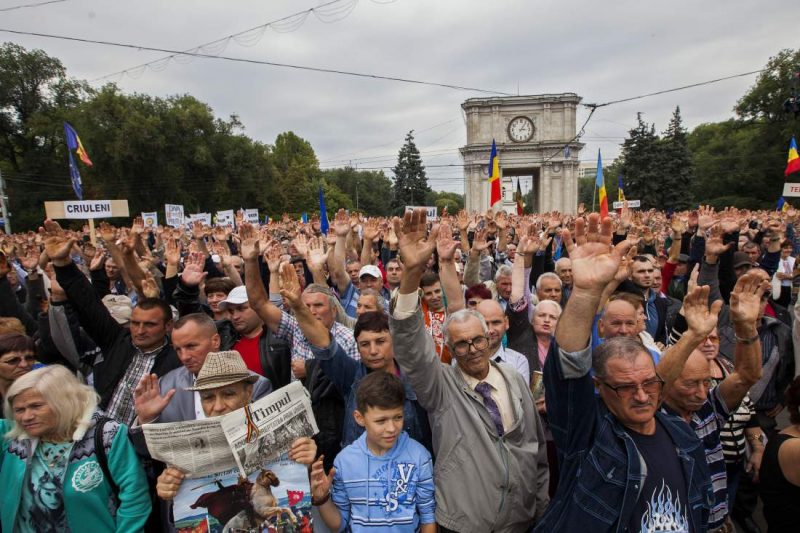
Pic of recent massive demonstration outside Moldovan Parliament.

This story might appear obscure but it reflects a bigger issue - about how Russian revanchism is reported back through democratic Europe's free media.  The issues it describes have also often been the story in Ukraine. How solid, liberal ideas like 'balance' and reporting 'both sides' can become a failure to tell the truth. How inserted reporters don't pay attention to the locals. How the messy 'European ideal' needs much closer reporting if we're to truly live up to any democratic ideal.

In the 1959 British comedy The Mouse That Roared a tiny, obscure European country ends up through comedic slight-of-hand being feted by both sides in the Cold War. In comedy, it showed how much of Europe is to the British 'Ruritania', an inexplicable country whose peoples and cultures all mess into one. As the article explains this approach lives on with today's lens of geo-politics and ideas of 'colour revolution' (via Russian infowar) muddying the coverage yet more.

Reblogged with permission from Open Democracy Russia.

====

By Mihai Popșoi  
 
There’s more to Moldova's protests than “pro-European” versus “pro-Russian”.

Moldova’s image as the poorest country in Europe is rivaled only by its obscurity. In rare outbursts of international media coverage — often related to human trafficking, arms smuggling or mass protests — Moldova is depicted as a pawn on the regional chessboard, caught in a tug of war between Russia and the west. There is no denying that, in a world of realpolitik, Moldova is indeed a playground.

Yet there is more to this intellectual inertia than meets the eye. The sheer lack of nuance and insight displayed by the international media with regards to the latest developments in Moldova is as disappointing as it is predictable. 
Much in the way of confirmation bias is at work here — the tendency to search for or interpret information in a way that confirms one's preconceptions. People are usually unwilling and, at times, admittedly unable to comprehend complex phenomena, especially when simple mental shortcuts are readily available.

Professional journalists and political analysts pride themselves on preventing or minimising the influence of such biases on their work. This is easier said than done, particularly in today’s world of ubiquitous geopolitical expediency. Moldova is a case in point.

Perils of European integration


Since the so-called ‘Twitter Revolution’ of 2009, Moldova has embarked on a path of economic transformation and political democratisation — or so everyone thought. The post-revolutionary government took on a rather inspirational name, the Alliance for European Integration, which proved to be both a blessing and a curse.

Generous western financial assistance and political support locked the United States and European Union into the costly self-fulfilling prophecy of a ‘success story’. But the success failed to materialise, despite promising beginnings. Five pro-European governments succeeded each other faster than the public could keep up with, and they spared no effort in building an elaborate discourse of European integration both at home and abroad. One could not help but be mesmerised by the audacity of Moldova’s leadership that promised to bring the country into the EU by 2020.


Over 100,000 protesters took to the streets of Moldova's capital in September 2015 to protest the ‘stolen billion’. Photo courtesy of Maria Levcenco.

Naturally, high hopes developed among more gullible Moldovans and international development partners alike. But the signs of trouble appeared early on.

As early as 2011, there have been hostile takeovers of privately held shares in several leading banks, known as the raider attacks. Then came the infamous ‘Huntigate’ scandal of 2013 — a cover-up of a fatal accident during a lavish hunting spree attended by the top brass of the country’s judiciary, including the Prosecutor General. Finally, ‘the billion dollar bank heist’ left the country perplexed as to how one could steal the equivalent of 15 percent of GDP from three banks with impunity.

Once a poster child of Moldova’s European Integration, Vlad Filat, former prime minister and Leader of the Liberal Democratic Party, ended up a scapegoat for the missing billion. Meanwhile, Filat’s archenemy the oligarch and senior vice president of the Democratic Party, Vlad Plahotniuc, became the sole decision maker in the country.

By hook or by crook, Plahotniuc was able to create a majority coalition (which oddly bears no name). It was rushed to a vote in parliament as protesters gathered outside and soon started demanding early elections. This clearly begs the question: how can international media refer to the current reincarnation of previous governments as pro-European?

Monstrous coalition


Reports from Euronews, BBC, New York Times as well as Russia Today all described the new government as ‘pro-European’ — much to the bewilderment of Moldovan civil society. In a very heartfelt piece on his personal page, Dumitru Alaiba, a former economic and financial advisor to two prime ministers, urged international media and western politicians: “Do what you must, just don’t call this government ‘pro-European’. It is not Europe that they represent. And don’t call us, the people, pro-Russian either.”

Well-respected media institutions used a default template for covering Moldova, relying mainly on the fact that the new government presented itself as pro-European. A more astute analysis would indicate that the new government is ‘pro-European’ in name only.

After numerous Moldovan activists wrote public letters calling upon western media to take a more mindful view of the ongoing protests, a change of tone occurred. There is now a broad acknowledgement that protesters were, and are, a distinctly heterogeneous group.

Admittedly, many of them are pro-Russian, yet a lot are as pro-European as they come. What unites them all is a genuine frustration with an ad-hoc “monstrous coalition” government and a desire for a more democratic and prosperous future.

This is largely missing from the international media discourse, caught in the cross fire between Russia and the west. Russia has capitalised on the growing anti-European sentiment in Moldova, and by supporting these ruling elites, western media and western politicians have only vindicated Kremlin’s propaganda.

Another piece of the puzzle


Russia’s postimperial syndrome is built on the belief that the west is containing its resurgence by creating a belt of instability in south-east Europe — a mantra that rarely departs from Russian TV screens. Moldova is seen as just another piece of the puzzle.

Moscow has a clear agenda of trying to bring Moldova back into its orbit and does not shy away from making its intentions known either.

For instance, in the aftermath of the 2010 parliamentary elections, Sergei Naryshkin, head of the Russian presidential administration, attempted to broker a coalition deal between the Communists and the Democrats. In the 2014 campaign, Russia openly supported the Socialist Party.

Russian media, which still holds a lot of sway over Moldovan public opinion, has been an indispensable tool in this process. Interestingly though, the rebroadcasting rights in Moldova for the most popular Russian federal TV channels are owned by so called ‘pro-European’ politicians, primarily Vlad Plahotniuc. He owns, among a few others, the Moldovan license for Russia’s flagship Channel One. Russian media coverage of protests in Moldova paints the EU in a negative tone, while reinforcing the message of Eurasian Economic Union as a better alternative. The aim of these reports may be as much to appeal Russia's domestic audience as it is to influence public perceptions in Moldova.
This sort of nuance is helpful in understanding the complexity of the Moldovan political landscape, which cannot be reduced to a mere east-west dichotomy.

The same is true for the protest movement. Many things that politicians had kept to themselves, such as allegations of blackmail and corruption, came to light only after mass protests erupted. However, for a long time, protesters could not set their differences aside in order to pursue a common goal: early elections.

Even when they finally did, the much heralded unity of protesters across ethnic, linguistic, ideological and party lines proved too good to be true. The nascent movement is constantly being undermined by infighting.

Besides, there have always been doubts about the independence of such political players as the socialist leader Igor Dodon, Our Party head Renato Usatii, and front man of the civic platform turned political party, Andrei Năstase. Hence, the real tragedy is that genuine popular protests are led by less than candid individuals.

Bridging the divide


Instead of helping to bridge this divide, both media and politicians have contributed to the increased polarisation of public opinion by presenting just one side of the debate, reinforcing the ever-present confirmation bias.

This development is particularly visible when it comes to Romanian or Russian news reports, as well as political commentary on developments in Moldova. Self-proclaimed leader of the Moldovan diaspora in Russia, Aleksandr Kalinin, posted a Facebook video calling upon Vladimir Putin to come and rescue the Moldovans from what he saw as an imminent takeover by Romanian and Ukrainian special forces.

The response came in a leading Romanian newspaper from none other than a prominent Romanian analyst and former adviser to Romanian president Traian Băsescu, Iulian Chifu, who called the video an “official request” to Putin. To his credit, Chifu went on to debunk Kalinin’s bogus allegations, but the latter was afforded much more attention than he deserved even in the aftermath of Crimea and Donbas.

The EU's former enlargement commissioner Štefan Füle is perfectly right when he says that: “We should be more active in addressing [pro-Russian] propaganda about what the Eurasian Economic Union offers versus what the EU offers a country like Moldova.”

Undeniably, Russian media will continue to produce characteristically biased reports about Moldova, but if western media want to have any claim to a higher moral ground they have to give up using simple shortcuts and produce accurate accounts no matter how tedious or inconvenient that may be.

Max Seddon’s recent article in the Financial Times, for example, does just that. He reports that “In private, some European diplomats say they would welcome a pro-Russian government — if only so that the current coalition cannot further tarnish the EU. Says one: ‘Asking them to do reforms is like asking turkeys to prepare Christmas dinner.’” 


Who are the pro-Europeans now?


No matter how ironic it may sound, a pro-Russian government is likely to be the only thing that can rehabilitate the European Union’s image in Moldova. The risks of a new government changing Moldova’s foreign policy course are minimal: it would be economically irrational and politically suicidal, since most of the burden of adjusting to the new EU-Moldova Association Agreement has been incurred, while the benefits are only kicking in. 


The new government cannot be called pro-European and, to its credit, it does not use the term. The coalition that Plahotniuc has put together literally has no name nor a coalition agreement. It relies on the program of the previous government despite being a “coalition of the willing”. Namely, the will of the 57 lawmakers being to preclude early elections and stay in power for another three years despite the sheer collapse of public trust after the infamous bank heist and the utter refusal to accept any blame either by the government or the parliament.

Moldova is a case study for state capture, though perhaps had Moldova been an EU candidate country, things would have been different via conditionality. The West has sacrificed democracy for geopolitical interests, which is usually a recipe for disaster down the road.

The sole threat of an imminent pro-Russian government is likely to galvanise and reboot the political system, albeit incrementally, with a new breed of upstanding young professionals exiting their comfort zones and entering the public domain to the benefit of their communities and their country — the alternative being a drift away from the values of democracy and the rule of law, all under the watchful eye of the international media.


See also:

Friday, 6 November 2015

On LGBT rights Ukraine stuffs up again


In September Elton John traveled to Ukraine to tell the country's leaders to support LGBT rights. He spoke at a gathering of much of the country's elite at the invitation of one of its oligarchs.

John spoke of the need for 'dialogue', saying:
We have to have it because there is a revolution of acceptance and understanding happening around the globe. And for any country wanting to build a more tolerant society, you have to be a part of it.
Speaking, as he was to mainly businesspeople, he explained how equality was good for business:
Laws and policies designed to repress LGBT citizens and to keep people in the shadows hinder economic development. Such policies are detrimental to business and economic interests. They jeopardize the safety and well being of employees and workers.

Everyone listened politely and applauded him yet seven weeks later the Ukrainian parliament has rejected basic labour protections for LGBT people.

The decision is not just bad for LGBT people but kyboshes the relaxation of visa requirements for Ukrainians wanting to travel to the European Union - including LGBT non-discrimination is a basic requirement for the EU, although far from the only one.

The specific amendment received only 117 votes, with 226 needed.

According to Halya Coynash:
A suspiciously large number of MPs were absent, and many abstained, rather than voting against.
The Chair of the parliament's Committee on European Integration, Irina Herashchenko, condemned her fellow MPs behaviour on Facebook, writing:
Today, when the Verkhovna Rada of Ukraine, the European countries should fulfill their commitment to non-discrimination and support the European norm about impossibility of any discrimination in employment, including on the grounds of gender identity or sexual orientation, started a real coven obscurantist. Our core values ​​- respect for the identity of this man! Respect! By the difference! And do not get into the personal lives of people.
The journalist and activist Maxim Eristavi wrote:
Serhiy Kaplin, MP, president's "Petro Poroshenko's Bloc": "I haven't voted because of my religious stance, also because our ancestors, Cossacks would just trample those people with their horses'

Pavlo Unguryan, MP, prime-minister's "People's Front": 'There's no discrimination of them. We, as the country with a thousand year old Christian tradition, just simple can't allow this'

Volodymyr Ariev, MP, president's "Petro Poroshenko's Bloc": "I took this sin. I voted yes. You can slap me around, but it was a demand for visa-free regime with EU. Everyone will answer for their decisions before the God in the end"

These comments show that the Western partners of Ukraine pretty much failed to communicate to local political elites what basic human rights protection means and why hate speech from a politician is not acceptable anymore anywhere in countries that call themselves civilized.
The possibility for introducing change via the courts was suggested on 20 October, by Foreign Minister Pavlo Klimkin, "as we have in the Constitution clear provisions on the impossibility of discrimination." Though there is no indication that the government will support this.

It has been previously reported that the pressure to exclude LGBT from any anti-discrimination provisions is, unsurprisingly, coming from the Ukrainian Church. There have also been signs of pressure from international religious conservative forces and there may well be a Russian hand also at work.

But the bottom line is a complete absence of leadership from politicians.

In Ukraine little if any progress has been made on LGBT rights. There have been recent assaults on two community centres, in Kryvyi Rih and Odesa. Earlier there was the assault on the Kyiv Pride March.

We recently learned that the county's human rights strategy had been drawn up without any mention of LGBT people. 89% of openly gay people reported discrimination during the previous three years in a 2011 survey.

Some progress has been made in the way the state treats trans people.

In occupied Crimea and in the Donbas (where homosexuality has been recriminalised) of course the situation for LGBT is far worse. 

There have been questions asked as to whether the EU's position will hold. According to regional LGBT groups there has been a "lack of consistent and uncompromised commitment of the EU to human rights of LGBTI persons, non-discrimination, and respect of diversity in its cooperation with eastern neighbours."

According to a report put out earlier in September by the Equal Rights Trust on inequality in Ukraine:
LGBT rights have become a fragile off-shoot of a pro-European choice: “we’d rather have a gay pride in the streets of Kyiv than Russian tanks”, a Kyiv resident told the Trust.
Maxim Eristavi wrote last year about the spinelessness shown by the EU on LGBT rights in their negotiations with Ukraine - a fact which has gone unreported and completely undermines Russian propaganda.

Eristavi has also written about how gay people were part of the Maidan demonstrations that overthrew the corrupt government of Yanukovych. Eristavi counted seven gay people among the 'Heavenly Hundred' murdered by Berkut/Russian special forces. A number of people reporting on the military fight in East Ukraine have noted the presence of LGBT on the frontline as they condemned this parliamentary vote.

Never mind the rejection of basic human rights, it is shameful what Ukraine is doing to the memory of those who have fought and died for it.

Thursday, 22 October 2015

Ukraine: Punished for pursuing a European future

Demo immediately after President Yanukovych cancelled EU Association Agreement, November 2013

Reblogged with permission from Progress. Jamie Milne is a Labour Councillor in the London Borough of Lewisham and the founder of Labour Friends of Ukraine. He tweets @j_m_milne.

====

By Jamie Milne

The report by the Dutch Safety Board into the Russian BUK missile that brought down flight MH17 provided a brief revival of interest in Ukraine this week. But for those who know and care about this embattled but optimistic country the trend is clear – the Russian annexation of Crimea and attack on eastern Ukraine is being forgotten.

Ukraine has suffered extraordinary hardship in the last 18 months and, while Ukrainians hold their future in their own hands, western support is vital. The European Union and United States must not allow their response to Russian aggression to become frozen along with the conflict.

If they can manage to rouse themselves for the first rewriting of European borders by force since the second world war, Angela Merkel, Barack Obama and David Cameron should consider three approaches that would discourage future aggression and eventually roll back past misdemeanours.

First, the west should undergo a fundamental rethink of policy towards Russia which persistently sees differences between Vladimir Putin and the west as artificial and born of mistrust rather than a reflection of completely incompatible visions of the future. It must, of course, continue to isolate Russia in light of its intervention in Syria. Obama blundered by rewarding Putin with a meeting straight after his visit to the United Nations. The message on Russian state media was clear – diplomatic isolation over Crimea and the Donbas was over. Since then American policy appears to have changed with the growing realisation that Russia’s intervention is explicitly pro-Assad and entirely unconcerned with Islamic State. Freezing out Russia is both a moral and prudential approach that deepens Putin’s pariah status for his support of one of the world’s worst regimes and denies him the diplomatic showboating he desires.

Punishing Russian eschewal of international norms is vital but little thought has been given to support for Ukrainian president Petro Poroshenko and the new Ukraine. For a young nation of 45 million people that has put lives on the line to pursue a European future this is an unforgivable omission. For the west, the wisest Ukraine policy is also the best Russia policy – assist in the creation of an enterprising, successful country shorn of corruption that Russians are envious of and wish to emulate. A flourishing Ukraine solves the Donbas problem and ultimately addresses the Putin problem. The current approach – a mean trickle of cash that keeps Ukraine on life-support coupled with credulous diplomatic agreements – is an unwitting pro-Putin policy.

Finally, western leaders must stop acting as moderators and start behaving like an ally. The Minsk II agreement signed by France and Germany legitimised the Kremlin-backed rebels and left Poroshenko a mendicant in his own country – requiring permission to secure his own borders and to hold elections in the Donbas.

The politically ‘wised-up’ speak knowingly of Putin’s strategic cunning but the truth is his assault on Ukraine has been a disaster. Only through a pitiful lack of willpower and turning our back on our values have we made it possible to lose an easy fight. In putting right their mistakes, Obama, Merkel and Cameron would be doing a better day’s work than they have done for a long time on the international stage and would go a long way to silencing a man who has become the world’s principal cause of instability.

Friday, 4 September 2015

Back brave LGBT comrades in Ukraine


There have now been a series of attacks on LGBT organisation in Ukraine by the far right. Back in June, following comments backing the right to demonstrate by the President, the Kyiv LGBT Pride March went ahead but it was then attacked by the far right. One of the police officers protecting the marchers was seriously injured.

Then last month a march in the Southern city of Odesa was banned and the offices of the local LGBT organisation attacked with firecrackers. Despite the threats activists in Odesa held a flash mob without incident. The banning of the march was criticised by the US Embassy.

Last week we learned that the county's human rights strategy had been drawn up without any mention of LGBT people. And last week a party and home in Kryvyi Rih was attacked and several people badly injured.

In occupied Crimea and in the Donbas, where homosexuality has been recriminalised, of course the situation for LGBT is far worse.

Maxim Eristavi wrote last year about how gay people were part of the Maidan demonstrations that overthrew the corrupt government of Yanukovych. Eristavi counted seven gay people among the 'Heavenly Hundred' murdered by Berkut/Russian special forces. He also wrote about the spinelessness shown by the EU on LGBT rights in their negotiations with Ukraine - a fact which has gone unreported and completely undermines Russian propaganda.

One of the basics of being in the EU is anti-discrimination laws but although LGBT were included in a draft law drawn up last December they were dropped from subsequent versions, reportedly as a result of pressure from churches. So the trade agreement with the European Union will start at the beginning of next year without such protections.

The unbanning of the Kyiv Pride march after Mayor Klitscho blocked it 'in time of war' shows that Western pressure can have an effect.

LGBT must not be sacrificed in the name of solidarity with Ukraine or in the name of national solidarity.

Western supporters of Ukraine and Western LGBT rights groups must keep on the pressure and must put a boot up the backside of the EU. Ukraine has no excuses, none, and must be firmly told that.

As many have commented, the deaths of three young soldiers outside the Ukrainian parliament last week during the violent demonstration by the far right was a sharp reminder to the government that it is past time to ensure that the same far right forces also attacking LGBT people are put back in their box.

According to a report put out earlier this month by the Equal Rights Trust on inequality in Ukraine:
LGBT rights have become a fragile off-shoot of a pro-European choice: “we’d rather have a gay pride in the streets of Kyiv than Russian tanks”, a Kyiv resident told the Trust.
This underlines why we must have the backs of our brave comrades in Ukraine, like these people who protested openly in Kyiv last Sunday.

Translation courtesy Olena Shevchenko. Reblogged with permission from Insight.

===

LGBTQI public action-performance was held in Kyiv aimed at protecting the rights LGBTQI community, titled "I will disappear soon." The event took place at 1 PM at the Kyiv city administration with the participation of the NGO "Insight" and other activists.

One activist performed a performance, during which she was lying on the ground covered with rainbow flag and a banner: "I will disappear soon." Other participants were standing around, holding banners: "For freedom of speech", "All Different All Equal", "not ashamed to be gay" and others that you can see in the photos.
"We are trying to say that we live in this country, we are as citizens, we live here and now, and we demand freedom - the same as other people. We want freedom not only for ourselves but for each and every one of us. We say that the right to freedom of expression, the right to peaceful protest, the right for self determination is violated in Ukraine.

We believe that this is a right time to begin to deal with it. We believe that this requires laws and mechanisms as well as education on human rights.

We call for tolerance towards all of us, and we are against violence. We are not afraid - we will go further, and will fight for human rights," said the head of the NGO Insight, Olena Shevchenko.
Loud music from speakers in front of the Kyiv City administration muffled speech. But no one can force us to shut up.

Friday, 14 August 2015

Ukraine: Get it together on LGBT rights

Photo from the VKontakte page for the Odesa Festival

It is both disturbing and frustrating to read, yet again, of Ukraine blocking LGBT rights, in this case the right to demonstrate.

As Maxim Eristavi wrote last year, gay people were part of the Maidan demonstrations that overthrew the corrupt government of Yanukovych and Eristavi counted seven among the 'Heavenly Hundred' murdered by Berkut/Russian special forces. He also wrote about the spinelessness shown by the EU on LGBT rights in their negotiations with Ukraine - a fact which has gone unreported and completely undermines Russian propaganda.

That Western pressure can work was shown when President Poroshenko said that the Kyiv Pride march should be allowed to go ahead, dismissing Mayor Klitscho's reasoning. I have no doubt that diplomatic or other pressure on Poroshenko led him to say that.

Western supporters of Ukraine and Western LGBT rights groups must keep on the pressure and must put a boot up the backside of the EU. Ukraine has no excuses, none, and must be firmly told that. We must have the back of our brave comrades in Ukraine.

Reblogged with permission.

===


By Halya Coynash

The Odesa District Administrative Court has allowed an application from the Odesa City Council and banned the Equality March planned by the LGBT community for Aug 15. The grounds presented and accepted by the court were that disturbances were likely and the authorities could not guarantee law and order.

The application, heard on Aug 12, was supported by the Odesa Police. Kirill Bodelan, Press Secretary for the Odesa Pride 2015 Festival told Dumskaya that the authorities had tried to get all Festival events from Aug 13-15 banned. They wanted to prohibit even the organizers from gathering in groups of more than 3. The court hearing apparently went on until 2 a.m. “After long arguments only the march was banned”, Bodelan says.

Interfax Ukraine reports that the applicants claimed that there was a negative attitude among the public to the Festival, and a high likelihood of violence to participants in the march and disruption of public order. The court also noted that football matches were scheduled for Aug 14 and 16, and ultimately concluded that the march could present a real danger and threat to public order, and to the safety both of participants and other members of the public.

The organizers say that over 200 people, including foreigners, have registered for the Festival and they are adamant that it will take place. They have, however, encountered other disturbing problems with people refusing to rent out venues for the events.

Mob rule?

There are a number of right-wing organizations, especially Right Sector, who have not only expressed antagonism to the LGBT community, but have threatened members with violence. They are almost certainly to blame, together with VO Svoboda thugs, for the violence in Kyiv during and after the May Equality March.

Their homophobia is not a valid excuse for restricting citizens’ rights. This was in fact affirmed by President Petro Poroshenko on the eve of the Kyiv Equality March. He was responding after Right Sector came out with anti-LGBT and anti-western statements identical to those regularly heard in Russia. Right Sector also issued an appeal to the Mayor of Kyiv, Vitaly Klichko asking that the march be banned. The authors of this opus claimed, without providing any evidence, that “the public are very negative in their attitude to such LGBT actions. Most Kyiv residents are believers and against such a phenomenon.” More details of the ‘arguments’ presented: United in Homophobic Bigotry: Right Sector echoes Russian anti-LGBT line

The Kyiv March did take place with a very large contingent of police brought in to maintain order. Five police officers were injured during the march, one very seriously.  The Gay Alliance and other civic activists initiated a collection for the injured officer who has thankfully recovered. 10 participants were attacked by masked thugs, presumed to have been from the same far-right parties, after they dispersed. While commending the efforts of the police and National Guard, Amnesty International in Ukraine was still critical, saying that the authorities should have taken better measures to ensure the marchers’ safety after the event.

Odesa’s different path

It may be understandable, but it is also disturbing that it should be Odesa which has now decided to ban an analogous march. This is the city which on May 2, 2014, saw violent disturbances and the tragic fire in the Trade Union House, with the loss of 48 lives.

One of the reasons why the events got out of control lies with the police. 15 months later there is frustratingly little progress in establishing who was to blame for the failure to implement an action plan. This had been drawn up specifically to prevent disturbances that day before, during and after a planned pro-unity demonstration and football match  (See: Odesa May 2 Investigation: A Failed Test for Ukrainian Justice as well as some limited progress here).

There were well-founded reasons to anticipate trouble back in April-May 2014, with Odesa seeming the obvious next target for Russia’s aggression after Donbas. The uses the Russia’s propaganda machine has made of the tragedy of May 2, 2014 have only heightened concerns, as have the string of terrorist attacks and separatist fakes.

There may well be grounds for concern now, but these are only heightened when the authorities, police and court are all willing to restrict people’s rights, claiming that they cannot protect them from homophobic thugs.