Now posts ↓

Showing posts with label content. Show all posts

Sunday, 15 June 2008

Scrapbook clips catch up

Quickie job this week ;]

Will highlight a comment left with Off with the pixies from Dan McQuillan.
As the guy with the job of delivering the UK Catalyst Awards, I'd of course prefer to take more optimistic view.

But I agree that the critical thing is to move from excited blah blah to real impact. I'm trying to bring to catalyst as much grit as I can from my experience in co-founding social innovation camp.

We'll have to wait and see whether catalyst phase two can produce the kind of mentoring, incubating and financing that will deliver dynamic social startups.
Gerry McGovern, always worth reading, has started a series on What is the role of government on the Web?
For the government to truly serve its customers on the Web it needs to address the following issues:
1. Get away from a technology obsession
2. Manage customer top tasks, not government websites
3. Get politicians off government websites
4. Stop government vanity publishing
5. Develop a government archive
Federal Times has a very interesting piece on Gov’t. 2.0: Wikis, blogs and more - use in the US government.
The blog is a bold move for TSA [Transportation Security Administration | U.S. Department of Homeland Security] because it fully embraces public comments on what the agency is doing wrong, said Stephen Goldsmith, director of Harvard University’s Innovations in American Government program.

“They’re going to insult you whether you have a blog or not,” Goldsmith said. “You might as well learn from what they’re saying.”

Using discussion boards and e-mails, [Environment Protection Agency] EPA’s new social Web site, called National Dialogue on Access to Environmental Information, has pulled comments from across government and the country to help [EPA’s chief information officer, Molly] O’Neill as she fashions a new information-sharing policy.

Since O’Neill came on board last year, EPA has embarked on four such projects that integrate blogs, wikis, discussion boards and other social networking Web tools, which are collectively referred to as Web 2.0, into EPA’s business.

“The technology is not complicated, it’s just a different way of doing business. And getting people to do business in a different way is culture change and that’s a challenge,” O’Neill said.
New Canadian survey on the public's attitudes to use of web 2.0 in government.
When asked to consider specific ways that government might use social media, the respondents showed strongest support for:

1. Websites where government scientists or experts could answer the public’s questions
2. Websites that would allow Canadians to express their views on different issues
3. Audio tours or pod casts of historical and natural sites across Canada that could be downloaded.
Jakob Nielsen updates his guidance on Writing Style for Print vs. Web
Summary: Linear vs. non-linear. Author-driven vs. reader-driven. Storytelling vs. ruthless pursuit of actionable content. Anecdotal examples vs. comprehensive data. Sentences vs. fragments.

We should accept that the Web is too fast-paced for big-picture learning. No problem; we have other media, and each has its strengths. At the same time, the Web is perfect for narrow, just-in-time learning of information nuggets — so long as the learner already has the conceptual framework in place to make sense of the facts.

For example, I dated "learning around the campfire" to 32,000 years ago to coincide with the emergence of high culture and the Cro-Magnons. Not that the Neanderthals didn't have campfires — they simply didn't have the cultural depth of modern humans, so I don't think their storytelling was equal to my seminars. So, did I actually remember that Cro-Magnon culture started 32,000 years ago with the Lascaux cave paintings? No, I looked that little fact up online.
Now where do you think this clip is from?

More than 10 new e-Government services will be launched in the next six months, while more than 15 e-Government services will come online within two years, Secretary for Commerce & Economic Development Frederick Ma says.

He told the Legislative Council today the e-Government services include the transport information system and the electronic health record system.

The bureau will also launch a geographical user interface to help users locate information and implement a unified identity management framework to verify their identity and safeguard their personal data.

A pilot scheme in forming district cyber centres will be conducted to provide hardware and technical support for children in low-income families and needy residents to access online resources.

Mr Ma added all Government bureaux and departments have revamped their websites to comply with Internet accessibility standards stated in the internal guidelines for information dissemination since 2003.

An inter-departmental committee regularly reviews the guidelines and released the latest version early this year.

Guessed? Hong Kong.

Facebook over? Only in Islington says Rory Cellan-Jones on BBC/dot.life
The social networking scene is settling down into separate camps. The very young are with Bebo. The music crowd are still on MySpace. The obsessive technophiles are on Twitter - latest Tweet from one sad West Coast blogger: "I have 3,500 unanswered direct messages. Please do not send more." But the mass of students and young professionals seem to be gravitating towards Facebook.
Is the Daily Mail editing the government too?
"In the same way that there are standards that are essential to broadcasting, in this converging world I believe there should be a set of standards online".
That's culture secretary, Andy Burnham. Sweetheart, talk to some Aussies about the 'issues' of going down this road. Pa-leaze!

Worth a read on cyber-censorship is Seth Finkelsten.

Also worth pointing out that repeated testing has shown the failures of censorware (filters), including one done earlier this year for San Jose libraries, plus, of course, that anyone can find out how to Bypass Internet Censorship.

House of Lords two-up now on the Commons as they launch a YouTube Channel.
The five videos aim to explain the "role, impact and relevance" of the House of Lords and "reach out to young people and other audiences who may not be involved in politics or well informed about the role of parliament".
Wired's Thomas Goetz makes a great point about Obama's FightTheSmears.com.
By putting their own website out there front-and-center, and then getting everybody to link to it (starting with all the media covering the launch of the site), the result will be to drive fightthesmears.com towards the top of a Google search on, say, "obama muslim" or "michelle obama whitey". Ideally, if enough of the pro-Obama network links to fightthesmears.com, it'll drive the sites that peddle in the rumor-mongering, which are now the first results on said searches, off the top of the results list. Ideal long term result: any curious low-information voter who eventually bothers to google these pesky rumors will immediately be led to the debunking rather than the rumor.
And this is coming over here too. The disgusting Melanie Philips repeats the dirt for The Spectator.

Eric Schmidt thinks Google should extend a helping hand to 'old media'. He "hopes its recently acquired advertising service DoubleClick will aid newspapers as they struggle to corral more online revenue".

Bob Ostertag has some warnings about Obama's Internet Money Machine and the Future.
Yes, this is a wonderful thing that the Internet has democratized political financing in an unprecedented way. What is even better, the fact that the progressive guy figured out the new money regime first may catapult him from freshman senator to the White House, opening one of the most exciting chapters in American political history.

But it is not insignificant that in the process, vast sums of money are flooding into the political arena.
Worth something in twenty years will be ... McCain condoms! (Barack ones too).

Christopher Ciccone, brother to Madonna Ritchie (nee Ciccone), is writing a book. Met them both (if by meet you can count 'hello, this is ...' 'hello, goodbye') in my gossip column days. Some daft queen thought she'd enjoy a tacky drag troupe and being showered by glitter at a not-that-glamorous 'do' and birthday bash for Chris by the harbour in Sydney. As I recall, they didn't enjoy Oz very much .. wonder if that'll make his book ... ?

Quote of the week from GC Weekly:
Earls Court, location of this week's GC 2008 Expo, was replete with [sic] beautiful people and futuristic technology.

The fact that the venue was also hosting Graduate Fashion Week and a Doctor Who exhibition may have contributed in some small way to these qualities. But you could not beat Kable's conference when it came to threatening behaviour from chairpeople.

Brian Derry of Assist said he would expel people from the session he chaired if they violated the no-mobile policy - dancing to the tunes of their ringtones. Alternatively, they could pay £10 to the charity of his choice.

Mark Logsdon of Barclays, speaking at a session on security, revealed that his organisation charges £50 for rogue mobile vocalisations. But after adjusting for banking salaries, that works out around a hafpenny.

It might not have been appropriate for Dave Mitchell of BT, chairing a session on the NHS National Programme for IT, to have punished the use of telephones. But he did threaten a collective punishment for the audience, if it failed to show suitable interest: a video nasty on the auditorium's big screen.

Luckily, Mitchell decided it was necessary to deploy a video of former National Programme guvnor Richard Granger on his holidays. The threat was enough.

Tuesday, 6 May 2008

Jakob: keep cutting those word counts


Continuing my love affair with Jakob Nielsen, he has some sound, tested advice from the latest Alertbox:
On the average Web page, users have time to read at most 28% of the words during an average visit; 20% is more likely.
Something interesting he cites in the detail is that, although the research is with 'high-end users':
This might not be a problem in the long run, however. If, for example, we compare data we collected in 2008 for our Fundamental Guidelines for Web Usability seminar with a similar study we ran in 2004, we find that 2008's average behavior is close to that of 2004's higher-end users.
Also:
The authors found that the Back button is now only the 3rd most-used feature on the Web. Clicking hypertext links remains the most-used feature, but clicking buttons (on the page) has now overtaken Back to become the second-most used feature. The reason for this change is the increased prevalence of applications and feature-rich Web pages that require users to click page buttons to access their functionality.
He also reports two interesting observations from WebSiteOptimization:
(1) Over the last 5 years, the average Web page grew from 94 KB to 312 KB: a growth rate of 82%/year.

(2) Despite this obesity epidemic, observed response times for U.S. users with broadband decreased from 2.8 to 2.3 seconds per page (average across 40 big business sites) from 2006 to 2008.

My comments:

(a) First, let's remember that almost half of the Internet users still don't have broadband, particularly in rural areas. In fact, FarmersOnly.com explicitly decided to design for dial-up access.

(b) While 2.3 seconds is better than 2.8, it's still 130% slower than the 1.0 seconds required for optimal user experience and a true sense of flow while navigating.

(c) In the past, big images were the largest offender, but now response times are delayed by the inclusion of ever-more external objects, code snippets, and "widgets." Keep a lid on it. The biggest contributor to interactivity is still the ability to navigate fast and furiously.

Sunday, 20 January 2008

Column width · Bigger isn't better


The poll I ran came in with 'narrow' as the favourite for text column width.

I wasn't surprised, as I've always taken the idea that newspapers were onto something — around the twelve word mark and the eyes/brain needs to stop and go to another line.

That's why sites which have text running the full width of a screen wear the eyes out (unless your eyes are already worn out, or it's a mobile screen).

Guru Jakob
says:
Readability: How easy is it to read the text in various columns, given their allocated width?
And talks a lot about scrolling. Which is increasingly prevalent user behaviour.

Resizability is the key, meaning fluid design.

As for the content, Jakob was talking about 'Inverted Pyramids in Cyberspace' in '96. Again, something newspapers have always done.

The more things change ....


Wednesday, 12 September 2007

Google loses it and other musings


I've posted before about removing widgets because the servers serving them were too slow - and holding up other content. Well add to this the widget being reprogrammed with no warning and disappearing.

That's what Google just did with Reader. Changed something so one aspect of the service disappeared, in this case my 'what I'm reading' widget - vanished. Fortunately, I spotted it because someone else did and alerted me, I thought to check whether I could redo it and I could.

Crap customer service from Google - adding to the accumulating bad image they have in that regard - as sending me an email alerting me to it changing is dead, dead simple. Automatable, even.

Because I figure it's a one off (hah!) I did a bit more and withered my feeds and put them through the Reader widget.

Availability is very important! Google Maps is a real alternative to expensive alternatives not just because it's free but also because it's available, it's reliable. MS Live Local isn't, it's slow. Haven't experimented with Yahoo Maps yet but I prefer their interface and they're fast, so there is a Google alternative.

I also removed the Technorati 'tag cloud' widget because it wasn't picking up my tagging — Blogger has 'labels' rather than tags, the cause I believe. You clicked 'environment' and it gave no results. I haven't seen an easy to use 'tag cloud' widget yet (I may now go look, they're the best way to organise content :).

I really dislike how Technorati's changed and I haven't seen much development in areas like widgets with them for a long while (Read/Write Web has more about Technorati's woes).

Blogger does seem some way behind WordPress, which appears to be the cogniscienti choice, having used that elsewhere and seen what else it provides I see why. I just find myself defaulting to Google products because it's easier and quicker and the negatives aren't crucial.

Wednesday, 22 August 2007

Network TV · Eyeballs crashing but TV ads still work


Jeff Jarvis has looked at a new IBM study (he hat tips Om Malik) of (First World) media use.
  • TV networks’ share of online TV viewing is only about 33 percent, below YouTube and barely ahead of Google and social networks in the U.S. — and the alternatives are only beginning (in the life of internet video, it’s only 1954).
  • Says IBM:
    The global findings overwhelmingly suggest personal Internet time rivals TV time. Among consumer respondents, 19 percent stated spending six hours or more per day on personal Internet usage, versus nine percent of respondents who reported the same levels of TV viewing. 66 percent reported viewing between one to four hours of TV per day, versus 60 percent who reported the same levels of personal Internet usage.
  • 63 percent in the U.S. said they would watch advertising before or after quality, free content (34 percent said they’d be willing to pay). Speed up, advertisers.
  • “Content” is now, at last defined as conversation as well. Use of content services: 45% social networks; 29% user-generated sites; 24% music services; 24% premium video content for TV (not sure what that means); 18% online newspaper. Ouch.
  • 58% have already watched online video and 20% more are interested.
  • DVRs are good for TV: 33% watch more TV as a result (58% the same)
  • 74% contributed to a social network; 93% contributed to a user content site. Who says that forums are only for nuts, blogs for early adopters, and photo services for geeks? Everybody’s making content.
  • Why do they do it? Feel part of a community, 31%; recognition from peers, 28%. Conversation.
  • Primary reason for viewing content on a user site: 46% said the recommendation of a friend.
  • But here’s the fly in my future-of-advertising ointment. Asked which ads “most affect your impression of a product or company,” TV commercials on major networks got the lion’s share.


Friday, 17 August 2007

Debating the "Cult of the Amateur"


The Barnes and Noble Debate - "Cult of the Amateur"

Andrew Keen, the author of "The Cult of the Amateur" debates his ideas that the Internet is killing culture and the media with (from left) Nicholas Carr, Keith Teare, Andrew Keen, Steve Gillmor, moderated by Dan Farber (ZDNet Editor). Runs 30 minutes. June 19 at Campbell's Barnes and Noble bookstore (near San Jose).

Excellent debate. Some hyperbole, especially from Steve Gillmor [Sgt Pepper as disruptive as Web 2.0?] and some scary notions from Nicholas Carr. A lot breaks down crossing the Atlantic too, which isn't commented on. Everyone's nice to Andrew.

Part 2:


"I should have defined amateur more clearly."

"How's it feel to be a node?"

> Referencing earlier talk · Media literacy in a media saturated world
“The world is not binary,” Dan Gillmor said. “It’s nuanced and complicated, and we are failing to deal with that in this conversation. No one is arguing that traditional media reaches absolute perfection or arguing that new media is perfect….We are engaged in finding our way in a difficult period of de-evolution of the old journalism business model and the rise of a new one.”

He went to say, “Whether we can make it through this very messy period with great journalism is a question, but I think we can. It will include things we directly pay for and indirectly pay for with advertising, and individuals and collectives at the edge of network will create value.” <

> Referencing · Chris Anderson (Long Tail): Why Free is the Best Online Policy
An idea Anderson proposed that will no doubt cause controversy among reading purists is the idea of putting ads in books. Such a book could be free or very low cost, and a copy of the same book without ads would be more expensive. <


Part 3:


"When something old goes away, that's more than just a 'transition'"

"You want to go back to the C16th where we need rich families to pay us, so this [broke musician] guy has to be employed by Steve Jobs?"

"Amateur radio was the original blogosphere."

Bizarre, rambling, possibly crystal-induced audience question answered by "I think that's a really good question" from Andrew. You can tell he's on the PR trail.

Friday, 15 June 2007

Clearing search pollution?


Now here's an interesting proposition ..

Today I'm thrilled to announce the Mahalo Greenhouse, a place where the public can build search results that-if accepted by our Guides-will be included in the Mahalo search index.

Oh yeah, if we accept your search result we will pay you $10 to $15 per search result (the range is based on how many search results you've completed: more here).

Now, if you're a disciple of Yochai and you absolutely will not work on a web-based project for money, we've got an amazing proposition for you: make the web better by writing spam-free search results and we'll donate your fees to the Wikimedia Foundation. So, you can make the world better 2x: first by making clean, spam- free search results and second by helping keep the Wikipedia running (those server bills ain't cheap!).

We've earmarked up to $250,000 in donations to the Wikipedia this year.

I love Wikipedia. They've got me already. Have lost several hours in Wikimapedia, which is brilliant and growing. I just tried 'Paradise garage' and got nowt though ... it'll grow..

Web Guru, Dan Gilmor, loves it. He blogs that Maholo founder Jason Calacanis, at the NMK event in London this week, called for wide efforts to rid the Net of the pollution he says threatens to choke off all of the value.

Calacanis hates SEO, calling them 'one of the worst polluters. (Click on his slide, left, to see a trajectory of decline.).

But, he says, blogs have so far responded fairly well with antibodies. (The “blogs” slide at right has a happier ending.) Naturally, he pitches his new company as an andidote for part of the problem.

There’s no question that the major Internet companies (read Google, Yahoo, Microsoft et al) have not done enough to curb the pollution. But do we really want to toss out the part of this that machines handle so well? I don’t think so.

Gilmor is reminded of the Open Directory Project, which ironically is a pillar of Google - "but this time with payments for the editors. Not a bad idea."

As I said, not a bad proposition ...


Sunday, 6 May 2007

Bytes · Belgians go backwards - police.uk unavailable - tech And guns

  • Yahoo! Pipes, the graphical, web-based RSS re-mixer, has significantly increased its geo support. They now provide a map output that plots your data on a Yahoo! supplied map. Pipes will also export geocontent in KML.

  • That group of Belgian newspapers that sued Google to be removed from its index are now back in.

    Their traffic went through the floor so they ended up having agreed to use the commonly-accepted blocking standards that they initially rejected as not being legal.

  • Michael Cross reports that the national police portal, police.uk, greeted visitors this week with: "services have been temporarily suspended."

    It still does:


    Bike stolen again? Don't try to report it through the web. This is a big comedown for a site which, three years ago, was supposed to put us at the forefront of e-government. Britain was one of only two countries in Europe letting citizens report non-urgent crimes on the web, should we so wish.

    We didn't, of course. User figures were derisory. As it wasn't in government's interest to make reporting crimes easier, the police portal had almost no promotion. The fact that it represented a nonexistent organisation, the UK police force, didn't help either.

    However Cross also claims that:

    The members of society most likely to need public services - as victims of crime, for example - are the least likely to be confident internet users.

    Er, the biggest group of crime victims are Youth, and they're the most confident users by some stretch...

    The above image (not just the unavailability but how it's dealt with) is a SCANDAL. The Guardian should have made much more of this.


  • In the wake of the latest US gun massacre, the BBC reports, tech tools are being more hastily investigated.

    Rave Guardian - invented after research found that phones are one of the primary tools students use to keep safe ... allows the student to set a timer - for perhaps half a hour, when they leave their friends' dorm room to go back to theirs. If they return safe they can simply turn off the alarm.

    "If something did happen, it would transmit their location every three minutes - including their profile - to campus safety," Rodger Desai, president and CEO of the New York based company Rave Wireless, told BBC World Service's Digital Planet programme.


    After I blogged about vampiric capitalists snapping up 'vatechmassacre.com' et al, I got comment and looked at some of the US blogosphere's debate, post-massacre.

    As a Brit, it's difficult not to see the solution as simple, and not requiring yet more sophisticated technology (especially ones with other more sinister uses) — ban guns.

    But it was good to see the blogosphere showing it's use as such solutions get debated.


Saturday, 5 May 2007

Bytes · YouTube copyright - Apple greens- Online soap hit

  • A new study has shown that YouTube is overwhelmingly not relying on copyrighted content. Vidmeter says it's more than 90%. Takedown notices cover less than 6% of the views on YouTube. The Premiership is now suing them alongside Viacom.

  • Coming in very late: Michael Grade has announced that ITV "plans to learn from the mistakes of the music industry" and "keep control" of its content as that content moves online.

    It wants to make it's website ("The ITV portal to its television and programmes") the destination.

    Good luck to them but they've made themselves a rod through completely ignoring findability and viral buzz — no posting I'm a Celebrity viral nuggets on YouTube..

  • UK Online Centres — which are just about the only people addressing the digital divide — are under threat because of buck-passing on funding amongst Whitehall departments.

    In Singapore, they have a whole eCitizen Helper Service, which is a partnership with businesses.

    Need help to transact with the Government online?

    Don't worry, eCitizen Helper Service is available island-wide. The service offers free assistance for all citizens and residents to access the Government services online. Look out for our mascot at participating outlets.


  • Greenpeace have welcomed Steve Jobs promise that Apple will be greener. Jobs move follows a long and persistent campaign.

    "It's not everything we asked for. Apple has declared a phase out of the worst chemicals in its product range, Brominated Fire Retardants (BFRs) and Polyvinyl Chloride (PVC) by 2008. That beats Dell and other computer manufactures' pledge to phase them out by 2009. Way to go Steve!

    But while customers in the US will be able to return their Apple products for recycling knowing that their gear won't end up in the e-waste mountains of Asia and India, Apple isn't making that promise to anyone but customers in the USA. Elsewhere in the world, an Apple product today can still be tomorrow's e-waste. Other manufacturers offer worldwide takeback and recycling. Apple should too!

    Now, let's take it to the next level! An Apple green to the core!"

  • A San Francisco TV Station recently premiered a show online — it was a documentary — but a daily teen-aimed soap opera, is entirely online and already a minor hit.

    Prom Queen is averaging roughly 200,000 views a day, and has accumulated more than 5.2 million views since its April 2 debut.

    While relevant benchmarks are hard to come buy in this uncharted space, the show’s daily audience is equivalent to a low-rated cable series, though much smaller than individual clips of popular YouTube ‘series’ like lonelygirl15, which sometimes yield more than a million views.

    Web Shows is a Comedy Central project where “webisodes” that originated online will then make their small screen debut in July.

    Another example of an online-traditional TV experiment is Jack Black’s Acceptable.tv, which ties to a show on VH1.


  • The Register is reporting that fans who missed out on Glastonbury tickets are nevertheless being spammed.

    Michael Eavis runs the Glastonbury ticketing through the huge Mean Fiddler organisation and the Reg suggests that "data was somehow leaked".

  • Jacob Nielsen comments on eBay's reported record profits for Q1.
    In presenting the record numbers, the CEO, Meg Whitman, said that "the company had been benefiting from changes in the user experience that had increased the number of auctions leading to sales" (as quoted in The New York Times, April 19).

    This is a great example of the benefits of usability for e-commerce: income comes from multiplying the amount of use with the conversion rate. The more you improve the user experience of finding products, researching them, and buying them, the higher your conversion rate.

    Yet most sites invest vastly more in bringing in new traffic (increasing an almost-irrelevant "unique user" count) than they invest in making these users convert.

    The cost of doubling traffic is a hugely expensive advertising campaign. Doubling conversion costs a modest usability project to identify your users' main pain points followed by targeted redesigns of those elements. Much cheaper – and a sustainable advantage, whereas traffic brought in by ads will subside when your advertising budget runs out.

    In eBay's case, user experience is so important for profits that it's one of the main things the CEO mentions to the financial press in presenting the quarterly results. eBay has a particularly competent user experience department, but smaller companies usually find that a smaller usability effort can increase their financial performance materially. Your first usability test will uncover a gold mine of low-hanging fruit, to mix metaphors.


Thursday, 26 April 2007

LiveBus.org - brill new gmaps mashup


Amazing mash-up from James Wheare/ Sparemint Design.

LiveBus.org mashes RealTime bus information to gmaps very, very well. All in a great interface.

Only covers Oxfordshire and Surrey, but is anyone else in the world doing this?


About this site

This website is an improved interface for live bus times in the UK. It works by combining real time updates from local authorities with a searchable database of bus stops across the country. You can search for a bus stop by name, locate it on a map or browse by bus routes or locality to find the stop you need.

If you're on the move, you can also receive updates direct to your mobile through the traveline-txt service. Just find your bus stop on LiveBus.org, note down its SMS phrase (e.g. oxfadaja) and follow the instructions carefully. Messages can cost up to 25p on top of your operator's usual SMS charges, so make sure you fully understand the terms.

If live updates aren't available or convenient, most routes also link to scheduled timetables, courtesy of traveline.

LiveBus.org is not affiliated with traveline, any local authorities, bus companies, or the Department for Transport and is freely provided as an alternative to existing services.

The maps are not yet working in Internet Explorer.

I'd love to hear your comments.

Sunday, 22 April 2007

'Simplicity' in web design


When Google came along the first reaction of most people was to the design. 'Clean', 'uncluttered' — 'simple' was the dominant first take.

But we generally don't want any of this in a product, especially one we tell others about.

As Don Norman, points out:
"I also know that companies have to make money, which means they have to deliver the products that their customers want, not the products they believe they should want. And the truth is, simplicity does not sell."
Gerry McGovern discusses on his blog why we buy complexity even when the simple option would be better? And how does this false dichotomy relate to websites?
  • We do judge a book by its cover; we do think beauty is skin deep. If something looks complicated, then we immediately assume that it must be powerful; must have greater value.
  • We love to show off. Complexity is like the peacock's feathers. It is brash and impossible to miss. Complexity lets other people know how clever we are and how rich, because we can afford such complexity.
  • We might not need all these fancy features right now, but there might be some time in the future when we will. Buying complexity insures us against future need.
But
  • None of the above conditions operate on a website.
Because
  • We don't pay for visiting a website with our money; we pay for it with our time .. there is a strong motivation to spend as little time as possible.
  • Websites are about the present, not the future. Investing in a product is about predicting all the future uses we may have for it. Visiting a website is about now.
  • We like websites that resemble websites we're used to visiting, because they are more familiar and easier to navigate.
  • When we go to Google we are usually alone. We search for cheap flights, but we certainly don't go around advertising that we're cheap.
Our web behavior is:
  • Relentlessly simple and hugely impatient.
  • We use the Web during the ad breaks for The Daily Show.
  • We simply don't have time to waste on complex navigation, convoluted language, or the vanity publishing of navel-gazing organizations.

This is Nielsen's “F” pattern:
Users had more fixations at the beginning of a line than the end of a line, and also the fixations were more for the first few lines than for subsequent lines.

However, as the Poynter Institute just found, studying news websites, if you grab people and get their attention they will read your copy.
Readers select stories of particular interest and then read them thoroughly. Nearly two-thirds of online readers, once they chose a particular item to read, read all the text.
They labelled this, The Myth of Short Attention Span.

Discussing the Report on American Public Radio's Marketplace Alan Jacobson of Brass Tacks Design underlined this point:
For instance, if you had a 2,000-inch story about Princess Diana, any Anglophile will read every column inch of that story regardless of the format. I worked with an editor once who told me, "Alan, they will read it if we print it on a paper bag, if they care about it."
How do you grab attention?
Research subjects also were quizzed about what they learned from a story, revealing that readers could answer more questions about a story when it included “alternative story forms,” such as
  • Q&A’s,
  • timelines,
  • graphics,
  • short sidebars, and
  • lists.
Webwrights will see this in their logs - an audience who spend a lot of time on your site.

This is important as the take-away around simplicity is often just that - give them nothing else.

As Poynter underlines, people want to search and scan websites for the content nugget they want quickly. But once they've found it, they want everything you've got - all the detail, including the shipping costs.

They want longer pieces, if it's useful (which it often is).

If you behave like some websites - Virgin's new website say (I'm a customer) - and only give them the nuggets and hide the depth - you fall back into a user's judgement that beauty is skin deep.
If something looks complicated, then we immediately assume that it must be powerful; must have greater value.
Portraying the complexity behind the simplicity is the real key in web design.

Ireland awards political vloggers, UK talks regulation

Spot the difference.

Irishelection.com has created the Online Irish Politics Awards to recognise what they're calling 'digital doorstepping'.

Organiser Cian O'Flaherty said:
"This will be the first Irish general election with a lot of participants experimenting with online media like YouTube, Bebo pages and blogs."

"There's probably going to be an awful amount of crap put out there -- frankly -- and we want to reward those who make a real effort before a jaundiced view of the internet and Irish politics sets in."

"A lot of journalists have been jeering at the internet in terms of its effect on politics here and jeering at politicians for not engaging the youth vote."

"These awards might help deflect that cynicism. Yes, a lot of 20- to 30-year-olds don't vote, but if they can discuss politics in a medium they can relate to it gives them an improved sense of ownership of the process."

"Some of the political advertising companies and spin doctors may not like this because they advise and control 'image' and 'message' but tools like e-mail allow general access to politicians, and although it doesn't beat meeting people in person on the campaign trail, it can work well if done in the right way."


Irish politicians are nothing if not ambitious online, going by the soundtrack to this video:


Meanwhile in the UK The Electoral Commission and Ofcom are said to be watching web campaigning closely, at least initially to keep track of election spending.

Ofcom says that it's jurisdiction only extends to "a website broadcasting pictures which filled the full screen".
"If it looks and feels like television, it might well be subject to regulation," an excited spokesman said.
The EU's extremely controversial audio-visual media services directive, which will increase the regulation of video content on the web, is due to come into force in 2009.

Ofcom is, of course, wetting itself:
"That will shake up the way we regulate and will bring many more services under the scope of regulation - but we are not there yet."

Google backlash, latest versions

The Google backlash now has it's own meme. amongst those contributing:
  • The New Orleans Musicians Relief Fund, who think they're blocking quotes by their spokesman, the legendary Dr John, from Google News because of their criticism around the New Orleans maps controversy.

  • The ex-owners of DodgeBall, whose SMS social networking software was acquired then mothballed:
    "The whole experience was incredibly frustrating for us - especially as we couldn’t convince them that dodgeball was worth engineering resources, leaving us to watch as other startups got to innovate in the mobile + social space."

  • The American Blind & Wallpaper Factory (ABWF), the US's biggest reseller of window blinds, whose legal case for trademark infringement is going forward. AdWords allows the use of competitor's trademarked names.

  • Three US public-interest groups who've brought a joint complaint to the Federal Trade Commission about a potential threat to consumer privacy following the acquisition of DoubleClick.

  • Sir Martin Sorrell, chief executive of the WPP advertising group in the UK, who also criticised the DoubleClick deal, claiming it would give Google an 83% share of the contextual and targeted online advertising market.
    "Google is a short-term friend and a long-term enemy and probably the shorter term just got a little bit shorter and the longer term got a bit closer as a result of the DoubleClick acquisition."

    "I think the DoubleClick acquisition clearly raises some regulatory issues which a number of media owners, publishers and competitors like Microsoft are very exercised about."

    He also said that it raised issues, "as to whether we are happy to let Google have our client's data and our own data which Google could use for its own purposes."
  • The Daily Telegraph, who following the recent Belgian court case where Google was ordered to stop aggregating a Belgian newspaper's content, are making similar noises.

  • Video content providers (including the TV Networks' owners) are lining up against them. AdSense is being geared up to distribute content.

  • As part of Rupert Murdoch's general clearance of competitors from MySpace, they've launched a Google News competitor.

  • The New York Times added lustre to the anti-Google meme with a feature this week.

    Complaints range from them hoarding all the talent, causing a 25 to 50 percent salary inflation for engineers in Silicon Valley, to the belief that Google is using up all the good "ideas":
    That's just the way it works in this country. Any time any thing gets too big, it eventually starts to die a slow death from the backlash that always rears its ugly head. I certainly can see why people are comparing Google to Microsoft. It does look like they are following in their footsteps… But, I'm pretty sure that Microsoft will be glad that there there is someone else to take the heat off of them.

However
this meme has history. Back in 2003, when PageRank lawsuits were appearing in the courts and people were complaining that blog posts were prominent in SERPs, Salon wrote:
Google's halo is beginning to tarnish. Much of this has to do with the influence the firm now wields in virtually every corner of the Web ... Google is so good that it's now seen, in some ways, as an arbiter of truth, a kingmaker.

-----

Tuesday, 10 April 2007

Online news readers last longer


The Poynter Institute
has released their annual eye-tracking study of American news sites. This year they compared the differences between how people read the news online vs newspapers.. Their main finding?
Readers select stories of particular interest and then read them thoroughly.

And there's a twist: The reading-deep phenomenon is even stronger online than in print.

At a time when readers are assumed to have short attention spans, especially those who read online, this qualifies as news.
They weren't expecting this result.

As well, it found:
  • Online readers read 77 percent of what they chose to read with broadsheet newspaper readers reading an average of 62 percent, and tabloid readers about 57 percent.
  • Nearly two-thirds of online readers, once they chose a particular item to read, read all the text.
  • People paid more attention to items written in alternative story forms such as a question and answer format or as lists, and preferred documentary news photographs to staged or studio pictures.
  • Subjects paid an average of 15 percent more attention to alternative story forms than to regular story text in print. In broadsheet, this figure rose to 30 percent.
  • 75 percent of print readers were methodical compared to half of online readers. Methodical readers tend to read from top to bottom .
  • Large headlines and photos in print were looked a first but online readers went for navigation bars and teasers.
Although, as some commentators have pointed out, the headline spin about long stories isn't exactly the case simply because print stories are different to online (where they can be shorter, or longer, or enhanced), Poynter says that in the study's details the claim holds true for comparable length stories (medium and long) — people are more likely to completely read stories online.

It's only just out and more holes will be picked but that would be astonishing if it's true.

Thursday, 29 March 2007

Bad vs good customer service

Was looking at Alexa's new ranking by country feature:

According to it we (my council) have about 8% more overseas traffic than our actual stats show. Hmmm.

It also claims that we have lots of people visiting from Peru, Slovakia , Czech Republic, Brazil. Hmm again. Actually we do have 3% US and numbers from Poland and China (but actually a huge diversity). Lots of people in those countries must have the Alexa tooolbar....

Why it is worth looking @ Alexa is comparisons, as other sites suffer much the same - tool-based - distortion.

Anyway, I was drawn whilst comparing 'rank' - oww, a tad 'how big is yours'? I feel another JackP comment a lá 'we really are sad geeks who ought to get out more, aren't we?' coming on - to the offer of a T-shirt displaying said rank!

Off I go to .. zazzle

I'm dumped into a Flash state and - it appears - a design-your-own-t-shirt thing, which looks like fun - and there's my rank - so ...

one thinks >> 'share' and maybe 'change it to something else?'

So I hit Save and am dumped back into .. where?

I can see I'm in a community based around selling designs, it's a design community.

Huh?

All very interesting but I just want A teeshirt.. maybe .. maybe not now.. must be easier ways — is what I'm immediately thinking.

I must have gone through twelve screens before I find my 'in progress' design.

Their website design has things like a disguised promo link in your account nav - I forgot to mention it made me sign up - next to your 'cart'. That made me hate them.

You have to learn stuff to get back to that teeshirt you were previously thinking 'cool'.

Eventually I find the design, but the only size image on offer (bar screen grabs in the design process - I was thinking 'forward to a friend' remember?) is this >>

Bah. Humbug.

Ages later and there's still no email in my inbox

Lost maaaaaaa buizness zaazzhellee

Whereas ..
  • I order flowers from a UK supplier easily found through a Google common keyphrase search.
  • They drop me straight into an excellent, responsive online process. and that undercuts interflora nearly by half. Plus they're Fairtrade. Plus they take the payment method I want.
  • Get asked if I want to input precious detail like 'do we need to ring a bell?'.
  • Immediate email which neatly explains the process, another confirmation of dispatch, another delivery as promised, and efficiently described throughout.
  • and what to do if it goes wrong.
  • and '5% off your next purchase from us!'
  • and - and it's the tone of their plain text email response which is done so well - a friendly
'p.p.s. to ensure that you receive all of our emails please add customer.service@imogenstone.com to your address book or trusted sender list.'
Very nicely done.

Simple, done well, which is harder than it looks.

Bytes · Dipping tipping point - Women love the web - Internet improves lives

  • Google is moving further into translation - first stop Arabic and Mandarin (that's what the US Army wants).

  • Forty three per cent of people say they surf the web and 42 per cent work at a computer whilst watching TV / women were found to be particularly heavy users of laptops whilst watching TV. Thinkbox.
  • According to Mark Read, director of strategy for WPP, speaking to the AOP, "The digital tipping point is here – 2006/2007 – and the UK is by some measures the most advanced market"
    • Google, Yahoo and a few other new media brands are putting significant power behind ambitious and disruptive strategies
    • Media consumption change is profound, particularly for youth
    • Digitisation is changing the nature of all media and this revolution is far broader than the internet
    • Traditional media companies, including WPP, are very challenged by many of these changes

  • Shaun Woodward, Minister for Culture, Media and Sport has warned that the threat of content regulation for online publications with audiovisual content, proposed by the European Commission, has not yet been averted.

  • Women are spending more time online than ever before and 70 per cent even go so far as to say they could not live without it, according to research by (my old stomping ground) IPC Southbank.
    This line is slightly frightening (with my emphasis): ' The majority of premium women (86%) have shopped on the internet, and last year they spent on average £840.'

  • New Oxford Internet Institute report shows that key science websites are failing to register in the top 30 Google search results.
    For example the HIV/AIDS researchers reported using national journals, charity organisations, statistics and public sector organisations but none of these appear in the top 30 search results for generic domain keywords.
    NB: The Oxford Internet Institute website has no search!

  • North East Lincolnshire has bought censorware SurfControl "to protect 26,000 pupils"
    They do seem to have thought about misblocking - “The solution’s built-in categories, keywords and customised settings make it easy for us to deliver comprehensive filtering without unnecessarily blocking legitimate sites" - but what about self-censorship? SurfControl blocks blogs, MySpace and default blocks dating sites - what could be wrong with looking at those of a lunchtime?

  • BT Digital Living Report 2007:
    internet have improved people’s lives by
  • making it easier to gather information (76 per cent),
  • saving time with chores with services like online banking (65 per cent), and
  • improving communication (40 per cent).
  • More than half of parents that were interviewed (57 per cent) also believed that the internet has helped their children’s school grades.
  • 45 per cent of UK parents now use email as the primary means of communication with family members
  • Transport for London, one of the biggest government sites, has been overhauled. Was pleased to see they've finally answered where non-London UK citizens can get an Oyster card - possession of which saves you a fortune. They previously said zip about that. Unfortunately it's that they still haven't worked out how to sell them online or by any other method.

    Monday, 26 March 2007

    Text text, boring text


    The Poynter Institute has an interesting interview by Guillermo E. Franco, who edits the leading Spanish language magazine El Tiempo online.

    He spoke with Chris Nodder from the Nielsen Norman Group about how text usability guidance is evolving (or not) in this era of Web 2.0 and mass broadband. Guidance has always emphasised the centrality of plain text to the user experience — is this changing?


    Highlights:
    Video and audio are tempting media because often designers feel that they can get their message across better with moving pictures or narration. However, it is still very difficult to search either content type, which means that text is still the primary medium if you care about content retrieval.

    In our studies, even teens -- typically seen as early adopters -- were often confused by the steps required to get content to play on their PCs, let alone transferring that content to other devices.

    Making text easier to read on a display is just part of the problem. The larger and more complex issue is deciding what to write in the first place.

    Reading for pleasure or entertainment is obviously a different activity [to scanning news headlines]. However, I would ask journalists whether they feel that their Web sites are currently used for this purpose. Our research suggests otherwise.

    Content creators must avoid the vain notion that Web site visitors care about eloquent prose. Visitors are goal oriented, so they care much more about the ease with which they can extract information from the page.


    Saturday, 24 March 2007

    FoxSpace? RupertSpace? MySpace?


    Hey you, get out of my space: Tila Tequila's News Corp attack

    · Singer pleads with MySpace not to sell out
    · Corporate desire to make money from networking


    Rosie Swash and Paul MacInnes
    Saturday March 24, 2007
    The Guardian


    It began life as a humble social networking site to share pictures and music and became a byword for online youth culture. But now MySpace, the American website now owned by Rupert Murdoch's News Corp, has been accused of abusing its power by one of the singers it helped create.

    Tila Tequila who boasts 1.7 million "friends" on MySpace, has posted a protracted attack through her personal website after the site urged the singer to remove an element from her page that allowed her fans to buy her music.

    "Myspace will now only allow you to use "MYSPACE" things and that means you cannot find other ways to promote yourself", she wrote. "You're just stuck here. Myself and my millions of 'friends' on MySpace have been so loyal and MySpace would not be where they are today if it were not for 'US' so please I ask you guys ... don't sell out on us now."

    Tequila's protest draws focus to the growing desire to make money from social networking and other Web 2.0 sites. The issue revolves around the word "widget", the term used to describe small applications that can be incorporated into anyone's web page. Increasingly popular online, they can help companies sell their wares, effectively creating shop fronts in millions of new locations.

    In Tila's case her widget linked to an online music store called Hoooka.com. MySpace requested she withdraw it as it violated the site's terms of use regarding "unauthorised commercial transactions". MySpace recently signed a deal with a similar business called Snocap, which sells music from as many as 3m of the unsigned bands operating on MySpace.

    MySpace insists that it is not trying to push its users into using its own commercial services. "We support the freedom of expression and creativity of our community," a spokesman said this week, "and must continue to protect the experience of our users."

    But the suspicion remains that MySpace - sold last year for a jaw dropping $580m (£296m) - is now at the forefront of News Corps plans to become a dominant player in the new digital entertainment market. In an interview with the New York Times earlier this year Michael Barrett, chief revenue officer for Fox Interactive Media, a part of News Corporation, complained that the success of YouTube - sold to Google for $1.6bn last year - should have been News Corp's. "YouTube wouldn't exist if it wasn't for MySpace," he said. "We've created companies on our back."

    This week News Corp took a step to shaking those companies off when it announced plans with the broadcaster NBC to launch a rival to YouTube - a rival whose content will be streamed through MySpace.

    But it may yet prove that the audience remains one step ahead. There are a number of competitors snapping at MySpace's heels, with other musical tastemakers and retailers quickly expanding their audience.

    Christian Ward, a spokesman for the British music website LastFM, said that MySpace's restrictions on selling and sharing music have proved a shot in the arm for competitors. "LastFM is just one example of the kinds of sites around that provide a richer quality of streaming, so the songs simply sound better. It also provides the user with the ability to buy songs, which MySpace doesn't, and this is obviously a hit with the artists themselves."

    Ward highlights the indie band The Shins as an example of a shift in focus within the music community. They have 5m more listeners on LastFm than on MySpace.

    While sites such as LastFM or indiestore.com make a case for the strength of their business, they may also benefit from a change in attitude towards the once fiercely independent MySpace. Said one independent retailer, Justin Goldberg of Indie 911: "Why shouldn't they call it FoxSpace? Or RupertSpace?"

    Thursday, 22 March 2007

    Anemic growth for podcast listening


    Never really understood the buzz around podcasts. The very name is tied to one bit of hardware and - historically - that tends not to pan out. Internet radio on mobile devices seems much more attractive to me.

    DowJones
    Anemic growth for podcast listening

    The Corporate Podcasting Summit in London this week may have gotten off to a downbeat start after a research presentation by Tom Webster of Edison Media Research. Quoting from the yet-to-be-released "Arbitron/Edison Internet and Multimedia Study 2007," he said podcast listening isn't growing much.

    Only 13% of the national random sample of people surveyed for the 2007 report said they had "ever" listened to a podcast. Last year's research put the number at 11%. And despite the media's enthusiasm for video podcasts, Edison found only 11% have ever watched one. In 2006, the number was 10%. (These statistics were reported by Jason Van Orden, a podcasting consultant, who was on the conference program.)

    Paul Colligan, chairman of the event, put a positive spin on the numbers. He blogged that awareness of podcasting, or the percentage who had "heard" of it, increased to 37% in the latest report, compared to 22% a year ago.

    Nice try, Paul, but it is not good news

    Wednesday, 21 March 2007

    Usability and culture


    I gave a lecture today. Titled 'cheap'n'easy usability' [large ppd], it's one I've given before and covers discount aka guerilla usability testing.

    It was great fun. I love talking about this stuff.

    The students - it was at Westminster University - must have ancestors from every continent bar Antarctica, and I couldn't help but think what an enormous advantage that is / will be for London and the UK (something double underlined in a new New York magazine feature).

    Anyway, several of the questions related to a statement I made about picking testers, which is 'don't fret'.

    Yes, don't pick five geeks (or five attractive women)! But - beyond some variety - to get your 80% (most obvious) errors you don't need a demographically accurate sample.

    The key determinant of success is basic skill level and ability to use the interface.

    The questioners wondered about culture and how that impacts. They didn't quite trust my statement.

    There was a bit more in Jakob Nielsen in China, which I didn't post before, which explains this a bit better:
    We're testing both Chinese sites and Western sites, because we need to generate guidelines for the
    audience at our upcoming conferences in the U.S. and U.K.. It's actually more important to most of our clients how Chinese users use foreign sites than how they use Chinese sites, since most companies can't afford to build a fully localized site.

    There are certainly interesting differences between Asian users and the American, European, and Australian users we test in most of our studies. Details to come at the presentations later in the year once we have analyzed the data fully. But the most interesting finding from our current tests is "the dog that didn't bark" to refer to Sherlock Holmes.

    For most of the things we tested, there was NO DIFFERENCE in the usability guidelines between Asia and other parts of the world. This is similar to findings in our studies in Japan and Korea.
    The key bit here is 'build a fully localized site', because there are cultural differences when it comes to things like colour, icons and lots of other elements down to simple things like how Arabic websites go right/left or how Brazilian sites like more colour in general.

    Color-Culture Chart
    Color China Japan Egypt France United States
    Red Happiness Anger

    Danger

    Death Aristocracy Danger

    Stop

    Blue Heavens

    Clouds

    Villainy Virtue

    Faith

    Truth

    Freedom

    Peace

    Masculine
    Green Ming

    Dynasty

    Heavens

    Future

    Youth

    Energy

    Fertility

    Strength

    Criminality Safety

    Go

    Yellow Birth

    Wealth

    Power

    Grace

    Nobility

    Happiness

    Prosperity

    Temporary Cowardice

    Temporary

    White Death

    Purity

    Death Joy Neutrality Purity


    All interfaces will have small cultural differences - ATMs in Sweden have large buttons to cope with mittens.

    But it's the actual interfaces and the way people use them - what elements you pick and where you put them, what choices make sites usable or less usable - which doesn't change much.

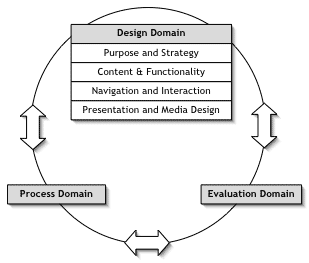
    There are commonalities and there are bodies trying to create international usability standards, including for web interfaces. This isn't published but the model below shows the wider reference points for considering web interfaces.


    The standard will detail guidance in four main areas:

    1. Purpose and strategy. What is the purpose of the site and how is this made clear to its users?
    2. Content and functionality. What is the site’s conceptual model? How is content organised and how should the site deal with issues such as privacy and personalisation?
    3. Navigation and interaction. How should the content be organised so that users can navigate the site easily? How will users search the content of the site?
    4. Presentation and media design. How should individual pages be designed so that people can make use of the information? How should multimedia be used?
    Where I think culture does impact, particularly in a discount usability setting may be in the interaction between the tester and the user — for example, it may not be appropriate for people to be as critical as you would like, they may defer to you.


    Not essential

    There's also the point that the technology itself can reflect one culture's norm - most obvious is the 'boysey' nature of some gadget and game design. Plus there are gender differences in the way people use the web.

    But, my general feeling, though, is that - well - fretting on this can obscure the very discount basis of the testing — specific design issues need specific testing to get right (or as near as dammit/budget allows), just as with accessibility.

    Discount testing is simply about getting you out of the woods, so to speak.