
Showing posts with label apple. Show all posts
Showing posts with label apple. Show all posts
Thursday, 18 December 2008

Tuesday, 2 December 2008
Hah, hah!
"I can't afford any of your products but can I buy some fake white earbuds so people will think I have a mypod?"
 "Sure. That'll be $40."
"A god who knows what we want."
"They cost $8 to make and I pee on every one."
"I never thought a company could be my soulmate ~ Owh, it's my first mybill!"
"I know our posters say 'think differently' but our real slogan is 'no refund'."
From a Apple followers blog:
Of all the snarky Apple references in pop culture, my all time favorite is [a] brief clip from The Simpsons. During a school assembly, Kearney tells his buddy, "...take a memo on your Newton: Beat up Martin." He scribbles away only to see the Newton's handwriting recognition interpret his memo as "Eat up Martha."
A few years ago, a number of plastic Simpsons characters were issued, and the Kearney character actually shipped with a tiny Newton with "Eat up Martha" on the screen. I have one in my office.

Postscript: Removed! Well it was virtually the whole show ... one more replacement embed but see lotsa persistent clips here once that's removed.
Monday, 25 August 2008
Scrapbook clips catch up

Chinwag looks (back?) at 'Black Hat marketing: the dark side of search':
I can’t definitely claim a connection between a willingness to embrace black hat SEO and a willingness to cut corners in other areas of business but it’s testament to the ease with which black hat rules can be applied.Millennial Marketing and the Obama campaign:
Design guru Michael Bierut[says] that the stand-alone logo, consistent use of the Gotham typeface ("very American ... conversational and pleasant") and his online look and feel make Mr. Obama the first candidate with a "coherent, top-to-bottom, 360-degree system at work. ... There's an absolute level of control that I have trouble achieving with my corporate clients."Another lesson from the campaign: Integrating Social Networking Tools into Political Campaigns
Profile pages, badges, buttons and even widgets are easy to build (believe me, if e.politics can have a widget, anyone can). In other words, campaigns don't have to dive right into the deep end — sometimes a dipping a toe or two into the pool of Facebook and MySpace fans will be enough.Mail report on the world's oldest Facebooker, Ivy Bean. Alleged I'd have to say. Post media coverage she now has '4823 friends'. It's all seemingly facilitated and I can't see anything saying she's actually using the web herself. Unlike many another so-called 'silver surfer'.
Blogging’s Glass Ceiling. NYT on just why women bloggers are a distinct minority.
All about the cyber attacks which preceded the war in Georgia. More from Wired.
"Another interesting aspect is seeing how certain countries are what I call 'cyberlocked,'" cybersecurity veteran Richard Bejtlich tells Danger Room. "We know a land-locked country has no access to the sea. Countries like .ge [Georgia] might rely too heavily on one or a handful of connections, potentially through hostile countries (eg, .ru [Russia]), for their physical connectivity. As a result, an adversary can control their network access to the outside world. A diagram from the Packet Clearing House, shows Georgia's network dilemma.Who exactly is supporting the Great Firewall of China: XSGuard Management System, who are Dutch; Cisco, American; Radware, Israeli.
Also on board are Lucent, Sun Microsystems, Nokia, Ericsson, Acsys Biometrics and Nortel Networks.
Cisco are the main offender, it seems.
Somehow missed from the who-ha headlines about the plan for refunds if your council isn't 'performing' (arf! arf!) is that the central 'new idea' from Whitehall is something called a 'Place Survey'. This will drop through your letter box and ask you to fill in a form containing no less than 174 questions!
PSF estimates that this will cost up to £50k per council. None of which is funded by Whitehall.
But neither is the cost of the concessionary bus fares scheme, which is carving huge holes in selscted council's budgets around the country.
Pressures on councils to reduce headcounts to meet efficiency targets and the shared services agenda are exacerbating a looming skills shortage of experienced staff in London local authorities, it has been claimed.No shit Sherlock. This is according to "a report to Capital Ambition, London's regional Improvement and Efficiency Partnership body, disclosed in minutes of a meeting of its Programme Board", and reported by PSF. This comes as a poll from local government IT supplier Civica showed that the majority of council managers surveyed say their local authority lacks the necessary in-house skills for transformation programmes and that 'transformation' is actually leading to a workforce skewed to the over 50s and a 'talent drought'.
If 'transformation' is to a big extent about the web and 'online services', which it is, then some 'talent' injected from the real world and released from the usual strictures is needed.
How to get them? Neither Hazel, Tom or the opposition have the vaguest clue ...
The Electoral Commission can be added to the list of those concerned about the use of electronic counting systems in the London Mayoral count.
Very cool rip on gmaps from XKCD

Coming to a ditzy red-top near you soon? 'Binaural beats' aka 'digital drugs'. Despite being actually 169 years old.
Very bizarre first 'interactive' YouTube video, from Mexico.
Here's another tool to add to those silly wordmaps of your blog and undoubtedly others, this one 'maps' Twitter.
And another expansion on Google Trends, which I likee.
Wired carried a great analysis of Twitter's, um' 'business model' ...
Cuil? I think not.
This made me laugh out laugh when it popped in my inbox.
The Association of Online Publishers (AOP)'s 'Digital Publishing Summit's keynote is to be delivered by (drum roll) ... Trinity Mirror CEO, Sly Bailey:
on the expanding role of digital publishing, and the future of local news. Sly runs a portfolio of more than 350 local and national brands - can you afford to miss this rare appearance from the former IPC Media CEO, who led the sale of the magazine group to AOL Time Warner?And also the loss of circa £35m @ IPC in one of the biggest f*ups during the f*up heavy dotcom crash and whose failure to improve the amateur-hour Mirror Online has amused us all for many years?
I think not.
Following another business character who I love to lampoon, Michael Grade attempted to blame ITV's failure to make money online to:
"Non-UK companies like Google and Apple [who] are free to build market-dominating positions online in the UK without so much as a regulatory murmur".Bah, humbug.
dailymail.co.uk has introduced a new section called 'The best of the web - digested' which, when it started at least, was dominated by The Independent and The Guardian.
More when I catch up ;]
Sunday, 22 June 2008
Scrapbook clips catch up
My piece on 'Why Obama could be good for gays' has been republished by PinkNews, unfortunately the formatting fell through their template ;[
Arianna Huffington has been all over the UK media this week as she made a flying visit to London. I have been reading HuffPost since it started and am still waiting for it to do international news. It now has a green section and a 'living' section and, in London, much focus was on her move into local news.
The big, huge gap in American news reporting is international. It is very clear from reading HuffPost that even the liberals are plain ignorant. And why? Lack of decent reporting. It is pretty damming of Arianna's enterprise that she is putting local US news before developing a truly international section to her, now, very influential website — I just wish someone would say this to her and that didn't appear to happen on her flying visit.
One recent instance where HuffPost behaved badly was during the Burmese cyclone. They just reported and didn't link to donation sites — whereas the old school aka the New York Times did, and immediately.
Via Netimperative: Mobile advertising is the most unpopular ad format in the UK, according to new research from Dynamic Logic.
The study indicated that print advertising generates the most positive reaction with UK consumers and is seen as having the most relevance.
The Dynamic Logic ‘AdReaction’ study gauged consumer’s opinions of advertising.

Jonathan Zittrain interview on BBC News 24's Click.
His new book, The Future of the Internet and How to Stop It, develops the theme about how the commercial world's platform dominance will spike the sorts of developments which we need to drive the Internet further. I have always been queasy about the odd attitudes towards corps like Apple and their closed, exclusive partnership relationships. Zittrain nails why and I have to read the book.
I think that Tim Berners-Lee would agree. In a speech last week he said:
Age Concern is developing an online campaign to encourage people to become more organised.
Cancer Research UK has launched a blog to tackle cancer myths.
Barack Obama is mentioning Google a lot on the trail to contrast himself with McCain (who cannot use a computer at all).
The authoritative Pew Internet Project has released a report on the election campaign thus far and found:
One of the least reported aspect of the disaster that is Zimbabwe is the ecological crisis. This organization is trying to do something about it.
Shake hands with killers... Harare Tribune article on the history behind today's suffering.
Quote of the week 1, from Radio 4's The Learning Curve:
Arianna Huffington has been all over the UK media this week as she made a flying visit to London. I have been reading HuffPost since it started and am still waiting for it to do international news. It now has a green section and a 'living' section and, in London, much focus was on her move into local news.
The big, huge gap in American news reporting is international. It is very clear from reading HuffPost that even the liberals are plain ignorant. And why? Lack of decent reporting. It is pretty damming of Arianna's enterprise that she is putting local US news before developing a truly international section to her, now, very influential website — I just wish someone would say this to her and that didn't appear to happen on her flying visit.
One recent instance where HuffPost behaved badly was during the Burmese cyclone. They just reported and didn't link to donation sites — whereas the old school aka the New York Times did, and immediately.
Via Netimperative: Mobile advertising is the most unpopular ad format in the UK, according to new research from Dynamic Logic.
The study indicated that print advertising generates the most positive reaction with UK consumers and is seen as having the most relevance.
The Dynamic Logic ‘AdReaction’ study gauged consumer’s opinions of advertising.

Jonathan Zittrain interview on BBC News 24's Click.
His new book, The Future of the Internet and How to Stop It, develops the theme about how the commercial world's platform dominance will spike the sorts of developments which we need to drive the Internet further. I have always been queasy about the odd attitudes towards corps like Apple and their closed, exclusive partnership relationships. Zittrain nails why and I have to read the book.
I think that Tim Berners-Lee would agree. In a speech last week he said:
"How can we make the Web be an infrastructure that allows more than one person to think more effectively than one person can? There's no proof yet that for creative thinking we've done that," he said. "The challenge is to build a system that allows the formation of half-formed ideas and allows collective creativity."HT: nomensa
Age Concern is developing an online campaign to encourage people to become more organised.
Cancer Research UK has launched a blog to tackle cancer myths.
Barack Obama is mentioning Google a lot on the trail to contrast himself with McCain (who cannot use a computer at all).
The authoritative Pew Internet Project has released a report on the election campaign thus far and found:
- 46% of Americans have used the internet, email or cell phone text messaging to get news about the campaign, share their views and mobilize others.
- 35% of Americans say they have watched online political videos.
- 10% say they have used social networking sites such as Facebook or MySpace to gather information or become involved. This is particularly popular with younger voters: Two-thirds of internet users under the age of 30 have a social networking profile, and half of these use social networking sites to get or share information about politics or the campaigns.
- 6% of Americans have made political contributions online.
- 39% of online Americans have used the internet to access "unfiltered" campaign materials, which includes video of candidate debates, speeches and announcements, as well as position papers and speech transcripts.
- 5% of Americans have posted their own original commentary or analysis.
One of the least reported aspect of the disaster that is Zimbabwe is the ecological crisis. This organization is trying to do something about it.
Shake hands with killers... Harare Tribune article on the history behind today's suffering.
At Zimbabwe's Independence then Prime Minister R. G. Mugabe established a government of apparent reconciliation including Zapu leader, Nkomo. The apparent integration of former warring combatants, Zanu's ZANLA and Zapu's ZPRA, into one Zimbabwe National Army proceeded. But, behind what eventually was revealed as a continuing charade, the ruthless accumulation of all power by Zanu (PF) proceeded apace.BBC News Online Magazine, 50 office-speak phrases you love to hate.
"The latest that's stuck in my head is we are still optimistic things will feed through the sales and delivery pipeline (ie: we actually haven't sold anything to anyone yet but maybe we will one day)."Would Australia's PM ban Botticelli? Germaine has a good 'ole go at Australia's Catholic PM.
Rudd would not recoil in horror from Botticelli's Birth of Venus, one hopes, but that, too, is the image of an adolescent. For some months, travellers on the London underground have been unable to escape the image of a naked pre-teen, fully lit and meticulously detailed down to her faint cloud of pubic fuzz. But no child protection campaigners have picketed the Royal Academy.The Village Voice's annual Queer issues had lots of good stuff, including Triumph of the Lipstick Lesbians.
Today's middle-class and wealthy lesbians, however, look mainstream. "I've certainly noticed a more glamorous element among lesbians," said Julie Bolcer, the news editor of Go magazine, a monthly based in New York that is this group's bible. Bolcer can be seen many nights prowling hot-girl clubs for news tips. She's surprised by how many women wear long hair and how "flagrantly feminine" many of her peers dress.21st Century ad from Heinz:
Quote of the week 1, from Radio 4's The Learning Curve:
"Up to 20% of school pupils could be classed as disabled under the Disability Discrimination Act".Quote of the week 2, from Tim Footman's The gay priests row is a holy smokescreen:
"Let's be clear: removing all the gay priests from the Anglican communion would provoke a serious staffing shortage; although they're better off than the Roman Catholic church, which would probably cease to exist if all the Hail Marys had to find alternative employment."
Wednesday, 30 April 2008
The kids are alllrreight

'Social Citizens' is a really fascinating paper from the Social Citizens project, sponsored by the Case Foundation. It's about young people (Millennials’) and how they are using online tools to connect to, initiate and run causes — the flip-side of the MSMs obsession with the negatives about the young and the Internet:
In October 2007, Thomas Friedman wrote in The New York Times that young people are members of Generation Q. He meant “Q” for quiet, and inactive, on the important social questions of the day. The celebrated American globalist could not have been more wrong. This generation is making noise, whether adults can hear it or not.You may have read echoes of this attitude in the tabloids (the 'hoodie' image above features prominently in the Daily Express).
The authors are very impressed with the scale and depth of youth engagement with change using the new technology in what they report on - just think of their impact on corporate behaviour. They go so far to compare them to the 'greatest generation' who fought WW2, and I don't think that's over the top given what we face with climate change:
One example of Millennials’ online activism is Causes on Facebook. In the spring of 2007, Project Agape posted its “Causes” application on Facebook. Within six months, more than 30,000 Causes were created on the social networking site, supporting over 12,000 existing nonprofit organizations. A brief survey of Causes on Facebook reveals an array of mainstream, apple-pie efforts, typical of Millennial activism. They are more practical than poetic, more passionate and less ideological in their activism efforts. Few could argue with the worthiness of helping orphans in China, trying to find a cure for AIDS and ALS, eradicating breast cancer, and helping underprivileged children learn to read.
However, the Causes application is different from traditional approaches because users are drawn to the cause first, then the institution (or group of volunteers if no formal institution exists). Joe Green, CEO of Causes on Face-book, describes the network interaction for causes this way: “There could be 1,000 causes aiming to help SaveDarfur.org with lots of different leaders and networks and lots of people reaching out in many ways.”

The paper documents a stack of other examples; 'Invisible Children' is one, which grew from four young guys' visit to Northern Uganda.
Preview:
[55' Movie on Google. 'In the spring of 2003, three young Americans traveled to Africa in search of such as story. What they found was a tragedy that disgusted and inspired them. A story where children are weapons and children are the victims. The "Invisible Children: rough cut" film exposes the effects of a 20 year-long war on the children of Northern Uganda. These children live in fear of abduction by rebel soldiers, and are being forced to fight as a part of violent army. This wonderfully reckless documentary is fast paced, with an MTV beat, and is something truly unique. To see Africa through young eyes is humorous and heart breaking, quick and informative - all in the very same breath. See this film, you will be forever changed.']
This is one of the most moving documentaries I've seen in years.
The authors see a flip side though, and speculate that this mightn't all be good:
Specific policy outcomes are not a significant component for most Millennial activist efforts. Social capital is the new commerce and the end result of many cause-related efforts spearheaded by young people.
Social action is a safe place to express a personal identity, and is much safer and easier than in the political arena with its inherent conflict and most often less-than-lofty outcomes. Danah Boyd (UofC Berkeley) explains, “We are living in a time of the elongation of childhood where kids are kept out of public life and only glimpse it through the mass media. Their lives are so heavily regulated and controlled, they don’t see a public world outside of the celebritization of political candidates.”
Is it possible to envision a very large generation of citizens who lead their lives at a great distance from government, even lives infused with causes, volunteering and a hopeful outlook about the world. Can government really be irrelevant to their lives, and, if so, is this a good thing for society? Is it important that young people are engaged in public policy advocacy? Is our tendency to connect only with like-minded people using our on line and on land social networks a good thing for activism or a critical bottleneck to the effective scaling for causes? Are social change institutions critical to the future of Social Citizens and their causes or are they becoming old-century anachronisms of top-down hierarchies that can’t survive much longer?What draws their involvement? Conflicts like Israel/Palestine get less attention from this group as they're less clear, more grey, than ones like Darfur.
But one thing the authors don't do in discussing negative disengagement from 'government' is make the connections with the Obama campaign — perhaps because it's partisan or just because the campaign's happening now — which exists because of a/the Internet and b/the same sort of new bottom-up/shared/devolved organisations which young people are establishing. This has seen an enormous increase in active political engagement by young people - and voting - though what will happen to 'the movement' once he's elected President is a moot point.
What they do have is some ideas:
Political participation can and should be more meaningful than political campaigns, such as the possibility of careers in public service and policymaking, including serving on committees and task forces for local government efforts.Now there's a big take-away for the oldies. And don't think this is just America. Most UK young people use social networks.
A major cautionary note for anyone interested in engaging young people in conversations about the role of government and policy issues is that these conversations must be authentic and spin-free, or youth will quickly tune out.
Go here for a bigger view than below
NB: scribd embed script is not Blogger friendly!
Friday, 7 March 2008
Amazing predictions - from 1900

1900, Ladies Home Journal: 'These prophesies may seem strange, almost impossible ... '
Telephones Around The World. Wireless telephone and telegraph circuits will span the world. A husband in the middle of the Atlantic will be able to converse with his wife sitting in her boudoir in Chicago. We will be able to telephone to China quite as readily as we now talk from New York to Brooklyn . By an automatic signal they will connect with any circuit in their locality without the intervention of a 'Hello Girl'.
Strawberries As Large As Apples. Coal Will Not Ne Used For Heating Or Cooking. Man Will See Around The World. Store Purchases By Tube. The American Will Be Taller. Trains One Hundred And Fifty Miles An Hour.
- Click image to read Amazing! Predictions!
Tuesday, 4 March 2008
Election viral video numbers go boom

Checking the numbers on US elections viral videos I was astonished to see the stats for the will.i.am (Black Eyed Peas) pro-Obama video. It's been posted nearly 5000 times and viewed by nearly 12 million in just over a month.
 To put this in context, 'dramatic look' (where some sort of rodent gives a cute impression of a bad actor) is 'just' 16 million and 2300 posts. Other videos with huge numbers, such as 'evolution of dance' (85 million) are universal, not just American.
Not long ago, 5 million for 'vote different' - the anti-Hillary viral which is based on the famous 1984 Apple TV ad - seemed astonishing. Another context is that "The Daily Show"with Jon Stewart on Comedy Central averages a nightly audience of just 1.3 million viewers (and, to be generous, maybe a million online).
Given that the Obama cheer squad video only really appeals to Americans, 12 million in a month marks a real turning point — viral video isn't a sideshow. It's also calculated, the Obama campaign has been pushing supporters to distribute it (despite not commissioning it) to 'bolster and deepen voter outreach' whereas the Clinton's buy time on TV.
Here it is:
Here's the really funny anti-McCain parody:
Tuesday, 26 February 2008
PC hearts lastfm

Last.fm is the British-born online music social network which was bought by CBS (of all people) last year. They have just 'upped the offering' by making a lot of music playable in its entirety on the website. And this has apparently helped its usage balloon in the States.
The reasons I love it are two sides of their core offering: new-to-me music. I love that the method introduces me to 'similar' music via various routes — one would be, after feeding the system lots of info, who else in the world shares my eclectic taste and another via 'tags'. But it also has an enormous archive so I can find music I've lost touch with, a lot from when I was a deejay (I've read that this makes me an example of their desired audience, middle aging blokes revisiting their youth!).
It's more than that though. It still has a 'community' feel, which is most evident on the forums where last.fm staff actually contribute. There's also local communities and lots of people with groups and events and more I've barely touched. But most of all it's enabled me to build up an archive so wherever I might be I don't need an ipod to hear 'my sort of music'.
I've had interesting experiences explaining it. 'Radio stations' really is a last.fm concept in need of a new name. Ain't easy to explain how it works but when showing it to a young friend of mine I jumped with glee when they 'got it' immediately. There are lots of ways to play around with it but the bottom line is you do have to give back to get out, it's not a passive medium.
The best thing by far though is the opportunity to be exposed to music you'll probably like but wouldn't otherwise know, and maybe a lil' bit further.
'tis the future with music I think. Apple be damned!
Sunday, 19 August 2007
Those Wikipedia edits in full ...

CalTech graduate student Virgil Griffith built a search tool that traces IP addresses of those who make Wikipedia changes.
WikiScanner is the work of Griffith, 24, a cognitive scientist who is a visiting researcher at the Santa Fe Institute in New Mexico. Mr. Griffith, who spent two weeks this summer writing the software for the site, said he got interested in creating such a tool last year after hearing of members of Congress who were editing their own entries.
Mr. Griffith said he “was expecting a few people to get nailed pretty hard” after his service became public. “The yield, in terms of public relations disasters, is about what I expected.”
Mr. Griffith, who also likes to refer to himself as a “disruptive technologist,” said he was certain any more examples of self-interested editing would come out in the next few weeks, “because the data set is just so huge."
Here's Wikiscanner. It's slow but persist — I found edits done from my work PC (these were legit!).
It has "editor's picks" — showing the latest body to be 'outed' using WikiScanner.
The Independent has helpfully done a round-up of what's been discovered thus far about who's editing Wikipedia.
An IP address that belongs to ExxonMobil, the oil giant, is linked to sweeping changes to an entry on the Exxon Valdez oil spill of 1989. An allegation that the company "has not yet paid the $5 billion in spill damages it owes to the 32,000 Alaskan fishermen" was replaced with references to the funds the company has paid out.
The Republican Party edited Saddam Hussein's Ba'ath Party entry so it made it clear that the US-led invasion was not a "US-led occupation" but a "US-led liberation."
A computer with a CIA IP address was used to change a graphic on casualties of the Iraq war by adding the warning that many of the figures were estimated and not broken down by class. Another entry on former CIA chief William Colby was edited to expand his cv.
An anonymous surfer at the Labour Party's headquarters removed a section about Labour students referring to "careerist MPs", and criticisms that the party's student arm was no longer radical.
A computer registered to the Dow Chemical Company is recorded as deleting a passage on the Bhopal chemical disaster of 1984, which occurred at a plant operated by Union Carbide, now a wholly owned Dow subsidiary. The incident cost up to 20,000 lives.
Voting-machine company Diebold apparently excised long paragraphs detailing the US security industry's concerns over the integrity of their voting machines, and information about the company's chief executive's fundraising for President Bush. The text, deleted in November 2005, was very rapidly restored by another Wikipedia contributor, who advised the anonymous editor, "Please stop removing content from Wikipedia. It is considered vandalism."
A computer linked to the Israeli government twice tried to delete an entire article about the West Bank wall that was critical of the policy. An edit from the same address also modified the entry for Hizbollah describing all its operations as being "mostly military in nature".
A dog breeders association in America removed references to two fatal maulings of humans by the Perro de Presa Canario dogs in the US. In 2001 a woman was attacked and killed by two Presa Canario/Mastiff hybrids in the hallway of her apartment building in San Fransisco. Last year a pure-bred Presa Canario fatally mauled a woman in Florida.
The National Rifle Association of America doctored concerns about its role in the increase in gun fatalities by replacing the passage with a reference to the association's conservation work in America.
A source traced to Discovery Communications, the company that owns the Discovery Channel, deleted reference to company's reputation for " guerrilla marketing".
Someone working from an IP address linked to MySpace appears to have been so irritated by references to the social networking website's over-censorial policy that they removed a paragraph accusing MySpace of censorship.
Boeing has made it clear that it is not just one of the world's leading aircraft manufacturers, but is in fact the leading company in this field.
Barbara Alton, assistant to Episcopal Bishop Charles Bennison, in America, deleted information concerning a cover-up of child sexual abuse, allegations that the Bishop misappropriated $11.6 million in trust funds, and evidence of other scandals. When challenged about this, Alton claims she was ordered to delete the information by Presiding Bishop Katherine Jefferts Schori.
A computer with an Amnesty International IP address was used to delete references accusing the charity of holding an anti-American agenda.
Dell removed a passage about how the company out-sourced its support divisions overseas.
Someone from Nestle removed criticisms of some of the company's controversial business practices, which have all subsequently been re-added.
The FBI has removed aerial images of the Guantánamo Bay Naval base in Cuba.
Computers with IP addresses traced to the Church of Scientology were used to expunge critical paragraphs about the cult's world-wide operations. On biography pages for dead celebrities, links were added to articles by a Scientology front group suggesting that pharmaceuticals were responsible for their deaths.
Someone at News International saw fit to remove criticism of the News of the World's anti-paedophile campaign by deleting the suggestion that this amounted to editorial hypocrisy. The original entry reminded readers that the paper continued to "publish semi-nude photographs of page three models as young as 16 and salacious stories about female celebrities younger than that."
An edit linked to the Conservative Party IP address expunged references to The MP Oliver Letwin's gaffe during the 2001 general election when he reportedly said he wanted to cut "future public spending by fully 20 billion pounds per annum relative to the plans of the Labour government" . The accompanying paragraph, explaining that when his own party failed to support the move he took a low profile on the election campaign, was also removed.
Some more:
- Someone from SeaWorld's owners removed a paragraph about criticism of SeaWorld’s “lack of respect toward its orcas [Killer Wales]”.
- Ebay deletes criticism of Paypal.
- Last year, someone at PepsiCo deleted several paragraphs of the Pepsi entry that focused on its detrimental health effects.
- Someone inside Wal-Mart Stores changed "Wages at Wal-Mart are about 20 percent less than at other retail stores," citing the author Greg Palast as the source, to "The average wage at Wal-Mart is almost double the federal minimum wage", citing Wal-Mart.
- Last year, someone using a computer at the Washington Post Company changed the name of the owner of a free local paper, The Washington Examiner, from Philip Anschutz to Charles Manson.
- A person using a computer at CBS updated the page on Wolf Blitzer of CNN to add that his real name was Irving Federman. (It is actually Wolf Blitzer.)
- Someone at The New York Times Company changed the page on President Bush repeating the word “jerk” 12 times. In the entry for Condoleezza Rice, the secretary of state, the word “pianist” was changed to “penis.”
- A member of Pope Benedict’s staff changed Gerry Adam’s entry to remove links to newspaper stories written last year that claimed Mr Adams was involved in a double murder in 1971.
- A BBC employee changed US President George W Bush’s middle name from 'Walker' to 'Wanker'.
- Someone from Al Jezeera changed Israel's entry to add: "Jews believe that they are chosen by God and that they are better than other people."
- Someone from the United Nations changed the late Italian journalist Oriana Fallaci's entry to describe her as a “racist whore.”
- Two Spanish TV stations exposed for performing an 'experiment' on John Lennon and Elvis Presley's entries.
- Games trade association ESA removed references to mod chips which can be used to play pirated game software.
- Apple employees editing the Microsoft page.
- Someone using a Connecticut Police computer added " the holocaust is fucking awseome."
- Editors from Christian-right Liberty University deleted the fact that Moral Majority leader and Liberty founder Jerry Falwell was fined in 1987 for illegally transferring funds for his ministry to his political action committees.
- Someone in the South African Government added "'I think that was all bullshit, thats why I deleted it. Thank you motherfucker!" on being discovered editing the HIV/AIDS entry.
- Someone at the ACLU added "during the Pope's final illness, he carried out many of the Pope's functions as leader of the Catholic Church, such as molesting young boys and degrading women."
- FoxNews removed references to misquotes, legal brushes, bad ratings, and gaffes by personalities — and, once exposed, responded by attacking Wikipedia's credibility.
In another blow to Andrew Keen, FoxNews and other anti-Wikipedia credibility types, they are now adding 'nofollow' tags to all outgoing links, thereby destroying Search marketeers attempts to 'game' Wikipedia.
Postscript: According to TechCrunch, Google also come out clean.
Monday, 16 July 2007
Bytes · Drag'n'drop directions - Tog heart iPhone - Our sexy EU
Google Maps have added a rather good new drag-and-drop feature for directions.
~~~~~~~~~~~
IBM Center for The Business of Government: "Bridging the Digital Divide for Hard-to-Reach Groups (1.2mb PDF)
Usability/HCI guru Bruce Tognazzini loves the iPhone, even though he can't use it - like lots of Americans - because his area isn't part of AT&T's network.
Jacob Nielsen is a little less excited, noting that the New York Times has reported download times of:
More from Tognazzini about why he loves the iPhone and Apple
~~~~~~~~~~~
ClickZ has been tracking where visitors to Presidential candidates websites go:
~~~~~~~~~~~
| Examples | ||||
 |  | |||
| Wall St. to JFK, New York (with live traffic) |
~~~~~~~~~~~
IBM Center for The Business of Government: "Bridging the Digital Divide for Hard-to-Reach Groups (1.2mb PDF)
- Recommendation 1: Offer free computer and Internet access to targeted groups.
- Recommendation 2: Provide long-term support to organizations seeking to reach targeted groups.
- Recommendation 3: Create partnerships with other organizations to share resources and expertise.
- Recommendation 4: Create strategies for long-term project sustainability.
- Recommendation 6: Raise awareness of the benefits and encourage use of e-government services among targeted users.
- Recommendation 7: Improve usability of the Internet and e-government services to targeted individuals and groups.
- Recommendation 9: Create a comfortable learning environment and provide informal training opportunities to targeted users.
- Recommendation 10: Involve targeted users by constant consultation.
Usability/HCI guru Bruce Tognazzini loves the iPhone, even though he can't use it - like lots of Americans - because his area isn't part of AT&T's network.

Jacob Nielsen is a little less excited, noting that the New York Times has reported download times of:
The impact of the network on the iPhone's total user experience is a good example of a general lesson: usability is a chain that's no stronger than its weakest link. Take e-commerce: navigation, search, product photos, product descriptions, the shopping cart, checkout, and site credibility all need great design. If any one of these fails, then no sale.
- NY Times: 55 seconds
- Amazon: 100 seconds
- Yahoo: two minutes (!)
~~~~~~~~~~~
ClickZ has been tracking where visitors to Presidential candidates websites go:
Clinton's site visitors were six times more likely to check out country music content, while visitors to the other three candidates' sites were no more apt to go country than others online. Those on Richardson's site were 15 times more likely to check out current hits, and Obama's site visitors were seven times more likely to check out urban music. Folks on Richardson's and Giuliani's sites were twice as likely to groove on urban music content.
| Top Content Segments Viewed by JoinRudy2008.com Visitors | ||||
|---|---|---|---|---|
| Content/Audience Segment | Number of Times More Likely to Visit than Remaining Web Users | |||
| Health Conditions, Asthma | 169 | |||
| Sportscar (GM only) | 47 | |||
| Sportscar | 37 | |||
| New Auto Buyer, Sportscar | 26 | |||
| Senior Travel | 23 | |||
| Used Auto Buyer, Minivan | 22 | |||
| Technology, Computers | 19 | |||
| Technology, Consumer Electronics | 18 | |||
| College Basketball | 17 | |||
| Source: Tacoda, 2007 | ||||
~~~~~~~~~~~
- Can new technologies help in actually enhancing accessibility for certain user groups and help sites to engage with their audiences more effectively? In his post on Accessibility and Innovation, Brian Kelly gives a quick run-down of his talk The Accessible Web, which he recently gave at the Web Adept: UK Museums and the Web 2007 conference.
- ReadWriteWeb:New Media Meets Old: A Look at Redesigned Mainstream News Sites
Conclusion: 'USA Today has social media down cold'
- Washington Post looks at online Reputation Management.
"Google's not in business to give you the truth, it's in business to give what you think is relevant."
The goal is to get Google and other search engines to seize on relevant sites that contain positive information on their clients and to downplay the rest.
- The EU now has its own YouTube channel and it includes a video montage of movie sex scenes promoting the EU's support for European film-making. Defending it the European Commission spokesman Martin Selmayr said
"The EU is not a bible belt. We believe in freedom of speech and artistic expression."
You tell those Poles, Martin.
Wednesday, 27 June 2007
Bytes · Estonian lessons - Best luminosity - What digidivide?
Back to life and catching up with the scrapbook ...
~~~~~~~~~~~
Michael Cross in the Guardian, talking about Estonia, found another reason why there are issues with DirectGov:
The updated Accessibility guidance from WCAG will have the following luminosity recommendations:
~~~~~~~~~~~
Public Sector Forums says that an important new review of the Government's strategy on the digital divide has been "hushed up".
- Apple Introduces Safari for Windows but it's still crap.
- The Dutch Cabinet are running online consultations on national policy - Samen werken aan Nederland.
- Pew's Spam 2007 Report [PDF] shows that Americans are becoming more savvy with email.
- This is the new Greek national portal - it's Flash and it moves and it gave me visions of black clad old ladies desperately trying to hit the right house whilst squinting at the text...

- What's on Americans' Minds? is a usa.gov page which lists the most popular pages, links and search terms.
~~~~~~~~~~~
Citizen engagement: Growing grass roots, Rosie Lombardi, CIO Government Review
Interesting stuff about eGov in Ontario
~~~~~~~~~~~Interesting stuff about eGov in Ontario
“We get better information by electronic means, and people find it easier to get to it. We’re not seeing as good information coming out of town hall meetings,” he says, adding that summarizing these verbal proceedings is a laborious, manual exercise. “Meetings become more a way to validate electronic feedback.”
The more dynamic Web 2.0 enables greater online collaboration and allows people to easily organize themselves into communities of interest, says Cunningham. “This will allow people to find each other and create communities around public debate on political decisions. Once they reach critical mass, these can make their positions heard and influence decision-making. Governments are struggling to be more modern and relevant in a post-modern world, so they ignore this trend at their peril.”
Michael Cross in the Guardian, talking about Estonia, found another reason why there are issues with DirectGov:
~~~~~~~~~~~Centralisation comes with penalties, however. One is that, however centralised services are arranged geographically, some users will lose convenience. Another penalty comes with size and complexity: government systems are already too big, and big and complex IT systems go wrong more often than small and simple ones.
Finally, as the Estonian experience shows, there is the vulnerability caused by creating a single point of failure. Not just to cyber-attack, but to old-fashioned terrorism. Not to mention industrial action: if the Treasury is considering taking on public-sector unions in the next spending round, it might want to reflect that picket lines can be shared services, too.
The updated Accessibility guidance from WCAG will have the following luminosity recommendations:
Level AA Threshold
· Large text (and images of large text) have a contrast ratio of at least 3:1
· Regular text (and images of regular text) have a contrast ratio of at least 5:1
Level AAA Threshold
· Large text (and images of large text) have a contrast ratio of at least 5:1
· Regular text (and images of regular text) have a contrast ratio of at least 7:1
~~~~~~~~~~~
Public Sector Forums says that an important new review of the Government's strategy on the digital divide has been "hushed up".
PSF has managed to track down the whereabouts of said obscure report – which we found helpfully buried away in a deep, dark corner of the DCLG's Digital Challenge website, down at the very bottom of this page.The report can be downloaded here, and shows that the Digital Inclusion Team completed and submitted their 125-page report in March. Strangely, it was not actually released until Sunday, 20 May, and then with no announcement or word of its existence, or any ministerial comment. A surprising move indeed, given the report's supposed importance and with digital inclusion being high on ministers' agendas, so we are told.
As we reported back in December when news of their findings first began filtering out, these made for very uncomfortable reading - depicting the Government's digital inclusion agenda as practically in chaos, with waste, repetition and disjointed policies the order of the day.
The report concludes - two years' on from the launch of the Prime Minister's much-vaunted Digital Strategy - that "the ownership and governance of the digital inclusion agenda", as well as policies and strategies, are "fragmented across government, industry and the third sector".
Monday, 28 May 2007
iGasm: Ann Summers missing a market
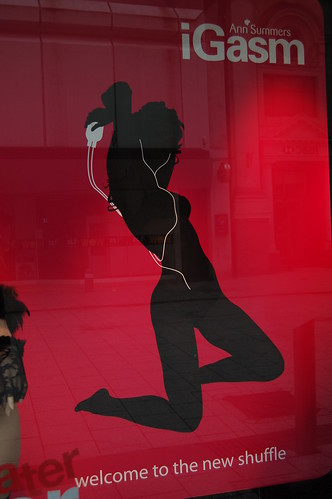
Most amusing to read the GeekoSphere's boyish delight over Apple v Ann Summers in iGasm Spat — the Ad is a wee bit of a rip-off though it's hardly discouraging iPod sales!
 Gizmodo typifying.
"I don't think it will work on Steve, as I think he is lacking the correct—how shall we say this?—plumbing.
| iGasm | ||
| An orgasm induced from listening to songs on an iPod or other mp3 player. I enjoyed that song so much it made me iGasm. | ||
Saturday, 5 May 2007
Bytes · YouTube copyright - Apple greens- Online soap hit
- A new study has shown that YouTube is overwhelmingly not relying on copyrighted content. Vidmeter says it's more than 90%. Takedown notices cover less than 6% of the views on YouTube. The Premiership is now suing them alongside Viacom.
- Coming in very late: Michael Grade has announced that ITV "plans to learn from the mistakes of the music industry" and "keep control" of its content as that content moves online.
It wants to make it's website ("The ITV portal to its television and programmes") the destination.
Good luck to them but they've made themselves a rod through completely ignoring findability and viral buzz — no posting I'm a Celebrity viral nuggets on YouTube..  UK Online Centres — which are just about the only people addressing the digital divide — are under threat because of buck-passing on funding amongst Whitehall departments.
In Singapore, they have a whole eCitizen Helper Service, which is a partnership with businesses.Need help to transact with the Government online?
Don't worry, eCitizen Helper Service is available island-wide. The service offers free assistance for all citizens and residents to access the Government services online. Look out for our mascot at participating outlets.- Greenpeace have welcomed Steve Jobs promise that Apple will be greener. Jobs move follows a long and persistent campaign.

"It's not everything we asked for. Apple has declared a phase out of the worst chemicals in its product range, Brominated Fire Retardants (BFRs) and Polyvinyl Chloride (PVC) by 2008. That beats Dell and other computer manufactures' pledge to phase them out by 2009. Way to go Steve!
But while customers in the US will be able to return their Apple products for recycling knowing that their gear won't end up in the e-waste mountains of Asia and India, Apple isn't making that promise to anyone but customers in the USA. Elsewhere in the world, an Apple product today can still be tomorrow's e-waste. Other manufacturers offer worldwide takeback and recycling. Apple should too!
Now, let's take it to the next level! An Apple green to the core!"
- A San Francisco TV Station recently premiered a show online — it was a documentary — but a daily teen-aimed soap opera, is entirely online and already a minor hit.
Prom Queen is averaging roughly 200,000 views a day, and has accumulated more than 5.2 million views since its April 2 debut.
While relevant benchmarks are hard to come buy in this uncharted space, the show’s daily audience is equivalent to a low-rated cable series, though much smaller than individual clips of popular YouTube ‘series’ like lonelygirl15, which sometimes yield more than a million views.
Web Shows is a Comedy Central project where “webisodes” that originated online will then make their small screen debut in July.
Another example of an online-traditional TV experiment is Jack Black’s Acceptable.tv, which ties to a show on VH1. - The Register is reporting that fans who missed out on Glastonbury tickets are nevertheless being spammed.
Michael Eavis runs the Glastonbury ticketing through the huge Mean Fiddler organisation and the Reg suggests that "data was somehow leaked". - Jacob Nielsen comments on eBay's reported record profits for Q1.
 In presenting the record numbers, the CEO, Meg Whitman, said that "the company had been benefiting from changes in the user experience that had increased the number of auctions leading to sales" (as quoted in The New York Times, April 19).
This is a great example of the benefits of usability for e-commerce: income comes from multiplying the amount of use with the conversion rate. The more you improve the user experience of finding products, researching them, and buying them, the higher your conversion rate.
Yet most sites invest vastly more in bringing in new traffic (increasing an almost-irrelevant "unique user" count) than they invest in making these users convert.
The cost of doubling traffic is a hugely expensive advertising campaign. Doubling conversion costs a modest usability project to identify your users' main pain points followed by targeted redesigns of those elements. Much cheaper – and a sustainable advantage, whereas traffic brought in by ads will subside when your advertising budget runs out.
In eBay's case, user experience is so important for profits that it's one of the main things the CEO mentions to the financial press in presenting the quarterly results. eBay has a particularly competent user experience department, but smaller companies usually find that a smaller usability effort can increase their financial performance materially. Your first usability test will uncover a gold mine of low-hanging fruit, to mix metaphors.


Tuesday, 17 April 2007
Google domination nears total

Heather Hopkins reports that Google's UK search share is now 79%
The last time I updated the figures was for SES London in February. Since then, Google has gained 2%, up from 77.77% to 79.38% of the UK search market.This is a very different picture to the United States, where Google is 50% of the search market by comScore and 64% by Hitwise.
Google's European share is lowest at 61% in Sweden and reaches 95% in Spain. In Australia it's 86%.
In Hong Kong, Yahoo! dominates, but in Singapore it's Google again. Baidu is top search engine in China.
Worldwide, comScore World Metrix has Google Sites 503,033 Total Unique Visitors (000) and Yahoo! Sites 458,985
ADDENDUM
Andy Kaveniac from compete.com writes me that Google is now near two-thirds US market.
On their blog:

Google just keeps going and going … almost puts the Energizer Bunny to shame. Google market share gained another 2ppts in March. So here’s a question. If Google gains one more point in market share, will we lose our veto power? That’s right, for all intents and purposes two-thirds of the 6.4 billion web search queries in the US pass through the Google servers.(He's referring to the Presidential veto over Congress)
I should note the differences in numbers/shares etc. Anything which falls outside the normal variance is about the different counting methods, but the clarity of the trend does point to the best way to look at stats - compare yer apples with yer apples, otherwise look for the trends. Especially for non-full-timers ;]
Tuesday, 20 March 2007
Historic origins of usability testing
The Usability Testing Central blog has an interesting, compact history of usability.

The 50s + 60s established a lot of the basic hardware and software but the next key marker was the establishment of Xerox's PARC (Palo Alto Research Center)
Then came the web and , in particular, the explosion of unusable websites during the dotcom boom. See the infamous boo.com, right.
Eventually the usability gurus Jakob Nielsen and Steve Krug prevail.
World War II was the starting point of electronics and electrical systems controlled by human operators through a "user interface". Industrial psychologists such as John Flanagan discovered that by reducing the amount of buttons, knobs, switches and control panels in new fighter aircraft- they could also dramatically improve operator performance.This led to something called the Critical Incident Technique (or CIT), used in the transition of the Supermarine Spitfire to the P-51 Mustang fighter cockpit.
The 50s + 60s established a lot of the basic hardware and software but the next key marker was the establishment of Xerox's PARC (Palo Alto Research Center)
Xerox is largely responsible for much of the innovation in user interfaces (still in use today!). Many know these as WIMP (Windows, Icons, Menus, Pulldowns). Xerox R&D work and resulting usability and user interface innovations propelled the current age of corporate usability research.This led to the Apple Mac and usability became the norm in computing R+D.
Then came the web and , in particular, the explosion of unusable websites during the dotcom boom. See the infamous boo.com, right.
Eventually the usability gurus Jakob Nielsen and Steve Krug prevail.
"In our first year we didn't spend a single dollar on advertising... the best dollars spent are those we use to improve the customer experience." - Jeff Bezos, Amazon.comNow we're at Web 2.0 and the phrase is 'user experience'.
Vote Different
This smart anti-Hillary vid - which directly steals from the famous Apple 'Superbowl' ad from 1984 - has already had 1,055,627 views in TWO WEEKS.
Better Connected, 'Accessibility' and all that

My fellow blogger Jack Pickard, who does a job not a million-miles dissimilar to mine, has commented on the controversy raging amongst UK eGov, focussing on accessibility.
It started with the annual SOCITM report on local government websites: Bettter Connected [parodied, right, by Public Sector Forums].
This report includes a section about accessibility, which uses a number of methods, including the universal standard devised by an organisation called WCAG , as well as the RNIB and Usability Exchange, to come up with a score — and herein lies the controversy.
The website Public Sector Forums reports very directly, exclaiming Why Better Connected 07 is garbage.
Another colleague Dan Champion weighs in with a more measured tone.
And now Jack:
This is the point. Who does it gain to dance around with one wrong line of code on one page out of several thousand? (Which is actually to a large extent what's at the back of this - one wrong line of code).Let’s stop saying that WCAG is a measure of accessibility. It isn’t. WCAG shows you things you can do that will likely make your site more accessible. But throw some real people at your site and it either will or it won’t be accessible to them, irrespective of what your WCAG conformance level says.
Remember: WCAG Conformance is not the same as accessibility.
Real people. Real tests. Real progress?
Move on: Getting input about the content from disabled people is something you can do whilst you fix that pesky code.
Because if people with disabilities are just gaining access to a whole lot of confusing councilese, what are they gaining? Frustration?
- Are you duplicating info that others provide?
- Are you directing people to the right sources (online + off)?
- Are the resources allocated in the budgets to get this right?
- Is your content of any practical use?
It would be a great help for eGov and disabled people if we focussed on usability, for one. Which we don't really do.
We do this where I work in a more formal way but, as well. here's a couple of things I've done:
- Sent things to disabled staff. In particular I have one blind staff member who I copy in occasionally. She looks at stuff and can tell me there and then whether it works or not. That simple fact has proven enough to get people to jump and move. Even without the blind person right in front of them. [accessify forum is another good place from practical guidance].
- Shown people the web from a disabled person's perspective. Done this twice with dyslexia (an-ex member of our team) and screen readers - that generally blows people away.
In 'Beyond Accessibility: Treating Users with Disabilities as People' he argued that:
It's time we moved beyond technical accessibility when discussing how to improve the Web for users with disabilities. We should consider these users as users: As people who have jobs to perform and goals to accomplish when they use websites and intranets. Once we've achieved technical accessibility, our new goal must be task support and increased usability of websites and intranets for people with disabilities.

Sure, users with disabilities are disabled, and many must use assistive technologies to access the Web. Obviously, websites must be accessible through alternative user interface devices, such as screen readers and screen magnifiers. If you can't get at the information or services that a website or intranet offers, then you definitely can't use it either. But, just because a design is theoretically accessible, doesn't mean that it's easy to use, simple to learn, or supports efficient job performance.
Nailed it, Jakob. In 2001.
Getting usability right means getting accessibility right.
Accessibility in eGov also sits within a wider context: where's the budget for content, for example? Where's the centrally produced, easily repurposable content? Is there policy?
We can buy feedback from differently disabled people but where's the simple methods and practical advice for real user input?
But the focus is so much on the technical - driven by both Whitehall, geek fascinations and commercial interests and exacerbated by living in our own, web bubble - that these sorts of, practical, questions are drowned out and non-technical people excluded
Here's a postscript from Bruce Tognazzini, talking to business:
Designing for the Differently-abled
Guess what? Designs for the disabled don't have to hurt usability for the normally-abled. In fact, if you are doing your job properly, your designs will help everyone.Lots of myths surround the whole disabled issue. First, you can give up thinking of yourself as permanently-abled. Most of us will end up with increasing disability, starting at age 40 when our eyes begin to go. If we live long enough, we can plan on a whole bunch of other systems to go, too.
We also tend to become temporarily disabled, and I'm not only talking about breaking your leg skiing. How about if you are trying to wheel a heavy suitcase down the street from where the cab abandoned you? Do you think that curb cut might turn out to be a good thing? When you get to the hotel, that silly ramp is going to look pretty good, too.
It is the same thing in software. Make an application usable by the blind and you have also given everyone else access to a powerful keyboard interface, particularly useful when struggling with an inferior pointing device on that cute little portable. (Nothing like a laptop or palmtop to make you temporarily disabled.)
Designs for the disabled can be screwed up. Apple created a special mode for the visually impaired in the early days of the Macintosh that would blow up a portion of the screen really big. It should have been useful for all users, but they had implemented it in such a way that you couldn't easily show and hide the expanded window. As a result, half your screen disappeared long-term. That was a reasonable price to pay for the visually-impaired. It was too high a price for the rest of us.
What to do
When you design for the disabled, do as Good Grips did:
• Design and usability-test extensively for the disabled.
• Also test across a broad spectrum of users as well, and keep a constant eye out for how your work can improve the lot of all users.
• Ensure that elements of your product do not actually impede its usability for the rest of us.
By the way, if you know the guy who is responsible for that toilet in the handicap stall with the seat four feet off the ground, how about passing this column on? I'd like to be able to leave my step ladder at home.


Subscribe to:
Posts (Atom)