Now posts ↓

Wednesday, 16 March 2016

Crimean referendum second anniversary myths exposed


Reblogged with permission.

====


By Halya Cornash

It is exactly two years since the so-called ‘referendum’ in Crimea which Russia cites as justification of its annexation of sovereign Ukrainian territory. The anniversary comes as Russia looks set to criminalize the Crimean Tatar Mejlis or elected representative body of the main indigenous people of Crimea which in 2014 called on all Crimean Tatars and others to boycott the event. Since it also comes at a time when the West is pushing Ukraine to agree to ‘elections’ in the Kremlin-controlled areas of Donbas, it seems worth recalling that supposed ‘expression of the people’s will’ and the motley crowd of far-right, neo-Nazi or extreme left-wing politicians who were invited to oversee it.

The ‘referendum’


This was announced on March 6, and held ten days later, on March 16, 2014.

There were two questions. No. 1 asked: Are you for the Crimea re-uniting with Russia, as a subject of the Russian Federation? No. 2: Are you for the reinstatement of the 1992 Constitution of the Republic of the Crimea and for the status of the Crimea as part of Ukraine? Neither question allowed for Crimeans to opt for the status quo. Since the second alternative required more knowledge of a largely theoretical constitution in force for only around 13 days in 1992, it was relatively unlikely that anybody would choose that option (more details here).


The ‘observers’


Far-right Belgian politician Luc Michel presented by pro-Kremlin TV Rossiya 24 as from the OSCE (which did not observe or recognize the ’referendum’ on Crimea

The event was in clear breach of Ukraine’s Constitution which stipulates that any decision changing Ukraine’s territory must be put to a nationwide vote. It was declared illegitimate not only by the Crimean Tatar Mejlis, but by the USA, EU countries, the European Parliament, the OSCE and Ukraine’s two main election watchdogs - the Committee of Voters of Ukraine and OPORA.

The Kremlin therefore turned to its friends. The team was led by Mateusz Piskorski. He once had links with the Polish far-right, but his main focus, and that of the new Zmiana Party which he headed early in 2015 seems to be an aggressively pro-Russian position on everything, including Ukraine. Piskorski himself has for years now faithfully served as a mouthpiece in support of Vladimir Putin’s Russia, with this including rubber stamping Russia’s ‘electoral’ stunts in, for example St. Petersburg, Moldova, Crimea and Donbas. He claims that he does not receive any funding from Moscow.

At least some of the Crimean ‘observers’ were financed by the Russian-based Eurasian Observatory for Democracy and Elections headed by Luc Michel and Jean-Pierre Vandersmissen, both supporters of the neo-Nazi Jean-François Thiriart and members of the extreme right Parti Communautaire National-Européen (PCN-NCP). The list of supposedly 135 observers included representatives of the far-right parties Jobbik (Hungary); Ataka (Bulgaria); Vlaams Belang (Belgium); Freedom Party (Austria) and others. There were also members of neo-Stalinist or extreme left-wing parties, including Germany’s Die Linke. Two Bundestag deputies from this German party have since twice visited militant-controlled Donbas, providing propaganda stunts for the so-called ‘Donetsk people’s republic’.

Anton Shekhovtsov reports that according to his sources, the ‘observers’ were paid USD 1600 for a 4-day trip to Crimea, as well as USD 250 per diem. Whether the reason lay in remuneration or elsewhere, it is certainly clear that the observers were there to praise everything. Some seemed in something of a hurry to demonstrate their willingness to serve. In a report on March 15, over a day before the event, the Kremlin-funded Russia Today quoted “an American foreign affairs analyst of Serbian origin, Srdja Trifkovic” as describing it as “legal and legitimate, democratic and right”. Trifković, Shekhovtsov notes, was a member of Radovan Karadžić’s wartime Republika and spoke in his defence during the war crimes trial in the Hague.

All these guests were effusive in their admiration. Far-right Catalonian politician Enrique Ravello called the event “an example for us all”.

It should be stressed that despite all of the Kremlin’s claims that it was ‘saving Crimea’ (and Donbas) from far-right anti-Semitic hordes, those invited to act as observers in Crimea – and militant-controlled Donbas, and to visit since have often been from notoriously anti-Semitic parties, such as the Hungarian far-right Jobbik Party.

Fiddled vote-count


The event was widely criticized and it is only Russia and the Kremlin’s friends who seriously call it a real referendum. Even Putin’s own Human Rights Council confirmed, after a visit to Crimea, that the turnout had been much lower than reported, and the results far less overwhelmingly in favour of joining Russia. The report found that while a large majority of residents of Sevastopol (where the Russian Black Sea Fleet was based) had voted for ‘joining Russia’ (turnout of 50-80%), the turnout for all of Crimea was from 30-50% and only 50-60% of those voted for joining Russia.

The authors also noted that Crimean residents had voted less for joining Russia, than for what they called an end to corrupt lawlessness and thieving rule of people brought in from Donetsk (where Viktor Yanukovych and most of his people were from). It was only in Sevastopol, they say, that people genuinely voted for joining Russia. The report was prepared by Council member Yevgeny Bobrov; together with prominent human rights defender Svetlana Gannushkina and lawyer Olga Tsetlina, following a visit to Simferopol and Sevastopol from April 15-18.

Retribution against Crimean Tatars who opposed annexation and refused to take part in the farcical referendum was swift. It has since intensified, and the Mejlis’ leaders are now exiled or imprisoned. Those few still at liberty may not be for long if the Mejlis is outlawed.

See also:

Wednesday, 24 February 2016

Moldova: A mouse, roaring a truth

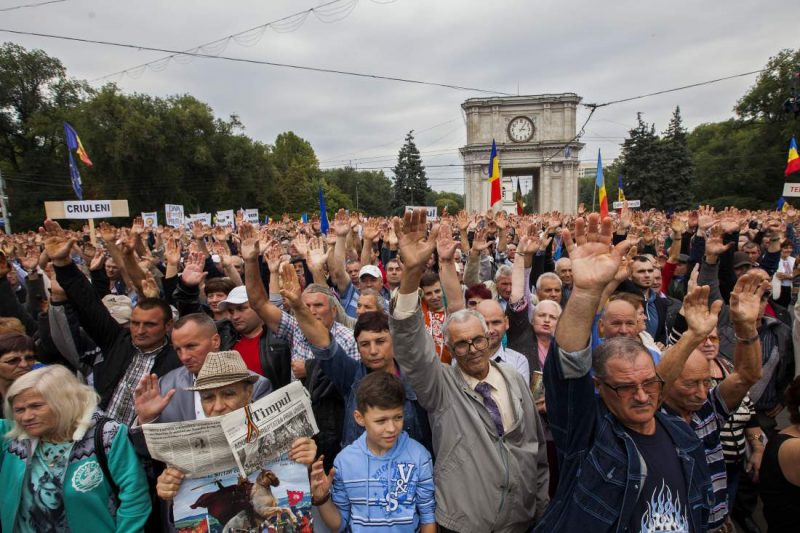
Pic of recent massive demonstration outside Moldovan Parliament.

This story might appear obscure but it reflects a bigger issue - about how Russian revanchism is reported back through democratic Europe's free media.  The issues it describes have also often been the story in Ukraine. How solid, liberal ideas like 'balance' and reporting 'both sides' can become a failure to tell the truth. How inserted reporters don't pay attention to the locals. How the messy 'European ideal' needs much closer reporting if we're to truly live up to any democratic ideal.

In the 1959 British comedy The Mouse That Roared a tiny, obscure European country ends up through comedic slight-of-hand being feted by both sides in the Cold War. In comedy, it showed how much of Europe is to the British 'Ruritania', an inexplicable country whose peoples and cultures all mess into one. As the article explains this approach lives on with today's lens of geo-politics and ideas of 'colour revolution' (via Russian infowar) muddying the coverage yet more.

Reblogged with permission from Open Democracy Russia.

====

By Mihai Popșoi  
 
There’s more to Moldova's protests than “pro-European” versus “pro-Russian”.

Moldova’s image as the poorest country in Europe is rivaled only by its obscurity. In rare outbursts of international media coverage — often related to human trafficking, arms smuggling or mass protests — Moldova is depicted as a pawn on the regional chessboard, caught in a tug of war between Russia and the west. There is no denying that, in a world of realpolitik, Moldova is indeed a playground.

Yet there is more to this intellectual inertia than meets the eye. The sheer lack of nuance and insight displayed by the international media with regards to the latest developments in Moldova is as disappointing as it is predictable. 
Much in the way of confirmation bias is at work here — the tendency to search for or interpret information in a way that confirms one's preconceptions. People are usually unwilling and, at times, admittedly unable to comprehend complex phenomena, especially when simple mental shortcuts are readily available.

Professional journalists and political analysts pride themselves on preventing or minimising the influence of such biases on their work. This is easier said than done, particularly in today’s world of ubiquitous geopolitical expediency. Moldova is a case in point.

Perils of European integration


Since the so-called ‘Twitter Revolution’ of 2009, Moldova has embarked on a path of economic transformation and political democratisation — or so everyone thought. The post-revolutionary government took on a rather inspirational name, the Alliance for European Integration, which proved to be both a blessing and a curse.

Generous western financial assistance and political support locked the United States and European Union into the costly self-fulfilling prophecy of a ‘success story’. But the success failed to materialise, despite promising beginnings. Five pro-European governments succeeded each other faster than the public could keep up with, and they spared no effort in building an elaborate discourse of European integration both at home and abroad. One could not help but be mesmerised by the audacity of Moldova’s leadership that promised to bring the country into the EU by 2020.


Over 100,000 protesters took to the streets of Moldova's capital in September 2015 to protest the ‘stolen billion’. Photo courtesy of Maria Levcenco.

Naturally, high hopes developed among more gullible Moldovans and international development partners alike. But the signs of trouble appeared early on.

As early as 2011, there have been hostile takeovers of privately held shares in several leading banks, known as the raider attacks. Then came the infamous ‘Huntigate’ scandal of 2013 — a cover-up of a fatal accident during a lavish hunting spree attended by the top brass of the country’s judiciary, including the Prosecutor General. Finally, ‘the billion dollar bank heist’ left the country perplexed as to how one could steal the equivalent of 15 percent of GDP from three banks with impunity.

Once a poster child of Moldova’s European Integration, Vlad Filat, former prime minister and Leader of the Liberal Democratic Party, ended up a scapegoat for the missing billion. Meanwhile, Filat’s archenemy the oligarch and senior vice president of the Democratic Party, Vlad Plahotniuc, became the sole decision maker in the country.

By hook or by crook, Plahotniuc was able to create a majority coalition (which oddly bears no name). It was rushed to a vote in parliament as protesters gathered outside and soon started demanding early elections. This clearly begs the question: how can international media refer to the current reincarnation of previous governments as pro-European?

Monstrous coalition


Reports from Euronews, BBC, New York Times as well as Russia Today all described the new government as ‘pro-European’ — much to the bewilderment of Moldovan civil society. In a very heartfelt piece on his personal page, Dumitru Alaiba, a former economic and financial advisor to two prime ministers, urged international media and western politicians: “Do what you must, just don’t call this government ‘pro-European’. It is not Europe that they represent. And don’t call us, the people, pro-Russian either.”

Well-respected media institutions used a default template for covering Moldova, relying mainly on the fact that the new government presented itself as pro-European. A more astute analysis would indicate that the new government is ‘pro-European’ in name only.

After numerous Moldovan activists wrote public letters calling upon western media to take a more mindful view of the ongoing protests, a change of tone occurred. There is now a broad acknowledgement that protesters were, and are, a distinctly heterogeneous group.

Admittedly, many of them are pro-Russian, yet a lot are as pro-European as they come. What unites them all is a genuine frustration with an ad-hoc “monstrous coalition” government and a desire for a more democratic and prosperous future.

This is largely missing from the international media discourse, caught in the cross fire between Russia and the west. Russia has capitalised on the growing anti-European sentiment in Moldova, and by supporting these ruling elites, western media and western politicians have only vindicated Kremlin’s propaganda.

Another piece of the puzzle


Russia’s postimperial syndrome is built on the belief that the west is containing its resurgence by creating a belt of instability in south-east Europe — a mantra that rarely departs from Russian TV screens. Moldova is seen as just another piece of the puzzle.

Moscow has a clear agenda of trying to bring Moldova back into its orbit and does not shy away from making its intentions known either.

For instance, in the aftermath of the 2010 parliamentary elections, Sergei Naryshkin, head of the Russian presidential administration, attempted to broker a coalition deal between the Communists and the Democrats. In the 2014 campaign, Russia openly supported the Socialist Party.

Russian media, which still holds a lot of sway over Moldovan public opinion, has been an indispensable tool in this process. Interestingly though, the rebroadcasting rights in Moldova for the most popular Russian federal TV channels are owned by so called ‘pro-European’ politicians, primarily Vlad Plahotniuc. He owns, among a few others, the Moldovan license for Russia’s flagship Channel One. Russian media coverage of protests in Moldova paints the EU in a negative tone, while reinforcing the message of Eurasian Economic Union as a better alternative. The aim of these reports may be as much to appeal Russia's domestic audience as it is to influence public perceptions in Moldova.
This sort of nuance is helpful in understanding the complexity of the Moldovan political landscape, which cannot be reduced to a mere east-west dichotomy.

The same is true for the protest movement. Many things that politicians had kept to themselves, such as allegations of blackmail and corruption, came to light only after mass protests erupted. However, for a long time, protesters could not set their differences aside in order to pursue a common goal: early elections.

Even when they finally did, the much heralded unity of protesters across ethnic, linguistic, ideological and party lines proved too good to be true. The nascent movement is constantly being undermined by infighting.

Besides, there have always been doubts about the independence of such political players as the socialist leader Igor Dodon, Our Party head Renato Usatii, and front man of the civic platform turned political party, Andrei Năstase. Hence, the real tragedy is that genuine popular protests are led by less than candid individuals.

Bridging the divide


Instead of helping to bridge this divide, both media and politicians have contributed to the increased polarisation of public opinion by presenting just one side of the debate, reinforcing the ever-present confirmation bias.

This development is particularly visible when it comes to Romanian or Russian news reports, as well as political commentary on developments in Moldova. Self-proclaimed leader of the Moldovan diaspora in Russia, Aleksandr Kalinin, posted a Facebook video calling upon Vladimir Putin to come and rescue the Moldovans from what he saw as an imminent takeover by Romanian and Ukrainian special forces.

The response came in a leading Romanian newspaper from none other than a prominent Romanian analyst and former adviser to Romanian president Traian Băsescu, Iulian Chifu, who called the video an “official request” to Putin. To his credit, Chifu went on to debunk Kalinin’s bogus allegations, but the latter was afforded much more attention than he deserved even in the aftermath of Crimea and Donbas.

The EU's former enlargement commissioner Štefan Füle is perfectly right when he says that: “We should be more active in addressing [pro-Russian] propaganda about what the Eurasian Economic Union offers versus what the EU offers a country like Moldova.”

Undeniably, Russian media will continue to produce characteristically biased reports about Moldova, but if western media want to have any claim to a higher moral ground they have to give up using simple shortcuts and produce accurate accounts no matter how tedious or inconvenient that may be.

Max Seddon’s recent article in the Financial Times, for example, does just that. He reports that “In private, some European diplomats say they would welcome a pro-Russian government — if only so that the current coalition cannot further tarnish the EU. Says one: ‘Asking them to do reforms is like asking turkeys to prepare Christmas dinner.’” 


Who are the pro-Europeans now?


No matter how ironic it may sound, a pro-Russian government is likely to be the only thing that can rehabilitate the European Union’s image in Moldova. The risks of a new government changing Moldova’s foreign policy course are minimal: it would be economically irrational and politically suicidal, since most of the burden of adjusting to the new EU-Moldova Association Agreement has been incurred, while the benefits are only kicking in. 


The new government cannot be called pro-European and, to its credit, it does not use the term. The coalition that Plahotniuc has put together literally has no name nor a coalition agreement. It relies on the program of the previous government despite being a “coalition of the willing”. Namely, the will of the 57 lawmakers being to preclude early elections and stay in power for another three years despite the sheer collapse of public trust after the infamous bank heist and the utter refusal to accept any blame either by the government or the parliament.

Moldova is a case study for state capture, though perhaps had Moldova been an EU candidate country, things would have been different via conditionality. The West has sacrificed democracy for geopolitical interests, which is usually a recipe for disaster down the road.

The sole threat of an imminent pro-Russian government is likely to galvanise and reboot the political system, albeit incrementally, with a new breed of upstanding young professionals exiting their comfort zones and entering the public domain to the benefit of their communities and their country — the alternative being a drift away from the values of democracy and the rule of law, all under the watchful eye of the international media.


See also:

Saturday, 20 February 2016

When Soviet hipsters risked jail for Jazz


Cross post from Little Green Footballs.

Here's a fantastic little documentary on the time when Jazz, Rock'n'Roll, anything sung by an emigre, even 'gypsy' music was illicit in the USSR. How people managed to distribute music is extraordinary - they used x-rays.

Writes Kim Kelly:
X Ray Audio: The Documentary explores the curious, sometimes fantastical story behind Soviet Russia's strangest cultural exports, and is part of a larger project which has seen Stephen Coates and Paul Heartfield publish a book and host muitple live events (the next of which will take place at Rough Trade East in London on March 9). As their website explains, "Giving blood every week to earn enough money to buy a recording lathe, one bootlegger Rudy Fuchs cuts banned music onto such discarded x-rays to be sold on street corners by shady dealers. It was ultimate act of punk resistance, a two-fingered salute to the repressive regime that gave a generation of young Soviets access to forbidden Western and Russian music, an act for which Rudy and his fellow bootleggers would pay a heavy price."
Take a trip back to a time and place it's nearly impossible to imagine with X Ray Audio: The Documentary.
Watch the documentary and four examples of groovy, Soviet-era music after the jump.

Friday, 19 February 2016

Russia: punishment psychiatry back in vogue


Reblogged with permission from People & Nature.

===

By Gabriel Levy

The Russian performance artist Pyotr Pavlensky has been sent to the notorious Serbsky Institute of psychiatry, and his family and lawyers are worried about him.

On 9 November Pavlensky poured petrol over the doors of the infamous federal security services (FSB) building at Lubyanka square in central Moscow and set fire to them. He named the action Threat [Ugroza]: friends photographed and filmed him as the flames took hold. (Damage was done, but no-one was hurt.) Pavlensky was arrested soon afterwards.

The FSB’s building was inherited directly from the Soviet KGB. Thousands of the regime’s political opponents were tortured and killed behind its austere façade.
Pavlensky has been charged with “vandalism motivated by ideological hatred”, whatever that means, and appeared at the Tagansky district court several times. At his first appearance he compared his case to those of Crimean activists jailed on false “terrorism” charges – including Oleksandr Kolchenko and Oleg Sentsov – and said he would not address the court further.

Oleksei Chirniy, who was charged along with Kolchenko and Sentsov, was also detained at the Serbsky institute prior to his trial. His supporters alleged he had been mistreated with psychotropic drugs.

Pavlensky is also awaiting trial for charges arising from an earlier performance, “Freedom” (“Svoboda”). In February 2014, days after the removal  of Ukrainian president Viktor Yanukovich, he went with collaborators he went to Malyi Koniushennyi bridge in St Petersburg, setting light to car tyres and banging dustbin lids, to recreate the atmosphere of the Maidan demonstrations in Kyiv.


Separation (Otdelenie). Pavel Pavlensky protesting against punishment psychiatry, October 2014. Photo from the Calvert journal site

Pavlensky was sent to the Serbsky State Scientific Centre for Social and Forensic Psychiatry last month (27 January) to be observed by doctors. The centre was then closed due to an outbreak of a strong flu-like virus, and Pavlensky’s lawyers have been denied access to their client.

Human rights campaigners are focusing on Pavlensky’s case and Amnesty International have expressed concern about it.

On 3 February, in Pavlensky’s absence, the Tagansky court extended his detention to 5 March. His wife expressed fears for his health in a facebook post: “We do not know if they are injecting him with drugs, trying to give him pills. We don’t know.”

Meanwhile artists are protesting about a decision by the National Centre for Contemporary Art to throw Pavlensky’s performance out of the contest for this year’s “Innovation” prize.

His action at the Lubyanka was included after an on-line vote by critics. But on 15 February, the organisers of the prize struck it off, on the grounds that it had involved an illegal act. Members of the expert committee that advised the organisers were angry; art critic Anna Tolstova quit the committee, saying: “I don’t consider myself obliged to agree with censorship and become part of the repressive machinery of the state.”

Clearly, the organisers have taken a step back. In 2010 the prize was won by the Voina group for painting a large phallus on a bridge near the security services headquarters in St Petersburg.
Punishment psychiatry has been on the rise in Russia again since the 2011 demonstrations against government ballot-rigging.
In October 2013, Mikhail Kosenko, one of the defendants brought to trial after those demonstrations, was sentenced to indefinite psychiatric treatment after the Serbsky centre declared him insane. Psychiatric treatment was also used in the recent case of Crimean activists, three of whom are serving long jail sentences in Russia and are widely regarded as political prisoners.

Pavlensky has protested against punishment psychiatry: in October 2014, he sat on the wall of the Serbsky Institute and cut off his earlobe to make his point. Then, he wrote:
“Armed with psychiatric diagnoses, the bureaucrat in a white lab coat cuts off from society those pieces that prevent him from establishing a monolithic dictate of a single, mandatory norm for everyone.”
But punishment psychiatry goes back much further. It was used in the Soviet Union from (at least) the 1940s, to deal with those who defied its tyrannical, misnamed “socialism”, and became widespread in the 1960s. It was the Serbsky Centre that developed the diagnosis of “sluggish schizophrenia”, which was widely applied to political dissidents.

Not only were internationally-known oppositionists, such as the independent trade union organiser Vladimir Klebanov and the second world war general Pyotr Grigorenko, confined to psychiatric institutions, but psychiatry was used against large numbers of less-well-known Soviet citizens. (Indeed two western writers who studied the phenomenon in Soviet times concluded that the abuse of psychiatry against prominent dissidents was “probably only the tip of an iceberg”. It had a wide-ranging function in dealing with “social deviants”: “suppressing individuality […] so that the state can maintain a stifling social as well as political control”. Sidney Bloch and Peter Reddaway, Russia’s Political Hospitals, Gollancz 1977, pp. 278-279.)

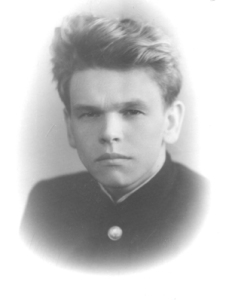
An early – and typical – case was that of Revolt Pimenov, a maths student who resigned from the Communist Party’s youth league, was diagnosed as schizophrenic and consigned to a psychiatric hospital – the sentence being lifted when he agreed to rejoin the league!

His story is recorded in the marvellous archive of the Chronicle of Current Events, a dissident journal. (Thanks to J who drew that to my attention!)
Revolt Pimenov in his student days. Photo from the Chronicle of Current Events archive

Finally, a thought about Pavlensky’s art. I am pretty conservative in my artistic tastes, but it works wonders for me. What is an artist supposed to do when his government becomes increasingly repressive and supports military mayhem in a neighbouring state? Paint landscapes?

In my view, setting fire to the doors of the Lubyanka was a cry of sanity in an insane world. I’m not blind to the limitations of individual protest – but this protest tried seriously to deal with the state machine’s monstrous corrosion of humanity.

If you are a western leftie thinking “well, this is hardly the worst example of state repression”, give me some credit. I know. I, too, see the sickening irony in the denunciation of Putin for ordering Syrian children’s deaths to gain diplomatic advantage – by people who had little to say about Tony Blair and George Bush ordering Iraqi children’s deaths on a vastly greater scale. Well, you know what … it’s not a competition! Putin’s violence is part of the same process as Tony Blair’s, not some sort of answer to it.

For me, this is about the reality with which my friends – activists in social and labour movements in Russia and Ukraine – have to deal.

If you’re a psychiatrist, please get on to your professional association about that institute. If you’re an artist, please get on to that art centre about that competition. If you’re a letter-writer, please follow Amnesty’s advice on protesting to the Russian prosecutor … and if you’re fighting for some other cause, big or small, please keep doing what you’re doing. How else can we deal with the inherent madness of the system under which we live?


See also:
 
Edited to add: On February 23 Pavlensky was transferred back to prison from the psychiatric facility. His wife said on Facebook that doctors tried to isolate him but other 'patients' backed him and "the blockade was broken".

Wednesday, 17 February 2016

If Labour Moderates Were Football Fans ...

[Click for larger version]

Reblogged with permission from my mate Jake Goretzki, who is a self-described 'September the Twelfther' (one of those who left the Labour Party on the day that Jeremy Corbyn was elected leader). 

Jake says that the idea behind his cartoon is that "while I get the idea of a party being its members, when the boss and staff and objectives go rogue (and the tokens of success and trophies are disdained), it becomes almost impossible to support. I increasingly compare Corbyn Labour to Wimbledon [football club] when it was franchised to Milton Keynes - the 'club' and heritage and place effectively hijacked, and the grinning horror of  Pete Winkleman an impossible prospect to 'carry on' with."

Friday, 12 February 2016

Russia in Crisis: the Agonies of the Oil Empire

Small business desperate to stop its demolition by Moscow City government display a Putin portrait


Reblogged with permission from LeftEast. Translated from the Russian by Emma Clair Foley.

Author Ilya Budraitskis is a historian, cultural and political activist. Since 2009 he is Ph.D. student at the Institute for World History, Russian Academy of Science, Moscow. In 2001-2004 he organized Russian activists in mobilizations against the G8, in European and World Social Forums. Since 2011 he has been an activist and spokesperson for Russian Socialist Movement. Member of Editorial board of “Moscow Art Magazine”. Regular contributor to the number of political and cultural websites.

=====

Everyone understands that the coming year will see Russia immersed in an economic crisis, one which will almost inevitably entail a social and political crisis. It was already over a year ago that Vladimir Putin, while taking part in his favorite genre of television, “direct association with the people,” assured viewers that the crisis was a matter of temporary difficulties which would be successfully overcome within a year or two. These assertions are not simply a propagandist’s device, but a reflection of deeply-rooted elements of the consciousness of Russia’s ruling elite, accustomed as they are to switching out strategy for tactics and reacting to challenges as they arise. This consciousness is the result of an unbroken decade of increase in oil prices during which the entire domestic economy was tightly bound to the export of natural resources.

The windfall from oil sales both created the sense that Russia’s foreign policy muscle was strengthening and guaranteed a constant rise in state spending. The army, the bureaucratic apparatus and the murky system of government procurements received the bulk of this beneficence. Nevertheless, the growth in spending in the social sphere was seen as more of a residual effect, and education and medicine have always been regarded as the first things to sacrifice when money is short.

The years of oil prosperity fostered the growth of an ugly social model in which the inflation of energy resource prices on speculation compensated for the decline of production, a phenomenal level of social inequality, corruption, and increasingly systemic authoritarian political power protecting the interests of the elite. Vladimir Putin’s popularity rested (and, for now, still rests) on this uncertain foundation. Key to this popularity was the widespread notion that because of his ruthlessness, Putin is the one person who is capable of guaranteeing “stability,” an enduring trajectory of national growth protected from any risk of shake-ups.

Protesting lorry drivers hope for some words from the Tsar
The most valuable insight here for the majority of Russia’s residents is that “Putinist stability” is now most definitely a thing of the past, and that the Russian elite has no backup plan for redeeming the situation. By last year it had already become clear that the government’s anti-crisis politics boils down to a local variety of austerity outdoing even the current politics of EU governments in its ruthlessness. It consists of sharply reduced social spending, forced pension reform (a proposed increase in the retirement age to 65), the refusal on principle to index salaries to the rate of inflation (12.9% last year) and more taxes and fees collected from the population. The weakening of the ruble, restrained with the help of currency reserves introduced onto the market and increased interests rates at the Central Bank, made loans inaccessible to small- and medium-sized business and contributed further to the economy’s collapse.

The state budget for 2016, in accordance with this crisis, is based on calculation that set the median price of oil at $50 a barrel, but it has already fallen below $30. Although the government has not yet publicly considered revising it, the Minister of Finance has already recommended that all other departments reduce spending by 10%.

The situation is exacerbated by the current system of revenue distribution between Moscow and the regions, in which all revenue becomes part of the federal budget, only then to be recounted into local budgets. The result is a growing tension between the government and regional authorities, who must bear responsibility for these “austerity measures” before the people. At the same time, in an effort to maintain his popularity, the president publicly demands from them demonstrations of “social commitment,” putting them in an impossible situation.

The sharp decline in government revenues exposes the vulnerability of Putin’s “power verticals,” that is, the complete political dependence of local powers on the center combined with their economic “autonomy” (that is, responsibility for fulfilling budget responsibilities). The political losses incurred from austerity must be shouldered by the federal government headed by Dmitri Medvedev or local governors—anyone but the president, whose popularity should not under any circumstance suffer as a result of a reduction in the quality of life of the people who support him.

The figure of Putin as a “national leader” is the main basis of legitimacy for those in power in the eyes of the majority. The irony of the situation lies in the fact that people trust their president, but they don’t trust the state he represents. In these catastrophic conditions the Putin political machine is preparing for parliamentary elections, which are set to take place in September 2016. Like all previous elections, they will have to conform to the script written by the Kremlin. It currently appears to name “United Russia” as the majority in Parliament, while casting Medvedev as the victim of growing passive dissatisfaction. The “independent” candidates, as well as the kept opposition (including the communists and Zhirinovsky’s party) will attack the government for its antisocial austerity measures, but the president will remain beyond the reach of critics.

This guiding script may get out of control and provoke a wave of public disturbances (as happened in December 2011, after the previous parliamentary elections). The principal difference today may turn out to be the combination of political protests against an antidemocratic system and social protests against poverty and the government’s neoliberal policies. 2015 saw a serious uptick in local protests in connection with delays in the disbursement of salaries, job cuts and unnecessary new taxes. In December demonstrations by truck drivers indignant at new, extremely high road tolls took place in nearly half of all regions of the country. In some cities, there were protest actions against harsh limitations placed on state medical coverage. On the whole, experts estimate that there have been 409 protests in the past year linked to the violation of workers’ rights (168 of which took the form of work stoppages). That’s 76% more than the average for the period 2008-2013.

The economic crisis along with the regular political cycle (parliamentary elections in 2016 and presidential elections in 2018), will unavoidably provoke and strengthen divisions within the elite. The possible battle lines can already be faintly seen: between Moscow and regional powers; between government finance experts and army lobbyists, who will insist on an increase in the defense budget in the face of “external threat,” and among state corporations, demanding all new subsidies from the state budget to finance their huge debts.

In the attempt to maintain the existing balance of forces, the regime must revisit their foreign policy of the past two years, including the war that is still dragging on in Ukraine, conflict with the west and the developing military engagement in Syria. Moscow is already taking active steps toward the removal of US and EU sanctions. For the first time since the moment that Russia annexed Crimea, direct negotiations over the fate of Donbas began in Kiev in between Ukrainian president Poroshenko and Russian representative Boris Gryzlov (a member of Putin’s inner circle of “friends”). This meeting was followed by an hours-long consultation between the Kremlin’s main “facilitator” of Ukrainian affairs and Assistant US Secretary of State Victoria Nuland. The repeal of the sanctions is necessary for the Russian government, among other reasons to enable large-scale foreign loans to augment depleted national financial resources. Dependence on oil prices could soon be completely replaced by another dependency—this time on international creditors.

All of this means that Russia is on the threshold of serious changes, which in the short term indicate an end to “Putinism” as a system—at least as we have known it during these “fat” years.

See also:


Monday, 25 January 2016

Putin is persecuting Russian anarchists + antifa

Dmitry Buchenkov. CC avtonom.org.

Reblogged with permission.


====


By Dmitry Okrest.

At the beginning of December, Dmitry Buchenkov became the latest person in Russia’s ‘Bolotnaya Case’, a series of investigations and trials into Russia’s opposition now in its fourth year.

Buchenkov, a 36-year old history lecturer at a Moscow medical university, is the 31st defendant in Bolotnaya. More than two hundred people were detained in the initial case, which stretches back to the ‘March of the Millions’, an opposition demonstration on the eponymous square in May 2012. The protest was timed to coincide with the inauguration of Vladimir Putin’s third presidential term, and this didn’t go unnoticed. During the sanctioned demonstration, the police cut off the square, in effect ‘kettling’ the protesters. Scuffles started between police and protesters, and a pitched battle of sorts began before the crowd was violently dispersed.

The prosecutions made against protest leaders, and allegations of geopolitical conspiracy, have come to symbolise the Kremlin’s response to the ‘Russian winter’ of 2011-2012. Despite the extent of the investigation and trial, Bolotnaya is yet to receive attention inside, or outside Russia. Journalists and activists are less and less interested. Only the police are still following it in numbers.

Yet the payback for Bolotnaya continues. On 22 December, Ivan Nepomnyashchikh, an engineer from the Moscow region, received a two and a half year prison sentence for participating in ‘mass disorder’, the charge against the majority of Bolotnaya defendants. By the time Buchenkov was arrested in early December, the first defendants from 2012-2014 were already on their way out of prison.

Dmitry Buchenkov will now face trial for turning over a chemical toilet on 6 May 2012. The prosecution’s main evidence is a photograph of a 30-year old man on Bolotnaya who looks nothing like Buchenkov.

Costly convictions


‘Buchenkov was an active member of the left-wing movement behind Autonomous Action, a large organisation of libertarian communists, which had dozens of groups in Belarus, Russia and Ukraine before it split,’ Aleksandr, a young anti-fascist, tells me. ‘Unlike most of the young anarchists who were detained during the march, Buchenkov's name was comparatively well-known’, he added.

‘Power exists and shall continue to do so for as long as human societies exist,’ notes Buchenkov in a letter to me. ‘The task of libertarian communism is not to destroy power, instead we should organise it in the form of self-government, on a socialist basis. The political task of anarcho-communism is to organise power in non-governmental forms.’

Indeed, Buchenkov’s arrest is another instance of the Russian authorities’ focus on anarchists and anti-fascists. Buchenkov now joins fellow members of Autonomous Action in jail—Aleksei Gaskarov, sentenced as part of Bolotnaya, and Aleksei Sutuga, who was charged with fighting against neo-Nazis in September 2014. For the past six months, Sutuga has been denied correspondence and held in solitary confinement.

Buchenkov’s investigator Aleksei Dobarin has form in this area. Dobarin has previously worked on the Bolotnaya case, investigating Vladimir Akimenkov and Leonid Rukavishnikov, activists from the far left Russian organisation Left Front (and who have condemned Russia’s actions in south-east Ukraine). Prior to Bolotnaya, Dobarin worked in the Kaluga region, some 70 km from Moscow, where he investigated nationalist and neo-Nazi groups.

As Aleksandr, the young anti-fascist, tells me, in the three years he’s known Buchenkov, the latest figure in Bolotnaya has had several encounters with the security services. Police officials would greet him at demonstrations, and he was threatened after starting a social club; once he was beaten to the point of losing consciousness.

But Buchenkov remained active. Forced to leave his work in a Nizhny Novgorod university, he moved to Moscow in 2009. Following Russia's 2015 economic crisis and multiple economic sanctions after the annexation of Crimea, he decided to publish a free newspaper, which he handed out to people coming to the Russian capital looking for work from the regions.

Despite the general fatigue of Russia’s civil society, Buchenkov’s case has attracted its attention—the defendant’s lawyer Svetlana Sidorkina is yet to gain access to the case. Instead, at the first hearing, Buchenkov was represented by a legal aid lawyer appointed by the Interior Ministry, who had previously worked as a police investigator in Siberia. More than 70 legal professionals have since signed an open letter questioning this behaviour.

Yet Buchenkov has few chances for solidarity from like-minded people in Europe. Following Maidan and the war in Ukraine, the European left has split once again.

Who are your comrades now?


The active participation of the far right in EuroMaidan, the war in Ukraine and annexation of Crimea has brought disarray to the left in Europe. Most were confused as to what position to take. After EuroMaidan, Kyiv was seen as ripe for revolutionary change. For others Russia—which opposed these changes—was an opponent of a unipolar world and thus an example to follow.

Russia’s alternative banner, as heralded by Russia Today, remains out of sight for Russian citizens themselves. The majority of programmes on the emancipatory potential of the Kurdish women’s movement or Julian Assange’s interview with the leader of Hezbollah aren’t accessible to Russian audiences. Only a few programmes come with Russian subtitles.

RT’s ‘western’ pull is effective. Last year, I interviewed Vicenzo Bellantoni, secretary of Italy’s Communist Refoundation Party, which had organised a series of lectures and concerts across Europe in support of the ‘Donetsk People’s Republic’ (DNR).

As Bellantoni saw it, the DNR was involved in a ‘mass anti-fascist struggle against an illegal fascist and reactionary government, which had come to power as a result of an armed coup. All communist movements are united in the people’s struggle, and we intend to resist this reactionary coup. We rely on many websites for our convictions: the sites of the Russian and Ukrainian communist parties, Russia-1 and Russia Today.’

‘There’s an idea in the west that there’s an alternative to the US-Brussels consensus,’ says Ilya Budraitskis, who coordinates the Russian socialist movement. ‘People have an intuitive need to replicate the familiar contours of the Cold War, where there’s two centres of power, each of which represents certain values.

‘The Soviet Union, and now Russia, is associated with social justice and national emancipation. We can choose which side in this global confrontation with which to associate ourselves. The mistake of many on the left is that, as they see it, Russia is far from the continuation of the Soviet Union.’

Short memories


For those who miss the USSR, the now disintegrated country is valued for its power and position in the world, as well as certain social welfare guarantees. Russia’s anti-fascist rhetoric and anti-American message have brought much in the way of support from some on the European left, who have chosen to support Moscow despite its violation of labour legislation, low wages and everyday xenophobia.

Buchenkov himself once declared that workers in authoritarian post-Soviet states now found themselves in semi-feudal relationships with employers. The political elite, he continued, had usurped state property while the opposition was weak. It could offer nothing but renewed religious conservatism or the fulfillment of neoliberal demands, concluded Buchenkov.

Indeed, as Budraitsksis sees it, ‘Contemporary Russia cannot present a single idea that could be mobilised elsewhere. It presents no alternative to the model of global capitalism emerging from Brussels or Washington. Yet either from inertia or a lack of memory, the politics of Moscow is seen precisely in this mold.’

Dmitry Buchenkov considers himself to be a leftist, but he comes from that minority of Russian left-wingers that view the Soviet experience and what came to replace it in a critical light. Unfortunately, the arrest of a left-wing activist in a country, which, according to tradition, is a staging ground for resisting American imperialism, is yet to garner a reaction.

A case in point is that of Aleksandr Kolchenko, the Crimean student and anarchist activist arrested last year for an arson attack on the office of a pro-Russian organisation. There was precious little solidarity from European countries, at least not in comparison to the murder of antifascist activists by neo-Nazis in the late 2000s.

Russia’s Anarchist Black Cross, an organisation set up to support political prisoners, notes that European activists are not only less interested in news of arrests, they’re giving less in terms of donations. Aleksandr, who is coordinating help for Buchenkov inside prison, also notes that attention from western NGOs is decreasing.

Instead, some on the European left are busy supporting the unrecognised republics in south-east Ukraine with music festivals, lectures and cinema clubs, comparing the conflict to the Spanish Civil War. Many more make clever remarks about Kyiv’s neoliberal path, while ignoring the fact that Moscow is travelling the same road.

‘You have to take everything that happens in life philosophically,’ writes Buchenkov from jail. ‘The people in prison are also people, our fellow countrymen, many people from former Soviet republics. It’s a slice of society, with all its problems and shortcomings.

‘I can only imagine why I’ve been arrested, but I believe that my imprisonment is connected to my political convictions. I didn’t exclude the possibility of persecution for my beliefs. I am outraged that I’m being persecuted for actions for which I am not responsible. I wasn’t even at Bolotnaya.’


Edited to add: In the UK the comrades from Italy mentioned by Okrest are matched by the (misnamed) group Solidarity with the Anti-fascist Resistance in Ukraine (SARU). That group is backed by Stop The War Coalition (STWC) leaders Andrew Murray and Lindsey German and the STWC website has promoted the group, as well as run numerous articles chiming with its politics. This has led to the extraordinary outcome of SARU backing smears against the National Union of Mineworkers for their solidarity work with Ukranian comrades. SARU are not marginal, they have almost 5,000 likes on Facebook.


See also:

Wednesday, 20 January 2016

Ukraine: please kill 'Odessa massacre' meme FFS

'Euromaidan' activists helping rescue people from fire at Trade Union House in Odesa, May 2 2014. Pic vasaphotography.com

Like deliberately missing a open goal in a penalty shootout, Ukraine is still failing to nail the meme that Maidan activists deliberately massacred pro-Russians in Odessa.

This meme has gone around the world (thank you John effin Pilger), and has driven actual lefties to sign up for the zombies running the 'People's Republics' in Eastern Ukraine - including Brits!

The meme ain't true, of course the Kremlin megarubles propaganda is BS, but once agin we have a vibrant Ukrainian civil society yellin that something must be done. They're right. They must be supported.

This is an open sore for the Maidan, for the 'Revolution of Dignity', and it must be closed.

Reblogged with permission.

===

By Halya Coynash.

20 months after the deadly disturbances and fire in Odesa on May 2, 2014, Ukraine’s law enforcement bodies have not only failed to properly investigate the events and find those responsible, but are effectively stymieing the investigation. This has forced the 2 May Group, a civic initiative of journalists and various experts, to publicly express their lack of confidence in the Prosecutor General’s Office and Interior Ministry and speak of ‘clear signs of sabotage’.

There seems more than enough cause for such criticism. It is over two months since the International Advisory Panel’s Nov 4 report identified serious failings in the investigation and lack of any real progress. That report clearly stated that, given evidence suggesting police complicity, as well as omissions, and the failure of the emergency services to respond in time to the fire, the investigation needs to be carried out by a body independent of the Interior Ministry. The 2 May Group soon afterwards publicly called upon the authorities to pass the entire investigation over to the same Department for Special Investigations within the Prosecutor General’s Office that is finally, albeit slowly, making progress on investigating crimes committed against Euromaidan activists.

The criticism and such constructive recommendations have all been ignored. Instead the Interior Ministry team has been reduced to two investigators and there is no visible progress on any front.

There is, however, permanent activity on the information war front with Russia and pro-Russian organizations actively pushing a narrative about a ‘massacre’ with the Trade Union building claimed to have been set alight on purpose by ‘Ukrainian radicals’. These are lies that have been used actively to recruit young men to fight in Donbas, and are regularly touted around Europe via a suspiciously well-funded ‘victim’ and highly misleading exhibition.

The 2 May Group has worked tirelessly to refute the lies which are also debunked by the findings of the International Advisory Panel. This is simply ignored in the propaganda reports while the failings in the investigation are trumpeted and often claimed to be deliberate sabotage because of things that need to be hidden.

It is impossible not to share the 2 May Group’s frustration over the failed investigation. While criticism is mainly directed at the Prosecutor General’s Office [PGO] and Interior Ministry - the bodies purportedly investigating the events, the activists also criticize the Security Service or SBU. The latter has not initiated any criminal prosecutions on separatism charges for which there would be every justification. The 2 May Group writes that following Russia’s invasion of Crimea and the events in eastern Ukraine, some of the anti-Maidan groups, particularly Odesskaya Druzhyna and Narodnaya Druzhyna, “turned into an instrument for dividing Ukraine – so-called ‘federalization’”. It was members of Odesskaya Druzhyna who provoked the disturbances on that fatal day and there is plenty of evidence that this was a planned attack.

Whoever started the trouble, it turned into full-scale disturbances with weapons used by both anti-Maidan (or pro-federalism) and pro-Ukrainian unity supporters.

6 people were killed and a further 12 injured by gunshot wounds during the disturbances in the centre. 42 died as a result of the fire which broke out in the Trade Union building on Kulikovo Pole. The fire was caused by a Molotov cocktail, however these were being hurled by activists on both sides and specialists agree that there is no way of knowing whether the fatal incendiary device was thrown from outside the building, or from inside.

The Interior Ministry’s Central Investigative Department was put in charge of investigating the riots, establishing the causes of deaths earlier in the centre and in the Trade Union building. They were also responsible for identifying those directly responsible for deaths; establishing where the weapons had come from (and disappeared to); and establishing the motives of the organizers of the troubles.

This same police CID was entrusted with investigating suspected negligence by emergency services staff. Most, if not all the deaths in the Trade Union building would have been averted had the fire brigade not taken forty minutes to arrive, despite repeated calls. The Prosecutor General’s Office [PGO] was put in charge of investigating negligence by police officers.

Both PGO and the Interior Ministry promised a swift and open investigation, with Interior Minister Arsen Avakov also announcing that foreign specialists would be involved, and that cases would be passed to the court within 3 months.

Only one of the people currently facing charges – Serhiy Khodiyak, a Maidan activist - is accused of involvement in these deaths. He is not in custody and members of Euromaidan have consistently tried to obstruct court hearings into the charges against him.
Of the 21 pro-federalist activists held in detention for very long periods (with 5 still in SIZO or a remand centre], most are facing vague charges of involvement in riots which could just as well be laid against a huge number of other people that day.

There are very serious questions to be answered over why a crucial action plan codenamed Khvylya [Wave] was ready but not registered and therefore did not come into effect. Petro Lutsiuk, the head of the regional police at the time, was placed under house arrest on May 13, 2015, and charged with professional negligence for the failure to register the action plan. Initial optimism that this might indicate real, albeit belated, progress soon fizzled. Lutsiuk was released from house arrest, and although he is supposedly now at the stage of reading the material against him, members of the 2 May Group are sceptical about the case turning into a real prosecution.

There have been constant attempts to blame the events on Dmytro Fuchedzhy, then deputy head of the Odesa Regional Police, who fled shortly after the events and is now believed to in Transnistria. It is known that Fuchedzhy supported the pro-federalism camp on Kulikovo Pole and there is video footage showing Fuchedzhy leave the scene with a minor injury in an ambulance almost certainly containing anti-Maidan activist Vitaly Budko [‘Botsman’], a key murder suspect. It was Fuchedzhy who allowed the storming of the police station by pro-Russian activists on May 4 and he personally ordered the release of 63 anti-Maidan activists, most of him were able to escape prosecution. Despite all of this, Ukraine has still not bothered to have Fuchedzhy added to the international wanted list.

People being rescued from the fire
The investigation was hampered from the outset by the destruction of material evidence during the night after the disturbances when the communal services were deployed in cleaning the streets. The 2 May Group reports that there was no attempt to cordon off areas where crimes had been committed, nor to carry out a proper inspection of the terrain.

The Trade Union building in turn was only closed to public access a month after the fire. Incredibly, the official inspection of the building failed to notice evidence, including bullet marks, demonstrating that firearms had been used to shoot at pro-Ukrainian activists from within the building. This was only added to the file material after the 2 May Group’s expert pointed it out.

Weapons


The 2 May Group calls the list of firearms removed absurdly short and notes that video footage shows that a much greater number of weapons were used. Some were taken from anti-Maidan activists and handed to the police, however there is no information as to what happened to them. The weapons used to kill Euromaidan activists Ihor Ivanov and Andriy Biryukov, and anti-Maidan activist Hennady Petrov have never been found. This is despite the fact that the bullet which killed Andriy Biryukov came from a weapon which is quite unusual in Ukraine and needs a special licence.

There has been no more than a formal response to the Group’s demand that the Odesa Regional Prosecutor investigate allegations that could implicate one of his employees in the concealment of the ‘Vulcan TK’ automatic rifle Budko is believed to have used to kill Ihor Ivanov (see: Prosecutor suspected of involvement in Odesa May 2 tragedy)

The 2 May Group is convinced that the investigation into the fire “is clearly being sabotaged at the highest level in the Interior Ministry”.
The Prosecutor General’s Office has narrowed the number of police officers accused of criminal inaction to just one person – Lutsiuk and is openly sabotaging the transfer of this case to an investigative body independent of the police and PGO.

Maidan supporters desperately trying to save opponents from the fire
The charges against Lutsiuk could also be laid against Volodymyr Bodelan, then head of the Odesa Emergency Services. Bodelan has admitted that he was personally responsible for delaying the fire brigade for 40 minutes. He finished his contract as planned, then stood for election to parliament. He disappeared for a few months after Lutsiuk was arrested, and liberally gave interviews to the Russian media full of misleading information and minimizing his role in the events. He recently returned, and obviously has his reasons for believing himself to be safe from prosecution.

An internal inquiry with the emergency services department found that nobody had been at fault, and the supposed criminal investigation is being carried out, as the international panel observed, by the Interior Ministry which cannot be considered an independent body.

There are no suspects, which the 2 May Group points out, allows the Interior Ministry to drag out the case indefinitely.

Failure to properly investigate events in which people lost their lives is a clear breach of the European Convention on Human Rights. This, as well as the numerous other failings in the so-called investigation, make it extremely likely that the European Court of Human Rights will in future issue judgements against Ukraine.

Ukraine’s law enforcement bodies are thus sabotaging an investigation which is of critical importance for Odesa and for Ukraine as a whole, given the cynical propaganda lies circulated about the tragic events. It is not only the victims and their families who have been betrayed.


*Watch an interview with the May 2 Group on Ukraine Today.

* Pilger's Guardian article a week after the events included content directly lifted from debunked Russian propaganda - see the weaselly footnote added by the Guardian.

See also:

Sunday, 17 January 2016

A Children's Treasury of bat*hit Corbyn lines


Another day and another statement from Jeremy Corbyn which has to be explained, or 'Corbynsplained' as DPJ Hodges so neatly coined.

Today it was that a diplomatic channel should be opened with Islamic State and that they have "strong points". Thus hashtag #ISISstrongpoints trending all day today in the UK.

In the same interview with Andrew Marr Corbyn refused to say that the Falklands Islanders deserved the right to determine their future.

It so happened that I noticed that James Bloodworth had retweeted Harry Phibbs pointing to a exchange in the House of Commons:

(Bloodworth commented that this was "such a dishonest argument when he was against NATO *during* the Cold War.")

So, as you do, I went to have a read of said exchange (from, as John Rentoul pointed out, July 4 2013) and found it awash with gobsmacking statements from Corbyn.

I'm leaving out commenting much on the ones on NATO as I have covered that nonsense in earlier posts on Corbyn (see 'Corbyn and Ukraine: It's not pretty'). But there's him. complaining about NATO going outside the North Atlantic. In response to Labour MP Jon Spellar, he says about the anti-piracy operation off Somalia:
Of course piracy off the coast of Somalia is not a good thing. Instability in Somalia is very bad, but surely one solves that problem by political support for changes in Somalia—to some extent that is happening and considerable changes are taking place.
'Surely.' This is a prime example of the fake 'Man Of Peace', virtue signalling Corbyn.

Where to start. So the solution to the piracy is an elusive 'political solution'? What about the here and now Jeremy? (And doesn't that sound a lot like his proposals for Syria?)

He obviously is unaware that the NATO operation was started to protect World Food Programme shipments of relief. Or that the navies of Russia, China, India and 15 other non-NATO countries are involved.

No, the operation is about NATO "looking for something to do" - 'surely'.

Complaining that NATO is presenting itself as the "armed wing of the United Nations" - when? where? - he actually said:
It may be that the UN should have its own force.
Great idea! Why didn't anyone else think of that!?

Scrolling down comes this gem in his rant about Afghanistan:
Al-Qaeda was founded by US trainers.
This is an urban myth. It never happened. You can read the vast swathes of evidence confirming this as myth on Wikipedia, including this from CNN journalist Peter Berger (who interviewed Bin Laden):
The story about bin Laden and the CIA — that the CIA funded bin Laden or trained bin Laden — is simply a folk myth. There's no evidence of this. In fact, there are very few things that bin Laden, Ayman al-Zawahiri and the U.S. government agree on. They all agree that they didn't have a relationship in the 1980s. And they wouldn't have needed to. Bin Laden had his own money, he was anti-American and he was operating secretly and independently. The real story here is the CIA did not understand who Osama was until 1996, when they set up a unit to really start tracking him.
@Twidun also noted that "he conflates the mujahideen with the Taliban (formed in 1992)." Of course its a convenient myth for Corbyn to propagate. But not one he's likely to be challenged over unless a journalist does and I would very much doubt they ever will. (Talking to you, Andrew Marr, et al.)

Carrying on ranting against NATO I am at an utter loss as to what he is on about here (highlight mine):
A whole new scenario seems to be being built up, namely that China will somehow occupy the Arctic and invade us from the Arctic ocean, and therefore we must develop a new missile shield—as we already have aimed against Russia—to protect ourselves.
China? The Arctic?

I would normally think this was a slip of the tongue but then literally the next thing he says is:
The USA is moving more into the Asia-Pacific region.
Eh? 'More'? Like it wasn't before?

And who among us cannot see this proposal as a contribution to world peace:
We have a growing arms race between NATO and Russia, despite the apparently cosy chats between members of the Russian Communist party and delegates to the NATO Assembly. I absolutely welcome those and wish they could be videoed and portrayed to the whole world. The same applies to China.
That was part of a rant about arms, something he has an obsession with, and I would note from my coverage of his views on Russia and Ukraine that he thinks the evil NATO is about:
Advancing military technology and a military presence further and further eastwards in order to create this ghastly scenario of some kind of hi-tech war with Russia in the future.
The war in fascist-run (Corbyn said that too) Ukraine is all about NATO trying out 'hi-tech' weapons? This will be news to the Ukrainians complaining about supplies to them from the West of non-lethal weapons, unless Corbyn thinks night vision goggles constitute that 'hi-tech'.

This daft idea you will not be surprised to learn comes from Seumas 'Uncle Joe' Milne but it also appears on the websites of Ron Paul fanboys and the pro-Kremlin conspiracist website globalresearch.ca.

Maybe the wingnut conspiracists are also writing about China invading the Arctic?

This was all from just one House of Commons session. There is lots more, of course, such as the Commons appearance where he goes on about how the world hates Britain cos Iraq when the truth is the opposite. Actual polling shows the UK is among the most respected countries in the World.

But these are facts and the Trump Corbyn fanboyz aren't big on those. Hence we are where we are.

Paging the News Quiz, Private Eye and satirists everywhere. The material writes itself, people.