Now posts ↓

Showing posts with label africa. Show all posts

Saturday, 21 January 2017

Two inaugurations: Two realities: Dakar vs DC


America does not take kindly to the world telling it stuff but there is an opera in this.

As the world watched - same time, same planet - its greatest power crowned a man who lost the vote to a woman. Same time, same planet, Africa peacefully forced out a man who lost power by the same majority vote to another man. Peacefully.

As the West hands nuclear codes to a man who lost the vote to a woman West Africa peacefully removes a man voted out by a majority.

Where?


The Gambia ('the' because of the river)  is a tiny, tiny country in West Africa you have probably never heard of. Its gay hating (a thing) dictator, Jammeh, won a coup. He lost 22 years later to someone, Adam Barrow, who once worked in a UK big box.

Jammeh conceded then he retracted. The region - ECOWAS - told Jammeh to give in. They had done this before, told losers to concede. This is what they do.

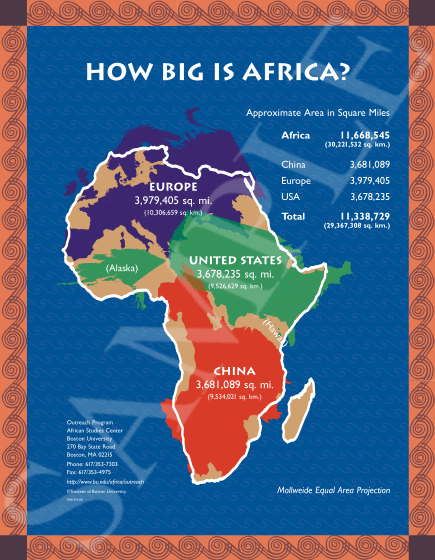
West Africa, ECOWAS, is bigger than the United States mainland. Thanks to a Belgian this rarely crosses our collective mind.

The UK big box guy was inaugurated in the neighboring state. All the neighbors said we will back you, with force.

In contrast to the rest of Africa this region had stood up for democracy. The dictator was forced from power. The same time as you inaugurated Trump.

Same time as the Trump inaugural was happening this was happening.

An African region was telling a member to uphold democracy.  It rolled out troops.

Another contrast


The US has a President who has a minority of votes. His election is predicated on a 200yr+ system designed to boost states with small populations in a system that this country has never tried to change. There is V strong evidence he was elected because of the intervention of a police chief, never mind the foreigners alleged to have interfered. There are electors calling him illegitimate.

How hard is it for this white Londoner to see this through African eyes? Not very.

As I mentioned, opera. Western tourists watched Trump's speech in The Gambia's capital's, Banjuy, airport as this all happened. Include that.

Make art from this.

Friday, 8 January 2016

A gay African 'anti-imperialism of fools'


As a Brit, perhaps excuse me these issues. They're not new.

The idea of an 'anti-imperialism of fools' is decades old (and behind an effin firewall on a magazine laughingly called 'Dissent').

Fortunately we have Nick effin Cohen via the hyper-capitalist Spectator *for free* to say:
In his Tyranny of Guilt, the French philosopher Pascal Bruckner emphasised the colonial mindset of ‘anti-imperialists’. The West may no longer dominate the world. (We are the first ‘imperialists’ without an empire.) But they can maintain that the West still matters because it is the root cause of the world’s ills. Psychologically, such narcissism is just about understandable as a compensation for decline. One day a cultural historian will notice that the explosion of chest-beating and garment-rending in the West coincided with the shift in economic power to east Asia. But as principled politics, the denial that there are reactionary movements and regimes in the world with motives of their own is a disgrace.
Thus may we view the fact of the New York Times blaming the US State Department for the persecution of gay men in Africa.

For the past few years the US has spoken up for LGBT rights, albeit selectively, worldwide and it has a small, funded support program. For most people this is progress and small beer, for others ... it is the 'Empire' doing its evil thing and promoting 'homocapitalism'.

The context from the Chomskyite left is of Glenn Greenwald telling Malians: 'I don't care what you f&cking think about an Islamist invasion, I know best.' (Which is what he actually did.)

IOW - and we already had a sense from their treatment of Muslim dissenters - it's tinged with racism, we Western lefties know best. 'Pro-gay'=pro-imperialist, in their minds. So of course the Times piece was gloatingly welcomed.

But the voices of actual gay Africans on US engagement with them wasn't heard (as it wasn't, shockingly, in the Times piece). Now they are speaking out.

Jay Michaelson writing in the Daily Beast:
Davis Mac-Iyalla, a Nigerian activist who founded the LGBT Christian organization Changing Nigeria in 2005, is one such person. “Obama raising the LGBT issue was marvelous,” Mac-Iyalla told The Daily Beast. “The African LGBT struggle could not have come this far without the support of the West.”

Mac-Iyalla also points out that the real turning point in terms of African perceptions of homosexuality as “Western” resulted not from U.S. foreign aid, but from the Anglican Communion’s evolution on the issue, beginning at the 1998 conference in Canterbury and culminating in the 2003 ordination of the first openly gay bishop, Bishop Gene Robinson.
Here's what the Times handed to African LGBT opponents and the Obama hate crowd:
Finally, the Times article radically overstated the amount of U.S. spending in the area, citing a figure of $700 million. That claim was duly repeated by anti-gay organizations like the Family Research Council (which, in a nice leftward turn, accused the U.S. of “cultural imperialism”) and websites like Breitbart.

But that figure includes the total amount spent on all “vulnerable populations” for public health purposes, not just LGBT people. According to Andrew Park, director of International Programs at the Williams Institute, which studies issues related to sexual orientation and gender identity, the actual figure is closer to $7 million—two orders of magnitude off.
The $700m figure is BS. And that BS still isn't corrected on the piece.
In fact, the only thing the Times got right was its impersonation of African anti-gay activists, who routinely say that homosexuality is a Western invention, a Western sin, or a Western value. They are the ones who link the justified rage at 300 years of Western depredation of Africa with opposition to contemporary Western policies. In what is now a series of articles, the Times has endorsed this view.
Adrian Jjuuko, executive director of HRAPF
This article has stirred so much that a number of African gay activists have publicly come out against it (comment from 76crimes.com).
“I read the article … with a lot of disbelief,” says Adrian Jjuuko, veteran Ugandan activist and executive director of the Uganda’s LGBTI-friendly legal organization, the Human Rights Awareness and Promotion Forum (HRAPF). The article described “a very different reality from what I as an activist …  have experienced,” he says.

“The US support was always done in a respectful way and after consultations with activists on the ground,” Jjuuko writes in a letter to the editor of the New York Times.

In addition to Jjuuko, critics citing the Times article’s inaccuracies have included:
Why should anyone be unsurprised that Africans are upset at a Times piece which quotes Obama critics but not fans?

Those, of course, who value Western criticism above African opinion.

And, oh look, it just happens to exactly match that coming from the US far right. Funny, that.

#facepalm


See Also:

Wednesday, 29 July 2015

Obama ‘kills it’ in another African speech


[Crossposted from Little Green Footballs]

Whilst American media and seemingly all the Americans in my timeline are otherwise engaged, Obama is ‘killing it’ on his state visit to Africa.

Here’s South Africa’s leading newspaper picking up on African Twitter.
To break-outs of rapturous applause, laughter and cheering, President Barack Obama became the first US president ever to address the 54-member African Union at its headquarters in the Ethiopian capital, Addis Ababa.

The speech, which touched on a variety of issues, lit the audience and also set twitter ablaze with poignant and often-pointed messages to Africa’s leaders and partners.
More: Obama ‘Kills It’ in His African Union Address - Here Are the Tweets to Read if You Missed It

Said South Africa’s Daily Maverick:
When he was finished, after nearly an hour at the lectern, the audience rose as one. “If you build the Africa you believe in, you will have no greater friend than the United States,” Barack Obama concluded, to raucous cheers and even a few ululations. Finally, the most powerful African in the world had come home – and he did not disappoint.
As with African Twitter, the New York Times’ main takeaway was the criticism of ‘Presidents for life’. Others noted the veiled criticism of China’s African presence, which reflected African concerns, and veiled LGBT rights support.

Obama specifically addressed supposed American hypocrisy - what Russia in particular loves to point to - saying:
Our American democracy is not perfect. But one thing we do is we continually re-examine to figure out how can we make our democracy better. And that’s a force of strength for us, being willing to look and see honestly what we need to be doing to fulfill the promise of our founding documents.
HT: Charles Onyango-Obbo

Watch the full speech after the jump:

Friday, 3 July 2015

World awaits Greenwald/STWCUk apology: 'We woz wrong', for example


There has been another massacre in Northern Nigeria by Boko Haram, the ISIS aligned Islamist terror group. At least 150 Muslims, including small boys, machined gunned during Ramadan prayers.

Andrew Coates notes the past history of reaction to calls for Britain to support efforts against Boko Haram by the likes of Stop The War UK (cf 'Stoppers'). Many people regard STWUK as a front for the notorious Socialist Workers Party. The Stoppers include MPs Caroline Lucas and Jeremy Corbyn and have the ear of much of the left as well as celebs like Brand and Boyle as well as foreign allies like the 'journalist' Glenn Greenwald. They have influence.

Coates notes that when Boko Haram's kidnap of 200 girls made international headlines that the Stoppers reaction was that "the "'free press' have exploded into a fit of pro-interventionist hysteria." Rather than the group's rise being due to insufficient Sharia law in the North of Nigeria - what the group actually said - the Stoppers knew better and reckoned it was "a response to severe economic inequality."

This is Stopper boilerplate. It writes itself.

So how about this when next you are hearing the persistent, mosquito-like Stopper drone .. recall the cries about how the French intervention against Islamists on the march in Mali would backfire. How it was ALL because of the intervention of the West in Libya. How it was ALL EVIL OUR FAULT BAD US FLAGELLATE FLAGELLATE.

Whilst you're recalling those events note how this news has seemingly been missed.

Mali: Peace Deal Raises Hopes of Stability
19 June 2015

Tuareg rebels finally appear to be willing to sign the May peace accord. While the Malian population welcomes this as a step toward more security, it has little faith in the UN stabilization mission, MINUSMA.

The new peace accord has been on the table for a while now. In fact, Mali’s government, international mediators and some armed groups already signed it on May 15, 2015, in the capital, Bamako.

The agreement calls for the recognition of the government in Bamako; in return it gives the north of the country more rights.

Representatives of a Tuareg-dominated alliance called the Coordination of Azawad Movements (CMA) have now agreed to sign the accord on Saturday (20.06.2015). Negotiations repeatedly failed in the past.
The article quotes a survey of Malians expressing disappointment with the UN peacekeepers. Why? Because "people thought the rebellion could be put down immediately and permanently." There are still some attacks by Islamists going on in the North and, as Jean-Hervé Jezequel notes, the deal has flaws and "risks collapse as international interests shift to other hotspots." Peace deals are inevitably imperfect.

But the survey's results should not be surprising considering the numerous reports at the time, even in the righteous Guardian, that the French paratroopers were being welcomed by ordinary Malians with open arms.

So as we await another drone from the Stoppers on Boko Haram let us also recall that time that Glenn Greenwald launched an anti-French tirade in the Guardian just when French troops were being welcomed to halt the Islamist advance. And that he was also saying that even if surveys showed Malians wanted the French troops he would still not support intervention.

https://twitter.com/ggreenwald/status/293853928280444929


Gary Brecher wrote about his Twitter scrap with Greenwald at the time, which ended with Greenwald saying that he could not give a toss for Malian opinion.

Greenwald wrote in the Guardian that the Mali intervention "will obviously provoke even more anti-western sentiment." Well obviously La Greenwald was W.R.O.N.G.

Will the Stoppers reflect that maybe they were wrong that one time about Mali? That actually the Malians were right to ask for and get French help? That maybe the Sierra Leonians asking 'war criminal' Blair for help 15 years ago might also have turned out to be a good thing? Or how about that a bit more intervention might have helped save some from the Rwandan genocide maybe?

Will they heck because the arrogant bastards know better than some black Africans who, as Greenwald makes clear, should know their place – isn’t that the sum total of these people's worldview?

  • Via @AgeofMockery, Casey Michel takes on Greenwald and his outlet's reporting on Ukraine and Russia; "pure, unalloyed farce."

Thursday, 10 October 2013

African inventor makes 3-D printer from scrap


I have been following African tech development for years. Many in the West will be unaware that in many areas they are way in advance.

In Nairobi hundreds of buses have Wi-Fi - unlike in New York or London. Africans have been able to use mobile phones to make payments and transfer money for years.

The  open source project Ushahidi, which allows users to crowdsource crisis information and began during the disastrous 2007 Kenyan elections, is now used worldwide.

So it does not surprise me that an African has done this:
Kodjo Afate Gnikou has imagination, talent and ambition. 
Using rails and belts from old scanners, the case of a discarded desktop computer and even bits of a diskette drive, he has created what is believed to be the first 3D printer made from e-waste. 
It has taken him several months to put together his experimental device. Lifting designs off a computer, the 3D printer produces physical objects. He shows us by “printing” a small round container. 
And it doesn’t stop there – the 33-year old says he believes this model is only the prototype for something much larger. His aim is to one day transport e-waste to Mars to create homes for mankind. 
“My dream is to give young people hope and to show that Africa, too, has its place on the global market when it comes to technology. We are able to create things. Why is Africa always lagging behind when it comes to technology?”, he asks. 
Some elements had to be bought new but, in all, his printer cost him 100 US dollars to build. 
Gnikou says his printer can also be useful on a daily basis as it can print various utensils needed in any household, that are not always easy to get hold of.
More: African Inventor Makes 3D Printer From Scrap. Video of Kodjo after the jump.

NB: If you're interested in following African tech development I recommend Eric Hersman.

Wednesday, 11 September 2013

Desmond Tutu schools NAACP over Africa and gays

Archbishop Desmond Tutu
Anyone spending anytime reporting on the situation of gays in the different regions and countries of Africa will soon learn that the issue is complex. It varies widely, for example in West Africa between Sierra Leone - see this horrific story of outing and beatings and exile - and Ivory Coast, which is relatively safe.

Look at something like the historic UN vote to include sexual orientation in a resolution against extrajudicial killings, supported by or abstained on by numerous African countries. Or Malawi, which has gone from being internationally condemned for locking up gays to seriously debating decriminalisation.

How you achieve change also varies widely. In some places it's about the very basics of survival in underground communities living in viciously hostile societies, in others it's about openly working with allies and becoming increasingly visible and treated decently in the media. So the tactics used by supporters vary widely and can't be copied from one place to the next even within Africa, let alone copied from the West.

I would have thought all I've just written is obvious but apparently not to the NAACP, America's premier civil rights group. Writes Colin Stewart:
American human rights advocates have undercut the work of their African counterparts by insisting on Western-style advocacy of gay rights from African supporters of human rights for all, says a group of prominent religious leaders and human-rights activists, including Archbishop Desmond Tutu of South Africa.

The issue arose this summer when Dartmouth College in New Hampshire chose, then rejected, an African bishop as the new leader of its Tucker Foundation, which “educates Dartmouth students for lives of purpose and ethical leadership, rooted in service, spirituality, and social justice.”

After he was announced as the new dean of the Tucker Foundation on July 14, the Rt. Rev. James Tengatenga resigned from his position as bishop of Southern Malawi.

In a message to the Dartmouth community on July 18, Tengatenga said, “I support marriage equality and equal rights for everyone.”
The Dartmouth College chapter of the NAACP led the opposition to his appointment citing his 2003 opposition to the election of Gene Robinson, an openly gay priest, as the Episcopal bishop of New Hampshire and a 2011 statement that Malawi’s Anglican provinces remained "totally against homosexuality."

The NAACP said they were "deeply troubled" by Tengatenga's appointment, despite his "newfound views on marriage equality and gay rights." He was subjected to an idiotic and ignorant campaign in the College's media, local media and this offensive stupidity in Huffington Post.

Dartmouth then cancelled Tengatenga's appointment.

A group of supporters, led by the legendary Archbishop Desmond Tutu, have condemned Dartmouth and the NAACP. They say:
It reflects badly on western human rights advocates who consciously or unconsciously engage in forms of cultural imperialism that undermine their own success and credibility by demanding proofs identical to their own kind and, in this instance, by also ignoring the voices of Africans and church leaders who have known and worked with Tengatenga in some cases for decades.
Tengatenga had said:
I have risked my life by advocating good and just government. As I told the search committee when I visited Dartmouth this spring, I have expected to die for the past decade because I have dared to speak out against official corruption and in defense of those Jesus called “the least of these.” I joke to my friends that I don’t leave the house after seven o’clock at night because I want to see who kills me.
His supporters say:
The phrase used on the ground in Malawi is “human rights for all Malawians,” because to speak about “LGBTQ rights” as such would be to add fuel to the flames of opponents for whom gay rights are “special rights,” and therefore indefensible.

The fact that James Tengatenga did not leave behind a record of press releases or public pronouncements — Western forms of activism — does not mean that he was only recently converted to the cause nor that he has not been a loyal and helpful ally to gay activists.  Rather, it means that he has been using the methods of the place in which he was trying to make a difference.
This letter from Malawian human rights defenders supporting Tengatenga expands on how they work on the ground and what Tengatenga's role was.

The well respected global gay supporter the Rev. Canon Albert Ogle, writes in SDGLN that:
The Dartmouth saga is the most recent example of American Christian liberalism paying more attention to the symbols of LGBT equality and inclusion rather than actually in the business of forming new moral paradigms for the 21st century.

Most liberal institutions in the USA including academia and the faith community have not taken the time or spent the resources needed to understand global homophobia. We are not paying attention to our own collusion in building up a new faith-based [and anti-gay] industry supported even by funding from the American taxpayer. Dartmouth’s response is only another example that we are really not listening and are prepared to throw good and resourceful people like James Tengatenga under the bus to protect some public persona that we are somehow more inclusive than we really are. Image trumps substance. The Rev. Kapya Kaoma, who was deeply shocked by this sad melodrama, expressed the delineation of battle zones simply as: “America is right. Africa is wrong.”
Tengatenga was more bluntly critical of Dartmouth and its NAACP chapter. He said that the college had "chosen to trust bigotry over truth and justice." Of the NAACP, he said:
Of all the groups to take the lead against a black person on flimsy grounds. … So much for the advancement of colored people … It is sad that such an institution can stoop so low.
Indeed. This reaction from Dartmouth to the Tutu-led statement suggests a whole lot of arrogant, deaf people -- and that reflects a much wider and willful ignorance, as Ogle points out. The fact that the Tutu statement was sent as a letter to The New York Times and they thought it not newsworthy, and that the statement has had virtually no gay (bar SDGLN) or black media attention, just underlines what appears to be willful, dangerous ignorance.
Enhanced by Zemanta

Thursday, 2 May 2013

The American Wahhabists


The horrific image above, which I make no apologies for posting, comes from the Ugandan Parliament.

The Ugandan lesbian activist Kasha Jacqueline posted it on Twitter. It is an example of the sort of disgusting anti-gay crap being distributed to Ugandan Members of Parliament. Kasha said it left her "sobbing" and pleading for advice on what to do about it.
Kasha also just tweeted the cover of a Ugandan tabloid headlined 'Broke MP Sodomised For ShS900m' (about £200,000 / US$345,000). Her comment on that headline was that it was "dense". Unfortunately many Ugandans would believe it.

The idea that gay sex results in people requiring surgery and that gays recruit and target boys did not descend (from heaven) on Uganda, it comes from American dominionist (theocratic) Christian activists. Groups like Right Wing Watch and Truth Wins Out have long documented the sort of vile propoganda, which extends to deranged claims like that gays ran the Nazi party, circulating amongst anti-gay activists.

Back a couple of years and the activities of these people and their links to Uganda were all over US media. Coverage topped by that of MSNBC primetime host Rachel Maddow, who spoke many times with author Jeff Sharlet. His work has exposed the secretive American groups whose aims are internationalist, to spread their theocratic vision worldwide. Other writers like Chip Berlet, writing here for Alternet, have examined just how deeply such militants have infiltrated US conservative politics.

The media focus was on the infamous 'Kill the gays' bill, proposed in Uganda and whose contents are directly linked to US influence. One US Christian activist in particular, Scott Lively, is actually being sued in a US court in a groundbreaking case for inciting persecution. Last month the group sueing Lively, Sexual Minorities Uganda (SMUG), exposed links between the people behind the shocking literature distributed to Ugandan MPs and US group LibertyCouncil.

Writes Dan Littauer in GSN:
[The 'Kill the gays' bill] language echoes the false and hateful allegation by Lively and Liberty Counsel that a ‘sodomy’ and ‘homosexualists’ groups from the West ‘promote’ ‘perversion’ in Uganda, naming LGBT activists as ‘militant homofascisits’.
An ironic persistent whine from anti-gay Ugandans is that they oppose homosexuality because it comes from 'foreign influence'. Uganda had no gay people before the whites arrived, they claim. Anyone reporting the ties of anti-gay activists to US funding is rigorously attacked despite a wealth of evidence showing the timeline between American missionaries arriving and anti-gay political action following.

That proposed law, which retains the death penalty (despite heavy spin claiming otherwise, a lie unfortunately bought into by much international mainstream media) is not dead, despite some non-Ugandan activists claiming 'victory!' over it. It still sits on the order paper of the Ugandan parliament, waiting for a vote.

Maddow hasn't covered Uganda for a couple of years now but neither have most others. Jim Burroway at the Box Turtle Bulletin, who do similar work to Right Wing Watch and Truth Wins Out, has been covering developments since Lively first appeared in Uganda. He thinks the bill could be revived for political reasons in Uganda and keeps a watchful eye.

The shocking tweets from Kasha show that anti-gay forces in Uganda haven't let up and, as Burroway has also warned, won't give up until their 'Kill gays' bill becomes law.

Wealthy, anti-gay, international fanatics

The activities of rich American religious fanatics are directly comparable to those of the rich Saudi Wahhabists, who also have their own 'by-the-book' proselytising brand of an Abramaic religion.

The new documentary 'God Loves Uganda' filmed US dominionist evangelical Lou Engel calling Uganda "ground zero" for American efforts.

Writes Peter Montgomery for Religion Dispatches:
It’s clear that much of the power American culture warriors have in Uganda comes from the money their ministries pour into the country along with their missionaries. At the massive Miracle Center Cathedral, the biggest megachurch in Uganda, the high-living pastor is quite frank that “American money helped us build this church,” adding, “whatever you see here is the fruit of American labor.” In another clip, a pastor marvels that aid from U.S. evangelicals increased threefold when they started attacking homosexuality.
Churches’ financial success brings added clout to anti-gay pastors like Martin Ssempa—who drives his congregation into a frenzy by showing explicit and extreme gay pornography—and the politicians allied with them, like David Bahati, the sponsor of the kill-the-gays bill.
The American Center for Law and Justice (ACLJ) is a multi-million dollar organisation, founded by US televangelist Pat Robertson (pictured on the cover of Time magazine). It is actively funding and organising anti-LGBT efforts in Zimbabwe, Kenya and elsewhere in Africa and in Brazil.

Mirroring Uganda, reports Rev. Kapya Kaoma, a Zambian priest, and Jandira Queiroz, a Brazilian activist, in the Huffington Post, in Brazil:
The ACLJ typically hires local staff for its international offices to mask the U.S. origins of their assault on LGBTQ and reproductive rights, while hypocritically using that façade to attack human rights advocacy as a neocolonial enterprise imposed on the country in question.
In international bodies like the UN another wealthy US group, Family Watch International (FWI), works with the Vatican and Islamic countries against gay interests. It actively recruits and indoctrinates diplomats in the sort of propaganda Kasha found in Ugandan MPs pigeonholes. FWI President Sharon Slater has said that:
Iran is one of the strongest nations in standing up for family values at the UN.
In Zambia, writes Chivuli Ukwimi:
There has been an increase in the number of visits to Zambia by notable American evangelical leaders calling upon Zambian leaders to reject ‘anti-biblical’ practices like homosexuality and abortion and uphold and retain the status of Zambia as a ‘Christian nation’. Of course, many of them have come with sizeable cheques to ‘support’ various churches and religious institutions. And opportunist religious leaders – like Bishop Edward Chomba, who was actually ex-communicated by the International Communion of the Holy Christian Orthodox Church in the US in 2007 – are happily jumping at the chance to make friends with their wealthy peers from across the sea by trying to out-do each other’s anti-gay rhetoric.

If you think you have heard this process before, it is because you have – in Uganda. And we know where that ended up – in legislation calling for the death penalty for homosexual acts, vile and vitriolic press ‘coverage’, and the murder of an LGBTI activist.
The West turns a blind eye

In Ethiopia a building anti-gay campaign is being fueled by US funded religious groups. It is reaching the point of proposing laws -- death sentences -- similar to those proposed in Uganda.

According to Ethiopian activists, the developing wave of persecution is being ignored by the US State Department and the British Foreign Office.

"The U.S. and other countries don’t do enough to push for an end to such violations," writes Rainbow Ethiopia. "It’s not because the foreign governments don’t know what’s going on."

This is not the first time that those countries have been accused of ignoring serious human rights abuses in Ethiopia -- for geo-political reasons -- and the charge undermines the pro-LGBT shift in foreign affairs claimed by both the UK and the US.

Although some may see any actions taken by Western governments opposing persecution of LGBT as 'colonialist' -- and anti-gay forces would loudly agree with that claim -- Ugandan activists have cited international pressure as the reason why the 'Kills gays' bill is not now law. Activists in Malawi, Russia and elsewhere have also supported international pressure.

Richard Lusimbo from SMUG told Littauer:
We need to hold accountable those in the west who support and praise for the persecution of the LGBTI people in Uganda and other parts of the world. Their work imposes a denial of rights and a life of hardship and suffering for gay people in Uganda and elsewhere.
English: Guy Sebastian and African children. S...
America's shadow foreign policy

According to activist the Rev. Canon Albert Ogle, American tax dollars are supporting many of those active in pushing for LGBT persecution internationally.

Ogle cites the invisibility of LGBT related services from the aid budgets of USAID, the Centers for Disease Control (CDC) and the Presidents Emergency Plan for AIDS Relief (PEPFAR) as well as in funds going to the United Nations Global Fund.

Organisations like the televangelist Billy Graham's family charity Samaritan’s Purse get millions for unscientific 'abstinence only' HIV/Aids programmes which exclude LGBT. And, Ogle notes, Andy Kopsa’s research shows that Samaritan’s Purse:
Brags about converting Muslims to Christianity through the distribution of "hygiene kits" and clean water projects in Niger. They have been found to be evangelising Haitians as part of their relief efforts.
But despite being censured previously for proselytizing with federal money, Graham's group still gets millions.
Another group, World Vision, massively funded by US taxpayers, won't employ gay people and have been involved in the anti-gay activity in Ethiopia.

Says Ogle:
[My Ethiopian friend] was arrested and tortured as a direct result of this kind of shadow foreign policy by American-based evangelical organizations that receive multimillion-dollar contracts from the American government. They hide behind good works to orphans and widows while ignoring the devastation they cause for the LGBT poor of the developing world. As more and more light is shed on a very hidden part of American-funded evangelism in the global south, the American tax payer deserves more accountability as to where their gifts are going and what they are actually used to fund.
Who's fighting American Wahhabists?

The pro-gay foreign policy announced with fanfare by Hillary Clinton in December 2011 is already showing some fruit. One little noticed example is the American government's support for LGBT organisation in Mongolia, where that country's parliament just discussed the issues for the first time and where a first ever Pride march is planned.

There are people working hard to end US support for anti-gay forces and, Ogle reports, that on April 8:
USAIDlaunched a new initiative with the Astraea Foundation, The Victory Institute and the Williams Institute to create a $12 million superfund to help struggling LGBT organizations in the Global South to try to reverse the impact of this kind of discrimination and invisibility.
"It is a beginning," says Ogle. But "so much more is needed to repair years of discrimination and neglect and to stop funding faith based programs that are on the front lines of LGBT oppression in many countries."

Evangelicals like Warren Throckmorton, who has done hard reporting on developments in Uganda and has been cited by Maddow, are working within religious circles to expose the international theocrats. The producers of 'God Loves Uganda' are using their documentary to try to get American evangelicals to "consider the impact of their words and deeds", writes Montgomery. He says that the film's producers have had hundreds of inquiries from churches for screenings.

Polls show that there has been a huge, positive swing in the attitude of American 'born again' Christians towards LGBT over the past quarter-century. Perhaps within another generation the American Wahhabists attempt to impose 'biblical law' outside America will have simply died at its source?
Enhanced by Zemanta

Thursday, 28 March 2013

Exporting American homophobia


One of the criticisms which you sometimes hear from 'global south', particularly African activists, about international LGBT activism as well as Western media is the failure to tackle Western religious groups and their interventions.

I thought of this whilst reading an extremely detailed post by Rev. Kapya Kaoma, a Zambian priest, and Jandira Queiroz, a Brazilian activist, about the activities of the American Center for Law and Justice (ACLJ). This multi-million dollar organisation, founded by US televangelist Pat Robertson, is actively funding and organising anti-LGBT efforts in Zimbabwe, Kenya and elsewhere in Africa and now, the article reports, in Brazil:
Filipe Coelho, director of the newly formed Brazilian Center for Law and Justice (BCLJ) and a friend of the Sekulows from his time studying in the U.S., says ACLJ decided to open an office in his country after discovering last year "how strong evangelical power is within Brazilian politics." A well-connected evangelical in the rapidly growing Assemblies of God church, Coelho was able to arrange a meeting for Jordan Sekulow with Brazil's vice president on 48 hours' notice. With more than 40 million people identifying themselves as evangelical in Brazil, the world's second-largest predominantly Christian country (after the U.S.), it presents a tempting prize for ACLJ expansion.
Though Brazil boasts the largest Pride parade in the world, it may come as a surprise that same-sex couples cannot marry or adopt and lack constitutional protections. In 2011 Rev. Silas Malafaia, pastor of the nearly 20,000-member Victory in Christ Assemblies of God church and vice president of the Interdenominational Council of Evangelical Ministers in Brazil (CIMEB), mobilized thousands to march through the capital city of Brasilia against a bill that would have extended protections to cover sexual orientation. After the Pride parade the same year, Rev. Malafaia, a family friend of the Sekulows and Coelhos, told listeners of his television show that the Catholic Church should "beat [literally 'stick'] down those gay activists" for using saints' images on posters.
Facing language like this, for 11 years Brazil's LGBTQ movement has unsuccessfully promoted an anti-homophobia bill that would make discrimination based on sexual orientation or gender identity an aggravating factor in hate crimes and speech. Evangelicals perceive this as a threat to their "religious liberty" to preach on national television that homosexuality is an abomination in the eyes of God. When Rev. Malafaia, who calls himself "public enemy No. 1 of the gay movement" and leads "crusades," asked his audience in 2009 to vote against the anti-homophobia bill, in a poll posted on the Senate's webpage, there were half a million "no" clicks in less than a week. His Twitter followers number close to half a million.
Brazil has some of the highest reported rates of anti-LGBT violence in the world. In 2011 I reported on how:
Thousands of Twitterers [are] expressing support for homophobic attacks on LGBT using the slogan "Homophobia? Yes!" (#homofobiasim, see English translation of tweets, some of which are explicitly pro-violence, pro-'corrective rape' of lesbians) or used the number of the proposed hate crimes law (yes=#PL122Sim, No=#PL122Nao).
Say Kaoma and Queiroz:
The ACLJ typically hires local staff for its international offices to mask the U.S. origins of their assault on LGBTQ and reproductive rights, while hypocritically using that façade to attack human rights advocacy as a neocolonial enterprise imposed on the country in question.
Warren Throckmorton has reported on another, similar organisation, Family Watch International (FWI). That group is particularly active at the United Nations, where LGBT activists have had a long presence and have been slowly gaining victories. FWI has worked with Islamic countries, including Iran, in opposition to UN resolutions calling for decriminalization of homosexuality and opposing violence against LGBT.

FWI President Sharon Slater has said that:
Iran is one of the strongest nations in standing up for family values at the UN.
Throckmorton reports that FWI has held conferences to "immerse UN delegates in U.S. right wing culture war talking points about homosexuality." This means working with discredited groups preaching the snake oil of conversion therapy like the National Association for the Research and Therapy of Homosexuality (NARTH).

American-sourced ideas that sexuality can be changed, so-called conversion or 'reparative' therapy, has gone around the world, popping up from Hong Kong to Ecuador.

Throckmorton, an evangelical who is professor at a liberal arts Christian college and has been a leading reporter on Uganda's 'Kill the gays' bill and 'reparative' therapy, had a message for fellow American Christians:
Social conservatives who generally support “pro-family” causes should take pause to consider what being pro-family means in a country like Uganda or Nigeria, where the conservative position is to detain gays on suspicion of homosexual behavior and then threaten them with jail or stoning.

Tuesday, 29 September 2009

The Eight Stages of Genocide

Crossposted from my new outlet, Cosmodaddy


How can we predict and prevent genocides? Greg Stanton outlines his groundbreaking theory on the eight stages of genocide: classification, symbolization, dehumanization, organization, polarization, preparation, extermination and denial.

Genocide in Darfur, he argues, has proceeded through these stages before our eyes. Genocide could have been prevented by means of intervention at any one of a number of critical points in the past, but the international response has amounted to too little, too late.

This has always been the case and I don't see this changing anytime soon, despite the best efforts of fantastic groups like Avaaz though groups like them remain our best hope, as does the work of people like Stanton who help people understand that - yes - things can be done and that genocide is not some 'natural, unstoppable force' like an earthquake or a tornado.

One starting point would be for those responsible for doing nothing to be seen to learn lessons and admit their errors. For 'never again!' to mean anything, it's essential. This is why the campaign around Belgium, for example, to own up to its horrific history in the Congo is so important, as important as for Serbia to own up to its role in the Balkan's genocides in the 90s.

It's also close - very close - to home. This is from a post of mine last year about Hillary Clinton's claim that she tried to stop the Rwandan genocide.

Rewriting history over Rwanda
The Americans weren't alone. The British, the French, the Belgians and much of the rest of Africa all either didn't do anything or actively stopped aid. They all looked for their own interests and none had any interest in stopping genocide.

It was Britain's ambassador to the UN, Sir David Hannay, who proposed that the UN reduce its force. A year after the slaughter, the Foreign Office sent a letter to an international inquiry saying that it still did not accept the term genocide, seeing discussion on whether the massacres constituted genocide as "sterile". Then Ministers John Major, Douglas Hurd, Malcolm Rifkind and Lynda Chalker have never even been asked about their role.

Virtually no-one emerges heroically (Canadian peacekeeper Roméo Dallaire is one and his view on Clinton's claims would be interesting to hear). In fact I would urge anyone to make themselves read the harrowing background as an object lesson in international power politics and its victims - a million of them in Rwanda. There's a blog which covers the 100 days before and during the slaughter in detail. 'A People Betrayed' by Linda Melvern is very good.

For Hillary to now try to adopt that heroic mantle is, as commentators have noted, worse than 'monstrous'.
Almost - almost - as monstrous as this comment from Gordon Brown:
"You cannot have Rwanda again because information would come out far more quickly about what is actually going on and the public opinion would grow to the point where action would need to be taken."
Where is Twitter on the genocides happening right now in the DR of Congo? Or the slaughter of indigenous people in Peru? Where is Brown? Where is Sarah Brown!?

Here is a list of the genocides taking place now in the world.

The media doesn't give a damn and, unfortunate but true, neither do most Twitter users.


HT: Domino


Reblog this post [with Zemanta]

Wednesday, 23 September 2009

PayPal still thinks Africa is the 'dark continent'

PayPal Inc.Image via Wikipedia

I just got an email from a friend in Austria. Inspired by a post on LGBT Asylum News he wanted to make a donation to the Sex Workers Outreach Program (SWOP) in Nairobi.
The people there are wonderful, and intelligent, and courageous and open-minded people indeed, and they deserve our help and solidarity. Tears are forming in my eyes when thinking of the women and men with HIV infection and AIDS living in poverty there.


But my friend found out that whilst sending money via PayPal is possible for people in Kenya receiving money is not.

When he contacted PayPal customer services by email they claimed that receiving money is not allowed by the legislation of Kenya. Yet he was able to send the money to Kenya via Western Union — for the transmission of Euro 100 he had to pay a fee of Euro 17,50 which is far higher than PayPal's charges.

Jonathan Gosier, a software developer, writer and social entrepreneur, explains on appafrica how:
PayPal, intentional or not, are sending a very strong message to the rest of the world about Africa.
Prior to moving to Uganda, Gosier had used PayPal for four years and estimates that he's transferred over $100,000 during that time

Bu this counted for nothing once he'd moved to 'the dark continent'.
Apparently PayPal’s way of ‘policing’ their service is to simply flag various IP addresses as being ’suspect’ . hrmm. I have a few Iranian and Indian friends who could tell you a bit about what it’s like to get profiled based on where you appear to be from. (And if they won’t suffice as anecdotal evidence, I’ve got a few million mexican and black american friends who’d double down on the sentiment.)

So Africa remains a high-risk zone as the sheer number of comments like these from paypal users indicates:

I am in the process of trying to sell a laptop. i have posted ads on comtrader and ebay. So far the item has been bought off ebay by a mother who wants its for a present for her daughter in AFRICA. Two people have expressed interest through comtrader, one wishes to buy it for a business associate in AFRICA, and the other wants it for himself, and guess where he lives….. AFRICA. Sorry for all the capitals, but am i missing something here. I’ve replied to the ebay purchaser who is going to pay through Paypal, which i know is covered by ebay so i feel safest. Just wondering if this obsession with me posting it to AFRICA is anything i should be sketchy about.

Or this person’s thoughtful reply:

Anything from africa is a scam so stay well clear. Re-list the item if you have too.

Wow. Anything from Africa is a scam. I better take back this computer I just bought from GAME!

The unintentional effect here is that by blanketing the whole region as suspect, it reduces the number of viable alternatives for legitimate businesses and professionals who want to use services like PayPal for trade. I use PayPal for some of my payroll now (for people who don’t live near me). However, whenever I do, PayPal flags my account and shuts it down temporarily ‘because I accessed it from a suspicious location’. To unlock it I have to call them, from Uganda and do a bunch of other stuff that’s inconvenient. I suppose this is the price of admission for using the service in country it wasn’t intended to be used in. So no complaint here either.

But what it does mean, is that from every angle legitimate African businesses are smacked in the face by measures put in place to police the one’s that are indeed abusing the system. But this affects even expatriates and NGOs that might want to use the service. If it’s accessed from a certain IP there’s a red flag, especially if that IP is not where you registered to use the service.
Once again, the message perpetuated here is to be cautious when dealing with Africans, Africa or anything you suspect of being related to the aformentioned. This is nothing new. Most people here have been dealing with such mentality their whole lives, why would it stop now that the medium has changed? To be fair, there’s truth to this stereotype. There is indeed a huge problem of scams here. There is some truth to most stereotypes, the word itself simply implies that those truths are applied where they don’t necessarily belong.

Unfortunately, there are a lot of people here who are just like consumers everywhere else in the world. They want to buy things, they want the conveniences of online shopping, they want to do business…and they want their neighbors to stop scamming you so they can have those things.
I realize that the problem can’t be solved entirely by Paypal alone but I would appreciate at least an option to flag my account in advance for what might be mistaken for ’suspicious activity’. I’d be happy to leave this to PayPal’s discretion but my problem is they aren’t using any. African transaction? Banned! Banks will allow customers to indicate that they will be abroad for a certain period so that they don’t shutdown accounts by mistake. Why doesn’t PayPal? You’d be surprised at how damaging these blanket policies can be to an organization like mine that simply just wants to pay employees and be paid by clients.

I suppose the complaint is that PayPal doesn’t give me an option to avoid my account getting bricked. It costs me money everytime they do it. they give me no alternative to prevent it from happening and when I talk to them, somehow it’s my fault for existing ‘in that country where The Last King of Scotland took place‘.
My Austrian friend says:
To me this is a kind of discrimination, and neo-colonialism, and racism towards African people, and it reminds me of the inhuman politics of the pharmaceutical industries not to reduce their prices for medicaments for HIV and AIDS in poor countries, but to accept the death of lots of people who could not afford these high prices. If you are living in a rich country of the European Union you survive, if you are a poor woman and a poor man in Africa you die. We must not accept it!
I thought of his experience and Gosier's whilst reading about the coming of broadband to East Africa (which includes Uganda) via the BBC's excellent series of reports.

This did warn of and catalogue the whole raft of other challenges to Africans other than the lack of broadband, which puts its arrival in context, but they missed this one.

Theresa Carpenter Sondjo notes that there are alternatives for African entrepeneurs to PayPal, however they are all more "more expensive and less flexible". That seems to be a running theme for Africa - lots of stuff to build a business is way more expensive, Africans have a stack of hurdles to jump over.

Maybe Oxfam, Mr Bono and Mr Geldof should get onto this one and start shaming PayPal?

Reblog this post [with Zemanta]

Monday, 8 June 2009

Socially responsible outsourcing

15 million Africans ready for work. Got tasks?

I posted recently about mobile developments in Africa and how they are being used in a number of imaginative ways - many of which which we're yet to see in the 'West'!

As well as being used to organise day labour they're also used by people to do small jobs such as translations. In Kenya, with its many languages, this is how help resources for mobile companies' customer services are being built - word-by-word

Nokia being used for translation job

Samasource is a fantastic new San Francisco non-profit that partners with small, talented, tech companies and nonprofit training centers in poor and rural communities (currently Kenya, Cameroon, Uganda, rural India, and Nepal) to find them clients.

It derives its name from the word sama, Sanskrit for “equal”.

Their partners must meet stringent social impact criteria - fewer than 20% of applicant firms are selected - and they specialize in services ranging from data entry to advanced software and website development.

It's about giving work, not aid to people in the world's poorest countries.


Here's a profile of Ann Wangui, a graduate with honors from Nairobi's Methodist University. She is an example of the sort of person who is struggling to find a job in Nairobi despite her qualifications and who Samasource aims to help.


This is certainly a much better approach than the one being adopted by the world's large tech companies. Erik Hersman recently posted Microsoft vs the Open Source Community in Africa.

If Microsoft developer communities do emerge in Africa, Erik writes, even with the massive hurdle of paying for expensive access to developer tools, "we’re still left with what one person wrote: …they will be formed from programmers who are completely dependent on American software for the livelihood: it’s neo-colonialism, pure and simple."
In Africa organizations have a lot of hurdles to overcome, not least of which is the straight cost of doing business. Where it might be simple for some organizations in the US and Europe to wave off a couple thousand dollars worth of licensing fees, the same is not true in Africa. The margins are lower, so every cent counts.

In a region where cost is so important, it’s amazing then that the most lucrative deals go to the Western organizations that have high costs for ownership and maintenance. These outside organizations use backdoor methods to gain contracts where in-country options are available, usually with less expense and with greater local support.
Hersman also reports that Microsoft are trying to muscle in on the African-developed Ushahidi crisis reporting social software with a new product called Vine. He says "if they really are about creating emergency and disaster software for use by normal people, then I would encourage them to not charge for it and to make it as open as possible for others to work with it."

Fat chance, I suspect.

HT: Owen Barder
Reblog this post [with Zemanta]

Sunday, 31 May 2009

In a major victory for LGBT asylum, Ugandan John Bosco defeats the Home Office

Cross-posted from LGBT Asylum News

Following an eight year ordeal the Ugandan gay asylum seeker John 'Bosco' Nyombi has finally won asylum in the UK.

Despite a well-documented media and government anti-gay campaign in Uganda, which has included articles and photos of Bosco, he was deported in September last year. The UK Border Agency making it usual claim that LGBT can be safe in such countries if only they are 'discreet'. However the method of his deportation, which involved deception, violence and rule breaking, led to a historic decision by a British court following which the Home Office was forced to return him to the UK in March, where he was immediately put into a detention centre due to an 'error'.

As Bosco feared for his safety if he was returned, and also because the Home Office might use any publicity about his case against him, a court ruling meant that subsequent media reports referred to him Mister X.

On his return to Uganda, Bosco has been dumped by UK officials with no support (LGBT asylum seekers are regularly returned without their mobile phones, clothing other than what's on their backs or other basic items or given any opportunity to put their affairs in order) and was arresred. He managed to escape after paying a bribe.

As his face and situation was known through the local media's anti-gay campaigning he went into hiding. Twice during this time he was caught by Ugandan police and put into prison where he was violently beaten by both staff and inmates because he is gay.

Bosco won his return because a judge Sir George Newman, said the Home Office was guilty of "a grave and serious breach" of the law. He had an outstanding judicial review but despite this he was deceived into a meeting at a removal centre where he was instead bundled into a van and taken to Gatwick airport.

At the airport, when he resisted leaving the van, he was handcuffed, punched in his private parts to make him straighten his legs so they could be belted together. Crying, he was lifted on to the plane and flown out of the country. (Jacqui Smith has ordered an inquiry into widespread reports of violence during removals).

His mobile phone had been taken from him and he was given no chance to contact friends or lawyers, even though Home Office rules required that he should have 72 hours' notice of removal to give him a chance to make calls.

Judge Newman said he was also satisfied that the actions of the Border Agency officers were "deliberately calculated to avoid any complication that could arise from Mr Bosco 's removal becoming publicly known."

Lawyers for the Home Secretary conceded in court that his removal was carried out illegally.
But they argued flying him back to the UK was pointless because the 38-year-old was bound to lose the fresh asylum claim he now wanted to make.

Rejecting their arguments, Judge Newman said: "I find it impossible to conclude, on the basis of the evidence as it now is [Nymombi's situation on retruning to Uganda], that there is not the real possibility that a judge might find that he is at risk if he is returned (to his homeland) by reason of his homosexuality."

As with the Ugandan lesbian Prozzy Kazooza, who was raped and tortured by the police and won asylum last year, this has now proved to be the case.

Bosco will now be able to return to the job he had held for seven years as a carer supporting vulnerable adults in the community in Southampton. His job has been held open by staff who had previously testified to his outstanding work.

In an email to the author Bosco said:
I was worried to death not knowing where my future will be other than death but now I can put a smile on my face.

Please I ask you kindly to pass on my sincere love and word of thank you everyone you know that supported me and prayed for me.

I will never say Britain is bad because I will include those good people helped me but Just Home office as a department they tortured me and can't understand why they had to do this to me when I obeyed all the rules.


Reblog this post [with Zemanta]

Friday, 24 April 2009

Tech lessons from Africa

Ushahidi: Crowdsourcing Crisis Information

Ushahidi, which means ”testimony” in Swahili, is an open source engine. The project was developed in the effort to better map out reports of violence in Kenya. This was after the post-election fallout at the beginning of 2008.

The aim of Ushahidi is to create a platform that any person or organization can use to set up his or her own platform for collecting and visualizing information. They explain that, ‘the core Ushahidi platform allows for a plug-in and extensions that can be customized for different locales and needs. The tool is open source allowing others to download, implement and use the engine so that they can bring awareness to crises in their own region.’

The core engine is built on the premise that gathering crisis information from the general public provides new insights into events happening in ‘near real-time.’

Ushahidi is also being utilised in the Indian election by Vote Report India.

screenshot of Vote Report India

Users contribute direct SMS, email, and web reports on violations of the Indian Election Commission’s Model Code of Conduct (PDF). The platform will then aggregate these direct reports with news reports, blog posts, photos, videos and tweets related to the elections from all relevant sources, in one place, on an interactive map.

Vote Report India aim is to not only increase transparency and accountability in the Indian election process, but also provide the most complete picture of public opinion in India during the elections.

Vote Report India is a non-partisan all-volunteer collaboration between software developers, designers, academics, and other professionals.

Here's Erik Hersman, aka WhiteAfrican, talking to TED about Ushahidi:


Here's a paper on the use of the Ushahidi platform in the Gaza war. Scroll to sec.5 for new media.

Recent research from ResearchICTAfrica reveals that Kenyans are spending incredible amounts on mobile communication as a proportion of income.

Here’s how it breaks down. The average Kenyan spends over 50% of their disposable income on mobile communication. For the bottom 75% of the population, that figure goes up to 63.6%. In terms of total individual income, the average Kenyan spends 16.7% of their income on mobile communication. That figure rises to 26.6% when looking at the bottom 75% of the population.

Africans are paying for mobile communication in spite of how expensive it is, not because of how affordable it is and because access to mobile communication is critical for people. Even if you are digging a ditch by the side of the road, day labour is now organised via SMS.

Nathan Eagle of MIT recently gave a talk to eTech where he explained about the mobile scene in Africa.


Entrepreneurs are constantly finding new uses for the technology.

A Kenyan water pump manufacturer combines an mobile-mPesa-enabled, solar-powered metering system with their water pumps. They give water pumps away for free and then make a profit by selling access to water via Safaricom’s mPesa service. Send the pump 20 Kenyan Shillings and it pumps 20 litres of water for you. This has increased the water pump companies business and made water more accessible to those who need it.

However, as Steve Song points out:
When a single mobile operator is a gatekeeper to water supply, something is wrong. For any village in this situation, [Kenya's largest mobile network]Safaricom can charge whatever they like.

If we accept the premise that, in places like Kenya, no one can afford not to have access to a phone, then one cannot help but feel that something needs to be done. A flour milling company in South Africa was recently fined more than 45 million Rand by the Competition Commission for price fixing and collusion. I think it is time to take a serious look at mobile operators.

Imagine an alternate reality where Africans paid less than 5% percent of their income on mobile communications and all phones operated on an IP-based network so that any new African innovation might be unlimited in terms of scope. Then we would see mobile-enabled social and economic innovation taking off in Africa.

As Nathan explains, African colleges and universities are turning out a lot of entrepreneurial tech talent. Unfortunately, much of this then migrates. Things like his work and the establishment of companies like Google Kenya is helping to stem this flow. Barcamp's have been held in Kenya and are coming up in Nigeria.

London is hosting a chance for sponsors and African innovators to meet up this weekend at Africa Gathering.

WhiteAfrican's blog is full of tales of tech innovation in Africa. Here he talks about the problems facing the next generation of techies in Liberia. Here's his list of African tech events.

Here Jonathan Gosier explains about his work in developing a tech hub in Uganda.


The rest of the world has a lot to learn from Africa, most obviously in developments around mobile phones.

HT: Kenya Pundit, WhiteAfrican