|
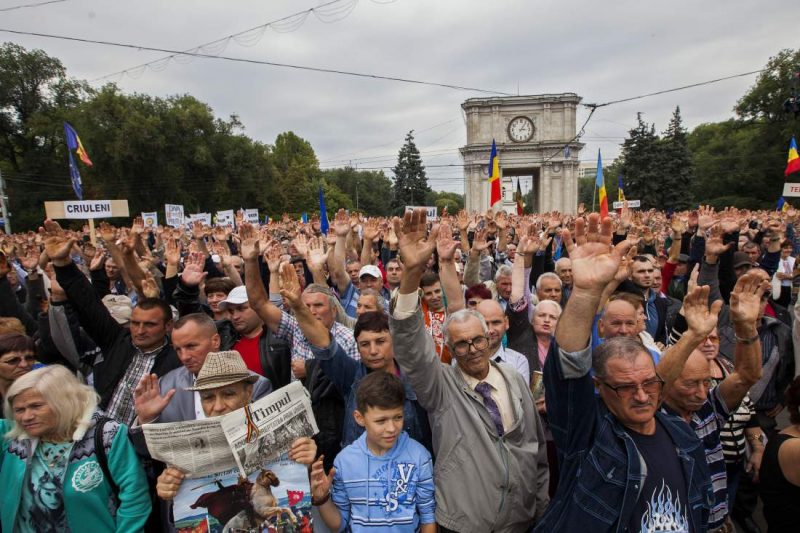
| Pic of recent massive demonstration outside Moldovan Parliament. |
This story might appear obscure but it reflects a bigger issue - about how Russian
revanchism is reported back through democratic Europe's free media. The issues it describes have also often been the story in Ukraine. How solid, liberal ideas like 'balance' and reporting 'both sides' can become a failure to tell the truth. How inserted reporters don't pay attention to the locals. How the messy 'European ideal' needs much closer reporting if we're to truly live up to any democratic ideal.
In the 1959 British comedy
The Mouse That Roared a tiny, obscure European country ends up through comedic slight-of-hand being feted by both sides in the Cold War. In comedy, it showed how much of Europe is to the British '
Ruritania', an inexplicable country whose peoples and cultures all mess into one. As the article explains this approach lives on with today's lens of geo-politics and ideas of 'colour revolution' (via Russian infowar) muddying the coverage yet more.
Reblogged with permission
from Open Democracy Russia.
====
By Mihai Popșoi
There’s more to Moldova's protests than “pro-European” versus “pro-Russian”.
Moldova’s image as the poorest country in Europe is
rivaled only by its obscurity. In rare outbursts of international media
coverage — often related to human trafficking, arms smuggling or mass
protests — Moldova is depicted as a pawn on the regional chessboard,
caught in a tug of war between Russia and the west. There is no denying
that, in a world of realpolitik, Moldova is indeed a playground.
Yet
there is more to this intellectual inertia than meets the eye. The
sheer lack of nuance and insight displayed by the international media
with regards to the latest developments in Moldova is as disappointing
as it is predictable.
Much in the way of confirmation bias is at work
here — the tendency to search for or interpret information in a way that
confirms one's preconceptions. People are usually unwilling and, at
times, admittedly unable to comprehend complex phenomena, especially
when simple mental shortcuts are readily available.
Professional
journalists and political analysts pride themselves on preventing or
minimising the influence of such biases on their work. This is easier
said than done, particularly in today’s world of ubiquitous geopolitical
expediency. Moldova is a case in point.
Perils of European integration
Since
the so-called ‘Twitter Revolution’ of 2009, Moldova has embarked on a
path of economic transformation and political democratisation — or so
everyone thought. The post-revolutionary government took on a rather
inspirational name, the Alliance for European Integration, which proved
to be both a blessing and a curse.
Generous western financial
assistance and political support locked the United States and European
Union into the costly self-fulfilling prophecy of a ‘success story’. But
the success failed to materialise, despite promising beginnings. Five
pro-European governments succeeded each other faster than the public
could keep up with, and they spared no effort in building an elaborate
discourse of European integration both at home and abroad. One could
not help but be mesmerised by the audacity of Moldova’s leadership that
promised to
bring the country into the EU by 2020.
 |
| Over
100,000 protesters took to the streets of Moldova's capital in
September 2015 to protest the ‘stolen billion’. Photo courtesy of Maria Levcenco. |
Naturally, high hopes developed
among more gullible Moldovans and international development partners
alike. But the signs of trouble appeared early on.
As early
as 2011, there have been hostile takeovers of privately held shares in
several leading banks, known as the raider attacks. Then came the
infamous ‘Huntigate’ scandal of 2013 — a cover-up of a fatal accident
during a lavish hunting spree attended by the top brass of the country’s
judiciary, including the Prosecutor General. Finally, ‘the billion
dollar bank heist’ left the country perplexed as to how one could steal
the equivalent of 15 percent of GDP from three banks with impunity.
Once
a poster child of Moldova’s European Integration, Vlad Filat, former
prime minister and Leader of the Liberal Democratic Party, ended up a
scapegoat for the missing billion. Meanwhile, Filat’s archenemy the
oligarch and senior vice president of the Democratic Party, Vlad
Plahotniuc, became the sole decision maker in the country.
By hook or by crook, Plahotniuc was able to create a
majority coalition
(which oddly bears no name). It was rushed to a vote in parliament as
protesters gathered outside and soon started demanding early elections.
This clearly begs the question: how can international media refer to the
current reincarnation of previous governments as pro-European?
Monstrous coalition
Reports from
Euronews,
BBC,
New York Times as well as
Russia Today
all described the new government as ‘pro-European’ — much to the
bewilderment of Moldovan civil society. In a very heartfelt piece
on his personal page,
Dumitru Alaiba, a former economic and financial advisor to two prime
ministers, urged international media and western politicians: “Do what
you must, just don’t call this government ‘pro-European’. It is not
Europe that they represent. And don’t call us, the people, pro-Russian
either.”
Well-respected media institutions used a default
template for covering Moldova, relying mainly on the fact that the new
government presented itself as pro-European. A more astute analysis
would indicate that the new government is ‘pro-European’ in name only.
After
numerous Moldovan activists wrote public letters calling upon western
media to take a more mindful view of the ongoing protests, a
change of tone
occurred. There is now a broad acknowledgement that protesters were,
and are, a distinctly heterogeneous group.
Admittedly, many of them are
pro-Russian, yet a lot are as pro-European as they come. What unites
them all is a genuine frustration with an ad-hoc “
monstrous coalition” government and a desire for a more democratic and prosperous future.
This
is largely missing from the international media discourse, caught in
the cross fire between Russia and the west. Russia has capitalised on
the growing anti-European sentiment in Moldova, and by supporting these
ruling elites, western media and western politicians have only
vindicated Kremlin’s propaganda.
Another piece of the puzzle
Russia’s postimperial syndrome is built on the belief that the west is containing its resurgence by creating a
belt of instability
in south-east Europe — a mantra that rarely departs from Russian TV
screens. Moldova is seen as just another piece of the puzzle.
Moscow has
a clear agenda of trying to bring Moldova back into its orbit and does
not shy away from making its intentions known either.
For
instance, in the aftermath of the 2010 parliamentary elections, Sergei
Naryshkin, head of the Russian presidential administration, attempted to
broker a coalition deal between the Communists and the Democrats. In
the 2014 campaign, Russia openly supported the Socialist Party.
Russian
media, which still holds a lot of sway over Moldovan public opinion,
has been an indispensable tool in this process. Interestingly though,
the rebroadcasting rights in Moldova for the most popular Russian
federal TV channels are owned by so called ‘pro-European’ politicians,
primarily Vlad Plahotniuc. He owns, among a few others, the Moldovan
license for Russia’s flagship Channel One. Russian media coverage of
protests in Moldova paints the EU in a negative tone, while reinforcing
the message of Eurasian Economic Union as a better alternative. The aim
of these reports may be as much to appeal Russia's domestic audience as
it is to influence public perceptions in Moldova.
This sort of
nuance is helpful in understanding the complexity of the Moldovan
political landscape, which cannot be reduced to a mere east-west
dichotomy.
The same is true for the protest movement. Many things
that politicians had kept to themselves, such as allegations of
blackmail and corruption, came to light only after mass protests
erupted. However, for a long time, protesters could not set their
differences aside in order to pursue a common goal: early elections.
Even when they finally did, the much heralded
unity of protesters across ethnic, linguistic, ideological and party lines proved too good to be true. The nascent movement is constantly being undermined by infighting.
Besides,
there have always been doubts about the independence of such political
players as the socialist leader Igor Dodon, Our Party head Renato
Usatii, and front man of the civic platform turned political party,
Andrei Năstase. Hence, the real tragedy is that genuine popular protests
are led by less than candid individuals.
Bridging the divide
Instead
of helping to bridge this divide, both media and politicians have
contributed to the increased polarisation of public opinion by
presenting just one side of the debate, reinforcing the ever-present
confirmation bias.
This development is particularly visible when
it comes to Romanian or Russian news reports, as well as political
commentary on developments in Moldova. Self-proclaimed leader of the
Moldovan diaspora in Russia, Aleksandr Kalinin, posted a
Facebook video
calling upon Vladimir Putin to come and rescue the Moldovans from what
he saw as an imminent takeover by Romanian and Ukrainian special forces.
The
response came in a leading Romanian newspaper from none other than a
prominent Romanian analyst and former adviser to Romanian president
Traian Băsescu, Iulian Chifu, who called the video an “
official request”
to Putin. To his credit, Chifu went on to debunk Kalinin’s bogus
allegations, but the latter was afforded much more attention than he
deserved even in the aftermath of Crimea and Donbas.
The EU's former enlargement commissioner Štefan Füle is perfectly right when
he says
that: “We should be more active in addressing [pro-Russian] propaganda
about what the Eurasian Economic Union offers versus what the EU offers a
country like Moldova.”
Undeniably, Russian media will continue to
produce
characteristically biased reports
about Moldova, but if western media want to have any claim to a higher
moral ground they have to give up using simple shortcuts and produce
accurate accounts no matter how tedious or inconvenient that may be.
Max Seddon’s recent
article in the Financial Times,
for example, does just that. He reports that “In private, some European
diplomats say they would welcome a pro-Russian government — if only so
that the current coalition cannot further tarnish the EU. Says one:
‘Asking them to do reforms is like asking turkeys to prepare Christmas
dinner.’”
Who are the pro-Europeans now?
No matter how
ironic it may sound, a pro-Russian government is likely to be the only
thing that can rehabilitate the European Union’s image in Moldova. The
risks of a new government changing Moldova’s foreign policy course are
minimal: it would be economically irrational and politically suicidal,
since most of the burden of adjusting to the new EU-Moldova Association
Agreement has been incurred, while the benefits are only kicking in.
The
new government cannot be called pro-European and, to its credit, it
does not use the term. The coalition that Plahotniuc has put together
literally has no name nor a coalition agreement. It relies on the
program of the previous government despite being a “coalition of the
willing”. Namely, the will of the 57 lawmakers being to preclude early
elections and stay in power for another three years despite the sheer
collapse of public trust after the infamous bank heist and the utter
refusal to accept any blame either by the government or the parliament.
Moldova
is a case study for state capture, though perhaps had Moldova been an
EU candidate country, things would have been different
via conditionality. The West has sacrificed democracy for geopolitical
interests, which is usually a recipe for disaster down the road.
The
sole threat of an imminent pro-Russian government is likely to
galvanise and reboot the political system, albeit incrementally, with a
new breed of upstanding young professionals exiting their comfort zones
and entering the public domain to the benefit of their communities and
their country — the alternative being a drift away from the values of
democracy and the rule of law, all under the watchful eye of the
international media.
See also: