Now posts ↓

Thursday, 12 September 2013

Refugee Convention assaulted by Australia and Israel

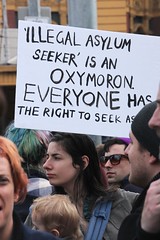
'illegal asylum seeker' is an oxymoron - Refug...
Refugee Action protest 27 July 2013 Melbourne (Photo credit: Takver)

Although the issue of refugees and asylum seekers has been the subject of furious - and often intemperate and ignorant - debate the world over only now is the actual Refugee Convention under serious threat.

In the run up to Australia's election something happened which caused a collective gawp for the sizable Australian minority who haven't lost their minds about refugee boat arrivals.

The then Labor government proposed a new policy of shipping boat arrivals to Papua New Guinea (PNG) and refusing them asylum in Australia, thus abrogating a basic principle of the Refugee Convention, which almost all nations are signed up to, either the 1951 Convention and/or the 1967 Protocol.

Australian policy towards asylum seekers is described by politicians as "harsh". 'Vindictive' and 'cruel' would be more apt. The place in PNG where boat arrivals are being sent (and only them, not those claiming asylum at an airport, logic has nothing to do with this politics) is a dump, on a tropical island, where rape and torture has been uncovered as ocurring - the government tried to cover that up. They are sending children there. The 'PNG option' came from strong arming and aid threats. Locals to the camp, on Manus Island, say they are being shut out of jobs and get no benefit from it. They say they would welcome the asylum seekers living in their community.

This was sold to Australians as "humanitarian" because it would 'stop the boats' coming from Indonesia as some of them sink and over 1000 are thought to have drowned since 2001. But another investigation found more cover up of a failure to stop boats at risk of sinking and aid them - another two-finger salute to international law, in that case the international law of the sea which demands mutual aid on the high seas.
In the dead of night on 17 December 2011, an asylum seeker boat called the Barokah left the coast of Java with around 250 men, women and children on board. One of them was ethnic Hazara man, Esmat Adine. The boat was so crowded, Adine couldn't even find a place to sit. The Barokah was just 40 nautical miles from Indonesia when it fell apart.
'At first I couldn't believe that our boat has sank,' Adine recalls. 'But I saw a toy is coming from the inside of the boat; it is coming by water. When it comes close to me, I realised that no, that was not a toy. That was a kid. That was a kid named Daniel. Daniel was with his mother; they were sitting in front of me, next to me, while we came by bus. When I saw Daniel's body, I realised that our boat has sank, and there is no further hope for us to be alive. '
Eight hours later, at 3 o'clock that afternoon, a passing fishing boat found around a hundred people in high seas, desperately clinging to debris. It was only able to rescue 34 people. Adine shouted to the people in the water, 'Be patient—we will bring you more boats, and they will rescue you.'
In Canberra that evening, Australian agencies became aware the Barokah had sunk. They told Indonesian authorities, because the boat was in their search and rescue zone.
Months later, customs officials would tell a Senate Estimates hearing that Indonesia had initially declined Australia's offer to help with the search and rescue.
But the official incident timeline, which Fairfax obtained under freedom information laws, revealed that BASARNAS, Indonesia's search and rescue agency, had asked AMSA to coordinate the rescue response—AMSA refused.
For two days, while men, women and children struggled to survive in waves up to six metres high, Indonesia and Australia did nothing.
Finally, on December 19, BASARNAS asked again for help. This time, AMSA agreed, and dispatched naval and Customs assets to the scene.
But it was too late. Two hundred and one people were dead.
(I should note there have been similar criticisms of the Italian and Greek's border protection services and the EU.)

Australia actually wanted the Refugee Convention to be changed to suit them. Fortunately they were rebuffed but who knows if either the new Australian government or some other governments peaked by the Australian effort will try again.

The Convention was drawn up in the wake of World War Two, during that period when most of the world worked together to draw up the basic laws which make up a decent, peaceful world. It was a reaction to the shameful way Jews attempting to flee Nazi Germany had been treated in the 1930s, as well as the immediate needs of those fleeing communism.

The latter is why Israel's abrogation of the Convention is causing such consternation as it acts much as Australia is doing. In Israel's case, I kid you not, trading refugees for weapons with Uganda.

Writes Natasha Roth for +972 Magazine:
That this is a war on asylum seekers and human rights is self-evident. But it is also a war on dignity and an assault on human memory and conscience. Whether or not the deal goes through, the fact remains that the Israeli government has seriously considered forcibly dispatching thousands of Africans, to a country not of their choosing, as part of a trade agreement. This brings up a historical recollection of such offensiveness that it is difficult to address it directly. Furthermore, the overlooked “commodity” in this proposed deal is space – for that is what the Israeli government will receive for its part in the potential bargain. This reported agreement is nothing more than a chapter in Israel’s playbook for ‘making room’ and homogenizing; it is persecution as ‘preservation.’ Doubtless one of Netanyahu’s spokespersons will find an appropriate moniker to try and lend some legitimacy to the proceedings (when the Serbs did the same thing in the 1990s, they dubbed it “ethnic cleansing”).
The Israelis characterise the refugees as "infiltrators". The Australians insist they're all "economic migrants".

The ones in Israel are all black, mostly Sudanese and Eritrean. The ones arriving in Australia by boat are mostly Muslim, Afghans, Iranians and Iraqis.

Makarere University Security Studies Professor Paul Omach told allAfrica.com that Israel's actions are 'just another example of a richer nation paying a poorer one to solve its problems'.
Israel looks at these immigrants, mostly Africans really, as unwanted in its country. So if somebody can take it and you can just sign the checks, and you get somebody who is itching for money, that is definitely what they will do.
The co-founder of the International Refugee Rights Initiative in Kampala, Dismas Nkunda, told allAfrica.com that the deal would completely undermine the Refugee Convention:
What happens to them, certainly that is going to be a very big legal problem, because on what basis are they being admitted in Uganda? They have not sought refugee status in Uganda, they have not sought asylum in Uganda. They sought first asylum in the first country they thought of, which was Israel. Actually, you might say that they might end up becoming stateless.
If Australia gets away with it and Israel gets away with it who will be next? If they want to do this just unsign and stop pretending to be 'humanitarian'. Why are there no consequences for those who sign up and then ignore the rules?

As Laissez Passer points out, Kenya's courts are doing a better job of defending international law than Israel's - you could say much the same of Australia's courts. And Kenya hosts hundreds of thousands of refugees. Israel 55000 and Australia far, far less.

Jerome Connolly and Joan Roddy write that:
An unwritten assumption underlying the Convention is that States Parties would not be faced with unmanageable flows of asylum seekers. But experience has belied that assumption on a number of occasions and shown how, in practice, this and other assumptions on which the smooth running of the Convention depends can be invalidated. Asylum determination procedures may be overwhelmed or made irrelevant by mass movements engendered by political violence, especially when conflict spills over frontiers. There may be an associated breakdown of political authority or alternatively borders may be closed as an emergency measure to protect the authority and resources of the host country. This may deny asylum to many refugees or lead to greatly diminished protection for them.
But neither Israel nor Australia are "overwhelmed" except by rhetoric saying they are "overwhelmed". Their actions go far beyond criticism you could make of the treatment of refugees and asylum seekers by Greece or the UK or Turkey, they undercut the basic concepts agreed on for years.

And this is happening when many are worried that growing conflicts and problems like climate change and water shortages will also test the Convention, that protections need strengthening not weakening.
Enhanced by Zemanta

Wednesday, 11 September 2013

Desmond Tutu schools NAACP over Africa and gays

Archbishop Desmond Tutu
Anyone spending anytime reporting on the situation of gays in the different regions and countries of Africa will soon learn that the issue is complex. It varies widely, for example in West Africa between Sierra Leone - see this horrific story of outing and beatings and exile - and Ivory Coast, which is relatively safe.

Look at something like the historic UN vote to include sexual orientation in a resolution against extrajudicial killings, supported by or abstained on by numerous African countries. Or Malawi, which has gone from being internationally condemned for locking up gays to seriously debating decriminalisation.

How you achieve change also varies widely. In some places it's about the very basics of survival in underground communities living in viciously hostile societies, in others it's about openly working with allies and becoming increasingly visible and treated decently in the media. So the tactics used by supporters vary widely and can't be copied from one place to the next even within Africa, let alone copied from the West.

I would have thought all I've just written is obvious but apparently not to the NAACP, America's premier civil rights group. Writes Colin Stewart:
American human rights advocates have undercut the work of their African counterparts by insisting on Western-style advocacy of gay rights from African supporters of human rights for all, says a group of prominent religious leaders and human-rights activists, including Archbishop Desmond Tutu of South Africa.

The issue arose this summer when Dartmouth College in New Hampshire chose, then rejected, an African bishop as the new leader of its Tucker Foundation, which “educates Dartmouth students for lives of purpose and ethical leadership, rooted in service, spirituality, and social justice.”

After he was announced as the new dean of the Tucker Foundation on July 14, the Rt. Rev. James Tengatenga resigned from his position as bishop of Southern Malawi.

In a message to the Dartmouth community on July 18, Tengatenga said, “I support marriage equality and equal rights for everyone.”
The Dartmouth College chapter of the NAACP led the opposition to his appointment citing his 2003 opposition to the election of Gene Robinson, an openly gay priest, as the Episcopal bishop of New Hampshire and a 2011 statement that Malawi’s Anglican provinces remained "totally against homosexuality."

The NAACP said they were "deeply troubled" by Tengatenga's appointment, despite his "newfound views on marriage equality and gay rights." He was subjected to an idiotic and ignorant campaign in the College's media, local media and this offensive stupidity in Huffington Post.

Dartmouth then cancelled Tengatenga's appointment.

A group of supporters, led by the legendary Archbishop Desmond Tutu, have condemned Dartmouth and the NAACP. They say:
It reflects badly on western human rights advocates who consciously or unconsciously engage in forms of cultural imperialism that undermine their own success and credibility by demanding proofs identical to their own kind and, in this instance, by also ignoring the voices of Africans and church leaders who have known and worked with Tengatenga in some cases for decades.
Tengatenga had said:
I have risked my life by advocating good and just government. As I told the search committee when I visited Dartmouth this spring, I have expected to die for the past decade because I have dared to speak out against official corruption and in defense of those Jesus called “the least of these.” I joke to my friends that I don’t leave the house after seven o’clock at night because I want to see who kills me.
His supporters say:
The phrase used on the ground in Malawi is “human rights for all Malawians,” because to speak about “LGBTQ rights” as such would be to add fuel to the flames of opponents for whom gay rights are “special rights,” and therefore indefensible.

The fact that James Tengatenga did not leave behind a record of press releases or public pronouncements — Western forms of activism — does not mean that he was only recently converted to the cause nor that he has not been a loyal and helpful ally to gay activists.  Rather, it means that he has been using the methods of the place in which he was trying to make a difference.
This letter from Malawian human rights defenders supporting Tengatenga expands on how they work on the ground and what Tengatenga's role was.

The well respected global gay supporter the Rev. Canon Albert Ogle, writes in SDGLN that:
The Dartmouth saga is the most recent example of American Christian liberalism paying more attention to the symbols of LGBT equality and inclusion rather than actually in the business of forming new moral paradigms for the 21st century.

Most liberal institutions in the USA including academia and the faith community have not taken the time or spent the resources needed to understand global homophobia. We are not paying attention to our own collusion in building up a new faith-based [and anti-gay] industry supported even by funding from the American taxpayer. Dartmouth’s response is only another example that we are really not listening and are prepared to throw good and resourceful people like James Tengatenga under the bus to protect some public persona that we are somehow more inclusive than we really are. Image trumps substance. The Rev. Kapya Kaoma, who was deeply shocked by this sad melodrama, expressed the delineation of battle zones simply as: “America is right. Africa is wrong.”
Tengatenga was more bluntly critical of Dartmouth and its NAACP chapter. He said that the college had "chosen to trust bigotry over truth and justice." Of the NAACP, he said:
Of all the groups to take the lead against a black person on flimsy grounds. … So much for the advancement of colored people … It is sad that such an institution can stoop so low.
Indeed. This reaction from Dartmouth to the Tutu-led statement suggests a whole lot of arrogant, deaf people -- and that reflects a much wider and willful ignorance, as Ogle points out. The fact that the Tutu statement was sent as a letter to The New York Times and they thought it not newsworthy, and that the statement has had virtually no gay (bar SDGLN) or black media attention, just underlines what appears to be willful, dangerous ignorance.
Enhanced by Zemanta

Tuesday, 10 September 2013

Behind the scenes of Assange's WikiLeaks Party disaster

English: Picture of Julian Assange during a ta...
Assange during a talk at 26C3 (Photo credit: Wikipedia)
Assange's Wikileaks Party got less than 1% in Australia's election at the weekend.

This followed damning revelations about party operations and preferences given to the far-right in the Senate. Formerly loyal insider Gary Lord here unloads on Assange and his Australian praetorian guard.
I first met John Shipton [Assange's father] when he was contacting National Council members prior to the formal registration of the WikiLeaks Party. As a long-time vocal supporter of Julian Assange and WikiLeaks, I was honoured to have been invited to join the Council. But given that the party would soon be under huge public scrutiny, there was something I needed to explain: I had gone bankrupt a few years earlier (after the failure of Kevin Rudd's Green Loans scheme, ironically) and I was still not formally discharged, so I was not sure if I was legally allowed to be on the Council.

John made a quick phone call to lawyer Kellie Tranter, later the party's NSW candidate, and then told me I would not be able to join the Council. After years of dedicated support for WikiLeaks, I felt gutted. But I accepted the decision in the best interests of the party.

"Never mind," smiled John with a sly wink, "we all have a few skeletons in our closets, don't we?"

John did not seem too unhappy at all about my situation, and I couldn't help wondering if that had something to do with my friendship with Julian's mum Christine. It was never going to be easy for the two of them to work together. [removed at request of Christine Assange - Gary]. My original understanding was that John would help set up the WikiLeaks Party and then step away from the day to day running of it. It's a pity this did not happen.

Months later, as the divisions within the party became more obvious, I contacted the Australian Electoral Commission myself, and learned that bankruptcy did NOT in fact prohibit me from being on the National Council (it only made me ineligible to run as a Candidate in the election, an option which was also discussed).

In retrospect, sharing my financial situation with John Shipton may have been one of the biggest mistakes of my life. I do not regret it because I did what I thought was right for the party and the values WikiLeaks represents. But given the WikiLeaks Party's own subsequent lack of honesty and transparency, my voluntary personal disclosure seems bitterly ironic.
.....
In New South Wales, the White Nationalists from Australia First and the militant Shooters and Fishers party were preferenced above the Greens. In Western Australia, Julian Assange's staunchest parliamentary supporter, Greens Senator Scott Ludlam, was preferenced below his strongest rival, the National Party. Even in Victoria, the Greens were well down the list behind minor parties. By contrast, the Greens had preferenced the WikiLeaks Party (WLP) extremely highly in every state. 
I had just spent a week on Twitter trying to suppress rumours that the Greens would be preferenced well down the WLP list, and now it turned out the rumours were true. Worse yet, the source of those rumours was a WLP National Council member, Cassie Findlay, who helped submit the NSW preferences. And after helping me and others look like fools, Cassie conveniently disappeared off Twitter and ignored my DMs (thanks for that, Cassie). 
The WikiLeaks Party issued a statement blaming an "admin error" for the preferencing debacle and promising a review AFTER the election. That was never going to be good enough. Social media was going off. The mainstream media was all over it. Our biggest detractors were rubbing our noses in it and there was nothing we could say in reply.  
We clearly needed a proper public response from the party ASAP. But all the WikiLeaks Party insiders were suddenly - and very strangely - silent. This was not OK.  
I spoke with the only National Council members I knew personally, Sam Castro and Kaz Cochrane. They were both in tears on the phone. I urged them to be patient and give things time to work out, but they explained that others were already walking out the door. When Leslie Cannold's resignation prompted a wave of departures the next day, I started publicly demanding answers from @WikiLeaksParty on Twitter.
.....
The WikiLeaks Party had promised a full inquiry AFTER the election. But Julian's August 30th appearance on ABC The Drum suggested that no inquiry would be necessary. Mistakes were made but nobody would be held accountable, the people who resigned over these errors were somehow out of order, even if Julian accepted responsibility, and in any case he agreed pretty much with everything that was done anyway.  
Was her serious? Or just trying to bluff his way through? 
.....
I am deeply concerned that the WikiLeaks Party was unnecessarily politicised, not by Greens supporters, but by people with a hidden right-wing agenda, including John Shipton, Greg Barns (campaign manager, former Liberal Party candidate and advisor to former PM John Howard) and Julian Assange himself.  
Gary joins a long, long line of former supporters burned by arrogant prat Julian Assange.

More >> Jaraparilla: Where's That WikiLeaks Party Inquiry?
Enhanced by Zemanta

Monday, 9 September 2013

Some contrarian thoughts on Russia and The Gays


Zhuravlyov and his colleague Nikolai Valuev, who is also no fan of sexual minorities
Is Russia's 'remove kids from gay parents' bill the straw that will break Russian anti-gay forces? When will Western media finally report that the Russian version of America's Christianist anti-gays have Russian opposition?

Last week the news came out that a long hinted at new anti-gay bill had been introduced in Russia's parliament, the Duma. Deputy Alexei Zhuravlyov's bill would make sexual orientation a factor in cases when the government is deciding whether to take a child into state custody.

Zhuravlyov (also written as 'Zhuravlev') said in an explanatory note to the bill that, according to experts, 5 to 7 percent of Russians have a "nontraditional" sexual orientation and a third of them currently have children. In accompanying supporting documents, Zhuravlyov refers to the fraudulent and debunked paper on gay parents published in 2012 by University of Austin professor Mark Regnerus. And in interviews Zhuravlyov has sounded more or less like a mirror image of the American anti-gay right-wing.

Harvey Fierstein cited the possibility of such a bill in his fiery New York Times editorial, which kick started the movement to boycott the Winter Olympics in Russia. American media has widely covered the move of lesbian journalist Masha Gessen from Moscow to New York with her family, citing the fear that her kids could be taken from her.

What is being ignored is that a wide number of sources think that such a bill is too absurd to pass Russia's Duma and be signed into law by President Putin.

The Moscow Times described the reaction of Mikhail Fedotov, head of the Kremlin's human rights council, as "indignation". It quoted him saying to the BBC's Russian service:
Will we deprive left-handed people of their driver's licenses now too? They're left-handed, you know, and all our vehicles have the steering wheel on the left side, so it's harder for a left-handed person to drive.
Fedotov told Interfax that if the bill rises 'to the top of public consciousness' that would be a 'disaster, and then we do not know what to do with it'.

The Kremlin's western-facing news service, Russia Today, reported that several top Deputies were "very skeptical about the initiative."

The St. Petersburg LGBT organization Coming Out, who were included in the civil society group which met President Obama on Friday, said:
We may derive consolation from the thought that this initiative won’t be approved due to its obvious absurdity, and legal complications in proving the fact of the parent's homosexuality. After all, deputy Elena Mizulina’s (“Fair Russia”) idea of removing children from homosexual families (initially all children, later adopted only) did not catch on.
(Mizulina is the one who has led the anti-gay activity in the Duma through her committee chairpersonship, and in the media. She has used the state to harass her critics and those who've made fun of her.)

The controversial activist Nikolai Alexeyev also thought it was unlikely that Zhuravlyov's bill would be signed into law. He described it to Interfax as "absolute nonsense".
I can't imagine how this initiative would be accepted in the Duma. I think it's just the latest populist move to attract attention to a certain individual. Deputies are competing to see who can come up with the most absurd initiative.

I don't believe that things like this can end up in law and be signed by the president. The president says the rights of homosexuals are not infringed upon, but initiatives like this will create excessive tension between Russia and the West. It's a provocation against the Russian government.
Russia has uplifting stories you're not reading

The idea of Zhuravlyov's bill as being 'anti-government' seems a bit odd, given that Zhuravlyov is a prominent member of Putin's United Russia party.

But the idea that the bill will not become law does make sense if you perceive Russia as not being a universally anti-gay hellhole. Alexseev's comment that the bill is a populist, careerist move makes sense if you compare Zhuravlyov's bill with the antics of Tea Party members in the US Congress, such as them voting to repeal Obamacare - what is it? - 60 times? But you would not judge America solely on the antics of those absurdist US Congresspeople.

Apart from those prominent Russians describing Zhuravlyov's bill as absurd, a quick skim of the Russian gay news portal Gay Russia reveals numerous examples of prominent Russians opposing anti-gay laws and defending gay people.

Many of these stories would obviously translate to interesting and insightful background for Westerners. Such as that of Ksenia Sobchak, a rich, glamorous 'it' girl turned media star and dissident who has 750k followers on Twitter. Sobchak has been one of the main targets of Deputy Mizulina in her at times farcical pursuit of her critics.

Sergey Lazarev сергей лазарев Take It Off 2012...Another one would be the hunky pop star slash actor Sergey Lazarev (450k on Twitter), who says he doesn't care about rumours that he's gay and that "I'm always loyal to the people with a different sexual orientation."

Gay Russia has an story about a prominent economist saying that it is inevitable that the anti-gay laws will be repealed because Russia's destiny is as part of Europe. Vladislav Inozemtsev said:
Everyday life in Russia today is too European. The same individualistic society, as there. And even more. No big[ger] individualists than Russians.
Inozemtsev suggested a repeal may happen quicker than most would think, 'within one or two years', and compared how quickly another civil society set back perceived as irreversible was actually reversed, from Putin appointment to the direct election of regional governors.

One incident highlighted for me how reporting on Russia and The Gays has become seriously skewed and, I would argue, is thus hurting LGBT Russians because it's hurting Western decision making on how and where to try to help them.

The venerable Russian American journalist Julia Ioffe (who was recently yelled at on air by a MSNBC host because she gave a 'counterfactual' answer on Snowden and Putin) wrote for the influential liberal magazine The New Republic 'Eight Horrific and Uplifting Stories About Being Gay in the New Russia'. These come from her own life and from Russian media and alongside the skinheads beating up gay and trans teens are friends aiding gay friends. It colourfully demonstrates the mixed, nuanced picture elsewhere absent.

The New Republic's URL for the story is 'gay-life-russia-eight-horrific-stories'. The lying page title, what you see in a Google search, is 'Gay Life in Russia: Eight Horrific Stories | New Republic'.

Seeing an upside to an absurd bill

Moves against gay parents are not just confined to Russia and Russia's anti-gay laws and rhetoric is being supported and echoed by right-wing forces in several Western countries. Coming Out's comments could also be said of some parts of America: that the real damage of such a bill is "the fact that such an initiative could be developed and put forth", that its mere existence amounts to "cruel harassment of LGBT families".

Thus even though she may well be wrong that the bill will become law and that a real threat does exist to her family (I would like to see someone put that to her), Gessen is understandably playing it safe as a parent because, as Coming Out puts it:
Politicians, endowed with power to guarantee safety and well-being of citizens, chose the most vulnerable social group – minorities with children – as their target.
(Edited to add: G. Rayner points out that "Masha Gessen has some special and unique concerns. Not only is she concerned about the proposed law about taking children away from gay people in Russia, there is the June law passed by the Russian Duma which prohibits gay foreigners from adopting children. Gessen is an American citizen with an adopted child, so, indeed, at least theoretically, she can be affected by this other law." I would say that as far as I'm aware she has cited what is now Zhuravlyov's bill rather than the existant adoption law.)

Yet if this bill is a step too far for those anti-gay politicians then a point I made in 'Some Comment on Russia and the Gays' is relevant.
It is also worth noting, as Alexander Kondakov explains at openDemocracy, that the received opinion that Russians are extremely homophobic may not be all it seems. He suggests that actual opinion, based on his reading of polling, shows a population actually much closer to Western opinion - 'not bothered', 'leave them alone' - than assumed, though due to ignorance and an absence of any information.
(Which reminds me of received opinion about British Muslims when polling shows tolerance: that they may religiously reject homosexuality but support anti-discrimination, that almost all UK Muslim MPs voted for gay marriage.)
So if the laws can become seen as somehow burdensome then maybe those evangelically believing in and prosecuting them can be isolated, as a minority. This is a familiar trajectory in many countries.
If the bill does advance (and especially if he is being asked to sign it) then given Putin's genuflections on 'non-discrimination' is it absurd to think he might publicly denounce it? That, as has happened so many times elsewhere (think of the Briggs initiative against gay teachers in California in the 70s, which Reagan opposed), that Zhuravlyov's bill might make the choices so stark that a path toward change opens up?

This is happening, recall, whilst the Russian LGBT and allies organised movement is visibly growing. 14+ Russian cities took part in global #Russia4Love protests last week, see more pictures like the one right in this album.


What will Russia do, what will Putin do, if the bill advances and, as Fedotov puts it, 'we [meaning the Kremlin] do not know what to do with it'. What if, as Inozemtsev suggests, rejecting the evangelical anti-gays does become seen as part of Russia's economic development, as about becoming more European? What if Novaya Gazeta journalist Elena Kostyuchenko succeeds in collecting evidence in order to 'out' gay but anti-gay Deputies, those hypocrites always found at the centre of anti-gay activity the world over, and actually publishes?

And is it so absurd to think that Coming Out's wish may come true?
We are convinced that the best evidence of tolerance towards LGBT people today can be a public apology from “United Russia” for debasing LGBT citizens and same-sex families with children with discriminatory statements and legislative initiatives, followed by repeal of such legislation, and further treatment of LGBT as equal in rights and dignity to all citizens of Russia. As is, this is yet one more in the list of legislative proposals that further promote discriminatory and homophobic attitudes in society, paint LGBT as an abnormality and a danger to children, and lead to grave violations of rights of LGBT people in Russia.

Enhanced by Zemanta

Saturday, 7 September 2013

Music · Earth, Wind + Fire


Not a good time for me right now, maybe last post for whatever?, but a rather odd link to Go-Go from DC, goddam Chuck brown, sorta via Tomansky and Youtube related linked me back to this transportation. Fitting. The first music which really got me into black American music, + thence a world beyond my little one.

Yeah, it blew me away as a 70s, white, Brit, provincial teen. I was 14. I had a friend intense in his Greenwaldian way (he later joined Militant) determined to convince me on the Nobel obliqueness of the Beatles. Via BBC American chart reports I discovered this, Earth, Wind and Fire's live album, and Ringo and Lennon and my mate's pretentiousness could forget it. I wore 'Gratitude's grooves out.

Right after this I discovered George Clinton and P-funk and ... and I still cannot stand unfunky white whiney #firstworldproblems music.

The shadow EWF turned into - if you hear this? Well, depress me some more. Don't Googles. Nile Rodgers is a hyper-exception. This music is jus raped by Grand Theft Auto millenials as pimpsic. Fuggit yr racist aholes. This was my G-spot in 70s Britain, + this is their G-spot as history.

Embeds after the jump from 'Gratitude':

Wednesday, 4 September 2013

The people we're OK with killing


There's a powerful piece of writing by Tommy Christopher on Mediate about a major US network excusing the murder of a disabled child.
People with Autism Spectrum Disorders (ASDs) are routinely slandered in the news media, even by parents of autistic children, but nothing comes remotely close to a CBS News report that sickly excuses the murder of 14 year-old Alex Spourdalakis by his mother and an accomplice. The report has spurred a petition to have CBS News take it down, but they really need to air a complete retraction, and discipline everyone involved in this travesty.
On Friday’s CBS This Morning, reporter Sharyl Attkisson delivered a report that was fatally flawed on several levels, but I hesitate to even mention the reporting itself, because even if everything in the report was 100% above-board and true, it would not support the sick conclusion that permeates it: that Alex Spourdalakis’ mother had no choice but to murder him. This sounds like an exaggeration, surely, but it is not. This was the explicit message of CBS News’ report.

The closest anyone in this report comes to denouncing Alex’s murder is anchor Gayle King, who introduces the piece by saying “The case is extreme, but it shines a light on the struggles of hundreds of thousands of families coping with autism.”
Why can so many journalists involved in compiling and presenting this report be so blind? Christopher quotes Ari Ne’eman, President of the Autistic Self Advocacy Network and the first presidential appointee with autism:
"An ideology, a dangerous ideology that preaches that people are better off dead than disabled, is what led to Alex’s murder."
This is hardly just an American problem. Hate crime against the disabled is going up in the UK, aided by, yes, them again, the media. In the UK's case it's a drip-drip of stories about fake benefit claimants, allegedly sourced back to the government.

In another powerful piece for ABC Australia Stella Young details harrowing case after harrowing case of:
Disabled people who have died at the hands of family members, and so often the media uses terms like 'compassionate homicide' or 'mercy killing' to describe the actions. But the killing of a disabled person is not 'compassionate'. It is not 'euthanasia'. It is murder.
In one case a daughter was starved to death.
Angela Puhle pleaded guilty to a lesser charge of manslaughter and was sentenced to a three-year good behaviour bond. Further, the judge described Puhle as "a loving and devoted mother". He said:
"You did all you could over the years to ensure she could live as happy a life as possible for a person with severe disabilities that she suffered from."
She will not serve time in prison.
Consider for a moment the fact that in South Australia where Kyla Puhle died of starvation, the offense of ill treatment of an animal - whether or not that ill treatment results in death - carries a maximum penalty of $50,000 or four years in prison (PDF). Earlier this year Adelaide man Hally French pleaded guilty to bashing a dog with a pole and suspending it from a clothes line. He received a three month prison sentence. The dog subsequently made a full recovery.
Like Christopher, Young makes this point:
While the disability support system may indeed be woefully inadequate to support these parents, it cannot possibly be used to justify murder.
Of course not, but I do wonder if there is not a collective responsibility. A community, neighbours, relatives, who let down those disabled people. Professionals who, like is often reported when a child is neglected and murdered, who saw warning signs but failed to take action?

If we can understand racism or homophobia as being something pervasive, as not limited to 'bad' and 'good' individuals, as not a personalised 'sin', then surely disabalism is also a collective and pervasive issue? That disabalism killed these people?

If these parents were killing their kids because they're gay then we'd understand that the parents are personally responsible but also that the community let them get away with it and allowed that level of hate to fester?

Hugh Ryan wrote a powerful piece last month in the New York Times reviewing a exhibition about the first five years of HIV/Aids in New York. He chronicles how the exhibition whitewashes those institutions, like, but far from limited to, the Catholic Church, who were perfectly happy to watch gays die.
Bad history has consequences. I’m not afraid we will forget AIDS; I am afraid we will remember it and it will mean nothing. If we cannot face the root issue — that we let people die because we did not like them — AIDS will become a blip on our moral radar, and this cycle will repeat every time we connect an unpopular group with something that scares us.
I survived that time and I can well recall: people wanted people like me dead, that's just the truth. It wasn't just individuals, it was something far more rotten.

If murder and ill treatment of the disabled is getting worse that's not about a few bad apples, it's about our collective decision to allow it to happen.
Enhanced by Zemanta

Tuesday, 3 September 2013

Three missing gay stories: Iran, Turkey, Belarus

Still from video of mob hunting gays in Jamaica

It's Russia, Russia, Russia when it comes to 'foreign gay news' these days. But it's a much bigger and badder gay world out there.

Although the video footage of gays being tormented by Russian Nazis is mainstream news, worse footage from Jamaica is failing to attract anything like the same attention. The Jamaican situation is getting so bad, with the government doing nothing about what seems to be a wave of murders and violent attacks, that the veteran, exiled gay leader Maurice Tomlinson is on the verge of calling for economic sanctions.

Should Tomlinson call for sanctions -- and get support from the organised Jamaican LGBT community -- I wonder if that will break through and get anything approaching the attention Russia has? I have to say I'm cynical.

Jamaica, however, does get at least some attention but there have been three recent stories which leapt out at me and I think deserve at least some coverage (as opposed to none) because they obviously qualify as serious news.

LGBT activism now 'terrorism' in Belarus

Belarus is the former Soviet republic now known as Europe's 'last dictatorship'. It's leader, Lukashenko, has accused 'the West' of trying to turn Slavs gay and is known for bon mots on the gays like that 'women become lesbians because men are worthless'.

The country may not yet have a 'gay propaganda' law like Russia's but there have been repeated rumours that it might actually recriminalise gay sex. When a gay group tried to officially register last December police raided gay clubs and activists found themselves hauled into police stations, one had his passport confiscated.

Now the government has adopted new policy on 'the fight against terrorism' which extends the logic of some of the statements coming from Eastern Europe (or from some anti-gay American activists for that matter): gay activism is 'terrorism':
The document also notes that the internal source of a terrorist threat can become a "weakening of patriotism and traditional moral values among the youth due to the insufficient level of development of civil society, the destructive impact of information on the process of socialization of young people, a manifestation of trends towards the increased social stratification, the presence of a significant number of criminal and other unlawful acts against the person and property"
Given all else that has happened to them, local gay activists sound wearied. Alexandr Paluyan from Gay Alliance Belarus told me:
Relative to the new law. Indeed, information about non-traditional family values, as it used to be called in post-Soviet countries, the authorities can really be regarded as terrorism. Due to the fact that since the beginning of this year is the total pressure on the LGBT movement in Belarus, it is not excluded, and this fact is to apply the law in the future, however, it seems to me that this will not happen. But the fact of the possibility of equating LGBT activists as terrorists, and information resources called terrorist, of course, a matter of concern.
Exactly how this might work out for them seems, from the limited information I could find, opaque because exactly how the policy will be applied is not clear. Nor is whether the equation of gay activists with terrorists will spread, but I would not be shocked if it does.

Iran criminalises homosexual identity

Last month amongst the Russia-related coverage National Geographic ran a story reminding everyone that 76 countries criminalise gay sex and ran through details on some of the worst places to be gay. In the midst of which this caused a double take:
An updating of Iran's penal code in May 2013 criminalized homosexual identity, rather than specific acts, making it punishable by 31 to 74 lashes.
There was no source given in NatGeo's story but I tracked it down to the veteran Iran watcher Hossein Alizadeh at the International Gay and Lesbian Human Rights Commission (IGLHRC). He confirmed it:
The new Iranian Penal code that was passed by the Guardian Council of the Constitution in Iran on May 1, 2013, states, "male homosexuality , in other cases rather than lavat [sodomy] and tafkhiz [rubbing penis between another man's tights without penetration], such as passionate kissing and lustful touching - is punishable by 31 to 74 punitive lashes of 6th degree." [Article 237].

The wording of the law [such as..] allows the judge to consider any other "homosexual" conduct - whether imaginary or real - as deserving punishment .... This vague law, in practice, paves the way for the punishment of anyone arrested on suspicion of homosexuality, but can't be tried on sodomy charges due to the lack of evidence.
(Here's the full text of the law on the Guardian Council's official website.)

I looked. This story got no publicity, in English at least.Why did the Iranian regime do this and what might it portend? I know reporting from Iran is difficult if not impossible but it would be good if some news outlet at least reported that this happened, and answered that question.

Turkey writes LGBT into draft constitution

Alongside Albania, Turkey is a Muslim-majority country which does have legal protections for LGBT people.

Contrary to preconceptions, those protections aren't the result of European Union pressures but of Turkey's thriving LGBT movement and the political support it receives.

The proposed new constitution is controversial, with many seeing it as a power grab for the ruling Justice and Development Party, or AKP, and Prime Minister Erdogan. However the current draft does, in a concession from the AKP, include "sexual orientation and gender identity, and other factors" as protected classes.

The language is in the preamble rather than the main text but even that concession, won by opposition politicians from the BDP (Peace and Democracy Party) and CHP (Republican People's Party), is being seen as a "milestone", according to Turkish politician Rıza Türmen and IGLHRC:
That identities be recognized at a constitutional level, even if it is in the preamble, by constitution drafters, is a significant gain for the LGBT. This step is a milestone for LGBT people in the Republic of Turkey’s constitutionalism.
If the constitution is passed it would be Turkey which would become the third country (after South Africa and, as I discovered, another very surprising African country) to offer LGBT explicit protections in its countries founding legal document. Yes, Turkey ...

There may be different reasons why these three stories aren't surfacing in international media but they're all information which should be more widely known.
Enhanced by Zemanta

Thursday, 29 August 2013

Australian Aboriginal community 'bombed': Australia shrugs


On Tuesday a report flickered across Twitter that an Aboriginal community in Western Australia had been "bombed". Wait, What!? The ABC report was that a bomb had been thrown at a group in the One Mile community outside Broome. Three had been injured, one very seriously.

This, one day after the fiftieth anniversary of the March on Washington. An event whose relationship to this report is not fanciful.

I dug around. There was no further reporting. But others, a very few others, had noticed. Bree Blakeman, a Canberra based anthropologist, was tweeting background. There had been another attack, arson, on emergency housing used by Aboriginal people. Local Aboriginal people did believe that their people had been attacked and were scared, she wrote.

Shift forward one day and the event was still not being widely reported. The local ABC then reported that the local police were calling it not a 'bombing' involving "explosives" anymore but 'pyrotechnics'. A 'firework' had somehow caused spinal injuries, burn or blast injuries which exposed bone and a 43 year-old woman had lost the use of her hands. Among the others injured was a 13 year-old girl. They repeated a comment made the previous night, emphasising that it may all have been a "prank" and played down a possible racial motivation.

This comment from the initial report suggests serious police apathy (my emphasis):
I'm looking forward to catching up with the people responsible for this and bringing it to their attention, and also bringing them before the judicial system.
The local ABC radio ran a call-in asking listeners if there 'should be more measures in place to stop fireworks and crackers coming into WA [Western Australia]?'

The infrastructure of Aboriginal Australia is a legacy of colonialism and dispossession. Communities which are former missions, gulags originally built for Aboriginal people in the 19th and early 20th centuries where they were to be trained as a second-class workforce. Shanty towns on the fringes of rural towns, like Broome, where segregation existed just like in Dixie and led to 'freedom rides' by Aborigines and concerned whites inspired by the American civil rights movement. Continuing this tradition of segregation, in Broome some white locals still want the 'Aboriginal problem' to be 'out of sight'.

One Mile in Broome is a legacy of what came before. It is part of a impoverished local community, where up to a quarter are homeless, in one of the richest parts of the world, and where sub-standard housing is the norm and its development constantly stalled. A community made poorer by sky rocketing rents and living costs.

Western Australia is rich from mining. Broome is no longer just a very isolated tourist and fishing town but a service centre for vast mines, oil and gas.

Blakeman suggests that one place to look for possible suspects could be "rednecks" flown in from the rest of Australia to work in the nearby giant gas works. She notes that swastikas have been daubed at One Mile.

She also points out that Australian police have form on dismissing attacks, even killings, of Aboriginal people as 'non-suspicious'. It is not just police in rural Australia. Police in Melbourne were caught using racist beer holders and their failures around racist attacks on Indian students caused an international incident. In Sydney, police treatment of Aborigines caused riots in 2004 in the inner-city suburb of Redfern, whose impact continues in the claimed persecution of the family of one of the youth whose death caused the rioting.

That the local police would underline that the Broome attack could be a 'prank' sets off warning signs for many as so many other violent, racist attacks in the past have been thus dismissed.

I will note that what exactly happened in Broome, let alone why, is unclear. A local freelance, Chris Campey, has been reporting and has been careful to simply report and not speculate. It may turn out to be a 'fiework' and a 'prank', though one which definitely has caused serious injury.

But physical attacks on Aboriginal communities are not rare. What they never are is 'terrorism'. If a "bomb" had been reported being thrown at parishioners of Sydney's influential Hillsong church, or at people outside Melbourne's Stock Exchange, it would dominate local media, we would know the names of those hurt, and international media would descend.

Those attacked in One Mile are the most marginal people in Australia. These communities are raw with violence, abuse and death. This is often the only view both Australians and the rest of us see of Aboriginal Australia. That can be damaging, dispiriting and inaccurate. I have written about the other side: the magical collaboration with scientists on Australia's unique history; on the great work being done in building Aboriginal enterprise and economic opportunity; on the breakthrough into the media and artistic mainstream.

But that a "bomb" can be reported as going off in Australia and it simply be ignored because of who it targeted speaks volumes about how far Australia has to go to tackle its ingrained racism.

Update, September 10: Police have ruled out racial motive and describe an "ignited object".

As I wrote, this situation may well have not been racially motivated. This does not take away from the initial and total absence of any reaction to the initial reporting, which would have been different if those reports were coming from anywhere but an Aboriginal community.

Enhanced by Zemanta

Wednesday, 28 August 2013

Music · Mahalia Jackson · How I got over


This is the great Mahalia Jackson performing at the conclusion of the March on Washington for Jobs and Freedom, fifty years ago today.

She almost didn't get to perform, having been barred by the Daughters of the American Revolution. This was reversed after intervention by Eleanor Roosevelt.

24 years before the black opera singer Marian Anderson had also performed at the Lincoln Memorial, after those same Daughters of the American Revolution had barred her from singing in Washington’s Constitution Hall.
In response, a broad coalition of civil rights advocates, with support from Eleanor Roosevelt and Secretary of the Interior Harold L. Ickes, organized a concert on the steps of the memorial. More than 75,000 people attended the performance, and millions more listened to the live radio broadcast.  Anderson opened by pointedly singing “My Country Tis of Thee, Sweet Land of Liberty.”  The concert lasted less than an hour, but it honored Anderson’s talents as a black artist and forever fixed the Lincoln Memorial as a symbolic shrine to civil rights.
How I Get Over was written by Clara Ward in 1951. According to her sister, Willa Ward, the inspiration was an experience Ward, Willa, their mother, Gertrude, and members of their singing group had traveling in the racially segregated South in 1951.
En route to Atlanta, Georgia, they were besieged by a group of white men. The men were enraged that Black women were riding in a luxury vehicle (a Cadillac), and surrounded their car and terrorized them with racist taunts. The women were rescued when, in a burst of inspiration, Gertrude Ward feigned demonic possession, spewing curses and incantations at the men, who fled.
Video of Jackson after the jump: