Now posts ↓

Wednesday, 12 August 2015

The left's Russia naivete

Image from a 'rap-trash group from Sankt-Pitersberg' according to ИванИваныч

Since I patted Harold Wilson on the back in a Miners' Welfare hall in the Midlands in the 70s I have been boy and man Labour. Even when I was yelling at them over the treatment of lesbian and gay asylum seekers I still supported them because I knew Labour could do better.

Ukraine is something else. If Jeremy Corbyn is elected leader he gets to select a shadow Foreign Secretary and he gets to set the direction of travel of Labour Party foreign policy.

As I explained in my now viral post on Corbyn and Ukraine it is clear as day that he supports Russian imperialism. But as I also explained I am pessimistic that the party will take Ukraine and Russia seriously because foreign policy was not being raised at the hustings. It still isn't. Only now - only now - is a key left website like Left Foot Forward publishing 'Why is no one challenging Jeremy Corbyn on foreign policy?'

So why should I trust that the party will reign Corbyn in on foreign policy? Which seems to be the argument from Corbyn supporters who share some, if not all, of my concerns. This puts all the weight onto one person, MP John McDonnell, Corbyn's agent in the leadership race, who does support Ukraine.

I wrote that post because, 1/ no one else was going to and, 2/ because I felt I owed it to the people of Ukraine. Unlike gay asylum seekers, people like the Ukrainian socialist I quoted have, for two years, struggled to get any hearing on the British left. There is no evidence suggesting that will change and that someone like McDonnell will be able, termite like, to eat away at the leader's Putin backing.

There is a perceptible naivete about Russia on the British left and I think it is utterly naive not to think that much of that may be down to Russia itself and not simply the absence of a strong Ukraine lobby or an Iraq hangover (as Gary Kent suggests in his excellent piece on Corbyn and foreign policy).

This is not just about the influence Russia Today and trolls from St Petersberg have on sentiment (which I agree with Jim Kovpak is probably counter productive) but something far subtler and more pernicious and far, far less discussed.

Russia has to an extent shown its hand regarding Corbyn. Russia Today broadcasts his rallies and a key Kremlin foreign policy adviser has said that Corbyn's election would be in Russia's interest.

They have other ways of influencing.

As Anne Applebaum points out when she wrote about Western 'useful idiots':
In some cases it even suits their own financial interests. Marine Le Pen, leader of the far-right National Front, has been lent millions of euros by a Russian bank. With so much money at stake, it’s not surprising she isn’t bothered by the deaths of more than 6,000 people in a totally unnecessary war. National Front leaders regularly visit Moscow. One of Le Pen’s advisers went to Crimea during the “referendum” there last year, to serve as one of the election observers who came to rubber-stamp the process.
Before anyone yells about conspiracies read this by John Schindler (reblogged with permission) which turns the Corbynite argument on its head.

Schindler is an ex counterintelligence officer and someone who I started to read around the time that I wrote about how the Snowden so-called revelations and their use by Glenn Greenwald was a libertarian ploy. I argued that socialists needed to wake up about the real political implications of a movement undermining faith in government as a good.

Schindler I tease as a 'secret socialist' - because he did indeed once write that he is. The idea that someone who used to work for the NSA could be, gasp, socialist probably makes a lot of people I know heads explode. Which I admit I do like the idea of.


From Atlas of Prejudice

Putin Turns Up His Special War Against Europe


By John Schindler

Over the last year, since the Russian theft of Crimea, I’ve unambiguously warned that Vladimir Putin means what he says and he will not shy away from confrontation with the West, even at the risk of major war. Opportunities to deter this resurgent Russia, which I counseled many months ago, were punted on by the U.S. and NATO, so we now face a serious risk of war with Putin over his mounting hegemony in Eastern Europe. Ukraine is just the beginning.

As I’ve long made clear, Russia does not play by Western rules, and Putin and his Kremlin, being Chekists to their core, place great value on what I term Special War, meaning a shadowy amalgam of espionage, propaganda, and terrorism that Western states are poorly positioned to counter. At the end of the last year I predicted that the Kremlin’s Special War against the West was sure to rise, and so it has in the first quarter of this new year.

Last week I explained how Russian espionage against the Czech Republic — no congenital hater of the Russians like, say, Poland or the Baltics — had become so serious that Prague had expelled three Russian spies in recent months, amid warnings from Czech counterintelligence that at least a quarter of the outsized number of Russian diplomats in the country were actually spies posing as diplomats.

Over the last year I’ve explained in detail how Russian intelligence abroad, encompassing the Foreign Intelligence Service (SVR) and the military’s Main Intelligence Directorate (GRU), have increased the scope and intensity of their operations against many NATO countries, including France, Germany, Hungary, and Poland. Most of these operations are undertaken by SVR or GRU officers serving under what the Russians term Legal cover, meaning they are pretending to be diplomats, trade representatives, and whatnot.

But in recent years there has also been an uptick in operations by spies whom the Russians term Illegals, meaning intelligence officers who serve abroad without any official protection, often posing as third-country nationals. The massive 2010 round up of a whole network of SVR Illegals in the United States proved a serious blow to the Kremlin, and their espionage still exhibits weaknesses, as evidenced by the recent arrest of an SVR Illegal operating in New York, a second-rater who did not belong to the elite of Russian spies.

Such Kremlin activities extend beyond NATO as well, and now it’s Sweden’s turn. A neutral that’s prone to downplaying threats on political grounds, and is always careful not to needlessly aggravate the Russian bear looming across the Baltic Sea, Stockholm has nevertheless had enough of clandestine Russian shenanigans in their country. This week they have gone public with the extent of the Kremlin’s Special War being waged against Sweden.

According to the Swedish Security Service (Säpo), at least one-third of the Russian diplomats in the country are actually spies. Recent months have seen repeated incidents of Russian intelligence provocations — submarines off the coast, SVR and GRU ramping up clandestine in-country operations — and Stockholm is worried, particularly because Kremlin efforts to recruit spies inside Swedish military and political circles are increasingly obvious.

Gone are the bumbling, vodka-swilling Russian spies of the 1990’s, when the Soviet collapse curtailed much espionage abroad. Since 2006, SVR and GRU operations against the West have risen steadily, to the point that current activities are as intense in number and audacity as they were at the height of the Cold War. Sweden is no exception, and Säpo’s chief analyst noted that Russian spies today are “highly educated and often younger than during the Soviet era. They are driven, goal-oriented and socially competent.” Not to mention that this is only talking about Russian Legals, not Illegals, who can be assumed to add to the ranks of Kremlin spies in Sweden, perhaps considerably.

As always, these spies are recruiting sources, disseminating disinformation, and fomenting dissent in the host country, per longstanding Russian espionage practice. This has become so serious that Stockholm now considers Russia to be the top threat to Swedish national security. The Säpo analyst bluntly explained, “There are hundreds of Russian intelligence officers around Europe and the West. They violate our territory every day … We see Russian intelligence operations in Sweden—we can’t interpret this in any other way—as preparation for military operations against Sweden.”

There’s the rub. Every week of late, Putin turns up the heat on NATO and the West: diplomatic threats, aggressive maneuvers with combat aircraft, the movement of late–model missiles to Kaliningrad, putting Stockholm, Warsaw, and Berlin within easy range of Russian tactical nuclear weapons. Now, Putin either wants open war against the West — not just the clandestine games of Special War — or we wants us to think he does: in either case, this is a terrifying situation.

Many believe that Putin thinks he can use the threat of nuclear blackmail to gain a free hand for Russian aggression in Eastern Europe, and they may be right. Certainly there is little in NATO reactions to Russian aggression to date that suggests a backbone is forming in Berlin, Paris, or Washington, DC. Whether or not the Kremlin wants major war is known only to Putin and the tiny circle of advisors, all hard-edged Chekists like himself, whom the Russian leader listens to.

For now, Special War will continue to achieve Kremlin aims, possibly without major war, while laying the intelligence groundwork for that bigger conflict, should that happen. Today’s news brings word that Polish counterintelligence has detected an air force officer spying for Moscow. He is reported to have passed classified information about Poland’s wing of F-16 fighters, the backbone of Polish defense against the Russians, in what may constitute a serious blow to NATO readiness on the Alliance’s exposed eastern frontier.

Another day, another Russian spy in the West detected. You can expect more of this. If we’re lucky, our conflict with Putin, which is being orchestrated by the Kremlin, will remain confined to SpyWar. Yet how robustly the West confronts Russian Special War — which is ultimately a question of politics, not counterespionage — is a good benchmark for how effectively we can deter a major, and possibly nuclear, war. Without political will, all the West’s acumen in military and intelligence affairs will matter little compared to the robust will shown by Vladimir Putin, who is playing for keeps, and intends to win.

  • Putin’s early years
    As a young spy in Dresden, Vladimir Putin sets the stage for his unprecedented career

Edited to add: Andrew Coates published on a worrying development on the French left, namely signally increased opposition to the EU and even a suggestion to work with the National Front (Marine LePen). Here is my comment to his post:

The Russians have every interest in aiding these forces. Destroying the EU is a clear aim and they will aid anyone, right or left, that will push towards that end.

This month there was the sight of MPs from Sarkozy’s party signing up for a Crimean day trip and Sarkozy himself has changed his rhetoric completely on Russia. They also have two former German Chancellors in their pocket.

John Schindler has written a couple of times on what the Russians are doing in France. This needs to be factored into any consideration of what is going on.

Here on what lay behind Russian TV carrying rants about Charlie Hebdo being a US operation:

“Yet the most interesting part of Martynov’s rant about the Paris atrocity isn’t actually his fact-free pinning it on American intelligence. He revealed what the Kremlin’s real agenda now is. He hailed Europe’s “voice of common sense, calling for the restoration of cooperation with Russia” in the face of terrorism — this being exactly what pro-Putin politicians in France like Marine Le Pen have called for — while asserting that nefarious U.S.-backed terrorism will have the opposite effect of pushing “Russia and Europe closer together in the face of common threats — terrorism and the hegemony of the United States.”

That is a perfect explanation of Moscow’s strategic aim in Europe today, as has been evident for some time to anyone with open eyes, and now Kremlin mouthpieces are saying it openly. As someone who has repeatedly warned Europeans that their rising right-wing is being co-opted by Moscow against NATO and the West, it’s an unpleasant surprise when the Russians are this unsubtle about it. Clearly Putin is feeling confident despite Russia’s dire economic predicament. Watch Paris and Madame Le Pen for the next move.”
http://20committee.com/2015/01/08/after-paris-the-kremlins-new-message/
(Note that nearly half of polled Russians blamed either the French government for allowing Charlie to exist or blamed Charlie itself http://www.rt.com/politics/226335-russian-charlie-hebdo-poll/)

Here is Schindler from last year on the Kremlin being “hyperactive” in France: http://20committee.com/2014/08/02/putins-espionage-offensive-against-france/

Monday, 10 August 2015

Workers’ solidarity in wartime: Bosnia 1993, Ukraine 2015

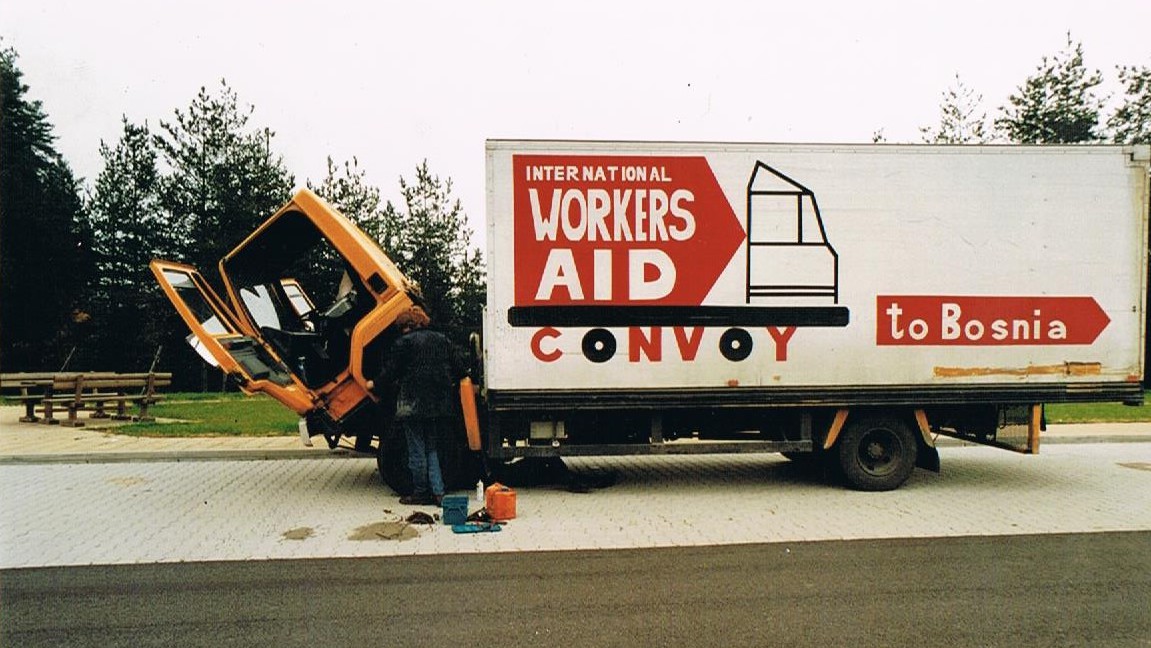
Workers' Aid lorries were all second hand!
Workers’ Aid lorries were all second hand!

This is reblogged with permission from People and Nature.

By Gabriel Levy

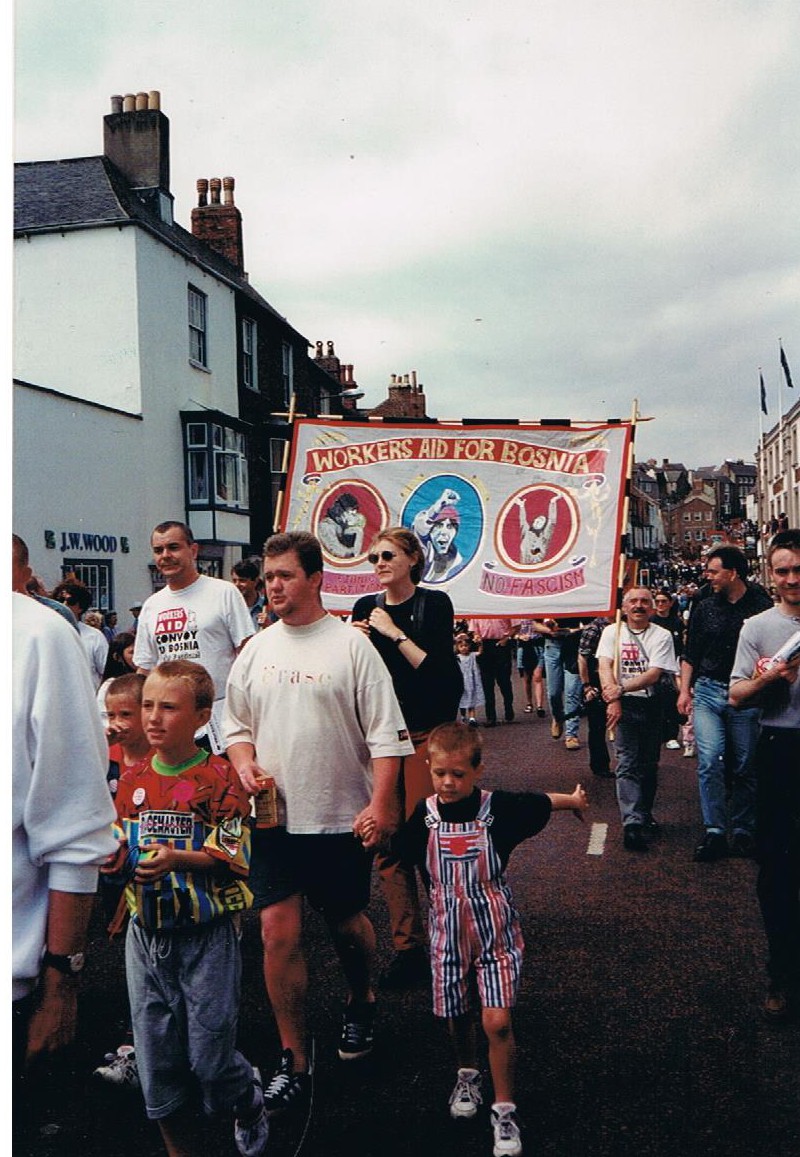
Workers' Aid marching with Bosnian refugees at the Durham Miners' Gala, 1995
Workers’ Aid marching with Bosnian refugees at the Durham Miners’ Gala, 1995
There is a fragile ceasefire in place in eastern Ukraine, but the devastation wrought by military conflict continues. Some Ukrainian socialists, disappointed by the weakness of the anti-militarist movement, have tried to find ways of delivering aid to communities in the east, and to refugees who have fled to other parts of Ukraine. Some have joined non-governmental organisations working on the ground; some have formed links with mining communities; others have launched an international campaign in defence of Alexander Kolchenko, the anarchist from Crimea facing trial in Russia on trumped-up “terrorism” charges.

In my view, these activists are taking forward the best traditions of the international working-class movement. One experience worth looking back to is that of Workers Aid for Bosnia, a group of labour movement activists, initially based in the UK, that in 1993 collected truck-loads of humanitarian aid and took them to the Bosnian mining town of Tuzla, which at that time was surrounded on three sides by the Serbian army.

Here is an interview with two of its organisers: JOHN DAVIES, a writer, actor and activist who lives in Liverpool and BOB MYERS, an activist based in Manchester.

Gabriel Levy: please explain how the Workers Aid convoys came about. Who proposed them, who acted on the proposal? What was the situation in Bosnia at the time, and how did the convoys impact on it?

John Davies: The Workers Aid convoys were organised in response to an appeal by a Serb socialist, Rade Pavlovic, who was appalled at the atrocities being carried out by the Serb nationalist/Stalinist leadership, and with the widespread support of the Serb intelligentsia.

Knowing of the way in which miners in former Yugoslavia had responded to an appeal for support from British miners during their great strike in 1984-85, Rade suggested reciprocal solidarity to the Bosnian miners. He also drew attention to the even older tradition of working class solidarity in Bosnia, going back to 1922, when Bosnian miners hid miners from Slovenia, Rumania and Hungary who were threatened with deportation for going on strike.

In Britain we started organising among the unions, the Muslim community, and on the streets.

We campaigned on the road, once we had purchased our first second-hand trucks, collecting at supermarkets, asking people to buy an extra item, and to make a donation for diesel. Because of the influence of the Communist Party, who saw Milosevic and his Greater Serbia fascists as somehow defending “socialist Yugoslavia”, support in the unions was patchy, particularly at leadership level. However, individual branches made donations and the campaign grew, and by the summer of 1993 there were campaigns in several European countries.

At the time multi-ethnic Bosnia looked a lost cause. Croat nationalists had attacked Bosnia in Hercegovina, and the internationally imposed arms embargo had left the newly formed BiH Army massively under resourced. Most of the Yugoslav People’s Army, with its largely Serb officers, had gone over to Serb nationalism. Western governments seemed quite happy with this, devising a series of “peace plans” predicated on the division of Bosnia along religious lines, and rewarding the ethnic cleansers.

The convoys had little effect on the political or military situation, at any stage of their development. However, they did allow us to challenge the prevailing misunderstandings about the situation, and some Bosnians have told us that even though the quantities of aid were tiny in the scale of the disaster, their effect on morale was very positive.

The campaign on the road in Britain, and I am sure elsewhere, also brought large numbers of young people into political activity, including hundreds of Bosnian refugees, who had until then found no other way to do anything.

Bob Myers: The war in Bosnia, in effect an attempted land grab to create a “greater Serbia” and a “greater Croatia”, was organised by the nationalist governments in those two countries. But they organised it at arm’s length, pretending it was an internal Bosnia civil war.

This lie was then reproduced by almost all western politicians and media – and the UN, who effectively said: “ah, the three Bosnian nationalities all want to kill each other, so the only solution is to separate them”. This portrayal of the situation left people around Europe confused about what to do. Their humanitarian instincts left them horrified by ethnic cleansing … but what could they do if people wanted to kill each other?

What Workers Aid did was to allow the voice of resistance to ethnic division from inside Bosnia to be heard outside. We began an activity which allowed people to take solidarity action in support of one side in the war – not an ethnic side, but the side of unity and working class solidarity which was unseen outside Bosnia.

Saturday, 8 August 2015

Now Putin steamrolls cheese


The threat to Russia from cheese is finally over, folks. On Thursday TV viewers watched live as tons of cheese and other banned products from the European Union were destroyed by steamrollers.

This surreal moment was too much even for many Russian TV viewers well used to surreal moments. A petition calling instead for the banned produce to be distributed to the needy went viral, prompting the spokesman for Putin, Dmitry Peskov, recently exposed as the owner of a fleet of outrageously expensive watches, to promise that the signatures would undergo "expert" checks.

Yet the outcry was genuine, not manufactured by the CIA or 'fifth columnists', as the BBC noted quoting editorials in Russia's normally pliant press.

The woman who started the petition, which had almost 300,000 signatures, Olga Saveleva told the BBC "if they start destroying food, what next? It's like our authorities don't care about the people."

She said that one pensioner had written to her saying "I can't eat, I can't buy this or that, so if you want to destroy produce, bring it to my home. I can eat it!"

From thebestofrussia.ru
"It is crazy, stupid, and mean," a Moscow priest, Aleksey Uminskiy, said. "This foodstuff could be distributed through charity groups who help people in need, the homeless, refugees, and the elderly."

Poverty in Russia is ticking upwards with more than 15% below the official poverty line (which is US $160 a month). Inflation is at least 16%, more for many common food items. Social and health spending has been simultaneously decreasing as the military and propaganda budgets go up and government revenue comes down because of the dramatic drop in the price of oil and the value of the ruble.

The state of Russia's government services was highlighted last week when it emerged that one pensioner had died and 18 were hospitalized from starvation in a prison masquerading as an old folks home.

Russia now has the highest level of wealth inequality in the world. However one sector of the economy is doing well. The builders of crematoriums are stepping up to meet the sudden demand to burn food.

At the same time that cheese is crushed and poverty is rising, Russia is moving to defend the elites money by spending billions compensating the rich for any loses from Western sanctions, possibly by using money intended to shore up Russia’s pension system. The pension fund has already been raided to fund the annexation of Crimea.

Russia banned food from the European Union, Canada, America and Australia last year in response to sanctions imposed after the invasion of Crimea. It believed that pressure from Europe's powerful farmers would get sanctions lifted but that has not happened and now the Kremlin is thinking about adding X-ray machines, defibrillators and condoms to a banned list which already includes medicines.

Meanwhile, Russian opposition politician and anti-corruption activist Alexey Navalny disclosed on his blog that Russian state agencies have continued to order banned products for their own needs.

Wrote Navalny:
They eat Dorblu cheese, dab their mouths with a napkin, and then turn to the camera and talk about how right it is to destroy European products.
The whole episode is surreal but also senseless as previously most ordinary Russians thought it was the West which had banned food exports to Russia. Now they know better. Here are two Russian 'opposition' journalists setting fire to cheese.


Aside from the mockery, after the highly public destruction the internet was flooded with pictures of poor Russians scavenging amongst the food dumps.


Yet Putin's approval ratings remain sky high. Writes William Echols:
Even when the authorities so brazenly flaunt their ill-gotten wealth, the Russian people still look West for the source of their social ills.  How long the Kremlin can keep up this shell game of misdirected blame is anyone’s guess.
Says the Russian commentator Andrey Piontkovsky (translated by Paul Goble):
Putin thinks he can get anything by intimidation, but he is no longer frightening anyone. And the economy of his country, “deprived of Western technology and credits will not be able to function normally” as the collapse of the ruble.

According to Piontkovsky, all this shows that “we are already at that stage of an authoritarian regime when it passes into a totalitarian one,” and “the fate of such regimes is,” he suggests, “a palace coup”  especially against a leader who has lost the mandate of heaven as shown by popular support.

Putin’s closest entourage, he continues, “understands that [Putin’s] policies not only threaten a national catastrophe but also (what is more important for them) hurts their personal interests for all of the people in the close circle of Putin are dollar billionaires who cannot exist without quite close, deep and friendly relations with the West.”

Now that the Russian people may be angry at Putin for what he is doing instead of remaining uncritically supportive, he suggests, may thus make the present moment or one very soon a time when those closest to the Kremlin leader will decide that it is time for him to go and for them to help him on his way out.

Friday, 7 August 2015

Free anti-fascist prisoner Alexander Kolchenko


Alexander Kolchenko is a left-wing social activist and antifascist who is being held in captivity by the Russian authorities. Along with renowned film director Oleg Sentsov, he was kidnapped by the Russian FSB (ex-KGB) and detained following the annexation of Ukraine’s Crimean peninsula,. He is held as a political hostage in Lefortovo jail in Moscow and has been charged with committing “acts of terrorism” and “belonging to a terrorist community”.

A call to action has been organised by the French 'Active Generation: The web activists network' and the International Solidarity Campaign For Alexander Kolchenko.

Only strong and massive pressure on the Putin regime, protests around the world would give a chance to set our comrades free. We demand their immediate discharge and the end of their prosecution.

Why is Alexander Kolchenko in jail?


Alexander, who has undeniably proved his antifascist stance over many years, is facing preposterous accusations of belonging to Right Sector, a radical Ukrainian right-wing organization, whose real role in Ukrainian events is blown out of proportion by Russian official propaganda. In modern Russia any activist — left-wing, anarchist or liberal — can be slandered as a member or sympathizer of Right Sector. This situation is comparable to the hunt for nonexistent 'Trotskyists' under Stalin, or the McCarthy witch-hunt for communists.

Putin’s authoritarian and nationalist regime, which uses in its propaganda everything from religious prejudices and conspiracy theories to outright racism, shamelessly steals “antifascist” rhetoric. And yet anyone who is considered bothersome is called a “fascist”, even if he/she stands on the opposite side of the political spectrum.

The case against antifascist Alexander Kolchenko and civil activist and film director Oleg Sentsov (investigators enrolled them into the same “terrorist” group) is political. It is meant to intimidate inhabitants of Crimea and prevent any resistance on the peninsula.

The most authoritarian of methods are now used in annexed Crimea to repress all discontent. Many people were obliged to leave Crimea because their life and freedom were threatened: lawyers, left-wing activists, students and trade union activists, anarchists, antifascists and Crimean Tatar activists who have fallen victims of ethnic discrimination.

Sentsov (left), Kolchenko (right)
What threats does Alexander Kolchenko face?

A terrible prison sentence of up to 20 years threatens Alexander for a non-existent “terrorist attack” in which he was not involved. Kolchenko and other Ukrainian political prisoners (such as the more famous Ukrainian pilot Nadezhda (Nadia) Savchenko) are detained only in order to demoralize opposition by show trials. Their freedom is directly linked to the stability of the Putin regime: if we can shake the confidence of Putin in his impunity, the prisoners will be set free.

  • There is no hope that Kolchenko, Sentsov and others will be judged fairly by the law. 
  • Their arrest was unlawful.
  • The charges against them are far-fetched.
  • It’s not a mistake, the regime knows what it’s doing.

Both men have refused to take part in their trial, which Sentsov called a "concert". He said at the opening of the trial:
Your Honour, I have already stated that I do not consider this court to be legitimate. We are citizens of Ukraine who were arrested on the territory of our country, and we are being tried on fabricated charges. I don’t, however, feel any animosity to you and other parties to this trial.

A lot of lies have already been spoken here and I therefore feel it necessary to clarify certain things, but I do not plan to later take part in these proceedings.

I consider myself a Maidan activist, but that does not mean that I am a criminal. Maidan was the main deed that I have carried out in my life, but that does not mean that I’m a radical, burned ‘Berkut’ riot police or drank anybody’s blood. We drove out our criminal President. When your country occupied Crimea, I returned there and engaged in the same volunteer work as on Maidan. I spoke with hundreds of people. We considered what to do next but I never called on anybody to carry out actions that could have led to deaths.  I did not create terrorist organizations, and I certainly had nothing to do with ‘Right Sector’.
Do they have support from NGOs?

The renowned Russian human rights organisation Memorial has condemned the trial and stated that it considers both men to be political prisoners. Amnesty International is also concerned.

Film director Sentsov has received support from the UK Culture Secretary John Whittingdale and widely within the film industry. Directors’ Fortnight at the Cannes Film Festival in May dedicated its opening event to Sentsov.

The main prosecution witness, Gennady Afanasyev, has confirmed that his ‘confession’ had been extracted through torture. The sole other witness, Oleksy Chirniy, told the Ukrainian consul and his lawyer that his testimony was given under duress. Kolchenko and Sentsov also say they were tortured. The Kharkiv Human Rights Protection Group has suggested that Afanasyev's retraction may mean that he is now in danger.

Kolchenko admits taking part in a failed firebombing of the office of the United Russia party. However, says Memorial, 'terrorism charges are "incommensurate both with the damage caused, and with standards of Russian practice."

Says Memorial:
We assume that Right Sector is being foisted on the indictment in order to create a primitive media image of a nationalist threat in Crimea.
Russian has imposed Russian citizenship on the pair and they are being prevented from seeing the Ukrainian consul and from being defended by a Ukrainian lawyer.


How can you help Alexander Kolchenko?

We’re asking international left-wing and libertarian forces for help. You can organize and lead actions of protest and solidarity, write letters to Kolchenko, send donations for lawyers and food parcels, help his family. It is also important to spread information about his case. Most of all, we need to dissociate ourselves from any forces that support aggressive expansion of Russian nationalism, even if they cover it up with 'leftist' and 'anti-imperialist' rhetoric. Putin’s regime is doing just fine without your sympathy, better save it for those who have become its victims.

When to start?


You can start right now by helping us to spread this text, translating it into other languages and sending it to comrades. We also strongly encourage you to organize demonstrations in support of Alexander Kolchenko and other political prisoners jailed in Russia.

Only strong and massive pressure on the Putin regime, protests around the world would give a chance to set our comrades free. We demand their immediate discharge and the end of their prosecution.


For case updates check the Kharkiv Human Rights Protection Group website.

This text has been adapted from The Ukraine Solidarity Campaign.

Edited to add: As the trial opened in a tiny courtroom in Rostov Sentsov made the following powerful statement:

Thursday, 6 August 2015

Boycott McDonalds: “it’s run by Jews”

Xpost from Little Green Footballs
 
No, London is not a hotbed of jihadists (neither is Birmingham, thank you very much Fox News). Yes, it has its fair share of rubbish jihadists. Witness:


When one of our activists at the Israel Advocacy Movement went undercover at a BDS protest of McDonald’s in Shadwell, London. The activists admitted they were not boycotting Israeli businesses - but all Jewish businesses.

On extremism, jihadism and counter-jihadism


Reblogged with permission from BobFromBrockley.

======

This post is prompted by David Cameron’s recent speech setting out a new agenda on addressing the threat of Islamist violent extremism, and also by the recent launch of a whole series of “counter-jihadi” initiatives on the British right, including the planning of a Mohammed cartoon exhibition in London in September. The latter has been the subject of a report by the anti-fascist group Hope Not Hate (HnH). My friend Sarah made some sympathetic criticisms of that report at Harry’s Place, for which she got some sharp criticism on Twitter. This whole topic is one which frequently inflames irrational passions and generates more heat than light. This post, therefore, is an attempt to set out a series of propositions on these issues as an attempt to cut through some of the hysteria.  I didn’t mean for it to get so long!

“Extremism” is not a helpful framing of the problem
 
Cameron frames his approach to Islamism in terms of the wider generic problem of “extremism”, noting that Islamism is just one of many forms of “extremism”, along with that of the far right. Cameron is right to note that other ideologies constitute a threat, and there are certain similarities between the Islamist far right and the British nationalist far right. However, the term “extremism” creates more confusion than it solves, especially when the border between extremism and terrorism is blurred, as it was in Cameron’s speech, and in fact can do damage.

The idea of “extremism” implicitly contrasts these ideologies to the “normal”, acceptable politics of the centre ground, of the mainstream status quo. The concept of “extremism” criminalises the desire for change. It stops us from looking carefully and critically at the ideologies caught in its remit – which closes down debate, imagination and criticism, and stops us from engaging “extremist” ideologies and challenging them politically. The concept of “extremism” can make minor, marginal ideologies seem more dangerous than they often are – and therefore can sometimes make them seem glamourous and exciting. 
 
We know from history that the rubric of “extremism” is most often used against the left. In recent decades, for example, we have seen huge amount of resources put into the policing and surveillance of left-wing politics, with undercover police officers inserted into ecological, anti-fascist and anti-racist movements, sowing havoc and ruining lives. Anti-capitalist groups like Occupy are lumped together with al-Qaeda and the IRA in the category of “domestic extremism”. The language of the guidance on extremism given to universities effectively means that not just jihadism but also anarchism should be excluded from such institutions. We have seen the infiltration and disruption of the campaigns led by the families of victims of racist violence, such as Stephen Lawrence’s; collusion in the blacklisting of union activists; and acts of provocation to push non-violent activists into criminal activity.

Cameron is wrong to think that extremism in general is a conveyer belt to violent extremism and terror
 
Cameron claims that “many [terrorists] were first influenced by what some would call non-violent extremists”; Islamism, he says, “has often sucked people in from non-violence to violence”. This is true, as far is at goes, but it is also true that most followers of “non-violent” extremism do not get “sucked” to jihadist violence, just as most anti-immigrant racists and casual antisemites do not get “sucked” to violent fascism. Not making that clear is problematic. 
 
The evidence-based blogger Anonymous Mugwump has collated all of the research showing very conclusively that there is no necessary or straightforward step from extremism to violent extremism, no single pathway from Islamism to terrorism; his case is pretty conclusive. 
 
(Cameron’s mistaken emphasis on this connection is probably due to the emphasis on the government’s thinking of the thinktank Quilliam, who have long argued, with little evidential basis, that extremism in general leads to violent extremism in particular – although their position,  as Amjad Khan argues here, is more subtle than Cameron’s: non-violent extremism, they say, provides the “mood music” for terrorism.)
 
As Anonymous Mugwump notes, there may well be good reasons to oppose some forms of non-violent extremism – but its connection to terrorism is not one of them. The category of non-violent extremism is basically a form of “pre-crime” or thought crime; making it into a security issue is dangerous because it criminalises beliefs that are not in fact criminally dangerous; it is a licence for authoritarian over-policing, for policing without the consent of communities. As I will argue more fully below, while terrorism is a policing issue, non-violent Islamism is a political issue, which should be challenged politically, by all of us – citizens, communities – and not from above by the state. 
 
Cameron is broadly right to highlight ideology over “root causes”

Wednesday, 5 August 2015

Putin, the war in Ukraine, 
and the far right


This is reblogged from Ukraine Solidarity Campaign

One note. The comment about the French socialist leader Jean-Luc Mélenchon at the end have been confirmed as true by someone who would know, the British socialist and Francophile Andrew Coates.

=======

Jean Batou is a member of the leadership of SolidaritéS S – an anticapitalist, feminist and ecologist movement for 21st century socialism – in Switzerland, he is professor of Contemporary International History at the University of Lausanne and the author of many books and articles on the history of globalization and social movements. An earlier and shorter version of this article was published in Spanish by Viento Sur. This has been republished from New Politics in the USA, an independent socialist journal.

Past and present imperialisms: Putin, the War in Ukraine, 
and the Far Right


Putin’s Russia is an imperialist state dominated by a capitalist oligarchy that controls the state and that has developed a bellicose attitude toward its neighbors, whom the oligarchy reproaches for having taken advantage of the collapse of the Soviet Union in order to escape its century-long tutelage. Embracing an ultra-nationalist ideology that gives a good deal of space to racism, anti-Semitism, and homophobia, its authoritarian neoconservatism has become a veritable standard for the European extreme right. For those of us dedicated to fighting Western imperialism, be it American or European, an understanding of the Russian state’s imperial nature, of its expansionist tendencies, and of the real nature of its contest with the West is essential.

In Eastern Europe, the Russian Federation is supported by important sectors of the extreme right such as Attack, in Bulgaria; the National Party, in Slovakia; Jobbik, in Hungary; the National Democratic Party, in Germany; the National Front, in France; the Freedom Party of Austria; the Northern League and the New Force, in Italy; the Flemish Interest Party, in Belgium; and so on.1 On March 22, 2015, at the Holiday Inn in Saint Petersburg, the Russia Patriot Party organized an International Conservative Forum involving a large number of these movements, with participation from Eastern Ukraine military leaders linked to fascist groups. That network will strengthen the connection among European nationalists who support the Russian Federation’s foreign policy against Brussels and Washington.

Which Russian Imperialism?

Some people nostalgic for the post-Stalinist Soviet Union close their eyes to this reality, forgetting that the denunciation of Russian imperialism was always at the heart of Lenin’s thought and action. Did he not advocate the defeat of Russia in 1914? On December 12 of that year, Lenin wrote,

The Great Russians cannot “defend the fatherland” except by desiring the defeat of Czarism in any war, this as the lesser evil for nine-tenths of the inhabitants of Great Russia. For Czarism not only oppresses those nine-tenths economically and politically, but also demoralizes, degrades, dishonors, and prostitutes them by teaching them to oppress other nations and to cover up this shame with hypocritical and quasi-patriotic phrases.2

Replace the word “Czarism” with “oligarchy” and Lenin’s judgment remains completely true today.

Russia is a unique imperialist power because as it colonized the non-Russian people of its empire, at the same time it brutally repressed and virtually enslaved the mass of Russian and non-Russian peasants inside Russia, generally from the seventeenth century onward, a process that resembled those perpetrated by the European powers in their far-flung colonies. With the emergence of capitalist imperialism in the last third of the nineteenth century, Russia sought to compensate for the relative weakness of its economic and financial monopolies by the exclusive military control of a vast territory and, as Lenin suggested in 1916, by “special facilities for robbing minority nationalities.”3 In this way Russia could try to play in the big leagues, as a junior partner of France and England. Not understanding this, some Marxists refer to Lenin in order to call into doubt the imperialist nature of today’s Russia, pointing out the relative weakness of its finance capital sector. But this only shows that they do not understand Lenin’s characterization of Russian imperialism before 1917.

Great Russian Chauvinism and Soviet Russia

Monday, 3 August 2015

Corbyn and Ukraine: it's not pretty


Last week a story emerged from Eastern Ukraine that sent chills. Journalist Maxim Tucker wrote that there were very real fears that the 'rebels' were building a 'dirty bomb'.

With the help of Russians, nuclear scientists supposedly, a repository of radioactive waste had been opened and there was 'chatter' about why. This, Tucker explains in this BBC interview, could mean that they were interested in building a psychological weapon, a fear weapon.

This would hardly be the first time that concern has surrounded the remains of the Soviet atomic programme - Barack Obama zeroed in on it as a priority years ago. Only last December seven men were arrested in Moldova suspected of smuggling nuclear material from Russia.

A nuclear fog hangs over the whole situation with Ukraine, Russia and the West

In March Russia's Ambassador to Denmark threatened that country with Russian nuclear weapons if it joined NATO's missile defence system. Putin himself said in April that he put Russia's nuclear arsenal on standby when he believed 'the life of ex-Ukrainian leader Viktor Yanukovych had been in danger'. And in April his Foreign Ministry accused the Ukrainian government themselves of building a dirty bomb.

Last month Andrei V. Kozyrev, a former Russian foreign minister, wrote in the New York Times that "things may even come to nuclear blackmail, as has been hinted." There are a number of scenarios being played out, not in the fevered imaginations of the mentally disturbed but by serious experts, which include a Russian atomic bomb going off.

The context for all this is a supposed threat to Russia. According to reports from Moscow the fever in which much of the Russian public seriously believe that the United States and the 'gay' Europeans are going to invade is not confined to the lumpen, the vatniks, but infects the Gucci loving, London mansion owning elites and the siloviki, the spooks and former spooks who run Russia.

When crowds mass in Armenia to protest a hike in electricity prices it is Americans doing down Russia in its 'sphere of influence'. When the people of Macedonia rose up against corrupt and authoritarian leaders they could not be doing it themselves they had to be paid by the CIA (or possibly on drugs).

Most famously, of course, the people of Ukraine - right and left wing - did not overthrow one of the most corrupt regimes in the world using their own agency. Oh no, it was all plotted from Langley (read Jim Kovpak's fabulous satirical takedown of this notion).

This fog, this miasma, in which serious people as well as idiots dream of men and women gathering in smoke-free bunkers in Whitehall and Brussels and DC (quite possibly sitting next to the luxury homes of Russian politicians whose corruption they happily tolerate) to plot against Russia has now reached the mainstream of Western politics.


Source: Atlas of Prejudice
Jeremy, Jeremy, Jeremy

It has infected both the mainstream French right and the French socialist left, and the Socialist German left.

And the possible leader of Britain's Labour Party, Jeremy Corbyn, has the fever too.

This is why a long standing supporter of CND, the Campaign for Nuclear Disarmament, can see the nuclear sabre rattling (alongside the talk of 'colour revolutions' threatening Russian interests, of Russia being 'surrounded') as rational, as "provoked".

Using the classic Soviet propaganda technique of 'projection' - creating confusion by accusing someone of doing exactly what you are doing - Corbyn can claim that:
The obsession with cold war politics that exercises the Nato and EU leaderships is fuelling the crisis and underlines the case for a whole new approach to foreign policy.
Leaning, as Russian propagandists and Kremlin trolls do, on a particular reading of history Corbyn can note that "Ukraine’s national borders have ebbed and flowed with the tides of history" and unwittingly echo Igor Strelkov, the FSB colonel and former Donetsk People’s Republic (DPR) 'Minister of Defense', who told Der Spiegel:
Kiev is a Russian city. I want a new Russian domination, which is historically justified. The Ukraine has been and remains a part of Russia. My dream is that Russia re-establishes its natural borders as they were in 1939.
Corbyn can claim that "Ukrainian politics are divided between Ukrainian and Russian-speaking people", which is simply not the case as anyone who visits Kyiv could tell him as the language spoken there is Russian. This plays into the Kremlin myth, and the reason given for invading Crimea, of Russian speakers being oppressed. He can repeat Kremlin memes that a glorious future awaits as Russia can form an alliance with China, a "Russia-China bloc", and screw the Americans (rather than the reality of Russia being forced to accept bad terms because it has no other choice).

He can claim that Ukraine has "been put under enormous pressure to come into the EU and NATO military orbit" when the NATO Membership Action Plan (MAP) was refused by the West in 2008. Immediately after the Maidan the new government said it did not want to join NATO, it was only last October after the Russian invasion that Ukraine said it wanted to join and non-aligned status was only revoked at the end of last year.

Why did Ukraine do that? Because non-alignment had "proved to be ineffective in guaranteeing Ukraine's security and protecting the country from external aggression and pressure." This is the same reason that Baltic states joined NATO as soon as they could - because they knew Russia was a threat, because Russia had repeatedly demonstrated that it was a threat, not because they had 'pressure' put on them or because of some "attempt to encircle Russia" or an "ambition of NATO expansion further eastwards", let alone for "more NATO or US-run bases in the region" (there are no NATO bases).

Russian imperialism - not mythical 'pressure' - is the reason why a majority in Ukraine now want to join NATO and it is also the reason why a majority of the public in  Sweden  also now support NATO membership. Even in Finland support for NATO membership is going up.

He also believes that some sort of deal was made after the Soviet Union collapsed that NATO would not 'expand eastwards'. This is not true, there is no evidence of any promises or whispers or anything else. It is an urban myth reminiscent of another one confidently repeated by, amongst others, Putin, that former U.S. Secretary of State Madeleine Albright once said that Siberia's vast natural resources were too important to the world for Russia to unfairly control on its own. Sounds about right to you? Well the source is not some FSB secret recording but a mind reading project. Yes, Russian spooks read Albright's mind and now Putin mouths the results.

I would throw in a jibe at this point about Corbyn believing that water 'retains a memory' but, to be fair, he is hardly the only one.

Friday, 31 July 2015

Racist @Redbull Obama event in Russia


Racism against black people in Russia has been making news lately because of the 2018 World Cup.

The Guardian reports about worries concerning the reception non-white players and supporters could receive in Russia.
A recent report by the Fare network and the Moscow-based Sova Centre for information and analysis has documented 99 racist and far-right displays and 21 racially motivated attacks by Russian football fans during the 2012-13 and 2013-14 seasons.
“The likelihood of a racist incident [during World Cup 2018] is very high. It’s not just that it might happen but that it happens very often,” said the Sova Centre director, Alexander Verkhovsky, at a panel of Russian and foreign football observers last month to discuss discrimination in Russian football.

Racism in the Russian stands has already drawn the ire of international and Russian authorities in recent months.
Ghanaian news site Starr FM says African concerns are so high they could spark a boycott:
Unlikely occurrence, you think?

Well, think again. It really wouldn't be the first time the Dark Continent would have turned its back on the sport's greatest event. Sixteen African nations boycotted the 1966 edition in protest of a 1964 FIFA ruling that required the three second-round winners from the African zone to enter a play-off round against the winners of the Asian zone in order to win a place at the finals, with the Africans asserting that winning their zone was enough in itself to merit qualification for the finals.
Piara Powar, the executive director of the Football Against Racism in Europe and a member of FIFA's anti-discrimination taskforce, has also said a boycott is a possibility, "and without them there will not be a World Cup in Russia."

Starr FM points out that there are other black players who could boycott outside Africa, in the Americas and in Europe.

Prior to the European football Championships in Ukraine and Poland in 2012 there were very similar concerns about racism. The BBC aired a documentary just before the event which led to calls for fans to stay away.

However the Championships went ahead without any significant incidents. Russia is presumably hoping that it can pull off the same trick, they are talking the talk and have been for a while now. But an incident this week has underlined just how much the international limelight may not shine kindly unless they get serious about racism.

The energy drink Redbull sponsors a 'Flugtag' around the world, including in Russia. It involves groups in costume jumping from height with a contraption over water trying to fly. It's a lot of fun.

But in Russia one of those groups (pictured above) involved a group in blackface with one in an Obama mask chasing a banana. Classic, 'blacks are monkeys' hideous racism that happens all around the world.

Here's a street sign in Lysva, in the Urals from July 2014.(via ).


Here's the picture that Irina Rodnina, an MP from Vladimir Putin's United Russia party and a triple Olympic champion figure-skater, posted on Twitter. (She later apologised.)


Last August Moscow police allowed students to project a laser light show depicting Obama fellating an unpeeled banana onto the US Embassy. This sort of imagery is 'normal' and officially allowed, despite Russia have plenty of laws covering racism and 'extremism', so why should the geniuses at Redbull in Russia think twice when they dreamt up a 'Obama Banana' group?

But Redbull is an international brand so what happens in Russia does not stay in Russia. Tell @redbull what you think!

Edited to add: The video has been removed from the Redbull website but a GIF was captured by Nikolay Nikolov.

Edited to add: The Guardian says:
Vadim Shevchenko, a spokesman for Red Bull, denied that the footage was meant to be racist and said the banana chase had not been planned.
Reporter Alec Luhn also notes something I'd forgotten:
Photoshopped memes showing Obama with bananas and calling the US president a monkey have appeared frequently on the Russian internet, including on a site of images often used by paid pro-Kremlin trolls.

Edited to add: Red Bull has now given this statement given to TIME:
The organizers of the Red Bull Flugtag in Russia regret our oversight in allowing these participants to tarnish what was otherwise an enjoyable event. It is never our intention to give a platform which would promote an offensive message. For the future, we will take more effective measures to prevent this sort of thing happening again.
Edited to add: This is what happened to one guy who tried to publicise Redbull's actions in Russia. The company issued a copyright claim to Youtube and as a result he got banned until 2016!


HT: ,