
 |
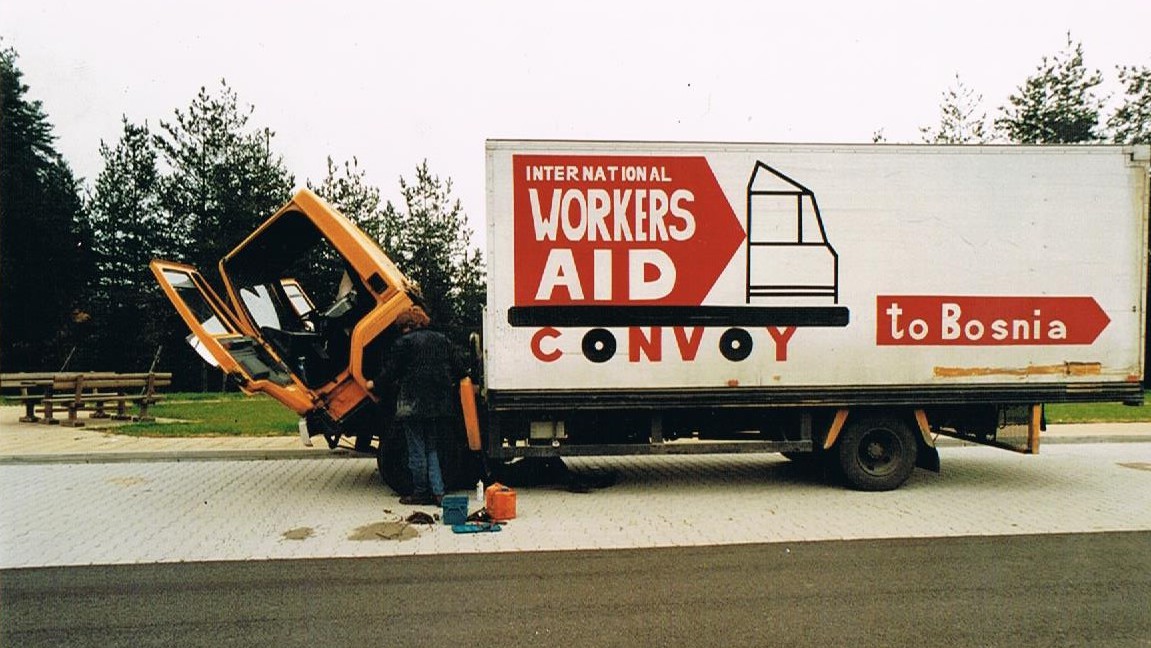
| Workers’ Aid lorries were all second hand! |
This is reblogged with permission from People and Nature.
By Gabriel Levy
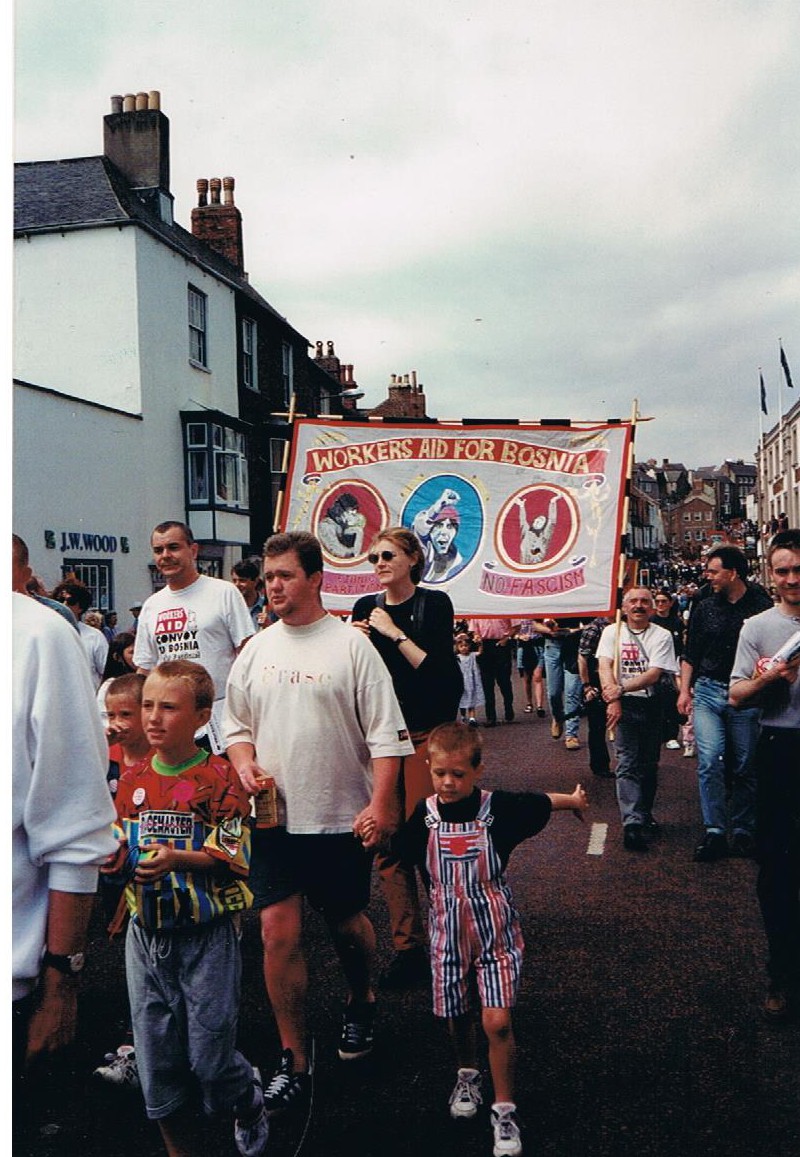 |
| Workers’ Aid marching with Bosnian refugees at the Durham Miners’ Gala, 1995 |
In my view, these activists are taking forward the best traditions of the international working-class movement. One experience worth looking back to is that of Workers Aid for Bosnia, a group of labour movement activists, initially based in the UK, that in 1993 collected truck-loads of humanitarian aid and took them to the Bosnian mining town of Tuzla, which at that time was surrounded on three sides by the Serbian army.
Here is an interview with two of its organisers: JOHN DAVIES, a writer, actor and activist who lives in Liverpool and BOB MYERS, an activist based in Manchester.
Gabriel Levy: please explain how the Workers Aid convoys came about. Who proposed them, who acted on the proposal? What was the situation in Bosnia at the time, and how did the convoys impact on it?
John Davies: The Workers Aid convoys were organised in response to an appeal by a Serb socialist, Rade Pavlovic, who was appalled at the atrocities being carried out by the Serb nationalist/Stalinist leadership, and with the widespread support of the Serb intelligentsia.
Knowing of the way in which miners in former Yugoslavia had responded to an appeal for support from British miners during their great strike in 1984-85, Rade suggested reciprocal solidarity to the Bosnian miners. He also drew attention to the even older tradition of working class solidarity in Bosnia, going back to 1922, when Bosnian miners hid miners from Slovenia, Rumania and Hungary who were threatened with deportation for going on strike.
In Britain we started organising among the unions, the Muslim community, and on the streets.
We campaigned on the road, once we had purchased our first second-hand trucks, collecting at supermarkets, asking people to buy an extra item, and to make a donation for diesel. Because of the influence of the Communist Party, who saw Milosevic and his Greater Serbia fascists as somehow defending “socialist Yugoslavia”, support in the unions was patchy, particularly at leadership level. However, individual branches made donations and the campaign grew, and by the summer of 1993 there were campaigns in several European countries.
At the time multi-ethnic Bosnia looked a lost cause. Croat nationalists had attacked Bosnia in Hercegovina, and the internationally imposed arms embargo had left the newly formed BiH Army massively under resourced. Most of the Yugoslav People’s Army, with its largely Serb officers, had gone over to Serb nationalism. Western governments seemed quite happy with this, devising a series of “peace plans” predicated on the division of Bosnia along religious lines, and rewarding the ethnic cleansers.
The convoys had little effect on the political or military situation, at any stage of their development. However, they did allow us to challenge the prevailing misunderstandings about the situation, and some Bosnians have told us that even though the quantities of aid were tiny in the scale of the disaster, their effect on morale was very positive.
The campaign on the road in Britain, and I am sure elsewhere, also brought large numbers of young people into political activity, including hundreds of Bosnian refugees, who had until then found no other way to do anything.
Bob Myers: The war in Bosnia, in effect an attempted land grab to create a “greater Serbia” and a “greater Croatia”, was organised by the nationalist governments in those two countries. But they organised it at arm’s length, pretending it was an internal Bosnia civil war.
This lie was then reproduced by almost all western politicians and media – and the UN, who effectively said: “ah, the three Bosnian nationalities all want to kill each other, so the only solution is to separate them”. This portrayal of the situation left people around Europe confused about what to do. Their humanitarian instincts left them horrified by ethnic cleansing … but what could they do if people wanted to kill each other?
What Workers Aid did was to allow the voice of resistance to ethnic division from inside Bosnia to be heard outside. We began an activity which allowed people to take solidarity action in support of one side in the war – not an ethnic side, but the side of unity and working class solidarity which was unseen outside Bosnia.
