
 |
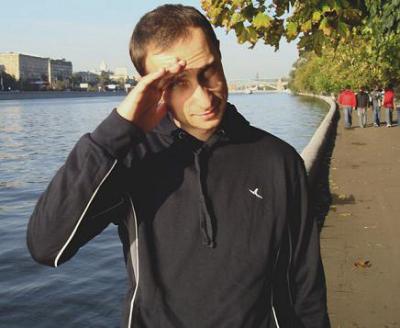
| Dmitry Buchenkov. CC avtonom.org. |
Reblogged with permission.
====
By Dmitry Okrest.
At the beginning of December, Dmitry Buchenkov became the latest person in Russia’s ‘Bolotnaya Case’, a series of investigations and trials into Russia’s opposition now in its fourth year.
Buchenkov, a 36-year old history lecturer at a Moscow medical university, is the 31st defendant in Bolotnaya. More than two hundred people were detained in the initial case, which stretches back to the ‘March of the Millions’, an opposition demonstration on the eponymous square in May 2012. The protest was timed to coincide with the inauguration of Vladimir Putin’s third presidential term, and this didn’t go unnoticed. During the sanctioned demonstration, the police cut off the square, in effect ‘kettling’ the protesters. Scuffles started between police and protesters, and a pitched battle of sorts began before the crowd was violently dispersed.
The prosecutions made against protest leaders, and allegations of geopolitical conspiracy, have come to symbolise the Kremlin’s response to the ‘Russian winter’ of 2011-2012. Despite the extent of the investigation and trial, Bolotnaya is yet to receive attention inside, or outside Russia. Journalists and activists are less and less interested. Only the police are still following it in numbers.
Yet the payback for Bolotnaya continues. On 22 December, Ivan Nepomnyashchikh, an engineer from the Moscow region, received a two and a half year prison sentence for participating in ‘mass disorder’, the charge against the majority of Bolotnaya defendants. By the time Buchenkov was arrested in early December, the first defendants from 2012-2014 were already on their way out of prison.
Dmitry Buchenkov will now face trial for turning over a chemical toilet on 6 May 2012. The prosecution’s main evidence is a photograph of a 30-year old man on Bolotnaya who looks nothing like Buchenkov.
Costly convictions
‘Buchenkov was an active member of the left-wing movement behind Autonomous Action, a large organisation of libertarian communists, which had dozens of groups in Belarus, Russia and Ukraine before it split,’ Aleksandr, a young anti-fascist, tells me. ‘Unlike most of the young anarchists who were detained during the march, Buchenkov's name was comparatively well-known’, he added.
‘Power exists and shall continue to do so for as long as human societies exist,’ notes Buchenkov in a letter to me. ‘The task of libertarian communism is not to destroy power, instead we should organise it in the form of self-government, on a socialist basis. The political task of anarcho-communism is to organise power in non-governmental forms.’
Indeed, Buchenkov’s arrest is another instance of the Russian authorities’ focus on anarchists and anti-fascists. Buchenkov now joins fellow members of Autonomous Action in jail—Aleksei Gaskarov, sentenced as part of Bolotnaya, and Aleksei Sutuga, who was charged with fighting against neo-Nazis in September 2014. For the past six months, Sutuga has been denied correspondence and held in solitary confinement.
Buchenkov’s investigator Aleksei Dobarin has form in this area. Dobarin has previously worked on the Bolotnaya case, investigating Vladimir Akimenkov and Leonid Rukavishnikov, activists from the far left Russian organisation Left Front (and who have condemned Russia’s actions in south-east Ukraine). Prior to Bolotnaya, Dobarin worked in the Kaluga region, some 70 km from Moscow, where he investigated nationalist and neo-Nazi groups.
As Aleksandr, the young anti-fascist, tells me, in the three years he’s known Buchenkov, the latest figure in Bolotnaya has had several encounters with the security services. Police officials would greet him at demonstrations, and he was threatened after starting a social club; once he was beaten to the point of losing consciousness.
But Buchenkov remained active. Forced to leave his work in a Nizhny Novgorod university, he moved to Moscow in 2009. Following Russia's 2015 economic crisis and multiple economic sanctions after the annexation of Crimea, he decided to publish a free newspaper, which he handed out to people coming to the Russian capital looking for work from the regions.
Despite the general fatigue of Russia’s civil society, Buchenkov’s case has attracted its attention—the defendant’s lawyer Svetlana Sidorkina is yet to gain access to the case. Instead, at the first hearing, Buchenkov was represented by a legal aid lawyer appointed by the Interior Ministry, who had previously worked as a police investigator in Siberia. More than 70 legal professionals have since signed an open letter questioning this behaviour.
Yet Buchenkov has few chances for solidarity from like-minded people in Europe. Following Maidan and the war in Ukraine, the European left has split once again.
Who are your comrades now?
The active participation of the far right in EuroMaidan, the war in Ukraine and annexation of Crimea has brought disarray to the left in Europe. Most were confused as to what position to take. After EuroMaidan, Kyiv was seen as ripe for revolutionary change. For others Russia—which opposed these changes—was an opponent of a unipolar world and thus an example to follow.
Russia’s alternative banner, as heralded by Russia Today, remains out of sight for Russian citizens themselves. The majority of programmes on the emancipatory potential of the Kurdish women’s movement or Julian Assange’s interview with the leader of Hezbollah aren’t accessible to Russian audiences. Only a few programmes come with Russian subtitles.
RT’s ‘western’ pull is effective. Last year, I interviewed Vicenzo Bellantoni, secretary of Italy’s Communist Refoundation Party, which had organised a series of lectures and concerts across Europe in support of the ‘Donetsk People’s Republic’ (DNR).
As Bellantoni saw it, the DNR was involved in a ‘mass anti-fascist struggle against an illegal fascist and reactionary government, which had come to power as a result of an armed coup. All communist movements are united in the people’s struggle, and we intend to resist this reactionary coup. We rely on many websites for our convictions: the sites of the Russian and Ukrainian communist parties, Russia-1 and Russia Today.’
‘There’s an idea in the west that there’s an alternative to the US-Brussels consensus,’ says Ilya Budraitskis, who coordinates the Russian socialist movement. ‘People have an intuitive need to replicate the familiar contours of the Cold War, where there’s two centres of power, each of which represents certain values.
‘The Soviet Union, and now Russia, is associated with social justice and national emancipation. We can choose which side in this global confrontation with which to associate ourselves. The mistake of many on the left is that, as they see it, Russia is far from the continuation of the Soviet Union.’
Short memories
For those who miss the USSR, the now disintegrated country is valued for its power and position in the world, as well as certain social welfare guarantees. Russia’s anti-fascist rhetoric and anti-American message have brought much in the way of support from some on the European left, who have chosen to support Moscow despite its violation of labour legislation, low wages and everyday xenophobia.
Buchenkov himself once declared that workers in authoritarian post-Soviet states now found themselves in semi-feudal relationships with employers. The political elite, he continued, had usurped state property while the opposition was weak. It could offer nothing but renewed religious conservatism or the fulfillment of neoliberal demands, concluded Buchenkov.
Indeed, as Budraitsksis sees it, ‘Contemporary Russia cannot present a single idea that could be mobilised elsewhere. It presents no alternative to the model of global capitalism emerging from Brussels or Washington. Yet either from inertia or a lack of memory, the politics of Moscow is seen precisely in this mold.’
Dmitry Buchenkov considers himself to be a leftist, but he comes from that minority of Russian left-wingers that view the Soviet experience and what came to replace it in a critical light. Unfortunately, the arrest of a left-wing activist in a country, which, according to tradition, is a staging ground for resisting American imperialism, is yet to garner a reaction.
A case in point is that of Aleksandr Kolchenko, the Crimean student and anarchist activist arrested last year for an arson attack on the office of a pro-Russian organisation. There was precious little solidarity from European countries, at least not in comparison to the murder of antifascist activists by neo-Nazis in the late 2000s.
Russia’s Anarchist Black Cross, an organisation set up to support political prisoners, notes that European activists are not only less interested in news of arrests, they’re giving less in terms of donations. Aleksandr, who is coordinating help for Buchenkov inside prison, also notes that attention from western NGOs is decreasing.
Instead, some on the European left are busy supporting the unrecognised republics in south-east Ukraine with music festivals, lectures and cinema clubs, comparing the conflict to the Spanish Civil War. Many more make clever remarks about Kyiv’s neoliberal path, while ignoring the fact that Moscow is travelling the same road.
‘You have to take everything that happens in life philosophically,’ writes Buchenkov from jail. ‘The people in prison are also people, our fellow countrymen, many people from former Soviet republics. It’s a slice of society, with all its problems and shortcomings.
‘I can only imagine why I’ve been arrested, but I believe that my imprisonment is connected to my political convictions. I didn’t exclude the possibility of persecution for my beliefs. I am outraged that I’m being persecuted for actions for which I am not responsible. I wasn’t even at Bolotnaya.’
Edited to add: In the UK the comrades from Italy mentioned by Okrest are matched by the (misnamed) group Solidarity with the Anti-fascist Resistance in Ukraine (SARU). That group is backed by Stop The War Coalition (STWC) leaders Andrew Murray and Lindsey German and the STWC website has promoted the group, as well as run numerous articles chiming with its politics. This has led to the extraordinary outcome of SARU backing smears against the National Union of Mineworkers for their solidarity work with Ukranian comrades. SARU are not marginal, they have almost 5,000 likes on Facebook.
See also:
- When Stop The War directs kids to war, and other t...
- Deselect Stop The War Coalition
- On Ukraine's UKIP-like Communist Party
- A short history of anarchism in Ukraine
- A Russian left take on the Russian economic crisis


