Now posts ↓

Saturday, 24 March 2007

Channel Four's interactive deadend

Watched Davina McCall's piercing look at the UK's abysmal Sex Education in schools on Friday. (Apparently the right-wing press had been creating "Outrage as Ch4 show gives condom lesson to youngsters." all the last week, passed me by ... )

It particularly seemed aimed at parents and involved parents. It was quite a grown up show, though if I see another 'mother' balking at even the bare acknowledgement that some people are gay ... Davina did at the one mention in the whole hour, literally six year olds (in sensible Holland) being asked 'and what do you call a man who loves another man?' in a lesson about LOVE... she reminded me of mothers interviewed in leafy Richmond who didn't want their kids readng
'Spacegirl Pukes' - an adventure for young astronauts

When nausea grips intrepid Spacegirl on the day of a mission to the stars she is lucky to have two mummies to help her out, but soon - yes - everyone is going "Bleurgh!"
Sounds offensive doesn't it?

Anyway, the final shot was her yelling into the camera right at us 'AND WHAT DO YOU THINK?' Now you'd expect something to flash up afterwards, however given the bad press around pound-a-minute phone lines, it'd be the website?

Wrong. There was no specific link to anywhere to 'TELL US WHAT YOU THINK'. On Channel Four's website, below the big picture advertising the teen sex-fest Skins, was the link through to 'Lets Talk Sex' and here we have the options under the heading DO SOMETHING

  • The Sex Test
    the same 200 questions Davina did (did you know sperm hangs around in the vagina for five days? or that sperm travels at 28 mph?). I got 30/45 when you're told by them if you get less than 35 you're ignorant. But there were two duplicates and some of the questions don't exactly seem like one's vital for anyone to know about.
  • Have your say
    "The debate on this site is now closed"
    "Why not write to your MP and tell them your views."
  • Polls
    Tell us what you think by voting in our polls.
    Should sex education be compulsory in the UK for all pupils regardless of their parents' wishes? Vote now.
    At what age should sex and relationships education begin at school? Vote now.
There is a 'Resource aimed at all those involved in delivering sex education (Word 185Kb)' and many links but it's not exactly Jamie Oliver, is it? It all ends up at 'Write to your MP'? If I was a parent wanting a lead as to how to get things changed I'd feel a little lost after Davina's in-my-face exhortation?

Real Estate Bubble Map wiki


"The goal of this experimental wiki is to protect homebuyers from overpaying in overvalued housing markets across the United States. Citizen journalists, particularly homebuyers turned embedded real estate reporters and buyer agents, are invited to add newspaper articles, favorite blog posts, and most importantly examples of falling prices to document what is really going on behind housing statistics, like median sales prices, that may understate changes occurring in local housing markets (see partial list of cities in sidebar)."
Real Estate Bubble Map wiki
created using the new tool Platial.

Miliband's pique in fits

A journalist friend of mine has been exchanging comment off-blog with me after my post Matthew Taylor is an ignoramus. A point he's made is that politicians and their ilk just aren't suited to actual interactivity. Today's post by GuidoFawks does suggest this is true!

Miliblogger Sulking, De-linking

Miliband has, in an incredibly revealing fit of pique, now removed his link to this blog from his blog-roll, (he only added Guido to his blog-roll a month ago for some blogospheric street cred). This follows the New Statesman recently removing their blog link last month after Guido criticised them for not covering the Smith Institute scandal, despite them sharing an office with the Sith. Is Guido bovvered?

This proves Guido's oft made point about politicians and their alleged desire for an interactive online conversation with the public, they only want agreement and consent, not dissent. How enjoyably childish of Miliband.

The case for Wikipedia

There's been quite a bit of anti-Wikipedia articles in the media of late, perhaps sparked by the arrival of an anti-Wikipedia movement — led by right-wing American evangelicals. Then there was the Editor exposed as a fraudster. Then they've been the culture and other wars (sometimes echoing real wars) ranging through it's pages and the 'professionals' who just instinctively hate it.

I've always thought that Wikipedia is, and will continue to be, one of the building blocks, a major gain from the Internet, something which couldn't otherwise exist. It's world-changing. It's notable that academics don't universally dislike it. It's also looking like the first stage in a truly big-scale open source project - Wikipedia founder Jimmy Wales now wants to build search.wikia.

"Search is a fundamental part of the infrastructure of the Internet and therefore human society as a whole," he added. "The main idea will be to change the competitive landscape of search and encourage global innovation."

However, it's not perfect, the model isn't perfect and sometimes they've got it wrong. Teething pains I say and this amazingly positive (and I'd say illustrative) story shows why.

The day I downloaded myself

When Mike Scott of the Waterboys looked at the Wikipedia entry on himself, he got quite a shock

Friday March 23, 2007
The Guardian


I started playing music not to become famous, but to make great work. I wanted to feel what the Beatles felt when they recorded the vocals on Eleanor Rigby. I wanted to experience what Bob Dylan or Van Morrison did when the first glimpses of A Hard Rain's A-Gonna Fall or Madame George started to shimmer through their imaginations. How can I say this? I wanted to be inside songs. And to varying degrees I've experienced this; I've made contact with my own wells of inspiration, and have maintained it, sometimes faintly, sometimes intensely, since I formed the Waterboys in the early 1980s.

Fame also is part of the artistic desire, in so far as an artist, having made their work, wants the public to experience and respond to it; and the need for recognition is important, especially as a spur to further creative acts. But if it replaces creativity as the "prime directive", the connection to inspiration is in trouble. The words "cart" and "horse" come to mind, in the wrong order.

So fame and I have circled each other warily for the past two decades. We've come to an accommodation, of sorts: fame knows I won't tart for her, and I know that fame, monster that she can be, requires careful handling and respect.

What further complicates our relationship is that I'm a private person. I love being on stage before an audience, but I like to walk the streets anonymously. And while I welcome criticism of my work, I object to being defined; if false ideas, motives or deeds are attributed to me, I bristle.

At times my actions have encouraged the spread of misconceptions about me. I did no interviews for four years at the height of the Waterboys' late 1980s popularity. Without my voice to set the story straight, all manner of entertaining but untrue stories flourished (my favourite: "He was in a hotel room with Bob Dylan when he was meant to be in the Top of the Pops studio").

Compounding this have been my allegedly unorthodox "career" decisions. These have included absorbing myself in folk music when I was expected to ascend to the rock stadia of the world, and making a one-man album in a spiritual community when a rollicking band tour would have done more for my profile. I took these actions because I was following where my inspiration led me, but they have often been banally misrepresented as "he's running away from fame/success/the world".

With some apprehension I noted the emergence of the rock encyclopedia books over the past 15 years, like the hideously titled Guinness Book of Rock Stars. Anytime I looked myself up in such books I found error after error. These ranged from outrageous fictions (that I was a heroin addict; I have never touched the satanic stuff), to common misconceptions (I'm often stated to be Irish, though I'm from Edinburgh). But having no means of redress, I had to like it or lump it.

These tomes are now superseded by the birth of a new beast: the Wikipedia online encyclopedia, which, unlike a book, can be edited by anyone. I'd been wondering what the Wikipedia entries on the Waterboys and myself were like. A while back I had a look.

I was pleasantly surprised. The entries were well-written and thorough, clearly the work of many dedicated authors and editors. There were excellent pictures I'd never seen before and broad histories of the band and myself, with intelligent reference to our musical, spiritual and literary influences.

Inevitably there were errors, including the confusion of my song Old England with the Clash's This Is England, and the scurrilous assertion that Christianity has influenced my lyrics (it hasn't). So I registered with Wikipedia under a pseudonym, and went in to fix them. An "edit" page popped up, with the text of the Waterboys entry displayed. The power of it! My own story before me, and the ability to change its telling was mine!

I took care to preserve the integrity of the article, and not remove anything I disliked (such as the daft old cliche that I'm "a madman or a genius depending on your point of view") if it wasn't a specific factual error. Yet I was so intoxicated by being able to correct the misconceptions that I ploughed right ahead without reading any of the Wikipedia editing guidelines.

Then a box appeared telling me someone else was editing the material simultaneously. I checked my changes and found, to my dismay, they were being unedited as I sat there. Some goblin of the web, some fiend, was undoing my correcting of my own story.

What did I do? I damn well went back in there, retyped my edits and pressed "save changes". And I won. After a couple of to-ings and fro-ings my competitor gave up, and my changes remained.

A couple of mornings later I read in the Guardian about a man who had been caught getting his PR to flatteringly alter his Wikipedia entry. I wondered if what I had done was similar and felt a qualm of guilt. I hadn't flattered myself, I had only corrected errors, yet my conscience said gently: is the subject of an entry the best and most objective person to unconditionally correct it?

So I rather sheepishly logged on and went to have a look at my changes and re-assess them. And they were gone. My competitor had outwitted me and gone in later to change it all back. I also noticed that a Wikipedia user had sent me a message: "Hi. Please make sure, especially when editing a featured article, to meticulously cite your sources for any changes or additions. Thanks."

A glance at the "history" box of the Waterboys page revealed that the sender was the same person who had undone my edits. Reading his clear and unaccusatory note, it was blindingly obvious to me that, of course, without proper references anyone could write anything in Wikipedia; and that however correct my changes were, my way of inserting them was naive, and hopelessly incongruent with the Wikipedia system and ideals.

Wondering whether other publicly-known individuals had experienced this, I delved deeper and found that a few hundred people register on Wikipedia as themselves and openly correct their own pages. This commits them to a process of public dialogue with other editors, and with people who may disagree with what they write about their own lives. I could do that, but, like writing letters to rock encyclopedias, it didn't appeal to me.

So I decided to leave the page to my courteous correspondent and others like him, and to complete the experience I wrote a short blog about it on the Waterboys' MySpace page.

Then a friend emailed to say I'd been outed. He gave me a link to a page called "discussion", appended to the Waterboys Wikipedia entry, where I found that two editors, including my correspondent, had read my blog and realised the rogue editor was me. Instead of denouncing me (which I expected), they were discussing how what I'd written in my blog had allowed them to substantiate some of my changes, which they'd reinserted into the article.

I contacted my correspondent and apologised for my bull-in-a-china-shop behaviour. He replied, welcoming my input if backed up by sources, and offered to make the changes for me if I supplied him with documentation. This I've done, finding published references to the facts and sending them to him, to see them appear in what is becoming an increasingly accurate and substantial history of the Waterboys - probably the best there is, at least until I write my own book.

As for fame, we continue to circle each other, but perhaps a little less warily after this episode.

· The Waterboys' new album, Book of Lightning, is released on April 2 on W14

FoxSpace? RupertSpace? MySpace?


Hey you, get out of my space: Tila Tequila's News Corp attack

· Singer pleads with MySpace not to sell out
· Corporate desire to make money from networking


Rosie Swash and Paul MacInnes
Saturday March 24, 2007
The Guardian


It began life as a humble social networking site to share pictures and music and became a byword for online youth culture. But now MySpace, the American website now owned by Rupert Murdoch's News Corp, has been accused of abusing its power by one of the singers it helped create.

Tila Tequila who boasts 1.7 million "friends" on MySpace, has posted a protracted attack through her personal website after the site urged the singer to remove an element from her page that allowed her fans to buy her music.

"Myspace will now only allow you to use "MYSPACE" things and that means you cannot find other ways to promote yourself", she wrote. "You're just stuck here. Myself and my millions of 'friends' on MySpace have been so loyal and MySpace would not be where they are today if it were not for 'US' so please I ask you guys ... don't sell out on us now."

Tequila's protest draws focus to the growing desire to make money from social networking and other Web 2.0 sites. The issue revolves around the word "widget", the term used to describe small applications that can be incorporated into anyone's web page. Increasingly popular online, they can help companies sell their wares, effectively creating shop fronts in millions of new locations.

In Tila's case her widget linked to an online music store called Hoooka.com. MySpace requested she withdraw it as it violated the site's terms of use regarding "unauthorised commercial transactions". MySpace recently signed a deal with a similar business called Snocap, which sells music from as many as 3m of the unsigned bands operating on MySpace.

MySpace insists that it is not trying to push its users into using its own commercial services. "We support the freedom of expression and creativity of our community," a spokesman said this week, "and must continue to protect the experience of our users."

But the suspicion remains that MySpace - sold last year for a jaw dropping $580m (£296m) - is now at the forefront of News Corps plans to become a dominant player in the new digital entertainment market. In an interview with the New York Times earlier this year Michael Barrett, chief revenue officer for Fox Interactive Media, a part of News Corporation, complained that the success of YouTube - sold to Google for $1.6bn last year - should have been News Corp's. "YouTube wouldn't exist if it wasn't for MySpace," he said. "We've created companies on our back."

This week News Corp took a step to shaking those companies off when it announced plans with the broadcaster NBC to launch a rival to YouTube - a rival whose content will be streamed through MySpace.

But it may yet prove that the audience remains one step ahead. There are a number of competitors snapping at MySpace's heels, with other musical tastemakers and retailers quickly expanding their audience.

Christian Ward, a spokesman for the British music website LastFM, said that MySpace's restrictions on selling and sharing music have proved a shot in the arm for competitors. "LastFM is just one example of the kinds of sites around that provide a richer quality of streaming, so the songs simply sound better. It also provides the user with the ability to buy songs, which MySpace doesn't, and this is obviously a hit with the artists themselves."

Ward highlights the indie band The Shins as an example of a shift in focus within the music community. They have 5m more listeners on LastFm than on MySpace.

While sites such as LastFM or indiestore.com make a case for the strength of their business, they may also benefit from a change in attitude towards the once fiercely independent MySpace. Said one independent retailer, Justin Goldberg of Indie 911: "Why shouldn't they call it FoxSpace? Or RupertSpace?"

Friday, 23 March 2007

6 year-old puts keylogger on MPs computer

Basingstoke gazette
By Jon Reeve

IT sounds too far-fetched for even the most fanciful of spy novels.

However, in this time of heightened terrorist alert, when the House of Commons is under constant guard from any sort of attack, a six-year-old girl from Winchester was able to hack into the parliamentary computer system.

It took the youngster, who has little knowledge of computers, just 15 seconds to seriously breach security using a simple device that can be easily, and legally, bought on the Internet.

The information she could have gathered after successfully bugging an MP's computer includes confidential passwords, top-secret files and sensitive personal details.

As part of a BBC investigation due to be shown tonight, the girl smuggled a £50 keylogger into one of the most heavily guarded buildings in the country.

With security focussed on keeping guns and bombs out, she walked past the armed police and through X-ray searches and no one batted an eyelid.

Once inside, the producers of Inside Out convinced MP Anne Milton to leave her computer unattended for just 60 seconds. Within a quarter of that time the youngster had successfully fitted the device.

Although a bug had just been attached to a machine within the House of Commons, not one alarm was raised.

Keyloggers, which are increasingly being used by hi-tech criminals and fraudsters, fit at the back of a computer and are designed not to be noticed by its owner. Once fitted, they record every piece of information typed into the keyboard for up to six months, which can include passwords, bank details or credit card numbers.

To retrieve the information the hacker simply needs a few seconds at a later date to remove the device.

Ms Milton told the programme, which is presented by Chris Packham, that she was shocked at how easily her computer was compromised.

"It really surprises me," said the Conservative MP for Guildford. "It's the speed, the size of the device and the ease with which it was attached to my computer. It's frightening to discover that someone can so easily spy on what you're doing without you knowing about it."

The House of Commons refused to comment on the security breach.

'Beyond belief'


Discovered in California and posted on John Naughton's blog. [More pix of the surrounding area for that sign!].

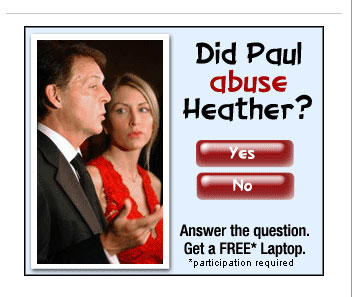
As was this, which comes from a banner ad which ran on the New York Times homepage amongst other places (I miss this delightful stuff, running AdBlock as I do ... ). Interesting that the blogger is associating the NYT with this banal ad.

16% of online shoppers judge site security on looks

16% of online shoppers judge site security on looks

New Media Age

Platform: Internet | Author: Will Cooper | Source: nma.co.uk | Published: 22.03.07

One in four online shoppers believe a reputable brand provides the most reassurance that they are buying from a secure source, according to new research.

In a survey undertaken by usability and accessibility specialist Webcredible, 28% of respondents said brand quality was a significant factor in whether they felt safe shopping online.

16% said that a professional looking site engendered trust, while 7% said simply having a contact number readily available was a factor.

However, 40% of people said they would only buy from a secure webpage, one with a https URL.

"It's surprising, but very encouraging, to see that so many online shoppers understand the importance of essential security measures like https," said Trenton Moss, director at Webcredible. "However, it's frightening to see that some internet users will naively put their trust in a website based solely on the way that it looks."

Webcredible surveyed 1,179 people.

City-wide Wi-Fi for Los Angeles

Mar 19, 2007
Story Art The LA Wi-Fi network will be the single largest citywide network in the country providing wireless, cost-effective, high-speed internet access

Working to connect all of Los Angeles to the global community and global economy, Mayor Antonio Villaraigosa has announced the LA Wi-Fi Initiative, which will provide residents, schools and businesses with cost effective, high-speed access to the internet. The LA Wi-Fi Initiative will plan and build the single largest citywide network in the country.

"Today is the start of Los Angeles version 2.0," Villaraigosa said last week. "Today we announce our commitment to creating the single largest citywide wireless network in the country."

> more